


 Chat with AI
Exam 1: Medicine

Exam 1: Medicine2 k Questions
Exam 2: Pediatric723 Questions
Exam 3: Psychiatry336 Questions
Exam 4: Surgery563 Questions
Exam 5: Obstetrics & Gynecology469 Questions
Select questions type


A 35-year-old woman comes to the physician with pain and stiffness of her wrists and hand joints for the last several months. Her morning stiffness lasts for more than an hour. She also complains of joint swelling. Her past medical history is significant only for a similar episode a year ago, which resolved with over-the-counter ibuprofen. Joint examination shows mild redness, warmth, swelling, and tenderness in the proximal interphalangeal and metacarpophalangeal joints and wrists. X-rays show periarticular osteopenia and erosions of the proximal interphalangeal and metacarpophalangeal joints. The patient began taking indomethacin, which provides good relief, but symptoms recur if she skips a dose. Which of the following is the most appropriate next step in management of this patient?
(Multiple Choice)
4.9/5  (75)
(75) A 23-year-old primigravida at 29 weeks gestation comes to the emergency department with sudden-onset severe shortness of breath. She woke up today with a fluttering sensation in her chest, which progressed to significant dyspnea, dry cough, and an inability to lie flat. Recently, the patient has had some exercise intolerance and tiredness, which she attributes to pregnancy. Her medical history is significant for recurrent sore throat requiring tonsillectomy as a child. She is a lifetime nonsmoker and does not use alcohol. The patient's lifestyle is mostly sedentary. She immigrated to the United States from India 5 years ago. Her blood pressure is 110/60 mm Hg and pulse is 144/min. The patient appears uncomfortable. An ECG shows atrial fibrillation with rapid ventricular response. Which of the following is the most likely diagnosis?
(Multiple Choice)
4.9/5 (76)
(76) A 56-year-old man comes to the office due to fatigue. He has a 20-year history of diabetes mellitus treated with daily insulin therapy. The patient also has end-stage renal disease and receives hemodialysis 3 times a week. He has been receiving erythropoietin therapy for anemia (pretreatment hemoglobin: 8.0 g/dL). Physical examination shows pale conjunctiva. Laboratory results are as follows:  Which of the following is the most appropriate intervention to improve this patient's symptoms?
 (Multiple Choice)
4.9/5 (78)
(78) A 16-year-old girl comes to the office for evaluation of painful menstrual periods. The patient underwent menarche at age 13 and initially had irregular menses. Her menstrual cycles now occur every 30 days, with 4 days of moderate bleeding. Her menses have become increasingly painful; lower abdominal pain starts a few hours prior to menses and lasts 1 or 2 days with associated fatigue, dizziness, and diarrhea. She misses school at least 1 day per month due to the pain but is able to maintain her grades and has no pain or other symptoms after completion of menses. The patient has a history of depression, for which she sees a therapist, but has had no recent changes in mood. She recently became sexually active and uses condoms for contraception. Her last menstrual period was a week ago. Vital signs are normal. Pelvic examination shows normal external genitalia and a clear discharge emerging from the cervical os. On bimanual examination, the uterus is mobile, nontender, and normal in size and contour. Bilateral adnexa have no masses or tenderness. Which of the following is the most likely diagnosis in this patient?
(Multiple Choice)
4.7/5 (94)
(94) A 32-year-old man comes to the clinic for an infertility evaluation. The man and his 31-year-old wife have been trying to conceive for the last 15 months and have unprotected sexual intercourse several times per week. The patient has no chronic medical conditions and takes no daily medications. His wife has no known medical conditions and has a child from a previous marriage. Her menstrual cycles are regular. The patient's vital signs are normal. On physical examination, the penis is uncircumcised and without lesions. Bilateral testes are palpable within the scrotum and are normal in size. There is no excessive firmness or tenderness within either testis. The left testis is positioned lower than the right. Superior to the left testis, there is a nontender clustered mass. It does not transilluminate and decreases in size when the patient is supine. A semen analysis shows a normal seminal volume but slightly reduced sperm count and decreased motility. Which of the following is the most likely cause of this patient's infertility?
(Multiple Choice)
4.9/5 (80)
(80) A 45-year-old woman comes to the office for follow-up. The patient has a history of type 2 diabetes mellitus complicated by nephropathy and end-stage renal disease and underwent kidney transplant from an unrelated donor 6 months ago. She is adherent with immunosuppressive therapy and regularly follows up with the transplant nephrologist. The patient reports good urine output and no pain at the transplant site but has had tremors in both upper limbs since the surgery. She has had no headaches, dizziness, or falls. The patient takes insulin and lately has been requiring a higher dosage despite no significant dietary changes. Temperature is 36.1 C (97 F), blood pressure is 152/90 mm Hg, pulse is 78/min, and respirations are 16/min. Physical examination shows bilateral hand tremor, which is most prominent during action. There is no rigidity; muscle strength, deep tendon reflexes, finger-nose testing, and gait are normal. Laboratory results are as follows:  Which of the following immunosuppression medications is most likely responsible for this patient's current findings?
 (Multiple Choice)
4.8/5 (83)
(83) A 25-year-old woman comes to the office due to 6 weeks of postprandial abdominal discomfort, flatulence, and nausea. The patient has tried both omeprazole and fiber supplementation without improvement of her symptoms. Although her bowel movements are currently regular, she had an acute diarrheal illness 2 months ago that resolved spontaneously. The patient has no vomiting, fever, bloody stools, early satiety, trouble swallowing, or unexpected weight loss. She has had no sick contacts, and her family history is insignificant. The patient does not use tobacco, alcohol, or illicit drugs. Temperature is 37.4 C (99.3 F), blood pressure is 120/80 mm Hg, and pulse is 80/min. She is well-appearing. Mucous membranes are moist, and cardiopulmonary examination is normal. The abdomen is moderately distended but nontender with no rebound or guarding. Complete blood count and serum electrolytes are within normal limits. Which of the following is the best next step in management of this patient?
(Multiple Choice)
4.9/5 (87)
(87) A 25-year-old man is brought to the emergency department after a syncopal event. His wife reports that they were resting in bed, watching television together, when he suddenly passed out. The patient was unconscious for approximately a minute, during which time there were a few bilateral jerks of the arms and legs. He has never had a similar episode but recently noticed some palpitations at night. The patient has no chronic medical conditions but had a fever as high as 38.3 C (100.9 F), along with a mild cough and body aches, throughout the day. Family history is significant for a male cousin who died unexpectedly in his sleep at age 37. Temperature is 38 C (100.4 F), blood pressure is 128/76 mm Hg, and pulse is 98/min. The patient is awake and alert and in no distress. The pupils are equal and reactive to light. The oropharynx is normal. Breath sounds are normal. No heart murmurs are heard. The extremities are well perfused, with symmetric strength. A rapid influenza test is positive. Which of the following is the most likely cause of this patient's syncopal episode?
(Multiple Choice)
4.9/5 (87)
(87) A 37-year-old man comes to the office after coughing up a small amount of bright red blood. He has had 3 days of fever, pleuritic chest pain, and cough productive of thick brown sputum. He started oral antibiotics for these symptoms 2 days ago but has seen no improvement. The patient received allogenic stem cell transplantation for acute myeloid leukemia 6 weeks ago, which was complicated by acute graft-versus-host disease and prolonged neutropenia. Temperature is 39 C (102.2 F), blood pressure is 102/66 mm Hg, and pulse is 112/min. Pulmonary examination shows right sided crackles. Laboratory results are as follows:  Chest x-ray reveals a dense right upper lobe infiltrate, which has grown in size when compared to the x-ray from 2 days ago. CT scan of the chest reveals several nodular lesions with surrounding ground-glass opacities in the right upper lobe. Sputum Gram stain shows inflammatory cells but no organisms. Which of the following is the most likely diagnosis?
 (Multiple Choice)
4.8/5 (81)
(81) A 54-year-old woman comes to the office as a new patient. She immigrated to the United States 3 weeks ago for political asylum. The patient has a history of hypertension and type 2 diabetes mellitus. She was also diagnosed with active pulmonary tuberculosis 4 months ago. She completed 2 months of intensive antituberculosis therapy with 4 drugs and now is on isoniazid and rifampin alone. Repeat sputum testings for acid-fast bacillus are negative. The patient feels well overall but does have tingling and numbness of the bilateral hands and feet that started a few weeks ago; she has no cough, fever, chills, or night sweats. She does not use tobacco, alcohol, or illicit drugs. Temperature is 37 C (98.6 F), blood pressure is 126/84 mm Hg, and pulse is 84/min. Lung auscultation reveals fine crackles in the left upper lung field. Heart sounds are normal and regular. Neurologic examination shows normal motor strength but decreased touch and pain sensation in the bilateral upper and lower extremities. Romberg sign is positive. Skin examination shows no abnormalities. Hemoglobin A1C level is 7%. Chest x-ray reveals fibrotic changes in the left upper lung. Which of the following is the most likely cause of this patient's current symptoms?
(Multiple Choice)
4.9/5 (73)
(73) A 45-year-old woman comes to the office with a 10-day history of a pruritic rash. The rash initially started on her hands and quickly spread to her fingers, wrists, and elbows. The itching is particularly pronounced at night. The patient works as a flight attendant and recently returned from an international trip, during which she stayed in a hotel for 3 days. Her roommate also developed similar symptoms a week after the patient did. The patient has no other medical conditions and takes no medications. She has one sexual partner and uses condoms for contraception. Her mother has a history of atopic dermatitis. Vital signs are normal. Skin examination shows small erythematous papules on the palms with scattered vesicles and pustules on the finger webs, palms, and wrist creases as shown below. There are numerous excoriations on the wrists and elbows. The remainder of the examination is within normal limits. 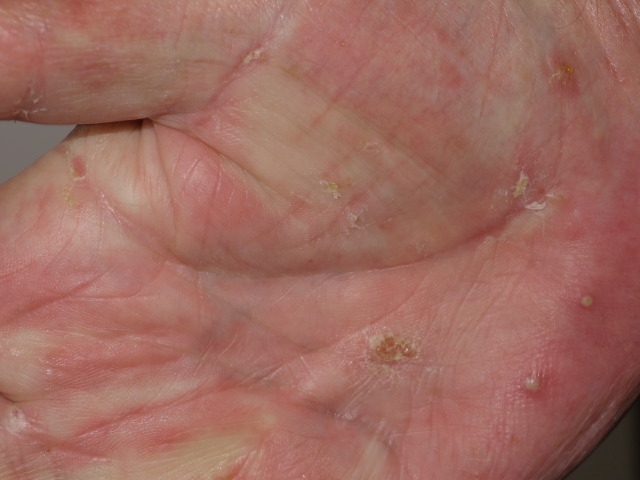 Which of the following is the most likely diagnosis?
 (Multiple Choice)
4.7/5 (73)
(73) A 26-year-old woman comes to the office due to an intensely pruritic rash on her back that has been present for the past 24 hours. The rash developed shortly after the patient awoke from a nap and has been spreading. Other than the rash, she has no symptoms. The patient reports no changes in cosmetic products or detergents. She has not been ill recently and has never had a similar rash. The patient has no known chronic medical conditions and takes no medications or supplements. She is not sexually active, and her last menstrual period was 2 weeks ago. Vital signs are normal. Appearance of the skin on examination is shown in the exhibit.  Oropharyngeal and cardiopulmonary examinations reveal no abnormalities. Heart and lung sounds are normal. Which of the following is the most appropriate next step in management?
 (Multiple Choice)
4.8/5 (78)
(78) A 65-year-old man is found to have an abnormal reading during screening tonometry. The patient has no visual symptoms or headache. Medical history is significant for asthma, for which he takes inhaled fluticasone/salmeterol routinely and inhaled albuterol on most days to control the symptoms. Vital signs are within normal limits. Eye examination shows normal conjunctivae, corneas, and lenses. Intraocular pressure is 28 mm Hg (normal: 8-21). Funduscopy reveals thinning of the optic disc rim and asymmetry of the cup/disc ratio between the eyes. Which of the following is the most appropriate next step in management of this patient's ocular condition?
(Multiple Choice)
4.9/5 (94)
(94) A 56-year-old man is admitted to the intensive care unit after being hospitalized 3 days ago for sepsis and acute respiratory failure due to community-acquired pneumonia. Medical history is remarkable for hypertension and moderate aortic stenosis that was last evaluated by echocardiography 2 years ago. On admission, the patient was intubated and placed on mechanical ventilation. He was also treated with intravenous fluids and antibiotics and required vasopressor therapy for 12 hours, after which he showed clinical improvement. While still intubated this morning, the patient develops sudden-onset hypotension and tachycardia. Temperature is 98.6 F (37 C), blood pressure is 82/54 mm Hg, pulse is 120/min, and respirations are 26/min. Cardiac examination shows regular rhythm with a rapid rate, and lung auscultation reveals bilateral breath sounds with crackles in the right lower lung field. The patient is rapidly infused with 2 L of normal saline with minimal improvement in his blood pressure. Pulmonary arterial catheterization is performed and shows:  Which of the following is the most likely cause of this patient's shock?
 (Multiple Choice)
4.8/5 (92)
(92) A 60-year-old man comes to the office due to several episodes of lightheadedness over the last 3 months. He experiences these episodes while trying to walk quickly or climb stairs. He "almost passed out" during the last episode. The patient describes his lifestyle as active but recently has felt more tired than usual during his daily activities. He has had no chest pain or palpitations. Medical history is significant for diverticulosis, for which he takes fiber supplements. The patient is on no other medications. Temperature is 37.1 C (98.8 F), blood pressure is 108/92 mm Hg, pulse is 88/min and regular, and respirations are 14/min. On examination, he has a 3/6 systolic murmur that is best heard over the right upper sternal border. Carotid pulses are slow-rising and delayed bilaterally. The lung fields are clear to auscultation. There is no peripheral edema. Which of the following additional findings is most likely to be seen on physical examination?
(Multiple Choice)
4.7/5 (69)
(69) A 40-year-old woman comes to the clinic for routine follow-up. She currently feels well. The patient has a history of Henoch-Schönlein purpura since childhood, resulting in stable chronic kidney disease with a baseline creatinine of 2.2-2.4 mg/dL and low-grade proteinuria (<1 g/day). She has hypertension, which is managed well with lisinopril and hydrochlorothiazide. Blood pressure is 126/84 mm Hg and pulse is 80/min. Examination shows no evidence of volume overload. Laboratory results are as follows:  Her potassium level 4 weeks ago was 5.3 mEq/L. Urine albuminuria is unchanged from that time. In addition to dietary counseling, what is the best next step in management of this patient's current condition?
 (Multiple Choice)
4.9/5 (79)
(79) A 60-year-old man comes to the urgent care center after being awakened by severe pain in his right great toe, which is suddenly swollen and very tender to the touch. He has also had occasional headaches and "unbearable" pruritus after a hot bath over the past several weeks. The patient does not use alcohol, tobacco, or illicit drugs. His temperature is 36.8 C (98.3 F), blood pressure is 140/90 mm Hg, and pulse is 90/min. Cardiopulmonary examination is normal. The abdomen is soft and nontender, and there is no appreciable ascites. The liver span is 10 cm at the mid-clavicular line, and the spleen is palpable 2 cm below the costal margin on full inspiration. His right great toe is swollen and erythematous, with severe pain on any movement. Aspiration of the affected metatarsophalangeal joint shows negatively birefringent crystals and many leukocytes but no organisms. Which of the following is most likely responsible for this patient's symptoms?
(Multiple Choice)
4.9/5 (82)
(82) A 31-year-old man comes to the office due to joint pains. About a week ago, the patient woke with some stiffness in his back and right heel; he subsequently developed right knee pain leading to difficulty ambulating. Two months ago, the patient was treated for urethral discharge at an outside clinic, and his genitourinary symptoms completely resolved. He has no history of trauma or illicit drug use. Temperature is 37.2 C (99 F). The right knee is swollen, tender, and warm to the touch; there is tenderness to palpation over the Achilles tendon and the sacroiliac joints. Oral examination shows mouth ulcers. Synovial fluid analysis from the right knee reveals a white blood cell count of 10,000/mm3 with many polymorphonuclear leukocytes; Gram stain reveals no organisms. Which of the following is the most appropriate initial pharmacotherapy for this patient?
(Multiple Choice)
4.9/5 (79)
(79) A 34-year-old woman with a history of idiopathic dilated cardiomyopathy comes to the emergency department due to progressive weight gain and dyspnea on exertion. She did not take her medications over the recent holiday period. Blood pressure is 110/70 mm Hg and pulse is 90/min and regular. Oxygen saturation is 92% on room air. On physical examination, jugular venous distension is observed with significant pedal edema. There are bibasilar crackles. Cardiac auscultation reveals a grade 3/6 holosystolic murmur best heard at the apex. The patient is admitted to the hospital and started on appropriate therapy with intravenous diuretics. Four days later, her symptoms have improved and she is ready for discharge. Weight has decreased by 5 kg (11 lb) since admission. On examination, the lungs are clear on auscultation and no heart murmurs are heard. Which of the following best explains the heart murmur heard in this patient on admission?
(Multiple Choice)
4.8/5 (80)
(80) A 24-year-old woman comes to the urgent care center due to increasing pain in her right leg. She initially felt a dull, aching pain at the anterior aspect of the lower leg 2 weeks ago. The patient is an avid dancer and often practices 4-5 hours a day; the pain has worsened and is now interfering with her dance sessions. Her medical history is remarkable for irregular, light menstrual periods, for which she is being evaluated by her gynecologist. The patient drinks alcohol only on social occasions and does not smoke or use illicit drugs. Temperature is 36.7 C (98 F), blood pressure is 122/78 mm Hg, and pulse is 70/min. BMI is 16 kg/m2. Examination shows point tenderness over the anterior aspect of the right shin. There are no skin abnormalities, and the rest of the physical examination is unremarkable. An x-ray of the lower leg reveals no abnormalities. Which of the following is the most likely diagnosis?
(Multiple Choice)
4.9/5 (83)
(83) Showing 401 - 420 of 1702
 Prev
- 1
- ...
- 2
- ...
- 3
- ...
- 4
- ...
- 5
- ...
- 6
- ...
- 7
- ...
- 8
- ...
- 9
- ...
- 10
- ...
- 11
- ...
- 12
- ...
- 13
- ...
- 14
- ...
- 15
- ...
- 16
- ...
- 17
- ...
- 18
- ...
- 19
- ...
- 20
- ...
- 21
- ...
- 22
- ...
- 23
- ...
- 24
- ...
- 25
- ...
- 26
- ...
- 27
- ...
- 28
- ...
- 29
- ...
- 30
- ...
- 31
- ...
- 32
- ...
- 33
- ...
- 34
- ...
- 35
- ...
- 36
- ...
- 37
- ...
- 38
- ...
- 39
- ...
- 40
- ...
- 41
- ...
- 42
- ...
- 43
- ...
- 44
- ...
- 45
- ...
- 46
- ...
- 47
- ...
- 48
- ...
- 49
- ...
- 50
- ...
- 51
- ...
- 52
- ...
- 53
- ...
- 54
- ...
- 55
- ...
- 56
- ...
- 57
- ...
- 58
- ...
- 59
- ...
- 60
- ...
- 61
- ...
- 62
- ...
- 63
- ...
- 64
- ...
- 65
- ...
- 66
- ...
- 67
- ...
- 68
- ...
- 69
- ...
- 70
- ...
- 71
- ...
- 72
- ...
- 73
- ...
- 74
- ...
- 75
- ...
- 76
- ...
- 77
- ...
- 78
- ...
- 79
- ...
- 80
- ...
- 81
- ...
- 82
- ...
- 83
- ...
- 84
- ...
- 85
- ...
- 86
- ...
- Next

Filters
- Essay(0)
- Multiple Choice(0)
- Short Answer(0)
- True False(0)
- Matching(0)