


 Chat with AI
Exam 1: Medicine

Exam 1: Medicine2 k Questions
Exam 2: Pediatric723 Questions
Exam 3: Psychiatry336 Questions
Exam 4: Surgery563 Questions
Exam 5: Obstetrics & Gynecology469 Questions
Select questions type


A 72-year-old woman comes to the emergency department due to intermittent chest pain for the last 2 days. She describes the pain as chest pressure associated with shortness of breath. She has never had similar symptoms. Her past medical history is significant for hypertension and hyperlipidemia. Physical examination reveals no heart murmurs. ECG shows normal sinus rhythm with T wave inversion in leads V4-V6. Initial troponin I level is undetectable. Two hours after the initial evaluation, she becomes unresponsive. Bilateral arm twitching is noted by the nurse. Her telemetry strip is shown on the image below.  Which of the following is the best next step in managing this patient?
 (Multiple Choice)
4.9/5  (83)
(83) A 25-year-old woman comes to the office due to "chest pain" that began 2 days ago. The pain is described as a constant soreness across the chest, and the patient is unable to sleep prone because of the pain. She is an avid runner and kickboxer and has been unable to maintain her normal exercise routine due to discomfort wearing a sports bra. The patient is sexually active with her husband and recently stopped taking oral contraceptives because the couple are trying to have a child. Her last menstrual period was 3 weeks ago; menses are regular, occur approximately every 28 days, and last for 6 days. The patient takes a daily folic acid supplement and no other medications. Vitals signs are normal. Palpation demonstrates bilateral, nonfocal chest tenderness and diffusely nodular, dense breasts. Which of the following is the most likely diagnosis in this patient?
(Multiple Choice)
4.9/5 (81)
(81) A 16-year-old girl is brought to the office after a day of fever, malaise, shortness of breath, chest tightness, and nonproductive cough. Her symptoms started after visiting a farm during summer camp. The patient says she was feeding hay to cattle and milking a cow to get farm experience. Her mother recalls that she "got sick" when visiting another farm several years ago, and it took her several days to recover after returning home. The patient has a history of eczema, and her brother has asthma. Temperature is 38 C (100.4 F), blood pressure is 120/70 mm Hg, pulse is 88/min and regular, and respirations are 22/min. Pulse oximetry shows 92% when breathing room air. Lung auscultation reveals bilateral fine crackles but no wheezing. Office spirometry shows decreased forced vital capacity. Which of the following are the most likely chest x-ray findings in this patient?
(Multiple Choice)
4.8/5 (71)
(71) A 75-year-old man with type 2 diabetes mellitus is brought to the emergency department due to weakness and blurred vision. Over the last several days, the patient has had a hacking cough, sore throat, and poor appetite. Temperature is 38 C (100.5 F), blood pressure is 100/60 mm Hg, pulse is 112/min, and respirations are 18/min. On physical examination, the patient is lethargic and has dry mucous membranes. Heart sounds are regular, and the lungs are clear to auscultation. The abdomen is soft, nontender, and nondistended. No rashes are present. There is mild, generalized weakness on neurologic examination. Laboratory results are as follows: 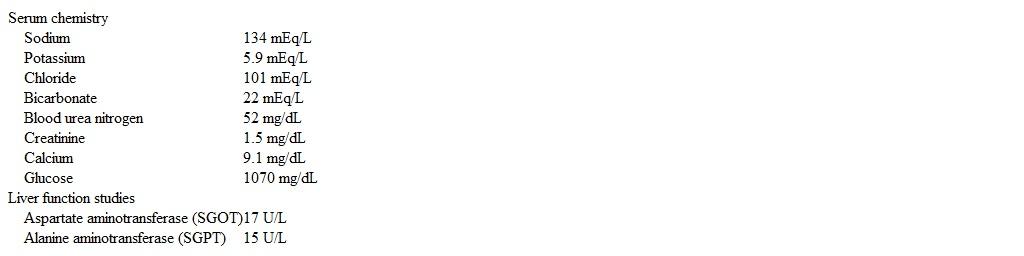 Which of the following is most likely present in this patient?
 (Multiple Choice)
4.7/5 (71)
(71) A 25-year-old woman comes to the office due to heavy menses. Over the past few months, the patient's menstrual periods have lasted 7 days rather than the usual 3 days. In addition, her menstruation has been unusually heavy and has, at times, bled through her clothing while at work. The patient is an active volleyball player but has not been able to play recently due to increasing fatigue; frequent, diffuse myalgias; and bilateral pain in her wrists that requires icing after practice. She has also noticed that her forearms become easily bruised in areas where the ball hits. The patient takes no medications and does not use tobacco, alcohol, or illicit drugs. Temperature is 37 C (98.6 F), blood pressure is 116/76 mm Hg, pulse is 76/min, and respirations are 16/min. There are scattered petechiae across the body with a few large ecchymoses on the forearms. The remainder of the physical examination is normal. Laboratory results are as follows:  Peripheral blood smear shows normal and large platelets. Which of the following is the best next step in evaluation of this patient?
 (Multiple Choice)
4.9/5 (77)
(77) A 32-year-old man is brought to the emergency department due to excruciating, sudden-onset chest and neck pain. He has no history of dyspnea, chest pain, or lower extremity edema. Height is 196 cm (6 ft 5 in) with long extremities. The hand joints show significant extensibility. Pectus carinatum deformity is present. Which of the following additional findings is likely in this patient?
(Multiple Choice)
4.9/5 (83)
(83) A 63-year-old man comes to the emergency department with substernal chest pain and diaphoresis. The pain started one hour ago and was not relieved with antacids. His medical problems include asthma, for which he uses inhaled fluticasone, and peptic ulcer disease, for which he takes omeprazole. Blood pressure is 160/100 mm Hg and pulse is 90/min. A bruit is heard over the right carotid artery, and a mild systolic murmur is present at the cardiac apex. Sublingual nitroglycerin and aspirin are administered and within minutes the patient reports resolution of pain. Which of the following most likely accounts for the improvement in his symptoms?
(Multiple Choice)
4.8/5 (79)
(79) A 45-year-old man is evaluated for recurrent sinusitis and otitis. He has been treated with antibiotics and intranasal corticosteroids on and off for the past 6 months, but he still has scant yellow nasal discharge occasionally mixed with blood. On review of systems, he has fatigue but no fevers, chills, cough, or abdominal symptoms. The patient is an ex-smoker with a 15-pack-year history. He takes over-the-counter ibuprofen and aspirin for joint and back pains. He is afebrile. Chest and abdominal examinations are unremarkable. Otoscopy shows erythema and a small ulceration in the right auditory canal. Laboratory results are as follows: 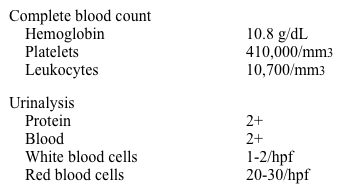 His HIV testing is negative. Which of the following is the best next step in management of this patient?
 (Multiple Choice)
4.9/5 (74)
(74) A 75-year-old man comes to the office for a routine preventive examination. He has no ongoing symptoms. The patient's medical history is significant for osteoarthritis, hypertension, and hyperlipidemia. Current medications include hydrochlorothiazide and atorvastatin. He does not smoke and consumes 1 or 2 beers on weekends. The patient walks 2 miles every morning and eats a balanced diet. Vital signs are within normal limits. His cardiopulmonary examination is normal, and his abdomen is soft and nontender. Rectal examination shows a diffusely enlarged prostate without nodules. The distal interphalangeal joints are enlarged, and his gait is normal. Laboratory results are as follows: 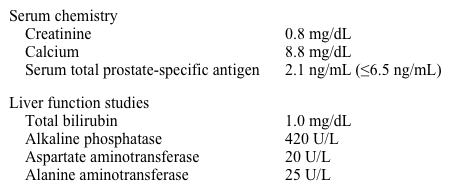 Which of the following is the most likely cause of the elevated alkaline phosphatase in this patient?
 (Multiple Choice)
4.8/5 (85)
(85) A 49-year-old registered nurse comes to the office due to sleep difficulties since receiving a promotion to an administrative position in the hospital several weeks ago. She finds her new job and its many responsibilities stressful. Her sleep schedule changed when she took the new position; she used to work the 4:00 PM-12:00 AM shift and had no sleep difficulties. Now she has to be at the hospital by 7:30 AM. The patient cannot fall asleep until 2:00-3:00 AM. She then awakens by alarm at 6:15 AM to get to work on time. She is exhausted all the time and has trouble concentrating and staying awake during meetings. The patient is increasingly frustrated by her sleep problems, which have occurred in the past with jobs or schooling requiring early start times. The patient has the same difficulty initiating sleep before 2:00-3:00 AM on weekends but feels better then as she is able to sleep without interruption until 11:00 AM. She does not use tobacco or alcohol. Which of the following is the most likely cause of her sleep difficulties?
(Multiple Choice)
4.9/5 (78)
(78) A 64-year-old man is evaluated for lower extremity edema and increasing abdominal discomfort. His past medical history is significant for diet-controlled type 2 diabetes mellitus and mitral valve repair surgery 12 years ago. He has smoked a pack of cigarettes daily for the last 40 years. His blood pressure is 142/80 mm Hg, and pulse is 92/min and regular. Jugular venous pressure is estimated at 16 cm H2O. A middiastolic sound is heard on cardiac auscultation. Lungs are clear to auscultation. There is significant ascites and 4+ lower extremity edema bilaterally. Laboratory values show serum albumin level of 3.2 g/dL. 24-hour urine protein excretion is 280 mg. Chest x-ray reveals normal heart size, clear lung fields, and spotty calcifications along the left heart border. Echocardiogram shows enlarged atria, normal left ventricular wall thickness, normal right ventricular size, and left ventricular ejection fraction of 65%. There is mild mitral regurgitation. Which of the following is the most likely cause of this patient's symptoms?
(Multiple Choice)
4.7/5 (89)
(89) A 74-year-old woman comes to the office due to several days of right ear pain. This morning she had 2 episodes of dizziness and almost fell. The patient is currently taking trimethoprim-sulfamethoxazole for an uncomplicated urinary tract infection. She has had no subjective fever, vision loss, or headaches. Temperature is 37 C (98.6 F), blood pressure is 116/78 mm Hg, and pulse is 100/min. Ear examination reveals several erythematous vesicles in the right external auditory canal with no drainage. The tympanic membrane is visible and intact. There is mild right-sided facial droop. The rest of the physical examination is unremarkable. Which is the most likely cause of this patient's illness?
(Multiple Choice)
5.0/5 (72)
(72) A 34-year-old woman comes to the office due to episodic mid-abdominal cramping pain, nausea, and watery diarrhea for the past 4-5 months. The episodes often occur within an hour of eating, and she has also experienced increased flatus and a bloating sensation. The patient takes a proton pump inhibitor for gastroesophageal reflux disease. She underwent a cholecystectomy 3 years ago due to symptomatic gallstones. She drinks alcohol on social occasions and does not use tobacco or illicit drugs. The patient jogs daily and goes to the gym 3 times a week. Over the past several months, she has been consuming more leafy green vegetables, fruits, and low-fat dairy products in an effort to lose weight. Her parents were born in China, but the patient has not traveled overseas in the past 4 years. Temperature is 36.8 C (98.2 F), blood pressure is 128/72 mm Hg, pulse is 87/min, and BMI is 30 kg/m2. The abdomen is soft and nontender. Fecal occult blood test is negative. Which of the following is the most likely cause of this patient's current condition?
(Multiple Choice)
5.0/5 (72)
(72) A 76-year-old woman is being evaluated for recurrent fever and cough. The patient was admitted to the hospital from a skilled nursing facility 7 days ago due to urinary tract infection and was treated with intravenous ceftriaxone. The patient has a history of dementia, and her hospital course has been complicated by delirium. She has received several doses of an antipsychotic medication to control agitation and anxiety. Over the past 2 days, she has had productive cough and recurrent fever. Temperature is 38.4 C (101.1 F), blood pressure is 120/70 mm Hg, pulse is 106/min, and respirations are 20/min. Oxygen saturation is 96% on room air. On physical examination, the patient appears somnolent. Dentition is poor. Lung auscultation reveals right-sided rhonchi and crackles. Heart sounds are normal. Chest x-ray shows infiltrate in the apical segment of the right lower lobe. Sputum Gram stain shows many neutrophils, gram-positive cocci in chains, gram-positive rods, and gram-negative rods. Which of the following was the most likely underlying trigger for this patient's current condition?
(Multiple Choice)
4.8/5 (78)
(78) A 35-year-old, previously healthy woman comes to the office for evaluation of left elbow swelling. The patient says the swelling started a week ago. It is associated with a mild ache but otherwise does not bother her. She works as a computer programmer, and for the past month, she has started intense exercises, including biking, sit-ups, push-ups, weight lifting, and running on a treadmill. The patient reports no trauma to the elbow or fever. Temperature is 37 C (98.6 F), blood pressure is 115/76 mm Hg, and pulse is 86/min. On examination, a 4-cm focal area of swelling is noted over the tip of the olecranon that is slightly tender and fluctuant on palpation. There is no warmth, erythema, or evidence of abrasion. Range of motion of the shoulders, elbows, and wrists is normal. The remainder of the examination is normal. Which of the following is the most appropriate next step in management?
(Multiple Choice)
4.8/5 (76)
(76) A 37-year-old woman comes to the emergency department due to vomiting and severe lower abdominal pain. The patient developed sudden-onset, sharp, right lower quadrant pain after waking up this morning. The pain has increased despite taking acetaminophen, and now she has persistent vomiting. The patient has been undergoing clomiphene ovulation induction due to anovulatory infertility, and her last menstrual period was 5 weeks ago. She has no medical conditions and has had no surgeries. Temperature is 37.8 C (100 F), blood pressure is 140/80 mm Hg, and pulse is 92/min. Abdominal examination shows tenderness over the right lower quadrant with guarding and rebound tenderness. On bimanual examination, there is tenderness in the right adnexa but no palpable masses or cervical motion tenderness. Hemoglobin level is 13 g/dL and leukocyte count is 16,000/mm3. Quantitative β-hCG is 2,840 mIU/mL. A transvaginal pelvic ultrasound shows a singleton gestation within the uterine cavity and normal bilateral adnexa with normal Doppler flow. Which of the following is the most likely diagnosis in this patient?
(Multiple Choice)
4.8/5 (82)
(82) A 50-year-old man comes to the office for a preventive examination. The patient is accompanied by his wife and daughter. He currently feels well and takes no medications. The patient works as an accountant at a large technology corporation. He smoked a pack of cigarettes daily for 5 years but quit 15 years ago. The patient drinks 1 or 2 alcoholic beverages per week. He emigrated from Colombia 5 years ago and is fluent in English. Physical examination is within normal limits. The provider recommends colon cancer screening, but the patient appears hesitant and states, "I don't think I really need that because I feel good right now, and I'm pretty sure I don't have cancer." Which of the following is the best next step?
(Multiple Choice)
4.8/5 (78)
(78) A 67-year-old man comes to the emergency department after losing consciousness while shoveling snow near his house. He reports having had a similar episode a month ago while carrying heavy bags from the grocery store. The patient has reduced his physical activity level over the last year due to progressive exertional dyspnea and fatigue. He has had no chest pain, palpitations, cough, or lower extremity swelling. His other medical problems include type 2 diabetes mellitus and hypercholesterolemia. He is a lifetime nonsmoker. Which of the following physical examination findings is most likely in this patient?
(Multiple Choice)
4.9/5 (70)
(70) A 55-year-old Caucasian male presents to the office for a routine check-up. He has no present complaints. His past medical history is significant for a long history of hypertension. He does not smoke or consume alcohol. His current medications are enalapril and hydrochlorothiazide. His blood pressure is 140/90 mm Hg and heart rate is 80/min. Physical examination reveals a moderately overweight man (BMI = 27 kg/m2) with a waist circumference of 41 inches. The laboratory studies show:
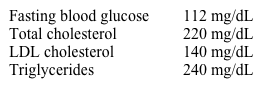 Which of the following is the most important pathogenic factor for this patient's condition?
 (Multiple Choice)
4.8/5 (68)
(68) A 28-year-old man comes to the office for follow-up. Two years ago, he was diagnosed with early-stage nodular sclerosis Hodgkin lymphoma after a chest x-ray revealed a mediastinal mass. The patient underwent combination chemotherapy and radiation treatment. Follow-up imaging has revealed no evidence of disease, and he currently feels well. The patient has no other medical conditions and takes no medications. He does not use tobacco, alcohol, or illicit drugs. Vital signs and physical examination are normal. Compared to the general population, this patient is at greatest risk for which of the following?
(Multiple Choice)
4.8/5 (81)
(81) Showing 1301 - 1320 of 1702
 Prev
- 1
- ...
- 2
- ...
- 3
- ...
- 4
- ...
- 5
- ...
- 6
- ...
- 7
- ...
- 8
- ...
- 9
- ...
- 10
- ...
- 11
- ...
- 12
- ...
- 13
- ...
- 14
- ...
- 15
- ...
- 16
- ...
- 17
- ...
- 18
- ...
- 19
- ...
- 20
- ...
- 21
- ...
- 22
- ...
- 23
- ...
- 24
- ...
- 25
- ...
- 26
- ...
- 27
- ...
- 28
- ...
- 29
- ...
- 30
- ...
- 31
- ...
- 32
- ...
- 33
- ...
- 34
- ...
- 35
- ...
- 36
- ...
- 37
- ...
- 38
- ...
- 39
- ...
- 40
- ...
- 41
- ...
- 42
- ...
- 43
- ...
- 44
- ...
- 45
- ...
- 46
- ...
- 47
- ...
- 48
- ...
- 49
- ...
- 50
- ...
- 51
- ...
- 52
- ...
- 53
- ...
- 54
- ...
- 55
- ...
- 56
- ...
- 57
- ...
- 58
- ...
- 59
- ...
- 60
- ...
- 61
- ...
- 62
- ...
- 63
- ...
- 64
- ...
- 65
- ...
- 66
- ...
- 67
- ...
- 68
- ...
- 69
- ...
- 70
- ...
- 71
- ...
- 72
- ...
- 73
- ...
- 74
- ...
- 75
- ...
- 76
- ...
- 77
- ...
- 78
- ...
- 79
- ...
- 80
- ...
- 81
- ...
- 82
- ...
- 83
- ...
- 84
- ...
- 85
- ...
- 86
- ...
- Next

Filters
- Essay(0)
- Multiple Choice(0)
- Short Answer(0)
- True False(0)
- Matching(0)