


 Chat with AI
Exam 1: Medicine

Exam 1: Medicine2 k Questions
Exam 2: Pediatric723 Questions
Exam 3: Psychiatry336 Questions
Exam 4: Surgery563 Questions
Exam 5: Obstetrics & Gynecology469 Questions
Select questions type


A 62-year-old woman comes to the emergency department due to fever and right foot pain. She has had increasing redness, warmth, and swelling at the dorsum of the right foot for the last 2 days and woke with pain and subjective fever today. The patient also has had itching in the skin under and between the toes for the last 6 months. Medical history is notable for obesity and type 2 diabetes mellitus. She does not use tobacco or alcohol. The patient works as a restaurant dishwasher and spends most of the day wearing waterproof rubber shoes. Temperature is 38.2 C (100.8 F), blood pressure is 166/98 mm Hg, and pulse is 102/min. Examination shows erythema and edema at the dorsum of the foot with palpable warmth and an indistinct border. There is extensive scaling and flaking of the skin between the toes. Examination findings are shown in the image below: 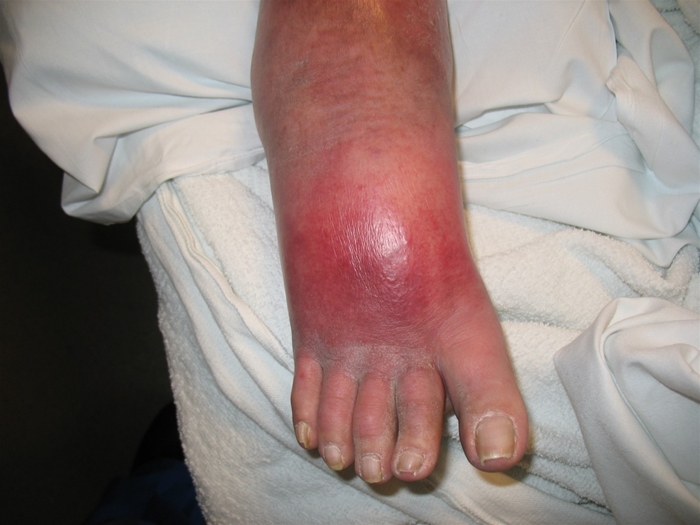 Palpation of the right inguinal region shows 3 or 4 slightly tender lymph nodes. Which of the following is the most likely cause of this patient's acute symptoms?
 (Multiple Choice)
4.8/5  (81)
(81) A 38-year-old man comes to the office due to 2 weeks of mildly pruritic and uncomfortable skin lesions. He first noticed a papule on his right index finger that soon ulcerated and began draining an odorless discharge. He then developed similar nodules on his right forearm. The patient has no prior medical problems. He drinks 1 or 2 cans of beer daily. He works as a landscaper and recently began living with his girlfriend, who owns a cat. Temperature is 36.9 C (98.4 F), blood pressure is 120/80 mm Hg, and pulse is 74/min. There is a nodular ulceration with nonpurulent drainage and surrounding erythema on the right index finger. Several proximal nontender subcutaneous nodules are palpable on his right forearm. No lymphadenopathy is present. Which of the following is the most likely cause of this patient's current condition?
(Multiple Choice)
4.8/5 (86)
(86) A 35-year-old man comes to the office in late October to follow up on asthma. He has long-standing mild-intermittent asthma treated with an albuterol inhaler as needed. Over the last 6 months, the patient has had more frequent symptoms; however, he started an inhaled corticosteroid 4 weeks ago and has had no further asthma symptoms since then. Medical history is notable for type 1 diabetes mellitus treated with an insulin pump. Vital signs and cardiopulmonary examination are normal. The influenza vaccine is recommended, but the patient declines, stating, "I got the flu shot last year and got sick anyway." Which of the following is the most appropriate response to this patient?
(Multiple Choice)
4.8/5 (82)
(82) A 64-year-old man comes to the office for evaluation of low mood and anxiety that began 2 months ago. The patient says, "I'm sad and anxious but I can't explain why. I just have this feeling that something bad is going to happen to me." He says that his coworkers have noticed he seems more reserved than usual. The patient has been skipping lunch due to a decreased appetite and has lost 9 kg (20 lb) in the last few months. He continues to enjoy reading mystery novels and has no difficulty falling or remaining asleep. The patient formerly smoked tobacco, with a 20-pack-year history, but he does not use alcohol or illicit drugs. Medical history includes recently diagnosed diabetes mellitus. Vital signs are within normal limits. BMI is 19 kg/m2. Physical examination is unremarkable. The patient is thin and appears anxious. He reports no suicidal ideation, hallucinations, or delusions. TSH level is 4.0 µU/mL. Which of the following is the best next step in management?
(Multiple Choice)
4.9/5 (71)
(71) A 35-year-old African American woman comes to the clinic due to exertional shortness of breath. The patient's exercise tolerance a year ago was walking 7 blocks but now she walks less than a block before becoming short of breath. She also feels lightheaded when she forces herself "to go on." The patient denies any episodes of syncope, chest pain, cough, wheezing, orthopnea, nausea, or lower extremity edema. She has been treated for Raynaud phenomenon and fingertip ulcerations for the last 2 years. She also suffers from severe heartburn controlled with high-dose pantoprazole. Family history is not significant. She does not smoke cigarettes or consume alcohol. Blood pressure is 112/72 mm Hg and pulse is 94/min. Pulse oximetry shows 95% on room air. BMI is 23 kg/m2.
Which of the following would be the most expected finding on physical examination?
(Multiple Choice)
4.8/5 (72)
(72) A 22-year-old woman comes to the physician with headaches for the last 6 weeks. The headaches are pulsatile in quality and associated with nausea. They are worse at night and awaken her from sleep. She has no photophobia, weakness, sensory abnormalities, or history of trauma. The patient takes no medications. Her body mass index is 33 kg/m2. Neurologic examination is unremarkable. Funduscopy shows papilledema. Computed tomography scan of the brain shows no abnormalities. Lumbar puncture shows an elevated opening pressure with otherwise normal cerebrospinal fluid analysis. Which of the following is the most appropriate next step in management of this patient?
(Multiple Choice)
4.9/5 (81)
(81) A 38-year-old woman comes to the office due to left knee swelling for the past 3 weeks. The patient has type 2 diabetes mellitus and recently started an exercise program consisting of aerobics and running to lose weight and improve glycemic control. She reports no falls or trauma. BMI is 35 kg/m2. On examination, the knees are not red or warm and demonstrate full range of motion. There is a 4-cm area of swelling in the anteromedial knee region 3 cm below the joint line. The swollen area is mildly tender on palpation. There is no joint line tenderness. A left knee x-ray reveals no abnormalities. Which of the following is the most appropriate next step in management of this patient's condition?
(Multiple Choice)
4.8/5 (79)
(79) A 60-year-old man comes to the office due to a 6-month history of constant back pain, thigh pain, and headache. He has moderate, deep, achy pain in the mid lumbar area that does not radiate and is worse with changes in position such as rolling over in bed. The patient has no significant history of trauma, and the course of his symptoms has been stable but persistent. He has been taking acetaminophen without relief. There is no associated nausea, vomiting, weight loss, fever, difficulty walking, leg numbness, or urinary symptoms. Medical history is notable for hypertension treated with chlorthalidone and lisinopril. He also uses a hearing aid for recently acquired, left-sided hearing loss. Blood pressure is 138/85 mm Hg, pulse is 76/min, and respirations are 12/min. BMI is 29 kg/m2. The patient appears comfortable and in no acute distress. Cardiopulmonary examination is normal. The abdomen is soft and nontender with no organomegaly. He has mild thoracic dextroscoliosis and a decrease in the normal lumbar lordosis. The lower extremities show mild anterolateral femoral bowing. Upper and lower motor strength, sensation, and reflexes are normal. Which of the following is the most likely cause of this patient's current condition?
(Multiple Choice)
4.8/5 (74)
(74) A 45-year-old woman comes to the office due to painful sores and blisters. Three weeks ago, the patient developed painful sores inside her nose and mouth, which made it difficult for her to eat and swallow. Two weeks later, she developed painful blisters on her trunk and extremities. The patient has no chronic medical conditions and takes no medications. Temperature is 36.8 C (98.2 F), blood pressure is 115/76 mm Hg, pulse is 82/min, and respirations are 14/min. On examination, the nasal, buccal, and palatine mucosa reveal several erosions, as shown in the exhibit. 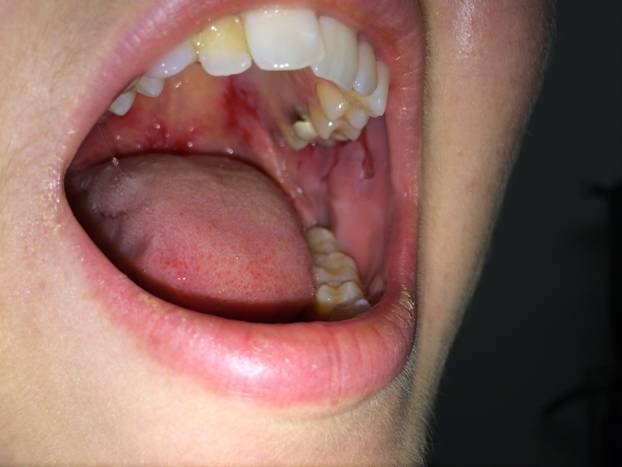 The skin shows scattered, large erosions and a few bullae on the chest, back, and extremities, with a background of normal-appearing skin. Heart, lung, and abdominal examinations are normal. Which of the following is the most likely diagnosis?
 (Multiple Choice)
4.8/5 (97)
(97) A 57-year-old woman comes to the emergency department experiencing severe lower back pain. The pain began 4 weeks ago and is getting progressively worse. At night, the pain has become so severe that it awakens her from sleep. The patient has tried over-the-counter ibuprofen with no relief of symptoms. She also reports feeling more tired than usual but says, "It is probably because my kids are home for the holidays and are keeping me busy." The patient has a history of breast cancer that has been in remission for 2 years. Her physical examination is significant for weakness and numbness of the left lower limb. Radiographic findings are consistent with metastatic lesions in her spine. Which of the following is the most appropriate next statement in initiating a conversation about this patient's condition?
(Multiple Choice)
4.9/5 (89)
(89) An 18-year-old African American man comes to the office due to several months of excessive urination. The patient voids every few hours during the day and wakes 2 or 3 times per night to urinate despite restricting his evening fluid intake. He says that his urine appears clear and has no visible blood. Medical history is significant for seasonal allergies, for which he frequently takes an antihistamine. He takes no other medications and does not use tobacco, alcohol, or illicit drugs. The patient is sexually active and does not use condoms. He was adopted at a young age; records indicate that his birth mother had sickle cell disease and died from a stroke at age 32. The patient is afebrile and normotensive. Hematocrit is 41% and serum sodium is 138 mEq/L. Urinalysis of a first-morning specimen reveals the following:  This patient's polyuria is most likely caused by which of the following?
 (Multiple Choice)
4.9/5 (76)
(76) A 40-year-old woman comes to the office due to joint pains. The patient has had achy pain in her hands and feet for the past several months, which is worse in the morning. She says her fingers feel stiff when she wakes up and she has difficulty opening doors or holding spoons. The pain gradually improves over 2-3 hours, but the patient feels fatigued throughout the day. Taking ibuprofen provides some symptom relief. Medical history is otherwise unremarkable, and she takes no other medications. Vital signs are within normal limits. Physical examination shows no rashes or oral ulcers. The wrists and fingers are swollen bilaterally and are tender to palpation. Laboratory testing reveals that hematocrit is 33% and serum creatinine is normal. This patient's current condition is most likely to directly increase her risk for which of the following?
(Multiple Choice)
4.9/5 (80)
(80) A 31-year-old woman comes to the office after 3 months of continuous burning upper abdominal pain that is only partially relieved by over-the-counter ranitidine or antacids. She also has experienced recent-onset constipation and excess urination. The patient reports no weight loss or decreased appetite. Her menstrual periods are regular. The patient's father has a history of "many stomach ulcers and multiple kidney stones." Her temperature is 37.1 C (98.8 F), blood pressure is 130/85 mm Hg, pulse is 78/min, and respirations are 14/min. Abdominal examination shows normal bowel sounds, tenderness in the epigastric region, and no palpable masses. Her stools are positive for occult blood. Laboratory results are as follows: 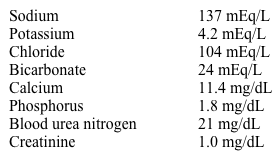 Additional evaluation is most likely to reveal which of the following?
 (Multiple Choice)
4.8/5 (74)
(74) A 56-year-old man comes to the office for follow up of hypertension. The patient had undergone kidney transplantation one year ago for focal segmental glomerulosclerosis. He was originally seen in the office 8 weeks ago for hypertension and had a blood pressure of 210/110 mm Hg; initially he was given amlodipine, but the patient continued to have hypertension. Two weeks ago, he was also started on lisinopril. In addition, he takes tacrolimus and low-dose prednisone. The patient currently feels well. Today, blood pressure is 160/90 mm Hg, pulse is 78/min, and respirations are 16/min. Examination shows normal jugular venous pressure, vesicular breath sounds, and normal heart sounds. The transplant site is nontender. Laboratory studies reveal a serum creatinine level of 2.4 mg/dL (2 weeks ago: 1.5 mg/dL). Serum tacrolimus level is within the normal therapeutic range. Which of the following is the most appropriate next step in management of this patient?
(Multiple Choice)
4.8/5 (71)
(71) A 65-year-old heavy smoker with a lengthy history of chronic obstructive pulmonary disease comes to the office due to recent-onset hemoptysis. He reports 3-5 episodes of coughing up blood in the past month. He also reports a 9.1-kg (20-lb) weight loss in the past 2 months. Chest radiograph reveals a suspicious lesion, and a bronchoscopy followed by biopsy establishes the diagnosis of squamous cell carcinoma of the lung. When the patient is informed of his condition and the prognosis, he asks that no one in his family be told the news yet. He seems tearful but cognitively intact. His wife, who usually brings him to his visits and is also his health care proxy, calls the next day to inquire about the pathology report. She says she is deeply concerned because her husband is reluctant to discuss his condition. Which of the following is the most appropriate course of action?
(Multiple Choice)
4.9/5 (76)
(76) A 38-year-old woman comes to the office due to chest pain. She describes the pain as sharp, localized to an area just left of the sternum, and nonradiating. The pain is constant but worsens somewhat with inspiration and movement. She first noticed the pain while exercising 3 weeks ago, but has experienced it at rest as well. The patient has no fevers, chills, dyspnea, swelling, or difficulty breathing at night. Her medical history is significant for 2 normal vaginal deliveries. Her father had a myocardial infarction at age 60. She does not use tobacco, alcohol, or illicit drugs. On physical examination, blood pressure is 112/69 mm Hg and pulse is 72/min. BMI is 34 kg/m2. There is tenderness to palpation over the sternum. Cardiac auscultation reveals a normal S1 and S2 without extra sounds or murmurs. ECG and chest x-ray are normal. Which of the following is the most appropriate next step in management of this patient?
(Multiple Choice)
4.9/5 (79)
(79) A 65-year-old man with a history of moderate chronic obstructive pulmonary disease (COPD) is brought to the emergency department with progressive dyspnea, productive cough, and fever over the past 2 days. Initial evaluation shows that the patient is in respiratory distress. Temperature is 38.8 C (101.8 F), blood pressure is 122/74 mm Hg, pulse is 110/min, and respirations are 32/min; pulse oximetry is 93% on 4 L oxygen by nasal cannula. A presumptive diagnosis of COPD exacerbation is made. His trachea is intubated and he is placed on mechanical ventilation. A central venous catheter is placed in the right subclavian vein. Intravenous antibiotics, glucocorticoids, and inhaled bronchodilators are administered. Despite these measures, the patient continues to desaturate over the next 20 minutes with a pulse oximetry reading of 83% despite breathing 100% inspired oxygen. His inspiratory pressures are elevated. Repeat vital signs show blood pressure of 80/50 mm Hg and pulse of 120/min. The trachea is deviated to the left. Breath sounds are absent on the right side and wheezes are heard on the left side. Neck veins are distended. Which of the following is the best next step in management of this patient?
(Multiple Choice)
4.8/5 (89)
(89) A 67-year-old man is brought to the office by his wife due to a month of increasing forgetfulness. Over the last 2 weeks, she has noticed that his gait has been unsteady. The patient reports increased fatigue. He has hypertension and hyperlipidemia, and is compliant with all medications. Over the last month, the patient has taken over-the-counter stool softeners for constipation. He worked as an automobile mechanic for 30 years before retiring last year. The patient smokes a pack of cigarettes daily and usually has a beer after dinner, but recently started drinking home-distilled whiskey. Blood pressure is 120/80 mm Hg, and pulse is 76/min. Examination shows clear lung fields and normal first and second heart sounds. The abdomen is soft and nontender without organomegaly. There is weakness on dorsiflexion of bilateral wrists and feet. Pinprick sensation is reduced over the hands and feet. Upper and lower limb deep tendon reflexes are 1+. Laboratory results are as follows:  Which of the following underlying mechanisms is most likely associated with this patient's clinical presentation?
 (Multiple Choice)
4.8/5 (82)
(82) A 32-year-old man is brought to the emergency department following the sudden onset of excruciating left-sided chest pain. Temperature is 37.2 C (99 F), blood pressure is 160/90 mm Hg, pulse is 125/min and regular, and respirations are 20/min. The patient is anxious and agitated and is sweating profusely. Both pupils are dilated, and the nasal mucosa is atrophic. Heart sounds are regular with no murmurs or rubs. The lungs are clear on auscultation. An initial ECG shows ST-segment depression and T-wave inversion in leads V4-V6. The first set of cardiac enzymes, including CK-MB and troponin T, is normal. Chest x-ray reveals no acute abnormality. Which of the following is the most appropriate next step in management of this patient?
(Multiple Choice)
4.9/5 (84)
(84) A 66-year-old woman comes to the office due to 4 days of watery diarrhea and abdominal cramps. The patient has had 7-10 loose stools daily with no blood or mucus. She has a history of constipation requiring frequent laxative use but last took a laxative 6 days ago. The patient received oral antibiotics for acute sinusitis 3 weeks ago. She has a history of gastroesophageal reflux disease and type 2 diabetes mellitus. The patient takes omeprazole and metformin daily. She smokes a pack of cigarettes daily. Temperature is 38 C (100.4 F). The abdomen is soft with mild distension and mild diffuse tenderness. No guarding or rebound tenderness is present. Stool testing for Clostridioides difficile is positive. In addition to recent antibiotic use, which of the following most likely predisposed this patient to her current condition?
(Multiple Choice)
4.8/5 (80)
(80) Showing 1481 - 1500 of 1702
 Prev
- 1
- ...
- 2
- ...
- 3
- ...
- 4
- ...
- 5
- ...
- 6
- ...
- 7
- ...
- 8
- ...
- 9
- ...
- 10
- ...
- 11
- ...
- 12
- ...
- 13
- ...
- 14
- ...
- 15
- ...
- 16
- ...
- 17
- ...
- 18
- ...
- 19
- ...
- 20
- ...
- 21
- ...
- 22
- ...
- 23
- ...
- 24
- ...
- 25
- ...
- 26
- ...
- 27
- ...
- 28
- ...
- 29
- ...
- 30
- ...
- 31
- ...
- 32
- ...
- 33
- ...
- 34
- ...
- 35
- ...
- 36
- ...
- 37
- ...
- 38
- ...
- 39
- ...
- 40
- ...
- 41
- ...
- 42
- ...
- 43
- ...
- 44
- ...
- 45
- ...
- 46
- ...
- 47
- ...
- 48
- ...
- 49
- ...
- 50
- ...
- 51
- ...
- 52
- ...
- 53
- ...
- 54
- ...
- 55
- ...
- 56
- ...
- 57
- ...
- 58
- ...
- 59
- ...
- 60
- ...
- 61
- ...
- 62
- ...
- 63
- ...
- 64
- ...
- 65
- ...
- 66
- ...
- 67
- ...
- 68
- ...
- 69
- ...
- 70
- ...
- 71
- ...
- 72
- ...
- 73
- ...
- 74
- ...
- 75
- ...
- 76
- ...
- 77
- ...
- 78
- ...
- 79
- ...
- 80
- ...
- 81
- ...
- 82
- ...
- 83
- ...
- 84
- ...
- 85
- ...
- 86
- ...
- Next

Filters
- Essay(0)
- Multiple Choice(0)
- Short Answer(0)
- True False(0)
- Matching(0)