


 Chat with AI
Exam 1: Medicine

Exam 1: Medicine2 k Questions
Exam 2: Pediatric723 Questions
Exam 3: Psychiatry336 Questions
Exam 4: Surgery563 Questions
Exam 5: Obstetrics & Gynecology469 Questions
Select questions type


A 47-year-old man comes to the office due to recurrent blisters on the skin of the back of his hands. He has also been fatigued for the past several months and has had occasional joint pain. The patient was told that his liver enzymes were elevated during a life insurance medical evaluation 2 years ago but did not follow up. He does not use tobacco or alcohol. The patient has no family history of skin disorders. Temperature is 36.8 C (98.2 F), blood pressure is 137/81 mm Hg, and pulse is 78/min. Skin examination shows small vesicles and erosions on the dorsa of both hands. Prior lesions appear healed with scarring and hyperpigmentation. The remainder of the physical examination is unremarkable. The results of liver function studies are as follows:  Further evaluation of this patient will most likely reveal which of the following conditions?
 (Multiple Choice)
4.9/5  (84)
(84) An 80-year-old woman is brought to the emergency department due to a day of lethargy and confusion. The patient's medical issues include hypertension, type 2 diabetes mellitus, coronary artery disease, peripheral vascular disease, and previous stroke. She smoked cigarettes for 30 years but quit after a myocardial infarction 10 years ago. The patient has been bedbound for the past 2 years due to a stroke. Temperature is 36.8 C (98.2 F), blood pressure is 74/48 mm Hg, pulse is 124/min, and respirations are 24/min. She has a sacral decubitus ulcer with purulent drainage and surrounding erythema. Chronic venous stasis changes are present on the bilateral lower extremities. Neurologic examination shows a confused patient who is unable to follow instructions. Laboratory results are as follows:  Invasive hemodynamic monitoring reveals the pulmonary capillary wedge pressure is 6 mm Hg (normal: 6-12 mm Hg) and mixed venous oxygen saturation is 82% (normal: 60%-80%). Which of the following findings would most likely be associated with this patient's hypotension?
 (Multiple Choice)
4.8/5 (73)
(73) A 40-year-old man is evaluated prior to being discharged from the hospital to a physical rehabilitation center. The patient was brought to the emergency department 2 weeks ago after his motorcycle collided with a truck. He was thrown 3 m (10 ft) away and sustained multiple rib and thoracic vertebrae fractures. The patient had no sensation or motor function below the T10 spinal level. Surgical stabilization of the fractures was performed, but there was no neurologic recovery. The spinal injury is also complicated by neurogenic bladder requiring urinary catheterization. Which of the following is most likely to reduce the risk of infection associated with urinary catheter use in this patient?
(Multiple Choice)
4.9/5 (72)
(72) A 22-year-old woman is brought to the emergency department by friends after passing out at a party. They report that alcohol and marijuana were available at the party but are not sure what the patient was using. The friends have seen her use cocaine and marijuana in the past. Bottles of prescription alprazolam and hydrocodone are found in her handbag. The patient has no known history of medical problems and there is no evidence of trauma. On examination, she is stuporous. Temperature is 36.1 C (97 F), blood pressure is 100/60 mm Hg, pulse is 54/min, and respirations are 6/min. The pupils are 3 mm and reactive. Heart and lung examination is normal and bowel sounds are present. On neurologic examination, the patient responds to painful stimuli and has decreased reflexes bilaterally. Administration of naloxone has no effect. Which of the following substances is the most likely cause of these findings?
(Multiple Choice)
4.7/5 (65)
(65) A 74-year-old woman comes to the urgent care clinic with nausea, lethargy, and decreased appetite for the past several days. She has also had increasing fatigue and occasional palpitations. Medical conditions include persistent atrial fibrillation and nonischemic cardiomyopathy. Left ventricular ejection fraction measured 3 months ago was 25%. Medications include furosemide, valsartan, metoprolol, digoxin, and apixaban. She has smoked one pack of cigarettes daily for the past 50 years. Blood pressure is 105/75 mm Hg and pulse is 55/min and irregularly irregular. She is afebrile. Lung auscultation reveals occasional scattered wheezes. The abdomen is soft and nontender with a liver span of 8 cm and nonpalpable spleen. There is no ankle edema. Neurologic examination shows no focal deficits. ECG shows atrial fibrillation and nonspecific T wave changes. Fingerstick glucose level is 78 mg/dL. Which of the following is the best initial test for this patient?
(Multiple Choice)
4.9/5 (74)
(74) A 54-year-old man comes to the office for diabetes follow-up. The patient has a 5-year history of type 2 diabetes mellitus treated with metformin. He also has hypertension and had coronary stenting for non-ST-elevation myocardial infarction a month ago. The patient feels well and reports no symptoms. Since the myocardial infarction, he has taken all medications as prescribed and strictly followed lifestyle recommendations. He does not use tobacco, alcohol, or illicit drugs. Blood pressure is 130/74 mm Hg and pulse is 68/min. BMI is 30 kg/m2. Physical examination shows no abnormalities. Serum creatinine is 0.8 mg/dL and hemoglobin A1c is 7.8%. Which of the following medications has an added protective effect on this patient's cardiac and weight-related comorbidities?
(Multiple Choice)
4.8/5 (87)
(87) A 53-year-old man comes to the physician complaining of worsening weakness and exertional dyspnea over the past 2 days. He had an upper respiratory illness 3 weeks ago but the symptoms never resolved completely. He has no chest pain or palpitations. His father died of a myocardial infarction at age 55. His blood pressure is 87/60 mm Hg and pulse is 109/min. Oxygen saturation is 95% on room air. His body mass index is 23 kg/m2. Internal jugular venous pulsation is 11 cm H2O. Lungs are clear to auscultation. Heart sounds are muffled. Which of the following is the most likely cause of this patient's complaints?
(Multiple Choice)
4.8/5 (75)
(75) A 19-year-old man comes to the office due to overwhelming "stress." The patient recently started working as a busboy in a restaurant and is afraid that he will be fired because he is often late. He says, "I live close to work, but the drive takes me a long time-I have to make a lot of stops." Every time the patient drives over a bump in the road, he is convinced that he has accidentally run over someone and immediately pulls over to check underneath the car. Even at work, he is unable to focus and must frequently check the news to see if any hit-and-run accidents have been reported. The patient has no previous psychiatric history, suicide attempts, or violent behavior; family history is notable for schizophrenia in a maternal uncle. The first-line pharmacotherapy for this patient's current condition primarily affects which of the following neurotransmitters?
(Multiple Choice)
4.9/5 (75)
(75) A 58-year-old man comes to the office due to muffled hearing and difficulty understanding speech over the past several weeks. Medical history includes hypertension, coronary artery disease, ischemic cardiomyopathy, and chronic kidney disease. He has had repeated hospitalizations for acute heart failure decompensation and was recently treated for acute prostatitis. Vital signs are within normal limits. Otoscopic examination shows no abnormalities. Audiometry reveals symmetric high-frequency sensorineural hearing loss. Which of the following medications is the most likely cause of this patient's current symptoms?
(Multiple Choice)
4.9/5 (60)
(60) A 52-year-old man comes to the physician with a long history of joint pain. The patient has pain and stiffness of the small joints of his hands. The symptoms are worse in the morning and can last several hours. He also has digit swelling. The patient's hands are shown in the image below: 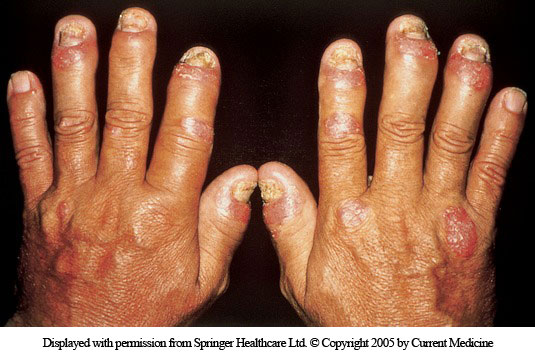 Which of the following is the most likely diagnosis?
 (Multiple Choice)
4.8/5 (83)
(83) A 36-year-old woman, gravida 2 para 2, comes to the office due to 2 days of right breast pain. She has also had fever, chills, muscle aches, and fatigue. The patient had a spontaneous vaginal delivery 6 weeks ago and has been breastfeeding her infant. Her husband has been feeding their baby pumped breast milk so that she can rest at night. The patient has no chronic medical conditions and takes a daily multivitamin. Her mother was diagnosed with metastatic breast cancer at age 55. Temperature is 38.8 C (101.8 F), blood pressure is 110/60 mm Hg, and pulse is 84/min. Physical examination shows a 5-cm area of erythema, induration, and tenderness at the upper outer quadrant of the right breast as well as right axillary lymphadenopathy. There is no fluctuance. The left breast has no abnormalities. Which of the following is the best next step in management of this patient?
(Multiple Choice)
4.9/5 (94)
(94) A 54-year-old male with a past medical history of type 2 diabetes mellitus comes to the emergency department complaining of shortness of breath. His blood pressure is 146/92 mmHg, respiratory rate is 26/min, and oxygen saturation is 87% on room air. Cardiac auscultation findings over the apex are given below. Based on the physical findings, which of the following is the best initial therapy for this patient?
(Multiple Choice)
4.8/5 (86)
(86) A 42-year-old woman is evaluated for depression and poor sleep. She also has mild headaches and muscle weakness. The review of hospital records indicates emergency department visits for anxiety and kidney stones. The patient is a lifetime nonsmoker and does not use illicit drugs. Blood pressure is 160/105 mm Hg and pulse is 85/min. Laboratory results are as follows:  Which of the following best explains this patient's hypertension?
 (Multiple Choice)
4.8/5 (67)
(67) A 21-year-old woman comes to the office with 5 months of fatigue, excessive sweating, and palpitations. The patient is slightly overweight and had previously been unsuccessful in losing weight with caloric restriction and exercise. However, she has lost weight during the past 6 months with an over-the-counter weight loss remedy. The patient has had no menstrual periods for the last 3 months. She is not sexually active. Her blood pressure is 136/70 mm Hg and pulse is 100/min. Her BMI is 26 kg/m2. The patient has lid lag but no proptosis. Examination of the thyroid shows a small gland without nodules or tenderness. Laboratory findings are as follows: 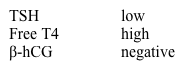 Radioiodine uptake by the thyroid gland is diffusely decreased. Which of the following would most likely be found in this patient?
 (Multiple Choice)
4.7/5 (86)
(86) A 65-year-old man comes to the office for follow-up for inadequately controlled hypertension. The patient has no symptoms except pain in the right thigh when walking uphill or climbing stairs; the pain resolves promptly with rest. Medical history includes coronary artery disease with stable angina that required coronary angioplasty and stenting 2 years ago; the patient also has hypercholesterolemia, a 20-year history of hypertension, and a 10-year history of type 2 diabetes mellitus. Medications include aspirin, metoprolol, valsartan, hydrochlorothiazide, amlodipine, atorvastatin, and metformin. The patient smokes 1½ packs of cigarettes daily and does not consume alcohol. Blood pressure is 177/100 mm Hg in the left arm and 180/100 mm Hg in the right. Which of the following is the most likely additional finding in this patient?
(Multiple Choice)
4.7/5 (80)
(80) A 30-year-old woman comes to the office due to hearing loss in her right ear. A week ago, the patient developed symptoms of nasal congestion, cough, and rhinorrhea. Three days ago, she traveled from New York to London. On her return flight yesterday, the patient developed hearing loss and severe pain in her right ear and noticed a drop of blood on her finger when she scratched her ear canal. All symptoms have resolved except for persistent hearing loss in the right ear. Which of the following is the most appropriate next step in management?
(Multiple Choice)
4.7/5 (89)
(89) A 54-year-old man comes to the office due to 2 weeks of progressive fever, exertional dyspnea, and nonproductive cough. The patient has a history of HIV infection but does not comply with antiretroviral therapy. Temperature is 38.9 C (102 F), blood pressure is 120/80 mm Hg, pulse is 100/min, and respirations are 28/min. Pulse oximetry is 80% on room air. Oxygen saturation increases to 92% with the use of a 100% nonrebreather mask. Laboratory results are as follows:  CD4 count is 170/mm3 and lactate dehydrogenase level is 480 U/L. Chest x-ray reveals diffuse bilateral interstitial infiltrates. What is the most appropriate next step in management of this patient?
 (Multiple Choice)
4.9/5 (95)
(95) A 42-year-old man comes to the office due to a skin rash on his left lower extremity. A month ago, the patient noticed several purple spots on his left calf that have progressively enlarged but are not painful or pruritic. He has no chronic medical conditions but has been treated for primary syphilis and anal gonorrhea. Temperature is 37.2 C (98.9 F), blood pressure is 136/82 mm Hg, and pulse is 86/min. Physical examination shows 3 purple-colored, elliptical papules measuring 1-2 cm on the left lateral calf. HIV testing is positive, CD4 count is 45/mm3, and HIV viral load is 45,000 copies/mL. In addition to antiretroviral therapy and treatment of the skin lesions, which of the following is recommended for this patient?
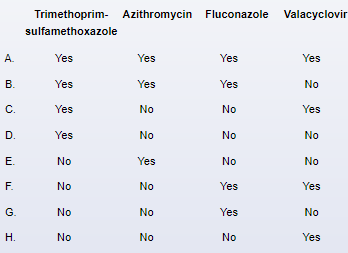
(Multiple Choice)
5.0/5 (71)
(71) A 57-year-old man who just returned from a cruise to the Bahamas comes to the emergency department with fever, nonproductive cough, and shortness of breath for the past 2 days. He has also had a headache, abdominal pain, and diarrhea for a day. The patient has a history of type 2 diabetes mellitus and has smoked a pack of cigarettes daily for 20 years. He does not use alcohol or illicit drugs. His temperature is 39.2 C (102.6 F), blood pressure is 110/65 mm Hg, pulse is 80/min, and respirations are 18/min. The patient's pulse oximetry shows 97% on room air. Lung examination shows crackles bilaterally. The abdomen is soft and nontender. The patient seems confused at times during the examination. His serum glucose is normal; serum sodium is 128 mEq/L. Chest x-ray demonstrates bilateral interstitial infiltrates. He is admitted to the ward. Which of the following antibiotics should be given to this patient?
(Multiple Choice)
4.7/5 (81)
(81) A 68-year-old man comes to the emergency department due to palpitations accompanied by mild dizziness and sweating. The symptoms started abruptly 30 minutes ago. He has had no chest pain or shortness of breath. Medical history is significant for hypertension and a myocardial infarction 6 months ago. The patient is an ex-smoker with a 30-pack-year history. Blood pressure is 102/65 mm Hg and pulse is 160/min and regular. Oxygen saturation is 98% on 2 L nasal cannula oxygen. On physical examination, prominent, high-amplitude jugular venous pulsations are seen intermittently at irregular intervals. ECG reveals a regular, wide-complex tachycardia. Which of the following best explains the patient's physical findings?
(Multiple Choice)
4.8/5 (74)
(74) Showing 1021 - 1040 of 1702
 Prev
- 1
- ...
- 2
- ...
- 3
- ...
- 4
- ...
- 5
- ...
- 6
- ...
- 7
- ...
- 8
- ...
- 9
- ...
- 10
- ...
- 11
- ...
- 12
- ...
- 13
- ...
- 14
- ...
- 15
- ...
- 16
- ...
- 17
- ...
- 18
- ...
- 19
- ...
- 20
- ...
- 21
- ...
- 22
- ...
- 23
- ...
- 24
- ...
- 25
- ...
- 26
- ...
- 27
- ...
- 28
- ...
- 29
- ...
- 30
- ...
- 31
- ...
- 32
- ...
- 33
- ...
- 34
- ...
- 35
- ...
- 36
- ...
- 37
- ...
- 38
- ...
- 39
- ...
- 40
- ...
- 41
- ...
- 42
- ...
- 43
- ...
- 44
- ...
- 45
- ...
- 46
- ...
- 47
- ...
- 48
- ...
- 49
- ...
- 50
- ...
- 51
- ...
- 52
- ...
- 53
- ...
- 54
- ...
- 55
- ...
- 56
- ...
- 57
- ...
- 58
- ...
- 59
- ...
- 60
- ...
- 61
- ...
- 62
- ...
- 63
- ...
- 64
- ...
- 65
- ...
- 66
- ...
- 67
- ...
- 68
- ...
- 69
- ...
- 70
- ...
- 71
- ...
- 72
- ...
- 73
- ...
- 74
- ...
- 75
- ...
- 76
- ...
- 77
- ...
- 78
- ...
- 79
- ...
- 80
- ...
- 81
- ...
- 82
- ...
- 83
- ...
- 84
- ...
- 85
- ...
- 86
- ...
- Next

Filters
- Essay(0)
- Multiple Choice(0)
- Short Answer(0)
- True False(0)
- Matching(0)