


 Chat with AI
Exam 1: Medicine

Exam 1: Medicine2 k Questions
Exam 2: Pediatric723 Questions
Exam 3: Psychiatry336 Questions
Exam 4: Surgery563 Questions
Exam 5: Obstetrics & Gynecology469 Questions
Select questions type


A 14-year-old boy comes to the office due to right ear pain, pruritus, and discharge over the past week. He has had no cold symptoms, hearing loss, dizziness, or tinnitus. The patient returned yesterday from a 2-week vacation at a lake house, where he swam and fished daily. Temperature is 37.1 C (98.8 F), blood pressure is 110/70 mm Hg, and pulse is 75/min. Manipulation of the right ear during otoscopy elicits pain. There is prominent swelling and erythema of the ear canal with purulent and crusty debris. The tympanic membrane appears normal and has normal mobility. The left ear is normal. Nasal and oropharyngeal mucosa are also normal, and no rashes or skin lesions are noted. Which of the following is the most likely causative organism of this patient's current condition?
(Multiple Choice)
4.8/5  (72)
(72) A 9-year-old boy is brought to the emergency department following a bicycling accident. The patient was riding downhill when he hit a rock and lost control. He was thrown off his bicycle and hit the handlebars before tumbling onto the pavement. The patient was not wearing a helmet but did not lose consciousness. Blood pressure is 118/80 mm Hg and pulse is 140/min. Examination shows ecchymosis over the right superior orbit with underlying tenderness and a few scalp abrasions. Visual acuity is 20/20 in the left eye. Using the right eye, the patient is unable to read the largest letter on the visual acuity chart and is only able to perceive light. There is a relative afferent pupillary defect in the right eye. Extraocular movements are normal, and the red reflex is symmetric bilaterally. Fluorescein dye testing is unremarkable. Which of the following is the most likely diagnosis in this patient?
(Multiple Choice)
4.9/5 (82)
(82) A 32-year-old woman is brought to the hospital due to sudden-onset left-sided weakness. According to the family, she has had fatigue, malaise, and decreased appetite over the last several weeks. She attributed these symptoms to a "viral infection" and treated herself with over-the-counter acetaminophen. Her temperature is 37.4 C (99.4 F), blood pressure is 140/86 mm Hg, and pulse is 82/min. The patient appears confused and agitated. Lungs are clear to auscultation. A 2/6 holosystolic murmur is heard at the cardiac apex. Extremity examination reveals left-sided muscle strength is 1/5 with hyperactive deep tendon reflexes. Babinski sign is present on the left side. Laboratory results are as follows: 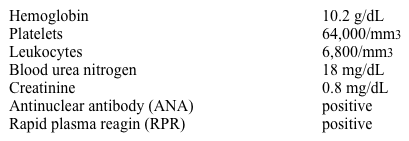 Cerebrospinal fluid cell counts are normal, and cultures are negative. Which of the following is the most likely diagnosis in this patient?
 (Multiple Choice)
4.9/5 (71)
(71) A 65-year-old man comes to the emergency department due to 3 days of progressive cough and shortness of breath. Medical problems include chronic obstructive pulmonary disease, hypertension, and chronic back pain. Evaluation in the emergency department reveals moderate respiratory distress with tachypnea and use of accessory muscles of respiration. Lung auscultation reveals diffuse wheezing. Heart sounds are normal and there is no extremity edema. Chest x-ray shows hyperinflated lungs with no infiltrate or consolidation. Noninvasive ventilation is begun, as are inhaled bronchodilators, systemic glucocorticoids, and empiric antibiotics. Respiratory status significantly improves over the next several hours, and noninvasive ventilation is stopped. The next morning, the patient is lethargic. Temperature is 37 C (98.6 F), blood pressure is 132/86 mm Hg, pulse is 92/min, and respirations are 16/min. Oxygen saturation is 96% on 2 L/min of oxygen via nasal cannula. The patient moves all extremities to painful stimuli but does not follow instructions. Lung auscultation reveals mild bilateral wheezing. Which of the following is the most appropriate next step in evaluation of this patient's altered mentation?
(Multiple Choice)
4.9/5 (81)
(81) A 68-year-old man comes to the emergency department with a 3-week history of progressive dyspnea, orthopnea, and lower extremity edema. His past medical history is significant for hypertension, type 2 diabetes mellitus, myocardial infarction 8 years ago, and congestive heart failure. Current medications include metoprolol, digoxin, enalapril, furosemide, spironolactone, and aspirin. His blood pressure is 135/80 mm Hg, and pulse is 75/min and regular. Symmetric 2+ pitting edema of the lower extremities is present. Point of maximal impulse is displaced to the left and a soft holosystolic murmur is heard at the apex. Bilateral crackles are present over the lower lobes. Laboratory results are as follows: 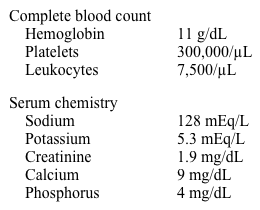 Electrocardiogram shows normal sinus rhythm and no acute ischemic changes. Which of the following is most likely accurate regarding this patient's condition?
 (Multiple Choice)
4.8/5 (78)
(78) A 54-year-old woman was diagnosed with breast cancer 6 months ago after seeing her physician for a lump in her breast. The patient underwent a mastectomy and has been receiving chemotherapy. She has had poor sleep and decreased appetite for the last 3 weeks. She has some nausea that is relieved by prescription medications. The patient feels down and says, "The chemo makes me feel weak and drained, so I don't want to do anything." She spends most of her time at home and does not feel like going out or talking to family and friends. Some days, she does not get out of bed and does not answer her phone. The patient has lost interest in reading and her favorite television programs. She feels at fault for having breast cancer because she missed 2 mammogram appointments. Which of the following is the most appropriate next step in management of this patient?
(Multiple Choice)
4.8/5 (82)
(82) A 16-year-old girl is brought to the office due to pain in multiple joints. The pain has primarily been in her left knee and hip, right shoulder, and both wrist and hand joints. The patient says the pain seemed to be in one joint and would improve after a day or 2 before moving to a different joint. She also notes that she had 2 days of fever and malaise a week ago, but these have since resolved. Physical examination shows tenderness and pain on movement of the bilateral wrists and left fingers. There is mild swelling and tenderness of the left knee with no erythema. Several 3- to 4-mm, nontender pustules with a surrounding erythematous rim are present on the left lower extremity. Left knee arthrocentesis yields clear synovial fluid with a leukocyte count of 30,000/mm3. Synovial fluid culture is negative. Which of the following historical factors is most likely associated with this patient's presentation?
(Multiple Choice)
4.7/5 (95)
(95) A 68-year-old man is brought to the emergency department after an episode of coffee-ground emesis followed by lightheadedness. He has had black, tarry stools for the past few days. The patient has been taking over-the-counter ibuprofen for osteoarthritis. His other medical problems include hypertension and removal of 2 hyperplastic colon polyps 4 years ago. The patient drinks 2 or 3 beers on weekends. He does not smoke. Temperature is 36.7 C (98 F), blood pressure is 112/72 mm Hg, pulse is 110/min, and respirations are 16/min. His lungs are clear to auscultation. The abdomen is slightly tender to deep palpation in the epigastrium. Laboratory results after the initial resuscitation are as follows: 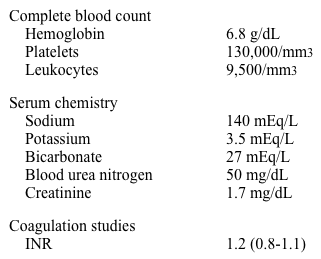 In addition to intravenous fluid resuscitation, which of the following is the most appropriate next step in management of this patient?
 (Multiple Choice)
4.8/5 (79)
(79) A 56-year-old man comes to the office due to progressive urinary frequency, urgency, and hesitancy for the past several months. The patient also reports new-onset low back pain and perineal pain during ejaculation. He has had no dysuria or hematuria. The patient has smoked a pack of cigarettes daily for 30 years. Temperature is 37 C (98.6 F), blood pressure is 130/76 mm Hg, and pulse is 80/min. There is no suprapubic or costovertebral angle tenderness. Examination of the external genitalia is normal. Rectal examination shows increased anal sphincter tone and a smooth, slightly enlarged prostate. Deep tendon reflexes are normal. Urinalysis shows many leukocytes and no erythrocytes. Urine culture grows no organisms. Serum prostate-specific antigen is 2 ng/mL (age-specific reference value is <3.5 ng/mL). Which of the following is the most likely cause of this patient's current condition?
(Multiple Choice)
4.8/5 (67)
(67) A 67-year-old Caucasian male complains of progressive visual loss in his right eye over the past several months. He has a history of hypertension and type 2 diabetes mellitus. Current medications include a daily baby aspirin, hydrochlorothiazide, lisinopril, and metformin. There is no family history of visual problems. He has a 35 pack year smoking history and admits to occasional alcohol use. He is afebrile with a blood pressure of 137/82 mmHg and pulse of 73/min. Cardiac and pulmonary examinations are unremarkable. A neurologic examination demonstrates no focal motor or sensory abnormalities. The patient is asked to cover his left eye and to look at a small spot on a grid made of parallel vertical and horizontal lines. He describes the vertical lines as being bent and wavy. Which of the following is the most likely cause of this patient's complaints?
(Multiple Choice)
4.9/5 (80)
(80) A 45-year-old white man comes to the emergency department due to shortness of breath, cough, and hemoptysis for the past 2 days. Over the past 2 months, he has had intermittent fever, malaise, and a weight loss of 5 kg (11 lb). His medical history is significant for gastroesophageal reflux disease and chronic rhinosinusitis. He has never used tobacco. The patient has lived his entire life in Chicago and never traveled outside the country. He works for a local granite and marble stone company. He does not use alcohol or illicit drugs. On physical examination, he appears ill. Temperature is 37.6 C (99.7 F), blood pressure is 120/80 mm Hg, pulse is 94/min, and respirations are 20/min. Lung auscultation indicates patchy rales bilaterally. Heart sounds are regular. Laboratory results are as follows: 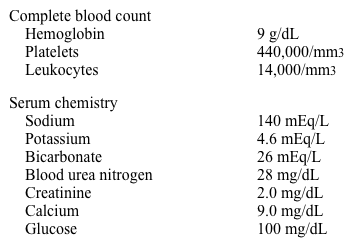 Chest imaging reveals multiple bilateral lung nodules with cavitation. Bronchoscopy shows several areas of tracheal narrowing and ulceration. Which of the following is the most likely diagnosis?
 (Multiple Choice)
4.8/5 (76)
(76) A 72-year-old hospitalized man is evaluated for new-onset paresthesia in the right hand. The patient was admitted to the intensive care unit 4 days ago due to pneumonia complicated by respiratory failure and septic shock. He was mechanically ventilated and treated with broad-spectrum antibiotics, intravenous fluids, and vasopressor therapy. Hemodynamic monitoring was performed using a right internal jugular venous catheter and a right brachial arterial catheter. The patient's clinical condition gradually improved. Today, he was extubated, and the arterial and venous catheters were removed. Since extubation, the patient has reported right hand discomfort with tingling and numbness. On examination, both hands are warm with 2-second capillary refill. Bilateral grip strength is diminished but symmetric, and sensation to light touch and pain is diminished in the lateral palm, thumb, index finger, and long finger of the right hand. Which of the following is the most likely cause of this patient's hand symptoms?
(Multiple Choice)
4.9/5 (80)
(80) A 55-year-old man is evaluated for puffiness of the face and abdominal distension over the past 4 weeks. He has hypertension and type 2 diabetes mellitus. The patient does not use alcohol, tobacco, or illicit drugs. His temperature is 37.1 C (98.8 F), blood pressure is 133/75 mm Hg, pulse is 82/min, and respirations are 14/min. He also has periorbital edema, moderate ascites, and 1+ bilateral pitting pedal edema. 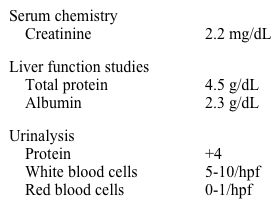 Twenty-four-hour urinary protein excretion is 5 g/day. This patient is at increased risk for developing which of the following?
 (Multiple Choice)
4.8/5 (87)
(87) A 28-year-old man comes to the office asking for antibiotics to treat a "sinus infection." He reports recurrent episodes of nasal congestion, rhinorrhea, and dry cough. The patient has used over-the-counter allergy medicines with some relief but continues to feel uncomfortable and has difficulty concentrating at work. He does not have shortness of breath, chest pain, or ocular symptoms. The patient has no prior history of allergies or asthma but had eczema during childhood. He does not use tobacco, alcohol, or illicit drugs. His temperature is 37 C (98.6 F), blood pressure is 120/78 mm Hg, and pulse is 76/min. Physical examination shows a transverse nasal crease, swollen and pale nasal turbinates, and a clear nasal discharge. There is no maxillary sinus tenderness. The posterior pharyngeal wall has a "cobblestone" appearance. Breath sounds are normal with no added sounds. Which of the following is the most effective therapy for this patient's condition?
(Multiple Choice)
4.9/5 (74)
(74) A 20-year-old hockey player is brought to the emergency department 30 minutes after falling headfirst into the hockey rink boards. He did not lose consciousness during the impact but was unable to move his arms and legs afterward. The patient was placed in a rigid cervical collar and transported to the hospital on a backboard; 2 large-bore intravenous catheters were inserted en route. On arrival, blood pressure is 128/78 mm Hg, pulse is 102/min, and respirations are 14/min. The patient is alert and appears anxious. Cardiopulmonary examination is normal. Neurologic examination shows intact cranial nerves. Pinprick and temperature sensation are absent below the level of the clavicles; vibratory sense is intact. The patient is still unable to move his extremities. CT scan of the cervical spine reveals a burst fracture of C5 with impingement of posteriorly displaced fragments on the spinal cord. Neurosurgery is consulted. Which of the following is the best next step in management of this patient?
(Multiple Choice)
4.8/5 (76)
(76) A 47-year-old woman comes to the office due to a recent change in mood. The patient says, "I began feeling really down about 3 months ago, but I can't think of anything that may have caused this. I'm also much more irritable with my family and friends than I used to be." She has no history of psychiatric illness. She also notes, "I've been having a lot of problems at work. It's a lot harder to plan and organize my day than it used to be, and I've been missing a lot of deadlines." The patient is very concerned about her symptoms because her father died in his mid-60s, 10 years after developing similar symptoms. Temperature is 36.9 C (98.4 F), blood pressure is 119/77 mm Hg, pulse is 64/min, and respirations are 14/min. She is fully oriented but scores a 24/30 on the Montreal Cognitive Assessment (normal: ≥26), losing points on tests of executive function. On examination, she demonstrates abrupt and random jerking movements throughout the extremities and face. Extraocular movement testing reveals delayed initiation of saccades, but slit lamp examination is normal. Gait is normal. The patient is unable to maintain her grip on grip testing. Sensation is intact in the distal extremities. Which of the following is the most likely diagnosis?
(Multiple Choice)
4.8/5 (80)
(80) A 21-year-old woman comes to the physician with progressive weakness and loss of energy. She nearly collapsed yesterday while performing one of her routine 3-hour workouts. She is not doing well academically in college despite persistent attempts to improve her grades. Her blood pressure is 102/58 mm Hg and pulse is 113/min. Her body mass index is 21 kg/m2. Fine hair is noted on her scalp. Examination shows dental erosions with slightly enlarged cheeks. There is no edema. Laboratory results are as follows: 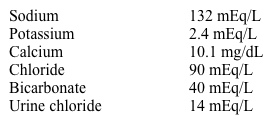 In addition to potassium supplementation, which of the following is the best treatment to correct the laboratory abnormalities in this patient?
 (Multiple Choice)
4.7/5 (68)
(68) A 32-year-old man comes to the office due to right ear pain for the past month. The pain often awakens the patient and increases in severity when he chews food. He does not have ear discharge, dizziness, sinus tenderness, or rash. Medical history is significant for generalized anxiety disorder, for which he takes sertraline. The patient does not use tobacco or alcohol. Vital signs are within normal limits. On examination, the ears are normal with a small amount of wax. Mobility of the tympanic membrane is normal, and results of the Weber and Rinne tests are normal. There are no lesions in the oral cavity, the tonsils are normal, and the teeth appear worn and smooth with no evidence of dental cavities or periodontal disease. Which of the following is the most likely diagnosis?
(Multiple Choice)
4.7/5 (86)
(86) A 26-year-old, previously healthy woman comes to the office due to worsening fatigue, constipation, and nonproductive cough for the past several months. The patient also reports occasional reddish, painful bumps on her legs and nonpainful, nonpruritic facial eruptions for the past week. She has had no fever, chest pain, orthopnea, or pedal edema. The patient does not use tobacco, alcohol, or illicit drugs and is in a monogamous relationship. Vital signs and pulse oximetry are within normal limits. Physical examination shows normal oropharyngeal mucosa and jugular venous pressure. The lungs are clear on auscultation and heart sounds are normal. The abdomen is soft and nontender. There are enlarged cervical and axillary lymph nodes. Examination of the skin reveals 3 violaceous, indurated nodules on the anterior shins, as well as facial eruptions shown in the exhibit. 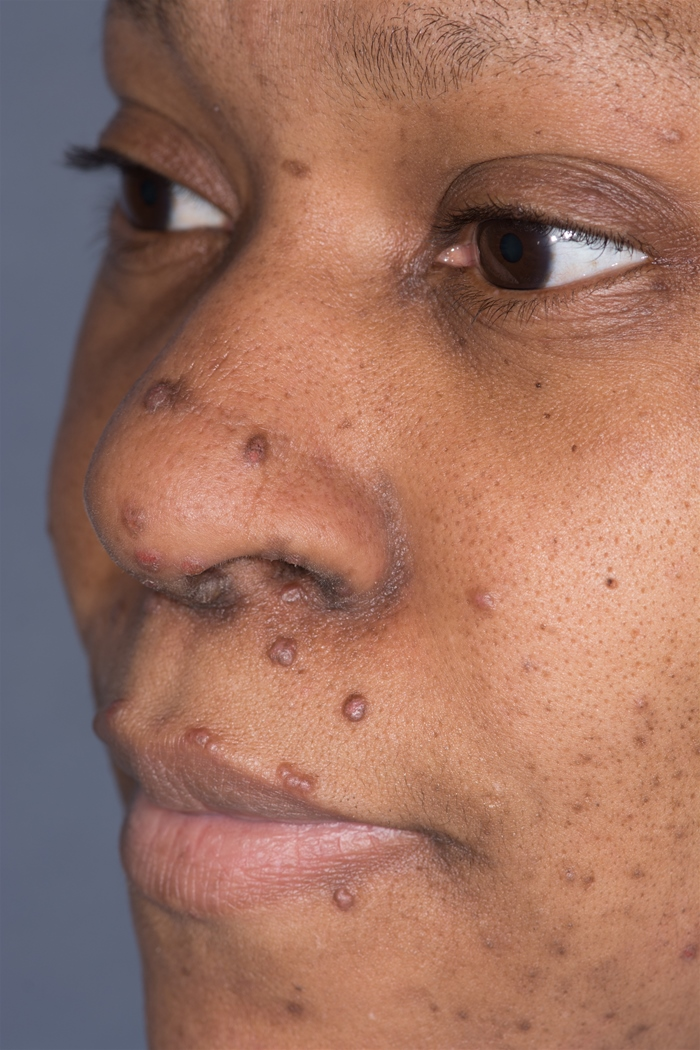 Chest imaging and laboratory studies are ordered. Which of the following sets of laboratory findings are expected in this patient?
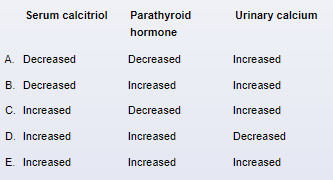
Chest imaging and laboratory studies are ordered. Which of the following sets of laboratory findings are expected in this patient?
(Short Answer)
4.8/5 (74)
(74) A 55-year-old woman comes to the office due to 3 months of night sweats. She has tried using a fan and sleeping without a comforter, but she continues to awaken several nights a week with bedsheets so drenched that she has to change them. During this time, she has unintentionally lost 5 kg (11 lb). The patient traveled to Vietnam with her church group 6 months ago and wonders if she may have "caught something." She took her antimalarial pills and received her pretrip vaccinations as recommended and has not had fevers. The patient does not use tobacco, alcohol, or illicit drugs. Temperature is 37.4 C (99.4 F), blood pressure is 144/78 mm Hg, and pulse is 96/min. She has pale mucosa but no scleral icterus. There is no cervical lymphadenopathy. Cardiopulmonary examination is normal. A spleen tip is palpable when she exhales completely. Laboratory results are as follows: 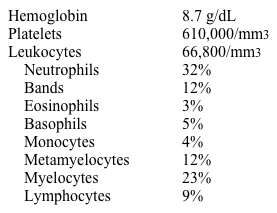 Which of the following is expected in this patient?
 (Multiple Choice)
4.8/5 (74)
(74) Showing 341 - 360 of 1702
 Prev
- 1
- ...
- 2
- ...
- 3
- ...
- 4
- ...
- 5
- ...
- 6
- ...
- 7
- ...
- 8
- ...
- 9
- ...
- 10
- ...
- 11
- ...
- 12
- ...
- 13
- ...
- 14
- ...
- 15
- ...
- 16
- ...
- 17
- ...
- 18
- ...
- 19
- ...
- 20
- ...
- 21
- ...
- 22
- ...
- 23
- ...
- 24
- ...
- 25
- ...
- 26
- ...
- 27
- ...
- 28
- ...
- 29
- ...
- 30
- ...
- 31
- ...
- 32
- ...
- 33
- ...
- 34
- ...
- 35
- ...
- 36
- ...
- 37
- ...
- 38
- ...
- 39
- ...
- 40
- ...
- 41
- ...
- 42
- ...
- 43
- ...
- 44
- ...
- 45
- ...
- 46
- ...
- 47
- ...
- 48
- ...
- 49
- ...
- 50
- ...
- 51
- ...
- 52
- ...
- 53
- ...
- 54
- ...
- 55
- ...
- 56
- ...
- 57
- ...
- 58
- ...
- 59
- ...
- 60
- ...
- 61
- ...
- 62
- ...
- 63
- ...
- 64
- ...
- 65
- ...
- 66
- ...
- 67
- ...
- 68
- ...
- 69
- ...
- 70
- ...
- 71
- ...
- 72
- ...
- 73
- ...
- 74
- ...
- 75
- ...
- 76
- ...
- 77
- ...
- 78
- ...
- 79
- ...
- 80
- ...
- 81
- ...
- 82
- ...
- 83
- ...
- 84
- ...
- 85
- ...
- 86
- ...
- Next

Filters
- Essay(0)
- Multiple Choice(0)
- Short Answer(0)
- True False(0)
- Matching(0)