Multiple Choice
A 74-year-old man comes to the office with increasing shortness of breath, especially on exertion. He also has cough with mucoid expectoration, especially in the morning. He has no orthopnea, paroxysmal nocturnal dyspnea, or chest pain. The patient was hospitalized for community-acquired pneumonia 2 years ago. His other medical problems include glaucoma, benign prostatic hyperplasia, and hypertension. He smoked a pack of cigarettes daily for 40 years and quit 2 years ago. His temperature is 37.2 C (98.9 F) , blood pressure is 144/96 mm Hg, pulse is 82/min, and respirations are 16/min. Pulse oximetry shows an oxygen saturation of 89% on room air at rest. His face appears plethoric. The chest is barrel shaped. Breath sounds are diminished throughout, and the expiratory phase is prolonged. Heart sounds are distant but regular, and there are no murmurs or gallops. There is no peripheral edema or jugular venous distension. Laboratory results are as follows: 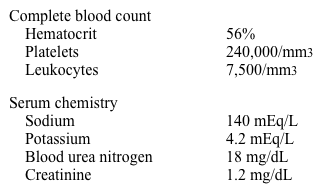 Which of the following interventions will have the maximum impact on this patient's survival?
A) Influenza and pneumococcal vaccinations
B) Long-term beta blocker therapy
C) Long-term supplemental oxygen at home
D) Maintenance low-dose oral corticosteroids
E) Mucoactive agents to thin sputum
F) Periodic phlebotomy
G) Prophylactic antibiotics to reduce exacerbations
Correct Answer:

Verified
Correct Answer:
Verified
Q316: A 35-year-old woman comes to the emergency
Q317: A 68-year-old man is brought to the
Q318: A 42-year-old man comes to the office
Q319: A 27-year-old woman comes to the office
Q320: A 60-year-old man comes to the emergency
Q322: A 2-year-old girl is brought to the
Q323: A 34-year-old previously healthy woman comes to
Q324: A 62-year-old man comes to the emergency
Q325: A 68-year-old man comes to the office
Q326: A 25-year-old woman comes to the physician