Multiple Choice
A 54-year-old man comes to the office due to erectile dysfunction. For the last 6 months, the patient has had progressive difficulty maintaining an erection long enough to have satisfying sexual intercourse. In addition, he has had loss of libido and a decrease in early morning erections. Medical history is significant for hyperlipidemia and coronary artery disease. The patient was admitted for an acute coronary syndrome 7 months ago, and a drug-eluting stent was placed in the right coronary artery. A follow-up treadmill cardiac stress test was negative; he is able to walk briskly for 30 minutes daily without developing angina or other symptoms. Current medications include metoprolol, atorvastatin, aspirin, and ticagrelor. Blood pressure is 122/70 mm Hg and pulse is 66/min. Cardiopulmonary examination is unremarkable except for mildly decreased pedal pulses on the right. He has normal testicular size, normal secondary sexual characteristics, and no gynecomastia. Laboratory results are as follows: 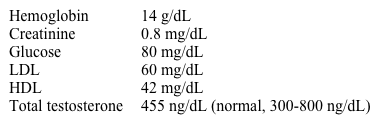 Which of the following is the best next step in treating this patient's erectile dysfunction?
A) Advise the patient to refrain from sexual activity
B) Intraurethral alprostadil
C) Oral sildenafil
D) Stop atorvastatin
E) Stop metoprolol
F) Testosterone therapy
Correct Answer:

Verified
Correct Answer:
Verified
Q1201: A 25-year-old man with ankylosing spondylitis comes
Q1202: A study was conducted to assess the
Q1203: A 40-year-old woman comes to the office
Q1204: A 15-day-old boy is brought to the
Q1205: A 70-year-old man is brought to the
Q1207: A 28-year-old man is brought to the
Q1208: A 52-year-old woman comes to the office
Q1209: An 18-year-old woman is brought to the
Q1210: A 45-year-old man comes to the emergency
Q1211: A 43-year-old man comes to the office