



 Chat with AI
Exam 1: Advanced Clinical Medicine

Exam 1: Advanced Clinical Medicine1 k+ Questions
Exam 2: Foundations of Independent Practice597 Questions
Select questions type


A 6-month-old girl is brought to the office for the first time for a well-child visit. The family recently relocated to the area to be close to a sick family member. Review of medical records shows an uncomplicated labor and delivery at 38 weeks gestation. Birth weight was 3.4 kg (7 lb 8 oz), which was at the 50th percentile. Head circumference and length were documented at the 60th percentile. At the 2-month visit before the family's relocation, she received her 2-month vaccinations and was documented at the 45th percentile for weight. She was not seen for a 4-month visit. The patient is able to sit with support and roll over. She is babbling consonants and reaching for toys. She drinks approximately 30 ounces of formula a day. Her parents started her on solids at age 5 months, and she eats fruits and vegetables twice a day. The patient lives at home with her parents and 2 older brothers. Weight today is 6.2 kg (13 lb 11 oz), which is at the 8th percentile; head circumference and length are at the 60th percentile. Physical examination shows an alert and active infant. She transfers a toy from her right to left hand. The remainder of the physical examination is unremarkable. The parents seem frustrated as the girl's 2-year-old brother takes the girl's toy and she screams. What is the most appropriate next step in management of this patient?
(Multiple Choice)
4.7/5  (92)
(92) A 62-year-old hospitalized man is evaluated for new-onset, right lower extremity pain. The patient underwent bypass surgery for 3-vessel coronary artery disease 2 months ago. He arrived at the emergency department 2 nights ago due to recurrent chest pains. At that time, ECG showed sinus rhythm with no ST-segment changes, but cardiac troponin I levels were elevated. The patient was initiated on unfractionated heparin, antiplatelet agents, a beta blocker, and a nitrate. A coronary angiogram was performed via the radial artery; it revealed graft insertion site stenosis and was treated with stenting. Postintervention echocardiography revealed left ventricular ejection fraction of 50% with no regional wall motion abnormalities. This morning, the patient had new, sudden-onset, right lower extremity pain. He has never had pain in that extremity before. The patient has a history of hypertension, hyperlipidemia, and type 2 diabetes mellitus. Current medications include aspirin, clopidogrel, rosuvastatin, metoprolol, losartan, isosorbide mononitrate, basal-bolus insulins, and subcutaneous heparin at a prophylactic dose. The patient is a former smoker with a 30-pack-year history. Temperature is 37.6 C (99.7 F), blood pressure is 138/84 mm Hg, pulse is 96/min, and respirations are 18/min. Physical examination reveals normal jugular venous pressure, clear lungs, no heart murmurs, and a soft, nontender abdomen. The right leg is tender and cool to the touch when compared to the left leg. Right lower extremity distal pulses are diminished, but capillary refill is intact. Left leg examination is normal with the exception of healed scars from previous saphenous vein harvesting. Neurological examination is normal. Laboratory results are as follows:
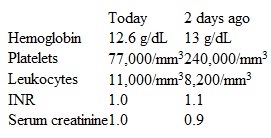 Analgesics and other supportive measures are provided, and vascular surgery is consulted. Diagnostic studies are performed, but the results are pending. Which of the following is the most appropriate next step in management of this patient?
 (Multiple Choice)
4.8/5 (83)
(83) During the same visit, she also expressed her concerns about breast-feeding the baby. She is concerned that some of the silicone will be admixed with the breast milk and cause adverse effects. She asks you if she should avoid breast-feeding the baby. Which of the following is the most appropriate response?
(Multiple Choice)
4.8/5 (72)
(72) A 23-year old Caucasian primipara gives birth to a full-term, female infant who has an isolated cleft lip. The mother says that her brother had a cleft lip and cleft palate which were surgically corrected. Her prenatal course was uncomplicated. She did not take any medications except multivitamins during the pregnancy. She does not smoke or consume alcohol. Careful inspection reveals an upper lip pit in the mother. Which of the following is the best statement concerning the infant's condition?
(Multiple Choice)
4.8/5 (77)
(77) A 14-year-old boy is brought to the emergency department by his parents due to cough and difficulty breathing. The patient has had a nonproductive cough for a week that worsens at night and prevents him from sleeping well. This morning he has been short of breath while walking and speaking. The boy has also had fever for the past 2 days. Medical history is notable for end-stage renal disease due to obstructive uropathy from a congenital posterior urethral valve. He received a living related donor kidney transplant 3 months ago. Temperature is 38.2 C (100.8 F), blood pressure is 120/80 mm Hg, pulse is 98/min, and respirations are 31/min; pulse oximetry is 82% on room air. Physical examination shows a tired-appearing boy in mild respiratory distress seated on a chair. He is tachypneic with diffuse rales throughout the lungs. His donor kidney is palpable in the lower abdomen and is nontender. Laboratory studies show a creatinine of 0.6 mg/dL. When questioned alone, the patient says that he has not been taking all his medications as prescribed. Which of the following would most likely have prevented this patient's current illness?
(Multiple Choice)
4.7/5 (91)
(91) A 46-year-old man comes to the physician's office for a pruritic rash. The patient was in his usual state of health until 2 months ago, when dark red lesions appeared over his wrists. The lesions progressed, and a few weeks later he developed similar lesions on his lower legs. This morning, the patient saw some "white lines" in his mouth and called for an urgent appointment. He has no fevers, chills, weight loss, or diarrhea. The patient has a history of hypertension, which is controlled with lisinopril. He does not use tobacco or alcohol, but has a remote history of intravenous drug use. Physical examination shows multiple, discrete violaceous papules and plaques over the flexural surfaces of the patient's wrists and lower legs as shown in the image below. Examination of the buccal mucosa shows whitish lacy streaks with a slight background erythema. The rest of his physical examination is unremarkable. 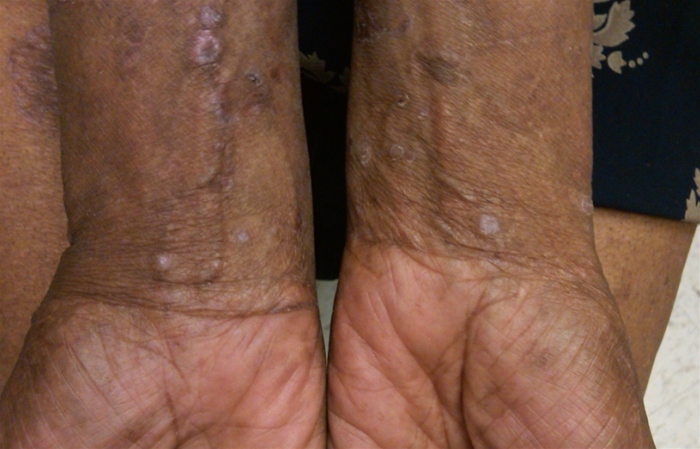 The diagnosis is confirmed with the appropriate studies. Which of the following is the most appropriate next step in evaluation of this patient?
 (Multiple Choice)
4.8/5 (84)
(84) A 15-year-old boy is brought to the office by his parents due to concerns about his pubertal development. The patient says, "I am the only one of my friends whose voice has not changed and who does not have any body hair. I'm tired of being called 'weak' in gym class." The patient has been fatigued lately, which he attributes to staying up late talking with friends; he otherwise feels well. He has had no recent headaches, vomiting, or vision changes. The patient has a good appetite and eats a well-varied diet. His father is 178 cm (5 ft 10 in) and his mother is 160 cm (5 ft 3 in). Blood pressure is 116/70 mm Hg and pulse is 78/min. Weight and height are at the 15th and 3rd percentiles, respectively, unchanged from his last visit 12 months ago. The patient's height has increased 4.5 cm (1.8 in) since then. Physical examination shows a well-appearing, quiet adolescent with no dysmorphic features. The thyroid is palpable and not enlarged. There is no gynecomastia. Cardiopulmonary examination is normal. The testes are soft and measure 2 mL (Tanner stage I). The phallus is normal in length. There is no axillary or pubic hair. The rest of the physical examination is normal. Bone age x-ray is consistent with age 13. When the family is asked if there are any concerns, the patient answers, "I'm worried that my body will never change and I'll be this way for the rest of my life. I'm stressed about changing in the locker room in front of my soccer teammates because I don't think I look like I should at my age. It makes me want to quit the soccer team." Which of the following statements would be the best response to this patient's concerns?
(Multiple Choice)
4.9/5 (73)
(73) A 45-year-old woman comes to the office for hypertension follow-up. She has been taking low-dose amlodipine for the past 2 years, and it has been effective in controlling her blood pressure without adverse effects. The patient has no other medical conditions. In the past year, she initiated and maintained an intensive diet and exercise program, resulting in a weight loss of 15 kg (33 lb). Since then, the patient's blood pressure at home has been consistently 115-120/70-75 mm Hg. Office blood pressure today is 118/74 mm Hg. The patient says "I have worked really hard for the past year to lose weight, and I don't like to take pills. Can I stop taking the blood pressure medication after this visit?" Which of the following is the best response to address the patient's request?
(Multiple Choice)
4.9/5 (76)
(76) A 35-year-old woman comes to the office for the third time in a month for follow-up. She called the office the night before reporting that her chest felt "tight" and was advised by the on-call physician to make an urgent office appointment today if she felt the need to be seen. The patient arrives an hour before her scheduled appointment and enjoys chatting with the office staff. She has a history of irritable bowel syndrome, dermatitis, anxiety, and mild asthma. Her record indicates that she has also called the office multiple times after hours to discuss various nonurgent matters, including questions about diet and hypoallergenic products. Today she is breathing normally and shows the physician a chart she has made documenting her asthma episodes and triggers. Temperature is 36.7 C (98 F), blood pressure is 120/80 mm Hg, pulse is 72/min, and respirations are 14/min. Examination shows no abnormalities. The patient says, "I didn't have time to show you this chart at our last appointment; the on-call doctor advised me to come in and show it to you." Which of the following is the best response to the patient's behavior?
(Multiple Choice)
4.7/5 (67)
(67) A 57-year-old woman comes to the office due to discomfort in her right hand. She reports that periodically her fingers "feel numb, with some tingling, sort of like they fell asleep." When the patient shakes her hands, normal sensation is partially restored. The symptoms are more often present at night but are occasionally experienced during the daytime as well. She has not had abnormalities of sensation on the dorsal surfaces of her hands, and she reports no shoulder or neck pain. There is no history of injury to the upper extremities. Medical history is notable for irritable bowel syndrome, mitral valve prolapse, degenerative knee arthritis, and hypertension controlled with lisinopril. She also takes an over-the-counter fiber supplement. The patient works as a bookkeeper. She does not use tobacco, alcohol, or illicit drugs. Vital signs are normal. BMI is 32 kg/m2. Neurologic examination shows no sensory loss, muscle weakness, or muscle atrophy in the right upper extremity. Provocative testing reproduces the patient's symptoms. Which of the following is the most appropriate next step in management of this patient's condition?
(Multiple Choice)
4.7/5 (72)
(72) A 66-year-old man comes to a community clinic after undergoing a computed tomography scan of the head at a local emergency department. He fell while stepping out of the bathtub and struck his head but did not lose consciousness. The patient sustained a small head laceration that was closed with sutures, but no other injuries were identified in the emergency department. He reports a longstanding history of normal-pressure hydrocephalus with frequent falls, but he has not followed up with his neurologist for several years. The patient is now asymptomatic with no headaches, focal weakness, or dizziness. His head computed tomography scan with bone windows is shown in the image below. 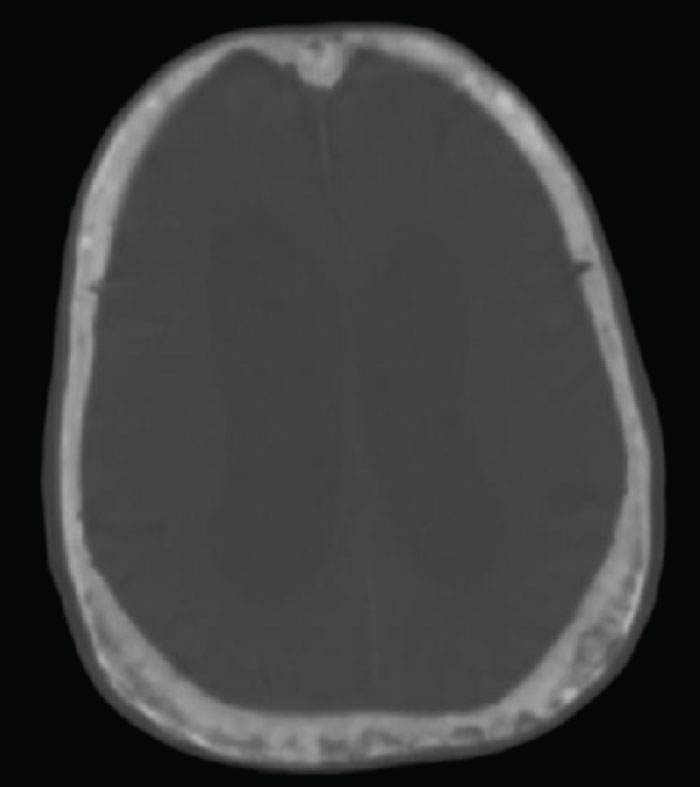 After the appropriate steps, the patient returns for follow-up one year later. He now complains of hearing loss in the left ear. What is the appropriate response to his complaint?
 (Multiple Choice)
4.7/5 (86)
(86) A 22-year-old man comes to the office to discuss laboratory test results. He is a competitive cross-country skier and is required to have periodic blood testing to comply with international rules. The patient feels well except for occasional heartburn for which he takes antacids. He trains strenuously on a regular basis and is on a very high protein diet. The patient's medical history is unremarkable except for a concussion at age 17; at that time, his serum calcium was noted to be borderline high, but the patient did not follow up with his physician after discharge from the hospital. His father was also found to have hypercalcemia at a young age but has not required any specific treatment and is otherwise healthy. The patient takes no prescription medications and does not use tobacco, alcohol, or illicit drugs. Laboratory results are as follows: 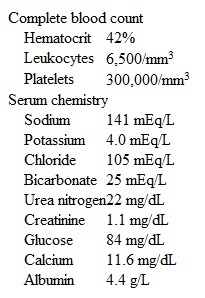 Which of the following clinical findings is most likely present in this patient?
 (Multiple Choice)
4.8/5 (65)
(65) A 23-year-old woman, gravida 3 para 2, at 35 weeks gestation comes to the emergency department due to vaginal bleeding that started after intercourse, 2 hours prior to arrival, and has soaked through 3 perineal pads. The patient reports normal fetal movement and mild intermittent cramping but no leakage of amniotic fluid. Her only prenatal visit was at 7 weeks gestation, when an ultrasound was normal. The patient has a history of 2 prior cesarean deliveries at term. The first delivery was performed for a category III fetal heart rate tracing; the second was an elective repeat. The patient has a history of intravenous drug use and smokes a pack of cigarettes a day. She has no known drug allergies. Blood pressure is 130/70 mm Hg and pulse is 98/min. The fetal heart rate tracing is 140/min with moderate variability, accelerations, and no decelerations. The tocometer shows contractions every 5 minutes. On examination, the patient is in no distress. The abdomen is gravid, soft, and nontender. There is frank blood on the patient's perineal pad. Item 1 of 2 Which of the following is the best next step in management of this patient?
(Multiple Choice)
4.8/5 (84)
(84) A study examines the role of different tumor markers or their combinations in diagnosing pancreatic cancer in patients with a solid lesion in the pancreatic head. The following table is reported: Based on the study results, a patient with a solid lesion in the pancreatic head is most likely to be free of pancreatic cancer if which of the following tests or combinations is negative?
(Multiple Choice)
4.8/5 (81)
(81) An 18-hour-old girl is undergoing a routine examination in the newborn nursery. The patient has urinated 4 times and passed meconium. She was born via uncomplicated vaginal delivery at 41 weeks to a 23-year-old primipara. Apgar scores were 8 and 9 at 1 and 5 minutes, respectively. Birth weight and length are at the 25th percentile for gestation. Temperature is 37.2 C (99 F). The patient is initially asleep but easily roused. Examination shows open and soft fontanelles, posteriorly rotated ears, and a small maxilla. The soft palate has a high arch, but no submucosal cleft is felt on palpation. The neck is short and webbed, without masses. Auscultation reveals a regular heart rate and rhythm with no murmurs. There is good air entry in all fields with no grunting, retractions, or nasal flaring. External genitalia are normal. The hands and feet are moderately edematous. Crease lines on both hands are normal. Pulses are 2+ in all extremities. Item 1 of 2 Which of the following is the most likely long-term outcome for patients with this condition?
(Multiple Choice)
4.8/5 (65)
(65) A 68-year-old woman comes to the office due to vaginal spotting. The patient first noticed dark brown blood stains on her underwear several months ago. She now wears a perineal pad that is partially stained by the end of the day. Occasionally she notices bright red blood on the pad as well. The patient has had no passage of clots or heavy bleeding. For the past year she has been sexually active with a new partner and recently noticed some postcoital bleeding. The patient has no dyspareunia, abnormal vaginal discharge, dysuria, or hematuria. She has constipation that is responsive to a high-fiber diet and stool softeners. In addition, the patient has type 2 diabetes mellitus that is managed with an oral agent. She had a cervical conization 20 years ago for cervical intraepithelial neoplasia; all subsequent Pap tests have been normal, including her most recent test 4 years ago. The patient is a former smoker but does not use alcohol or illicit drugs. Vital signs are normal. BMI is 30 kg/m2. Speculum examination shows no active vaginal bleeding. There is an erosion near the posterior fornix. The cervix is erythematous but there are no nodules or lesions. The uterus is small, mobile, and nontender. There are no adnexal masses or tenderness. On Valsalva, a mass is noted to protrude past the hymenal ring. Anal sphincter tone is normal on rectal examination. Which of the following is the most likely diagnosis for this patient?
(Multiple Choice)
4.8/5 (82)
(82) An 8-year-old boy is brought to the urgent care clinic by his grandmother due to a fever, sore throat, headache, and nausea that began yesterday. His symptoms have worsened and he is now having difficulty swallowing. He is up to date on vaccines and has no chronic medical conditions. The grandmother cares for the child after school while his mother is at work. The boy's father died of leukemia 3 years ago, and his mother is healthy. Temperature is 39.4 C (102.9 F), blood pressure is 100/70 mm Hg, pulse is 112/min, and respirations are 14/min. Pulse oximetry is 95% on room air. The boy is awake, alert, and in mild discomfort. Examination of the oropharynx reveals pharyngeal erythema and exudate. The uvula is deviated to the right and the left soft palate is depressed downward. The patient has pooled oral secretions but is able to swallow. There is bilateral anterior cervical lymphadenopathy. Lung fields are clear to auscultation bilaterally with good air entry. A small peritonsillar abscess is suspected and the proposed plan, including transfer to the hospital for needle aspiration, is discussed with the grandmother. When asked if she has written consent to permit treatment, the grandmother replies that she has never been asked such a question before. Which of the following is the best next step in management of this patient?
(Multiple Choice)
4.8/5 (68)
(68) A 65-year-old woman with a medical history significant for tobacco use, hypertension, and laparoscopic cholecystectomy is brought to the operating room for a lumbar discectomy. She is placed in the prone position. General anesthesia is induced with propofol and rocuronium, and the patient is intubated without complications. Anesthesia is maintained with sevoflurane. Five minutes later, prior to incision, the ventilator sounds an alarm. Peak pressures have increased to >40 mm Hg, and end-tidal CO2 has decreased from 30 to 20 mm Hg. Blood pressure is 90/60 mm Hg and pulse is 114/min. On examination, the patient is sedated and paralyzed. Heart sounds are rapid and regular. Bilateral wheezing is noted on auscultation of the lungs. What is the next step in management?
(Multiple Choice)
5.0/5 (79)
(79) A 27-year-old woman comes to the physician with a 1-year history of periodic irritability, anger, tension, and sleep disturbance. The symptoms begin predictably a week before her periods and resolve with menstrual bleeding. She has increased appetite, headaches, breast tenderness, and ankle swelling before her periods. The symptoms are severe enough to impair her performance at work. The patient's past medical history is insignificant. Her cycles are regular and last 29 days. She has no intermenstrual bleeding or vaginal discharge. She has never been pregnant. The patient does not use tobacco, alcohol, or illicit drugs. She has been sexually active with 1 partner for the last 3 years and uses condoms for contraception. The physician prescribes fluoxetine 20 mg/day. The patient returns after 4 months and says that her symptoms have not improved significantly. She stopped taking fluoxetine 5 days back.
What is the best next step in management of this patient?
(Multiple Choice)
4.9/5 (81)
(81) A 26-year-old Italian-American man comes to your office for the evaluation of low back pain. He has had this pain for the last eight months, and it is progressively getting worse. The pain is worse in the morning and gets better as the day progresses. He denies any history of trauma in the past. He works as a chef at a local restaurant. His father and uncles also have "back problems." His physical examination reveals a limited range of motion of his lumbosacral spine and markedly reduced chest expansion. The rest of his physical and musculoskeletal examination is unremarkable.
Which of the following is the most appropriate next step in the management of this patient?
(Multiple Choice)
4.8/5 (84)
(84) Showing 681 - 700 of 1121

Filters
- Essay(0)
- Multiple Choice(0)
- Short Answer(0)
- True False(0)
- Matching(0)