



 Chat with AI
Exam 1: Advanced Clinical Medicine

Exam 1: Advanced Clinical Medicine1 k+ Questions
Exam 2: Foundations of Independent Practice597 Questions
Select questions type


A 44-year-old woman comes to the emergency department complaining of several hours of severe occipital headache. The headache is described as intense and began suddenly when she was climbing up the stairs at the local subway station. She rested at home for 6-7 hours after the onset of symptoms, but the headache remains persistent and unbearable. The patient has mild nausea but no vomiting, blurry vision, muscle weakness, or syncope. She has a history of moderate-intensity tension headaches that concentrate around the temple. The patient has been taking over-the-counter pain killers for these headaches recently but states that this current headache is worse and differs from her usual pattern. She also has a history of mild intermittent asthma and dysmenorrhea. She has a 15-pack-year smoking history. Her temperature is 98 F (36.7 C), blood pressure is 142/90 mm Hg, and pulse is 95/min. She is in significant distress due to pain but is cooperative. There are no focal neurologic deficits. Non-contrast CT scan of the head shows no intracranial abnormality. Which of the following is the best next step in managing this patient?
(Multiple Choice)
4.7/5  (82)
(82) A 14-year-old girl is brought to the emergency department by her parents for the evaluation of left knee pain that started 2 hours ago. The girl landed on her left foot after jumping to spike the ball at a volleyball game and immediately felt an excruciating pain in her left knee. Her father says, "Her knee is very swollen, and I had to carry her here because she isn't able to put any weight on her left leg." The patient had no prior injury to the leg. Medical history is significant for systemic lupus erythematosus, which has been well controlled on daily hydroxychloroquine for the past year. The patient received a course of high-dose glucocorticoids last year, when she was initially diagnosed, but none since. She is also taking calcium and vitamin D supplements. Vital signs are normal. The patient is crying and in moderate distress due to pain. On physical examination, there is diffuse swelling and tenderness in the anterior left knee. Passive extension and flexion of the left knee does not elicit pain or a palpable click along the joint line; however, the patient is unable to extend the left knee against resistance or raise the leg off the examination table without assistance. With the knee flexed at 30 degrees, there is minimal anterior movement of the tibia in relation to the femur. Valgus stress to the left knee does not reveal an increased laxity. The patient has 2+ pedal pulses bilaterally and sensation is intact. Which of the following is the most appropriate next step in management of this patient?
(Multiple Choice)
4.9/5 (78)
(78) A 13-year-old boy comes to the office with his mother because of bed-wetting. The boy was toilet trained for urine during the day and night by age 3. Over the past 2 weeks, he has been wetting his bed every night. His mother has asked him to not drink juice just before bedtime, but he has ignored her. In the past few days, he also has refused to help with household chores and participate in gym class. The patient is developmentally appropriate for age and does not take any medication. Medical history includes oppositional defiant disorder, which is managed with behavioral counseling. Compared to 6 months ago, his height has increased along the 50th percentile, but his weight has remained stable at 44 kg (97 lb). Vital signs are normal. Examination is unremarkable. Which of the following is the best next step in management of this patient?
(Multiple Choice)
4.9/5 (83)
(83) A 16-year-old boy is brought to an urgent care center by his father due to a rash. The rash started as a small, red area on his thigh about 5 days ago. The patient says, "I first noticed the rash the day after I went hiking. I got a lot of bug bites so I didn't think much of it at first." The area has since increased in size and is tender to the touch. The patient has had no fever or other rashes. He has no medical issues and is up to date on immunizations. He is on the school wrestling team and lives with his parents, grandparents, and 2 younger siblings. His grandfather was recently diagnosed with shingles; all other family members are healthy. Vital signs are normal. Physical examination reveals a well-appearing boy in no distress. Skin examination reveals a poorly demarcated, flat 8 cm x 8 cm area of tender, warm, confluent erythema on the anterior left thigh. There is no fluctuance or drainage. The remainder of the examination is unremarkable. Which of the following pathogens is the most likely cause of this patient's rash?
(Multiple Choice)
4.9/5 (93)
(93) A 30-year-old woman, gravida 1 para 0, at 14 weeks gestation comes to the office for a routine prenatal visit. She has had no abdominal or pelvic pain, vaginal bleeding, or leakage of fluid. The patient had mild nausea and vomiting earlier in the pregnancy that has resolved. Review of systems is negative for hematuria, dysuria, and urinary frequency. The patient has no chronic medical conditions and has had no previous surgeries. She takes a prenatal vitamin and an iron supplement daily. The patient has no known drug allergies. She does not use tobacco, alcohol, or illicit drugs and runs 3-4 miles nearly every day. Blood pressure is 100/60 mm Hg and pulse is 78/min. BMI is 24 kg/m2. The fetal heart rate is 150/min by bedside Doppler ultrasound. Initial prenatal laboratory results were normal except for a urine culture, which grew pansusceptible Streptococcus agalactiae. Which of the following is the best next step in management of this patient?
(Multiple Choice)
4.9/5 (70)
(70) A 45-year-old man suffers multiple injuries in a motor vehicle accident. He undergoes several surgeries and has a long stay in the intensive care unit (ICU) complicated by hospital-acquired pneumonia, gastrointestinal bleeding, and deep venous thrombosis. After 30 days in the ICU, he is deemed ready to be transferred to the general medical ward. Which of the following is the most important aspect of patient handoff from the ICU team to medical team?
(Multiple Choice)
4.8/5 (80)
(80) A 31-year-old woman, gravida 2 para 1, at 36 weeks gestation comes to the emergency department due to regular menstrual-like cramping and low back pain. She reports no leakage of fluid or vaginal bleeding; fetal movement is normal. The patient's pregnancy has been uncomplicated. Her first pregnancy resulted in an uncomplicated vaginal delivery at 39 weeks gestation. She has no medical problems and had an appendectomy at age 15. She takes a prenatal vitamin daily. The patient has no known drug allergies. Temperature is 36.7 C (98 F), blood pressure is 100/70 mm Hg, and pulse is 94/min. The fetal heart rate monitor shows a baseline of 145/min, moderate variability, and no decelerations. The tocometer shows contractions every 3-4 minutes. Pelvic examination shows the cervix to be 4 cm dilated and 50% effaced. Ultrasound confirms a vertex presentation and an occiput posterior position. Prenatal laboratory results are notable for A, Rh(D)-negative blood type and a recent negative group B Streptococcus culture. Which of the following is the best next step in management of this patient?
(Multiple Choice)
4.9/5 (82)
(82) A 14-year-old girl is brought to the office by her father for a well-patient visit. She has intermittent asthma and allergies to peanuts, tree nuts, and shellfish. She uses an albuterol inhaler as needed and has an epinephrine auto-injector at home. The patient lives at home with her parents and 12-year-old brother. She is in ninth grade and is a straight-A student. She participates in student council, theater club, soccer, and field hockey. During the physical examination, the patient says that the acne on her forehead and nose is "so embarrassing! My friend told me to use water-based makeup to help cover my blemishes, which makes me feel better. I shower every night and use an unscented acne facial scrub at least twice a day. I read on the Internet about certain foods to avoid, but the list was really long." BMI is 21 kg/m2. Physical examination shows an oily complexion and closed comedones with minimal inflammation on the forehead. Examination shows no hirsutism or acanthosis nigricans. The patient and her father say that they prefer to avoid medication. Which of the following is the best next step in management of this patient?
(Multiple Choice)
4.8/5 (75)
(75) A 72-year-old man comes to the office for follow-up. Six weeks ago, he was evaluated for symptoms of depressed mood, loss of interest in activities, weight loss, poor concentration, and wishing he were dead. Physical examination and laboratory tests were unremarkable. He was diagnosed with major depressive disorder and started on fluoxetine. At today's visit, he reports feeling 80% better since starting the medication but is having intolerable side effects, including difficulty falling asleep and feeling jittery. On mental status examination, the patient is alert, cooperative, and mildly restless. His mood is minimally depressed and his affect is full. He has no suicidal ideation. He asks if he can try a different antidepressant. Which of the following medications would be most appropriate for this patient?
(Multiple Choice)
4.9/5 (67)
(67) A 70-year-old man comes to the office due to a skin rash. He has widespread redness and blistering across his neck and trunk, which are associated with severe itching. The rash was preceded by 4 weeks of widespread pruritus and occasional urticaria. The patient has a history of hypertension controlled with amlodipine for 2 years and lisinopril for the last 6 months. Vital signs are within normal limits. On examination, he has scattered vesicles and bullae with underlying erythema and urticaria, as shown in the image below: 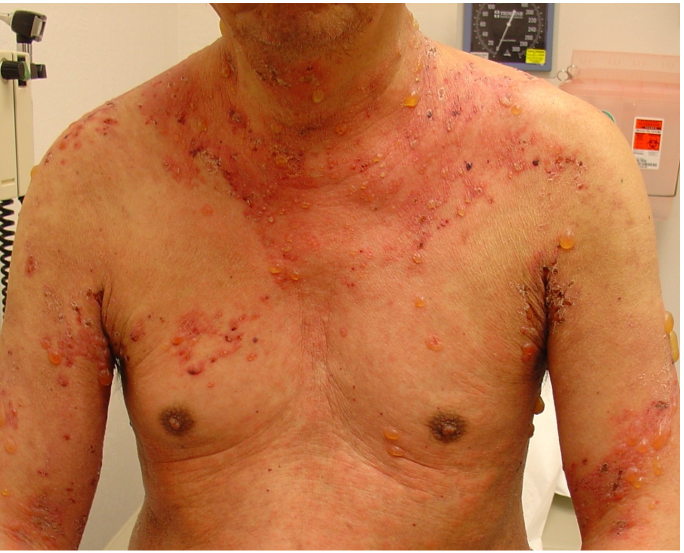 Which of the following is the most appropriate next step in management of this patient's condition?
 (Multiple Choice)
4.7/5 (67)
(67) A 42-year-old woman with a history of chronic alcoholism comes to the emergency department due to 2 days of severe abdominal pain. She describes the pain as sharp, nonradiating, and located in the center of her abdomen. The patient also reports nausea and several episodes of vomiting. Medical history is significant for type 2 diabetes mellitus and asthma. Medications include metformin, sitagliptin, and inhaled albuterol. For the last 2 years she has drunk 2 or 3 pints of alcohol at a time, several times a week. The patient smokes a pack of cigarettes a day and occasionally uses cocaine. Family history is not significant. Temperature is 36.7 C (98.1 F), blood pressure is 110/60 mm Hg, pulse is 92/min, and respirations are 16/min. Oxygen saturation is 96% on room air. BMI is 27 kg/m2. Physical examination shows dry mucous membranes, normal jugular venous pressure, clear lung fields, and normal S1 and S2. The abdomen is soft and tender in the midepigastric region without hepatosplenomegaly. Bowel sounds are present. There is no rebound tenderness, rigidity, or costovertebral angle tenderness, and no peripheral edema. Neurologic examination is within normal limits. Laboratory results are as follows: 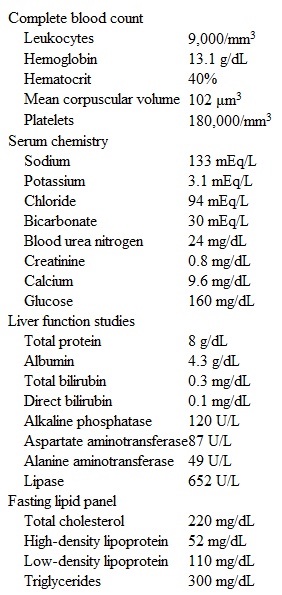 Abdominal ultrasound reveals no gallstones or pericholecystic fluid collection. The pancreas is not well visualized. Which of the following is the best predictor for the severity of this patient's disease?
 (Multiple Choice)
4.7/5 (91)
(91) An 84-year-old man comes to the office with a slowly growing, reddish-brown lesion on his face. He has had no associated pain, itching, or discharge and no history of trauma to the area. The patient is a retired postal worker and spends most of his leisure time on a nearby beach. Medical history is notable for moderate dementia, coronary artery disease, and diet-controlled diabetes mellitus. Examination shows a 0.6-cm, irregular, reddish-brown lesion on the forehead. Palpation of the submandibular and cervical lymph nodes is normal, and no other suspicious lesions are noted on skin examination. Biopsy of the lesion reveals well-differentiated invasive squamous cell carcinoma with no perineural or vascular involvement. After discussion with his family, the patient declines surgical excision but says he is willing to consider nonsurgical alternate treatments. Which of the following is the most appropriate recommendation for this patient?
(Multiple Choice)
4.7/5 (84)
(84) A 29-year-old woman, gravida 2 para 0 aborta 1, at 34 weeks gestation comes to the office for a routine prenatal visit. She reports no abdominal pain, leakage of fluid, or vaginal bleeding. There is normal fetal movement. Since her last visit 2 weeks ago, she has developed severe pruritus on her abdomen, which has not responded to over-the-counter moisturizers. The patient has had no recent contact with anyone who has had a fever, rash, or pruritus. She was diagnosed with gestational diabetes mellitus that is well controlled with an insulin regimen. Earlier in the pregnancy, she had an episode of vulvar candidiasis that was treated with a topical antifungal. The patient has no chronic medical problems or previous surgeries. She takes prenatal vitamins daily and has no allergies. The patient does not use tobacco, alcohol, or illicit drugs. Temperature is 36.7 C (98 F) and blood pressure is 100/70 mm Hg. BMI is 31 kg/m2. Fetal heart rate is 145/min and fundal height is 35 cm. Physical examination shows prominent abdominal striae and several red linear excoriations on the abdominal wall unrelated to the striae. Laboratory results are as follows: 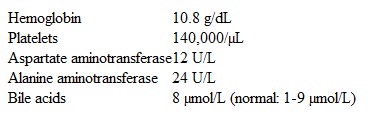 Which of the following is the best next step in treatment of this patient?
 (Multiple Choice)
4.9/5 (91)
(91) A 69-year-old woman underwent thyroidectomy due to thyroid cancer. The surgery was uncomplicated. Three hours afterward, the patient developed slurred speech and right-sided weakness. Temperature is 36.3 C (97.3 F), blood pressure is 140/86 mm Hg, pulse is 90/min, and respirations are 18/min. On examination, the patient is alert and awake, but her speech is incomprehensible. Strength is 2/5 in both right upper and lower extremities. Sensations are decreased on the right side of the body. The dressing covering the operative site on the neck is dry. There is no stridor. The extremities are warm with normal capillary refill time. Neurologic examination prior to the surgery showed no abnormalities. Serum glucose and calcium concentration are normal. Which of the following is the most appropriate next step in management of this patient?
(Multiple Choice)
4.8/5 (82)
(82) A 24-year-old woman has a 2.1-cm nodule in her right thyroid lobe. She is otherwise healthy and takes no medications. The patient has no past history of radiation exposure or family history of thyroid disease. She does not experience pain, difficulty swallowing, or voice changes. Physical examination is within normal limits. Laboratory studies show normal T3, T4, and TSH levels. An ultrasound of the thyroid gland reveals a solid nodule measuring 2.6 x 1.7 x 1.3 cm in the right lobe. The left lobe appears to be normal in size and echotexture. Further workup of this patient confirms the diagnosis of medullary thyroid cancer. Serum calcitonin is 300 pg/mL (normal 0-10 pg/mL). Genetic studies show a mutation in the RET proto-oncogene. Which of the following is the best next step in the management of this patient?
(Multiple Choice)
4.9/5 (73)
(73) A 24-hour-old boy is in the newborn nursery for routine monitoring and evaluation. The infant was born at 38 weeks gestation via unassisted vaginal delivery after 18 hours of labor. Apgar scores were 7 and 8 at 1 and 5 minutes after birth, respectively. Maternal prenatal testing, including negative group B streptococcus, was unremarkable. Birth weight was 2.7 kg (6 lb), which is average for gestational age. Temperature is 36.7 C (98 F), pulse is 148/min, and respirations are 35/min. On physical examination, he is breathing comfortably but crying intermittently. The anterior fontanelle is open, soft, and flat. The posterior fontanelle is difficult to palpate due to the presence of a 7 x 7 cm area of swelling across the vertex of the head, extending from the right to left parietal regions. The patient has normal tone and the presence of the Moro, suck, and palmar grasp reflexes. The remainder of the physical examination is unremarkable. The patient's father is very concerned about the head swelling and says, "His head is still very misshapen, and it appears the same as yesterday. It looks like something is terribly wrong." Which of the following is the most appropriate response?
(Multiple Choice)
4.7/5 (76)
(76) An 11-month-old girl is brought to the pediatrician by her parents for a follow-up visit. The patient was recently diagnosed with a rare multisystemic syndromic disorder characterized by cognitive impairment, deafness, skeletal abnormalities, and coarse facial features. The disorder occurs in ~1 in 100,000 births, and the underlying cause is unknown. The parents ask about factors that may have contributed to the development of the rare disorder. Which of the following types of study designs would be most appropriate to address the parents' question?
(Multiple Choice)
5.0/5 (71)
(71) After several years, the patient returns and requests a mammogram. She is now 35 years old, and her sister was recently diagnosed with breast cancer. Which of the following is the most appropriate statement regarding silicone breast implants and mammographic screening for breast cancer?
(Multiple Choice)
4.8/5 (66)
(66) A 68-year-old woman is referred for perioperative risk evaluation prior to breast implant removal. The patient was diagnosed with breast cancer 16 years ago and underwent left mastectomy, chemotherapy, and radiation, followed by breast reconstruction surgery. Recently, hardening developed around the implant, and she would like to have the implant removed. The patient has a history of a mild reduction in cardiac function that was first identified after she completed chemotherapy. Five years ago, she developed chest pain while walking on the golf course and was diagnosed with coronary artery disease requiring drug-eluting stent placement to the left anterior descending artery. Two years ago, she experienced an episode of facial droop and garbled speech that she was told may have been a transient ischemic attack. The patient's last echocardiogram was 6 months ago and showed a mildly dilated left ventricle with an ejection fraction of 40%-45% and mild mitral regurgitation. She walks up the stairs at a slow pace and sometimes stops to rest on the landing, but she thinks this may be because she has been sedentary and gained weight over the last couple of years. The patient has noticed no recent change in symptoms. She has a 20-pack-year smoking history but quit at the time of her breast cancer diagnosis. Blood pressure is 134/78 mm Hg and pulse is 65/min. BMI is 36 kg/m2. Physical examination shows a normal jugular venous pressure. There is a soft pansystolic murmur at the apex. Lung fields are clear on auscultation. No peripheral edema is present. Basic preoperative laboratory studies are significant only for a creatinine of 1.2 mg/dL. ECG shows sinus rhythm and nonspecific T-wave changes. Which of the following is the best preoperative management for this patient?
(Multiple Choice)
4.8/5 (67)
(67) An 8-year-old girl is brought to the office by her mother for evaluation of possible tuberculosis (TB). The patient's younger brother was recently diagnosed with active pulmonary TB, which he contracted from their grandmother. The patient has been in close contact with her brother but has had no fever, night sweats, cough, anorexia, or weight loss. She had a negative TB skin test at the time of immigration from Southeast Asia 2 years ago. The patient has not received the bacille Calmette-Guérin vaccine but is up to date with other recommended vaccinations. Vital signs are within normal limits and physical examination shows no abnormalities. Interferon-gamma release assay is positive and chest radiography is normal. Cultures from a gastric aspirate of her younger brother show acid-fast bacilli that are resistant to isoniazid (INH) but are sensitive to other anti-TB drugs. Which of the following is the most appropriate management for this patient?
(Multiple Choice)
4.9/5 (71)
(71) Showing 41 - 60 of 1121

Filters
- Essay(0)
- Multiple Choice(0)
- Short Answer(0)
- True False(0)
- Matching(0)