



 Chat with AI
Exam 1: Advanced Clinical Medicine

Exam 1: Advanced Clinical Medicine1 k+ Questions
Exam 2: Foundations of Independent Practice597 Questions
Select questions type


A 27-year-old woman, gravida 2 para 0 aborta 2, comes to the office for a preconceptual counseling visit. The patient had a spontaneous first trimester abortion 5 years ago and an ectopic pregnancy treated with methotrexate 3 years ago. Since then, the patient has been using depot medroxyprogesterone injections for contraception; her last dose was administered 13 weeks ago. She has been amenorrheic for the past 2 years. The patient has mild persistent asthma for which she takes an inhaled glucocorticoid and a short-acting beta agonist as needed. She does not use tobacco, alcohol, or illicit drugs. The patient drinks 2 cups of coffee each morning and has a glass of noncaffeinated diet soda with dinner. She follows a low-carbohydrate diet and exercises regularly. The patient has a younger brother with autism and a cousin who had a termination for a fetus with trisomy 18. Vital signs are normal. BMI is 24 kg/m2. Physical examination is unremarkable. The patient asks if there is anything she can do to prepare for pregnancy. In addition to discontinuation of the medroxyprogesterone injections, which of the following is the best advice for this patient?
(Multiple Choice)
4.9/5  (76)
(76) You are the current "on call physician" for your group, when you receive a call regarding one of your nursing home patients. The nurse reports that one patient has been acting strangely for the last few hours and is agitated at times. This patient is an 82-year-old female who has been in the nursing home for the last two years, and has always been very pleasant. You know her very well from your recent nursing home visit. She has a past medical history of hypertension, diabetes mellitus, osteoporosis, and Alzheimer's dementia. Her daily medications are amlodipine, metformin, calcium - vitamin D, and donepezil. You are concerned that something is not right with the patient.
Item 1 of 3
Which of the following is the most appropriate next step in the management of this patient?
(Multiple Choice)
4.9/5 (80)
(80) A 27-year-old man comes to the physician with pain in his left knee, ankle, and lower back over the last week. His back feels stiff in the morning and improves with activity. Three months ago, he was treated for chlamydia proctitis with azithromycin and ceftriaxone. He also had painless sores on his glans penis, but tests for syphilis were negative at that time. On examination, he still has multiple shallow ulcers on the glans penis. The patient reports no change in appearance of the ulcers over the 3-month period. There is no urethral discharge or inguinal lymphadenopathy. The left knee and ankle joints are swollen and nontender. No redness or warmth is noted. Laboratory results are as follows: 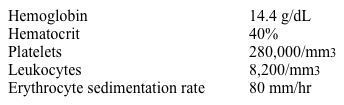 Synovial fluid aspirated from the knee shows a white blood cell count of 4,000/mm3 with 80% neutrophils. Gram stain is negative and no pathogen is isolated on fluid culture.
Which of the following is the best next step in management of this patient?
Synovial fluid aspirated from the knee shows a white blood cell count of 4,000/mm3 with 80% neutrophils. Gram stain is negative and no pathogen is isolated on fluid culture.
Which of the following is the best next step in management of this patient? (Multiple Choice)
4.8/5 (86)
(86) A 43-year-old Chinese-American man comes to the office. He is complaining of diarrhea, cramping abdominal pain, postprandial nausea and vomiting for the past five days. He also has dizziness, generalized sweating, and shortness of breath. He had a partial gastrectomy for a bleeding gastric ulcer one month ago. He has smoked one pack of cigarettes a day for twenty years, and quit two months ago. He does not use alcohol or drugs. The patient is a food handler. His medications are omeprazole and antacids. Examination reveals a mildly distended abdomen with increased bowel sounds. The epigastrium is mildly tender, and the postsurgical scar is healing well. Which of the following will be the most appropriate therapeutic intervention?
(Multiple Choice)
4.9/5 (69)
(69) A 73-year-old woman is brought to the emergency department due to headache and confusion. Approximately an hour ago, the patient fell while walking down the stairs and hit her head on the banister. She did not lose consciousness but has had worsening headache, nausea, and vomiting. She has also become incoherent. The patient has a history of persistent atrial fibrillation, hypertension, and end-stage renal disease. Her current medications include warfarin, amlodipine, metoprolol, and calcium acetate. She received maintenance hemodialysis earlier today. Blood pressure is 160/100 mm Hg and pulse is 60/min. The patient is lethargic and oriented to person but not to place or time. Cardiopulmonary auscultation reveals clear lung fields and an irregular heart rate. Muscle strength is equal on both sides. CT scan of the head without contrast reveals a right-sided subdural hematoma with mass effect. Hemoglobin is 11.6 g/dL and INR is 2.1. Surgical hematoma evacuation is planned. Which of the following is the best choice for rapid reversal of anticoagulation in this patient?
(Multiple Choice)
4.8/5 (71)
(71) An 84-year-old man comes to the physician with persistent dyspnea despite being treated with optimal medical therapy for congestive heart failure with low left ventricular ejection fraction. A recently published randomized clinical trial compared an angiotensin-neprilysin inhibitor (ANi) to an angiotensin-converting enzyme inhibitor (ACEi) in patients who have heart failure with a reduced ejection fraction. The following results were reported:
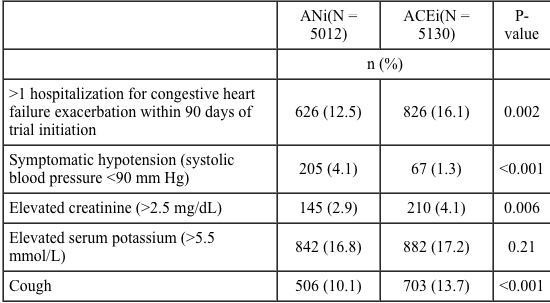 Which of the following would be of most concern when switching from an ACEi to an ANi?
 (Multiple Choice)
4.8/5 (90)
(90) A 24-year-old woman comes to the office for 3 months of worsening vulvar pain. The patient reports a burning sensation and pain that makes her skin feel "like it is being rubbed raw with sandpaper." The pain prevents the patient from having intercourse or wearing tight-fitting clothing. An over-the-counter antifungal preparation did not improve her symptoms. The patient has had no dysuria, hematuria, or vaginal discharge. She has no other chronic medical conditions and has had no surgeries. All Pap tests have been normal; she has never had a sexually transmitted infection. The patient is using depot medroxyprogesterone acetate for contraception. She drinks alcohol several times a week but does not use tobacco or illicit drugs. The patient has no known allergies. Family history is noncontributory. Blood pressure is 100/60 mm Hg and pulse is 80/min. BMI is 20 kg/m2. On pelvic examination, the external genitalia show no erythema, ulcers, or lesions; light contact of the vulva and labia with a cotton applicator causes sharp pain. Separation of the labia majora for speculum examination causes discomfort; however, insertion of the speculum does not cause vaginal pain. Speculum examination reveals a well-rugated vagina and a normal cervix with no abnormal discharge. A bimanual examination cannot be performed because of patient discomfort. Which of the following is the best next step in management of this patient?
(Multiple Choice)
4.7/5 (79)
(79) A 7-year-old girl is brought to the office for a routine health maintenance examination. While in the waiting room, she develops a nosebleed. An assistant pinches the patient's nasal alae against the nasal septum for 10 minutes while the girl is seated and leaning forward. This slows, but does not stop, the flow of blood. Prior to the appointment, the patient was at a summer camp playing outside in hot, dry weather. She has had no recent facial trauma, unusual bruising, or gingival bleeding. Blood pressure is 100/70 mm Hg and pulse is 94/min. On examination, the patient is sitting in a chair, awake, alert, and in no distress. A continuous trickle of blood from her left naris obscures the mucosa. She has no oropharyngeal lesions. Which of the following is the best next step in management of this patient's condition?
(Multiple Choice)
4.9/5 (90)
(90) A 76-year-old man is brought from the nursing home to the emergency department for evaluation of rectal discomfort that has worsened over the past 3 days. The patient also had an episode of a small amount of rectal bleeding. His other medical problems include chronic constipation, benign prostatic hypertrophy, and chronic obstructive pulmonary disease. His temperature is 37.2 C (99 F), blood pressure is 110/60 mm Hg, pulse is 100/min, and respirations are 20/min. Examination of the anal area shows a thick, protruding, rectal mucosal mass with bluish discoloration, concentric rings, and friability. He appears to be in moderate distress due to rectal discomfort. Which of the following is the most appropriate next step in the management of this patient?
(Multiple Choice)
4.8/5 (83)
(83) A 17-year-old boy is evaluated for abnormal urinalysis findings. He came to the clinic 2 weeks ago with low back pain, and a urinalysis at that time showed 2+ protein. He currently feels fine and has no urinary complaints. The patient has not exercised vigorously or taken any medications. He has no other medical problems and received all appropriate childhood vaccinations. He does not use tobacco or illicit drugs. The patient is not sexually active. His father had early coronary disease and a stroke. His blood pressure is 112/70 mm Hg and pulse is 77/min. BMI is 24 kg/m2. Physical examination shows no abnormalities. Laboratory results from this visit are as follows: 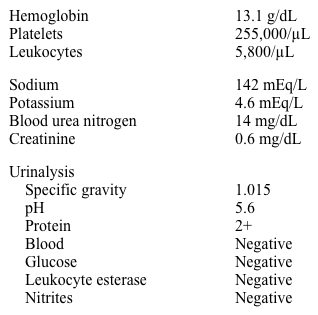 Urine sediment microscopy is unremarkable for casts. A 24-hour urine collection shows 600 mg of protein (normal <150 mg).
Which of the following is the best next step in management of this patient?
Urine sediment microscopy is unremarkable for casts. A 24-hour urine collection shows 600 mg of protein (normal <150 mg).
Which of the following is the best next step in management of this patient? (Multiple Choice)
4.9/5 (79)
(79) A 29-year-old man comes to the physician for a routine preventive examination. He is currently feeling well but states that he has always had "some dark spots" on his back. The patient has no family history of heart disease or cancer. He does not spend much time outdoors and had no prior sunburn. He does not smoke. Physical examination shows many pigmented lesions on his back as shown below. 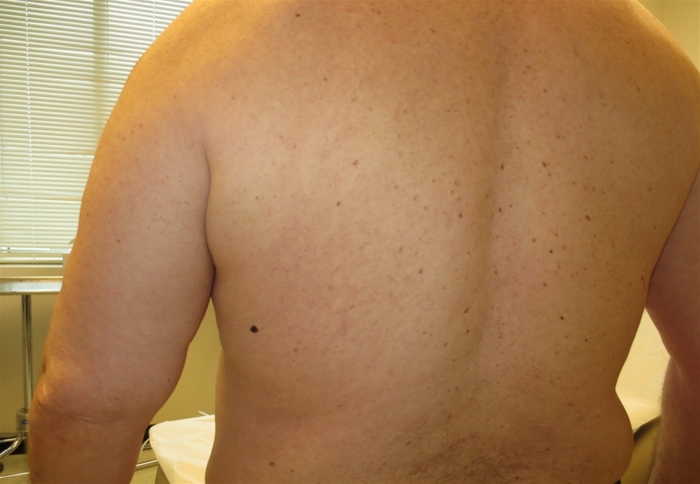 The following 8-mm lesion is seen on close skin inspection.
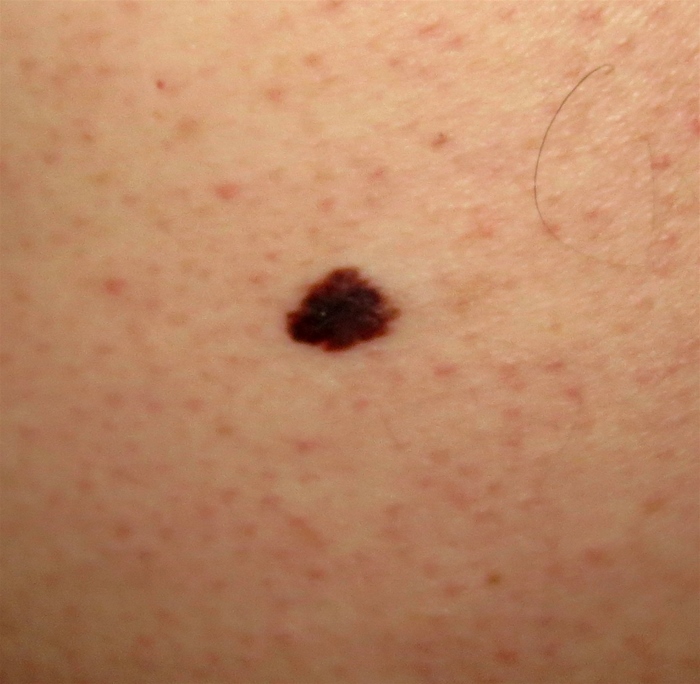 Which of the following is the best next step in the management of this patient's skin lesion?
The following 8-mm lesion is seen on close skin inspection.
Which of the following is the best next step in the management of this patient's skin lesion? (Multiple Choice)
4.7/5 (87)
(87) A 32-year-old man comes to the office for follow-up. Two weeks ago, he was evaluated for depressed mood, low energy, and poor concentration at work. The patient had difficulty getting out of bed in the mornings and called in sick to work 3 days in a row. Routine laboratory testing and physical examination were normal, and he was diagnosed with major depressive disorder. The patient was started on fluoxetine, which he has taken for the past 2 weeks. At today's follow-up visit, he reports that although still somewhat depressed, he feels more energetic and a little better overall. He says, "I have more energy, and it's a little easier to get motivated to go to work now." However, he reports new symptoms of mild nausea and occasional anxiety and restlessness. He also had difficulty sleeping one night, which is unusual for him as he previously was oversleeping. The patient drinks a glass of wine daily but does not use tobacco or illicit drugs. He is a sales representative and reports missing no workdays this past week. Vital signs are stable, and his physical examination is unchanged. Which of the following is the most appropriate next step in management of this patient?
(Multiple Choice)
4.8/5 (74)
(74) A 27-year-old woman, gravida 1 para 0, at 28 weeks gestation comes to the office for a routine prenatal visit. Her initial prenatal laboratory results at 12 weeks gestation were as follows: 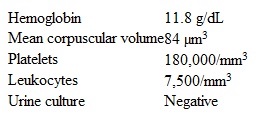 The patient reports no vaginal bleeding, leakage of fluid, or contractions. There is good fetal movement. She has increasing urinary frequency and nocturia but no dysuria or hematuria. The patient has a history of tension headaches, which have become more frequent but resolve with acetaminophen. She has no other chronic medical conditions or previous surgeries. The patient works in a retirement home and reports leg swelling at the end of her shift. She is a vegetarian and takes a daily prenatal vitamin. She does not use tobacco, alcohol, or illicit drugs. Temperature is 37 C (98.6 F), blood pressure is 128/76 mm Hg, and pulse is 86/min. BMI is 30 kg/m2; the patient has been gaining 0.5 kg (1.1 lb) a week during the pregnancy. The fetal heart rate is 152/min. Examination shows a uterus consistent with a 28-week gestation. There is trace lower extremity edema bilaterally. The patient has had no laboratory evaluations since her initial prenatal visit. The patient's test results from the 28-week prenatal visit are as follows:
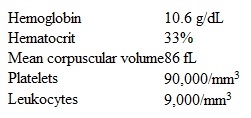 Which of the following is the most likely diagnosis?
The patient reports no vaginal bleeding, leakage of fluid, or contractions. There is good fetal movement. She has increasing urinary frequency and nocturia but no dysuria or hematuria. The patient has a history of tension headaches, which have become more frequent but resolve with acetaminophen. She has no other chronic medical conditions or previous surgeries. The patient works in a retirement home and reports leg swelling at the end of her shift. She is a vegetarian and takes a daily prenatal vitamin. She does not use tobacco, alcohol, or illicit drugs. Temperature is 37 C (98.6 F), blood pressure is 128/76 mm Hg, and pulse is 86/min. BMI is 30 kg/m2; the patient has been gaining 0.5 kg (1.1 lb) a week during the pregnancy. The fetal heart rate is 152/min. Examination shows a uterus consistent with a 28-week gestation. There is trace lower extremity edema bilaterally. The patient has had no laboratory evaluations since her initial prenatal visit. The patient's test results from the 28-week prenatal visit are as follows: Which of the following is the most likely diagnosis? (Multiple Choice)
4.9/5 (70)
(70) A 19-year-old, previously healthy woman comes to the emergency department due to right shoulder pain. The patient fell while skiing an hour ago and landed with most of her weight on her outstretched right arm. The pain is sharp and associated with tingling in the shoulder and arm. Temperature is 37.2 C (99 F), blood pressure is 140/90 mm Hg, pulse is 122/min and regular, and respirations are 14/min. On examination, the right shoulder is deformed; sensation is diminished over the right lateral aspect of the shoulder but intact throughout the rest of the arm and hand. Peripheral pulses are symmetric between the upper extremities. X-ray of the right shoulder is shown in the exhibit. 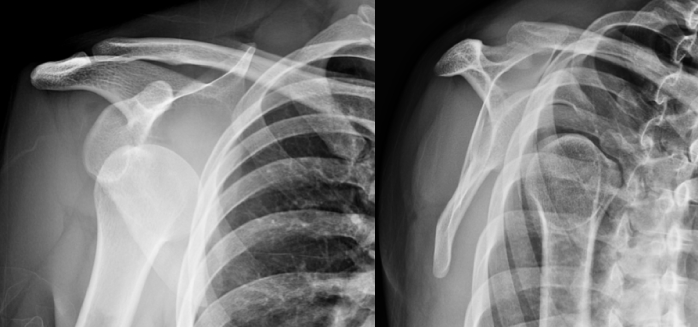 Which of the following is the best next step in management?
 (Multiple Choice)
4.9/5 (71)
(71) A 13-year-old boy is brought to clinic by his parents due to copious, purulent discharge from his right eye. The patient's eye was crusted shut this morning. His father was able to open the eye by wiping it with a damp washcloth. The patient went to school but was sent home by the school nurse. He has not had ocular pain, visual changes, or fever. He lives at home with his parents and older sister, none of whom have similar symptoms. The patient has mild myopia and wears contact lenses. He takes loratadine daily for seasonal allergies. Vital signs are within normal limits. Examination shows conjunctival erythema and yellow exudate in the right eye. The conjunctiva of the left eye is also erythematous, but there are no secretions. Visual acuity testing with the patient's contacts removed shows 20/80 vision in both eyes, consistent with his well-child examination at age 12. The parents administer the treatment as prescribed. After 2 days of treatment, the initial symptoms have not improved, and the child now says, "The light really bothers me, and it feels like there is something really painful in my eye." Which of the following is the most appropriate next step in treatment?
(Multiple Choice)
4.7/5 (88)
(88) A 25-year-old woman is brought to the emergency department after her boyfriend called police and reported that she was threatening to kill herself. They had been arguing when the woman suddenly grabbed a kitchen knife, waved it in the air, and threatened to stab herself. The patient says to the emergency physician, "I didn't mean what I said. This is all a big misunderstanding. I don't know why my boyfriend overreacted. We both had a little too much to drink tonight. I'm sure you know how that can get! I got upset when we were arguing and I just said something stupid. I have no intention of killing myself." The patient has no psychiatric history. She drinks socially and smokes marijuana. She does not use any other drugs or prescription medications. Vital signs are within normal limits. Examination shows no abnormalities. On mental status examination, the patient is alert with loud, slightly slurred speech. She says her mood is "fine" and denies any suicidal ideation, intent, or plan.
Which of the following is the most appropriate next step in management of this patient?
(Multiple Choice)
4.9/5 (69)
(69) A 40-year-old male is brought to the emergency room with confusion, lethargy, and decreased strength in his left arm. He is HIV-positive. He was diagnosed several months ago, but he refused any kind of therapy. His most recent CD4 cell count was 40/μL. A lumbar puncture is performed, but cerebral spinal fluid findings and cytology are inconclusive. A CT scan reveals a well-defined small focal lesion in the right cerebral hemisphere. Biopsy findings are consistent with primary CNS lymphoma. You decide to proceed with radiation therapy and corticosteroids, and to institute HAART. Which of the following is the best prognostic sign for this patient's condition?
(Multiple Choice)
4.7/5 (85)
(85) A 15-month-old girl is brought to the urgent care center due to 4 days of fever. Her father says, "Our entire family was sick with a cold last week, but no one had a fever for this long." The patient's symptoms began with rhinorrhea, cough, sore throat, and fever with daily temperatures >38.9 C (102 F). Three days ago, she developed bilateral conjunctival erythema with watery discharge. Yesterday, an erythematous rash appeared on her cheeks and slowly spread to the rest of her body. She attends day care 5 days a week, and several other children have been ill with similar symptoms, one of whom is currently hospitalized. The patient is otherwise healthy with no significant medical history. Her parents refused immunizations when she was age 12 months, as she had a fever after vaccination at age 6 months. Temperature is 39.4 C (103 F). Physical examination shows an ill-appearing girl lying in her father's arms. A maculopapular rash is present on the face, trunk, and proximal extremities. Bilateral conjunctivae are erythematous without discharge, and there are multiple anterior cervical lymph nodes bilaterally that are 3-5 mm (0.12-0.2 in). The hands, feet, and oropharynx appear normal. Which of the following is the most likely cause of this patient's symptoms?
(Multiple Choice)
4.7/5 (86)
(86) A 62-year-old woman comes to the office due to fatigue and lethargy over the last 6 months. She has a history of chronic kidney disease due to long-standing type 2 diabetes mellitus and hypertension. Temperature is 36.7 C (98 F), blood pressure is 140/90 mm Hg, pulse is 84/min, and respirations are 16/min. There is conjunctival pallor. The lung fields are clear, and no murmurs are heard on cardiac examination. The abdomen is nontender. Test of the stool for occult blood is negative. Laboratory results are as follows: 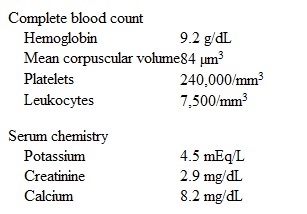 Which of the following is the best next step in management of this patient's anemia?
 (Multiple Choice)
4.9/5 (73)
(73) A 28-year-old woman with type 1 diabetes mellitus comes to the office to discuss insulin management. She anticipates participating in a 5-km (3.1-mi) jog to raise money for diabetes research. The patient was diagnosed with type 1 diabetes mellitus 3 years ago and takes 16 units of insulin glargine at bedtime and 4-6 units of insulin lispro before meals. She is regimented with her meal timing (breakfast at 5:30 AM, lunch at noon, and supper at 5:30 PM) and recently added a small bedtime snack to prevent nighttime hypoglycemia. The patient is generally aware of hypoglycemic symptoms but had an episode of severe hypoglycemia 3 months ago, requiring emergency department care and intravenous glucose. She has no history of pregnancy and her menstrual periods are regular. The patient does not use tobacco or alcohol. Her mother has type 1 diabetes complicated by proliferative diabetic retinopathy. Physical examination is unremarkable. Hemoglobin A1c is 6.9%. The jog is scheduled to start at 6:30 AM, and the patient expects it will take her 45 minutes to complete it. She intends to have breakfast at her usual time of 5:30 AM on that day. Which of the following is the most appropriate adjustment in this patient's insulin dose on the day of the walk?
(Multiple Choice)
5.0/5 (81)
(81) Showing 1081 - 1100 of 1121

Filters
- Essay(0)
- Multiple Choice(0)
- Short Answer(0)
- True False(0)
- Matching(0)