



 Chat with AI
Exam 1: Advanced Clinical Medicine

Exam 1: Advanced Clinical Medicine1 k+ Questions
Exam 2: Foundations of Independent Practice597 Questions
Select questions type


A 22-year-old woman comes to the office in April due to sinus congestion. Three weeks ago, she had subjective fever, myalgia, nasal congestion, sore throat, and dry cough a few days after visiting her sick nephew. Her symptoms initially improved with over-the-counter analgesics and decongestants, but she now has had 2 weeks of purulent nasal discharge, throbbing headache, and facial pain. The patient has a history of type 1 diabetes mellitus managed with premeal insulin boluses and an insulin pump for continuous subcutaneous insulin infusion. She also has a history of childhood eczema. She does not use tobacco, alcohol, or illicit drugs. The patient has no known drug allergies. Temperature is 38 C (100.4 F), blood pressure is 118/74 mm Hg, and pulse is 90/min. Physical examination shows swollen and erythematous nasal turbinates with yellowish-green nasal secretions. The left maxillary sinus is tender to palpation, with no sinus transillumination. The tympanic membranes and oropharyngeal mucosa are normal. Cervical lymph nodes are not enlarged or tender and lungs are clear to auscultation. Fingerstick blood glucose is 120 mg/dL. Which of the following is the best next step in management of this patient?
(Multiple Choice)
5.0/5  (68)
(68) An 8-year-old girl is brought to the office by her mother due to hair loss on her scalp. The mother first noticed a patch of hair loss a week ago, and the affected area is now slightly larger in diameter. The area is flaking and very pruritic. She also mentions, "My son had a similar rash on his arm but I didn't want to use his cream on her without an evaluation." The patient has had no fever, and there is no oozing, warmth, or edema of the scalp. She has no medical conditions and takes no medications. Immunizations are up to date. Physical examination shows a well-appearing girl who is scratching her scalp. Examination of the area of hair loss is shown below. Mildly tender posterior cervical lymphadenopathy is present. 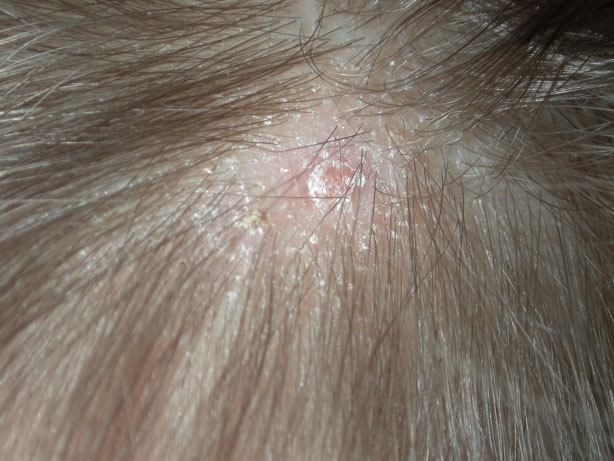 Which of the following is the most appropriate treatment for this patient's condition?
 (Multiple Choice)
4.9/5 (85)
(85) A 3-week-old male infant with Down's syndrome is brought by his parents to your office due to feeding difficulties. According to the mother, the infant becomes short of breath and his face turns blue during feeding, and when he cries. On chest auscultation, there is a harsh holosystolic murmur heard best over the lower left sternal border. There are no rales or wheezing over the lung fields.
Which of the following is the most useful test for diagnostic evaluation?
(Multiple Choice)
4.8/5 (84)
(84) A 66-year-old woman with systolic left ventricular dysfunction comes to the emergency department due to dizziness, palpitations, and shortness of breath. The symptoms started 2 days ago and have become progressively worse. Her cardiologist prescribed an extra dose of oral furosemide yesterday, but her symptoms did not improve. Six weeks ago, she was admitted for acute decompensated heart failure that was thought to be precipitated by atrial fibrillation. The patient underwent electrical cardioversion and was diuresed with marked symptomatic improvement. She has a history of atrial fibrillation, hypertension, type 2 diabetes mellitus, coronary artery disease, ischemic cardiomyopathy with a 30% ejection fraction, and osteoarthritis. She underwent coronary artery bypass grafting 5 years ago. Her current medications include low-dose aspirin, metoprolol, lisinopril, rosuvastatin, long-acting insulin, rivaroxaban, furosemide, and ibuprofen as needed. The patient has been adherent to her medical regimen. She does not use tobacco or alcohol. Temperature is 36.7 C (98 F), blood pressure is 126/82 mm Hg, pulse is 132/min and irregular, and respirations are 19/min. Physical examination reveals bibasilar crackles on auscultation. There are irregularly irregular heart sounds with no audible murmurs. There is 1+ symmetric peripheral edema. ECG shows atrial fibrillation with rapid ventricular response. Serum creatinine level is 0.8 mg/dL. After initial treatment, electrical cardioversion is planned. Which of the following is the most appropriate medication for long-term management of this patient?
(Multiple Choice)
4.8/5 (55)
(55) A group of hospital administrators at a tertiary care center is interested in optimizing quality-related outcomes, including length of hospitalization and patient functional status for high-risk patients undergoing neurosurgical procedures. Patients at highest risk for poor outcomes include those who are age >65 and have multiple medical comorbidities, including hypertension, diabetes, coronary artery disease, and heart failure. The administrators are considering methods to coordinate care between the attending surgeon and a hospitalist-led, multidisciplinary team. Hospital administrators decide to implement a team-based care model that involves comanagement of surgical patients by surgeons and a hospitalist-led, multidisciplinary team that includes physical therapists, a social worker, pharmacists, and a nurse case manager. A series of team meetings is held to define team goals, member roles, and methods for tracking desired quality and outcomes data. Which of the following approaches is recommended to improve team performance and clinical quality?
(Multiple Choice)
4.7/5 (75)
(75) A 34-year-old woman, gravida 2 para 1, at 32 weeks gestation comes to the office for routine prenatal care. The patient reports no contractions, vaginal bleeding, or leakage of fluid. Fetal movement is normal. The patient reports a dark rash on her face that she first noticed 2 weeks ago. She has applied an over-the-counter moisturizer to the rash daily for the last week but has not noticed any improvement. The patient has no chronic medical conditions and no previous surgeries. She takes a daily prenatal vitamin and does not use tobacco, alcohol, or illicit drugs. The patient has no known drug allergies. She works as an accountant and enjoys gardening on the weekends. Blood pressure is 120/80 mm Hg and pulse is 65/min. The fetal heart rate is 140/min by Doppler ultrasound. Fundal height is 32 cm. Skin examination is shown in the image below. The remainder of the physical examination is unremarkable. 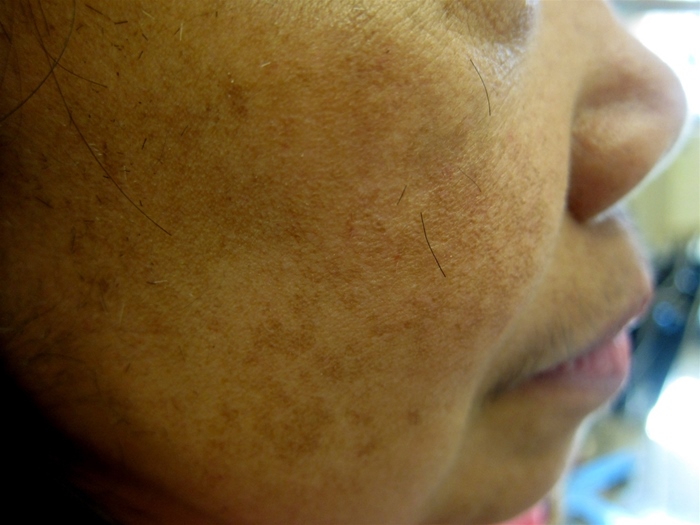 Which of the following is the best next step in management of this patient?
 (Multiple Choice)
4.9/5 (80)
(80) A 23-year-old African American female with type 1 diabetes mellitus comes to the office because of recurrent hypoglycemic episodes, which are distributed evenly throughout the daytime. She has had diabetes for the past six years, and has been on a stable dose of insulin. She had a 4-lb weight loss over a period of three months. She has marked loss of appetite, and feels fatigued. She denies any changes in her activity level. She also denies constipation, diarrhea, urinary complaints, cough, shortness of breath, and fever. She did not have her menstrual period for the past three months. She is a college student who lives with a female roommate, and is not sexually active. She denies smoking, drinking, or the use of recreational drugs. She denies any sick contacts or foreign travel. Her family history is unremarkable. On physical examination, she is 5'5" (163 cm) tall and weighs 120 lbs (54 kg). Her blood pressure is 90/60 mm Hg, and her heart rate is 100/min. She did not have skin rashes. Pigmentation was hard to discern. Other systems were normal. Laboratory results are shown below: 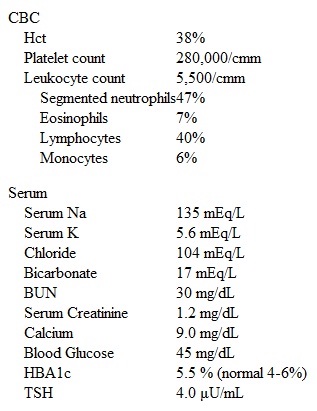 The EKG and urinalysis results are unremarkable. What is the most appropriate course of action in the management of this patient?
 (Multiple Choice)
4.9/5 (73)
(73) A 16-year-old girl comes to the office for an annual checkup, accompanied by her mother. The patient is a junior in high school and lives with her parents and 2 younger siblings. During the visit, she discloses that she has had sexual intercourse several times with a boy in her class. The patient believes she may be in love and says that the sex is consensual. Her partner is using condoms. When the physician inquires if her parents are aware that she is sexually active, the patient says, "I would never tell them. They are totally against premarital sex. They don't even allow me to date. They would be furious if they knew." Physical examination is normal and urine pregnancy test is negative. Routine laboratory screening for common sexually transmitted diseases is performed, and the patient is educated about safe sex and contraceptive options. The patient asks the physician to say nothing to her parents. The patient is encouraged to contact the physician with any further questions and concerns. She returns 6 months later for a pre-camp physical and tells the physician that she has continued to have sex with her boyfriend. The patient says, "Everything is going well; we have so much in common." On questioning, she admits that her boyfriend is not a boy in her class, but actually her 25-year-old, married, high school art teacher. She says, "We're doing our best to keep the relationship a secret because he is not ready to tell his wife. He promised me that he will leave her eventually." The patient mentions that her boyfriend has been tremendously helpful in developing her artistic ability and believes that he will help her gain admission to a prestigious art college. She says her chances of admission are increased by her A+ art grade and his positive letter of recommendation. Her parents are suspicious about the relationship with the teacher but have avoided discussing it. When asked if she feels coerced into performing any sexual acts, the patient adamantly insists the relationship is consensual. Physical examination is normal and urine pregnancy test is negative. Aside from the age of the patient and the age difference with her partner, which of the following is the most important determining factor as to whether this patient is in an abusive situation?
(Multiple Choice)
4.9/5 (88)
(88) A 32-year-old woman comes to the office due to leakage of urine. The leakage started a year ago and occurred occasionally while the patient was exercising but recently has worsened significantly. She states, "I leak urine every time I work out, particularly when I lift weights. I have been training for a triathlon and wanted to increase my strength, but now if I lift more than 15 kg (33 lb), I soak through my underwear." For the past month she has skipped workouts due to embarrassment from the leakage. The patient reports frequent urination and awakens 1 or 2 times at night to urinate. She has no dysuria or hematuria. The patient has no chronic medical conditions. She has had 2 cesarean deliveries but no other surgeries. The patient takes oral contraceptives and a daily multivitamin. She drinks 4 L (1.06 gal) of water daily but can double her intake on workout days. The patient does not use tobacco, alcohol, or illicit drugs. Blood pressure is 110/70 mm Hg and pulse is 58/min. BMI is 26 kg/m2. Pelvic examination reveals a normal-sized, anteverted uterus and no adnexal masses. Speculum examination shows a well-rugated vagina and no evidence of pelvic organ prolapse. Leakage of urine is observed when the patient is asked to cough. Serum electrolytes are normal. A urinalysis has a specific gravity of 1.001 but is otherwise within normal limits. Which of the following is the most likely cause of this patient's symptoms?
(Multiple Choice)
4.9/5 (87)
(87) A 27-year-old woman is brought to the emergency department due to a 4-hour history of chest pain that is localized to the middle of the chest and the upper sternal area. She describes it as "intense." The patient has never before experienced a similar pain. She also describes some nausea and a mild occipital headache. She has had no vomiting, abdominal pain, or shortness of breath. A friend who accompanies her to the emergency department says that they attended a party and the patient smoked crack cocaine shortly prior to her episode of chest pain. She did not consume alcohol. The patient has a history of intravenous drug use. She was treated with antibiotics for upper extremity cellulitis 6 months ago. There is no family history of premature coronary artery disease. The patient does not take any medications and has no known drug allergies. On initial evaluation, temperature is 37.8 C (100 F), blood pressure is 204/102 mm Hg on the right arm and 210/104 mm Hg on the left arm, pulse is 102/min and regular, and respirations are 18/min. Oxygen saturation is 99% on room air. The patient appears thin, anxious, and agitated. Heart sounds are normal and no murmurs are heard. Lungs are clear to auscultation bilaterally. The abdomen is soft and nontender. Lower extremity pulses are full and symmetric. There is no peripheral edema. ECG shows sinus tachycardia but is otherwise unremarkable. Portable chest x-ray reveals clear lung fields. Finger-stick blood glucose level is 98 mg/dL. After 2 hours in the emergency department, the patient has weakness in her right arm. Her chest pain is somewhat better, but she still has pain at the middle and upper part of the sternum. She has been treated with lorazepam, morphine, and nitroglycerin infusion. Blood pressure is 133/80 mm Hg and heart rate is 88/min and regular. Neurologic examination shows mild muscle weakness affecting the right upper and lower extremities. Speech is normal. Repeat ECG shows normal sinus rhythm with no significant abnormalities. Laboratory results are as follows:
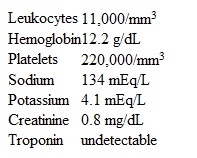 Immediate noncontrast CT scan of the head reveals no evidence of bleeding. Which of the following is the best next step in management of this patient?
 (Multiple Choice)
4.9/5 (84)
(84) A 15-year-old boy with chronic kidney disease is being evaluated for kidney transplantation. He has had chronic glomerulonephritis for the last 3 years. His current estimated glomerular filtration rate is 12 mL/min. He also has hypertension and mild intermittent asthma. His sister, who is 22 years old, is willing to donate her kidney. She has no medical problems. The initial testing shows an ABO antigen match and one human leukocyte antigen mismatch. The sister should be appropriately counseled about which of the following long-term risks of kidney donation?
(Multiple Choice)
4.8/5 (83)
(83) A 9-month-old boy is brought to the office for follow-up of an undescended testis. Developmentally, the infant sits without support, babbles, and can pick up objects with his pointer finger and thumb. He is fed formula and eats table foods 3 times a day. He was born at 38 weeks gestation without complications during pregnancy or labor and delivery. The patient takes no medications and has no allergies. He is up to date with vaccinations. Length, weight, and head circumference are at the 50th percentile. On physical examination, the infant is nondysmorphic, alert, and active, and is crawling on the floor. The abdomen is soft, nontender, and nondistended. Genital examination shows absent rugae on the left hemiscrotum with a palpable testicle in the left inguinal canal; the right testicle is palpable in the right hemiscrotum. The penis appears normal with a centrally located urethral meatus, and urinary stream is normal. The anus is patent with no lesions. Which of the following statements regarding this patient's genitourinary condition is most accurate?
(Multiple Choice)
4.8/5 (78)
(78) A 51-year-old woman is admitted to the hospital due to a 5-day history of increasing lethargy and confusion. The patient underwent arthroscopic knee surgery 2 weeks ago. Acetaminophen-oxycodone was prescribed with instructions to limit total acetaminophen dosage to ≤2 g/day. Medical history is significant for cirrhosis due to remote alcohol use disorder; she has abstained for several years. Temperature is 36.3 C (97.3 F), blood pressure is 92/51 mm Hg, pulse is 68/min, and respirations are 24/min. The patient is drowsy, inattentive, and unable to provide a history. Pupils are 5 mm and reactive to light bilaterally. Bilateral asterixis is present. Cardiopulmonary examination is normal. Bowel sounds are hypoactive; no fluid wave, shifting dullness, or tenderness is noted. Abdominal ultrasonography reveals minimal peritoneal fluid; liver echotexture is nodular with no suspicious masses. Complete blood count, renal function test results, serum electrolyte levels, and urinalysis are unremarkable. Liver function test results include an elevated prothrombin time, decreased albumin, and elevated total bilirubin, which are unchanged from baseline results obtained before surgery. Which of the following processes most likely precipitated the patient's current condition?
(Multiple Choice)
4.8/5 (70)
(70) A 22-year-old man comes to the clinic for routine follow-up of his mild asthma. He has a history of keeping his appointments but has missed the last three. Today he seems distracted and uninterested, answering various questions with very brief replies. At one point, the patient says that he would like to hurry the visit along so he can get home sooner. Following inquiries about his social life, he becomes more animated and describes spending time with new friends who "really know how to party." On further questioning, he says, "I have been snorting cocaine sometimes but it's not a big deal. I haven't used any this past week. I quit school because it was just stupid and I was wasting my money. I'm working as a waiter now and enjoying it. At least I can make my own money and not be dependent on my parents." The patient says that he has been living with his new friends since his parents asked him to move out 2 weeks ago, but he would "rather not talk about that." He denies any symptoms of depression, mania, or psychosis. Temperature is 37.7 C (99.9 F), blood pressure is 120/82 mm Hg, pulse is 86/min, and respirations are 15/min. Physical examination shows perforations of the nasal septum.
Which of the following is the most appropriate next step in management of this patient?
(Multiple Choice)
4.9/5 (72)
(72) A 54-year-old man comes to the emergency department after an episode of syncope. While he was watching television 30 minutes ago, he experienced sudden-onset chest pressure followed by a syncopal episode. He regained consciousness within a minute but continues to have chest "heaviness" and shortness of breath. Two days ago, the patient returned home from an extended car trip. He has a history of hypertension, osteoarthritis, and prostate cancer treated with brachytherapy. He is a former smoker with a 15-pack-year history and does not use alcohol or illicit drugs. Temperature is 38.3 C (100.9 F), blood pressure is 81/50 mm Hg, pulse is 110/min and regular, respirations are 26/min, and pulse oximetry is 92% on room air. The lungs are clear to auscultation. Cardiac examination shows a nondisplaced point of maximal impulse, with no murmurs but an accentuated pulmonic component of S2. Laboratory results are as follows:
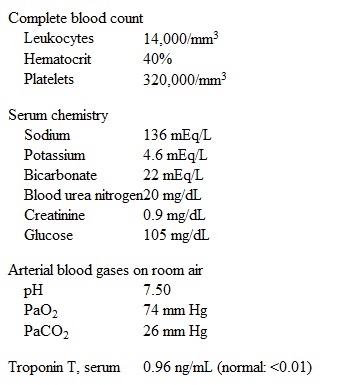 ECG shows sinus tachycardia with nonspecific ST-segment and T-wave changes. CT angiography reveals filling defects in the bilateral main pulmonary arteries. Blood pressure after multiple fluid boluses is 85/60 mm Hg and pulse is 108/min.
The patient develops progressive hypoxemia requiring 100% supplemental oxygen via a nonrebreather mask, but even with treatment his respiratory distress worsens and he becomes progressively confused and lethargic. Endotracheal intubation is performed and mechanical ventilation is initiated. Intravenous norepinephrine infusion is started due to persistent hypotension. Bedside echocardiography reveals right ventricular dilation and hypokinesis, but left ventricular contractility is normal. Which of the following is the best next step in management of this patient?
ECG shows sinus tachycardia with nonspecific ST-segment and T-wave changes. CT angiography reveals filling defects in the bilateral main pulmonary arteries. Blood pressure after multiple fluid boluses is 85/60 mm Hg and pulse is 108/min.
The patient develops progressive hypoxemia requiring 100% supplemental oxygen via a nonrebreather mask, but even with treatment his respiratory distress worsens and he becomes progressively confused and lethargic. Endotracheal intubation is performed and mechanical ventilation is initiated. Intravenous norepinephrine infusion is started due to persistent hypotension. Bedside echocardiography reveals right ventricular dilation and hypokinesis, but left ventricular contractility is normal. Which of the following is the best next step in management of this patient? (Multiple Choice)
4.8/5 (77)
(77) A 52-year-old woman is brought to the emergency department with fever, chills, nausea, skin flushing, and intense right-sided back pain. For the past week, she has experienced on-and-off back pain. She has no urinary urgency or burning on urination. Her past medical history is significant for peptic ulcer disease and right knee osteoarthritis. The patient takes naproxen occasionally for knee pain. She is not sexually active and does not use recreational drugs. Her temperature is 39.4 C (103 F), blood pressure is 90/70 mm Hg, pulse is 120/min, and respirations are 22/min. Physical examination shows costovertebral angle tenderness on the right side. No abdominal tenderness is present. Blood cultures are obtained. Intravenous fluid infusion and broad-spectrum antibiotic therapy are initiated. Helical computed tomography scan shows a right-sided proximal ureteral stone with dilated renal calyces. Which of the following is the most appropriate next step in management of this patient?
(Multiple Choice)
4.7/5 (85)
(85) A 32-year-old woman comes to the physician for the evaluation of a rash over her knees and elbows. She first noticed the rash 4 weeks ago. She has no associated symptoms of itching or joint pain. The patient has no significant past medical history. She takes oral contraceptive pills regularly. On physical examination, symmetric erythematous plaques are observed over the extensor surface of the knees and elbows. The plaques are covered with thick silvery scales as shown in the image below. 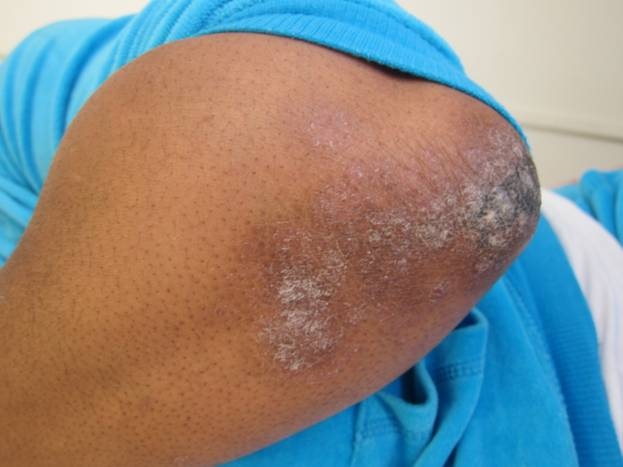 Which of the following is the most appropriate initial treatment?
 (Multiple Choice)
4.8/5 (63)
(63) A 2-week-old boy is brought to the office for evaluation of a skin lesion. His parents first noticed the lesion on the right side of his forehead a week ago. His mother says, "It doesn't seem to hurt him, but it is bright red and I am afraid it could bleed." The parents say there is no history of trauma or other skin lesions. The patient was born at term via spontaneous vaginal delivery with no complications, and he has no known medical conditions. His maternal aunt has a history of melanoma, and his paternal grandmother has had several basal cell carcinomas. Temperature is 36.7 C (98 F), blood pressure is 75/45 mm Hg, pulse is 135/min, and respirations are 40/min; pulse oximetry is 99% on room air. Physical examination shows a fair-skinned, well-nourished infant with a nontender lesion on the forehead that is 1.5 cm in diameter. There is no ulceration or bleeding, and the remainder of the skin examination is normal. Cardiac examination reveals a normal rate and rhythm with no murmurs. The lungs are clear to auscultation. Which of the following is the most accurate statement regarding this patient's condition?
(Multiple Choice)
4.9/5 (73)
(73) A 3-year-old boy is brought to the office for a routine visit. The patient is doing well, and his parents have no concerns. Review of systems is unremarkable. He was recently adopted from China; his medical and family history is unknown. The patient takes no daily medications and has received all recommended immunizations. His adoptive parents are schoolteachers, and the family lives in a newly built home. Vital signs are appropriate for age, and BMI is at the 40th percentile. Examination shows a quiet and alert boy. Cardiac, pulmonary, and abdominal examinations are unremarkable. Complete blood count and serum electrolytes are normal. Venous lead level is 60 µg/dL (normal: <5). X-ray of the abdomen reveals no lead-containing foreign bodies. Lead toxicity and exposure are discussed with the family. Which of the following is the best next step in management of this patient?
(Multiple Choice)
4.7/5 (82)
(82) A 16-year-old girl comes to the office due to her posture. The patient is a competitive diver and has difficulty maintaining a handstand on the diving platform due to the tendency to "lean sideways." She also "leans to the side" when trying to stand up straight. The patient has no other symptoms or medical conditions. She takes no medications and has no allergies. Her last menstrual period was 2 weeks ago. Height and weight are at the 50th percentile. The patient is alert and engaging. The neck is supple. The lungs have good air entry in all fields. Breast and pubic hair are Tanner stage 5. Forward bend test reveals a right rib prominence that is not relieved by placing a block under the contralateral foot. Achilles and patellar deep tendon reflexes are 2+. Posteroanterior and lateral spine x-rays reveal a Cobb angle of 17 degrees, indicating mild scoliosis. Which of the following is true about management of this patient?
(Multiple Choice)
4.9/5 (90)
(90) Showing 621 - 640 of 1121

Filters
- Essay(0)
- Multiple Choice(0)
- Short Answer(0)
- True False(0)
- Matching(0)