



 Chat with AI
Exam 1: Advanced Clinical Medicine

Exam 1: Advanced Clinical Medicine1 k+ Questions
Exam 2: Foundations of Independent Practice597 Questions
Select questions type


A 25-year-old man comes to the emergency department because of headache, palpitations, sweating, and irritability. He came directly from the health club, which he joined a few weeks ago. He states that after every exercise session during evening, before dinner, he develops similar symptoms and he gets symptomatic relief by consuming granola bars. He was diagnosed with type 1 diabetes mellitus eight years ago. He takes a combination of NPH and regular insulin before breakfast and supper. He states that he is very compliant with his insulin and meals. He does not have any other symptoms or chronic complications of diabetes. His blood pressure is 110/80 mmHg, pulse is 100/min, temperature is 36.7C (98F) and respirations are 14/min. He is slightly diaphoretic but completely alert and awake. His neurological examination is nonfocal. The rest of the examination is unremarkable. Which of the following is the most appropriate step to prevent further hypoglycemic episodes in this patient?
(Multiple Choice)
4.9/5  (79)
(79) A 39-year-old woman, gravida 7 para 7, is evaluated for increased vaginal bleeding. Twenty minutes ago, the patient underwent a vacuum-assisted vaginal delivery for fetal heart rate abnormalities of a 4.1-kg (9-lb) infant over an intact perineum. The placenta delivered spontaneously and was intact on inspection. Estimated blood loss for the delivery was 425 mL. This pregnancy was complicated by gestational hypertension for which the patient underwent induction of labor. Her 6 previous pregnancies were uncomplicated. The patient has no chronic medical problems and has had no surgeries. She takes a prenatal vitamin daily. She does not use tobacco, alcohol, or illicit drugs. The patient is now experiencing heavy vaginal bleeding with large blood clots. Blood pressure is 140/80 mm Hg, pulse is 106/min, and respirations are 20/min. On abdominal examination, the uterine fundus is soft and palpated 3 cm above the umbilicus. The perineal pad is saturated with blood, and there are fist-sized blood clots extruding from the vagina. Which of the following is the best next step in management of this patient?
(Multiple Choice)
4.7/5 (77)
(77) A 60-year-old man comes to the emergency department due to severe abdominal pain and an inability to void urine for the past 18 hours. The patient has a year-long history of urinary hesitancy and a weak urinary stream but has always been able to urinate prior to today. He has not had fever, chills, dysuria, or recent genitourinary trauma or procedures. The patient also has a history of chronic arthritis of the lumbar spine and was recently prescribed baclofen, which has provided some pain relief. He does not use tobacco, alcohol, or illicit drugs. Temperature is 36.5 C (97.7 F), blood pressure is 145/90 mm Hg, pulse is 95/min, and respirations are 18/min. The patient appears restless and in moderate distress. Abdominal examination reveals suprapubic fullness and moderate tenderness to palpation with no guarding or rebound tenderness. An enlarged, smooth, nontender prostate is palpated by digital rectal examination; no masses or fecal impaction are present. There is no tenderness to palpation of the lower back. Abbreviated testing of strength and sensory function is normal. Laboratory results are as follows: 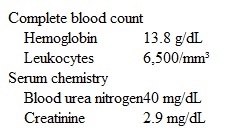 What is the best next step in management of this patient?
 (Multiple Choice)
4.8/5 (67)
(67) A 2-year-old boy is brought to the emergency department by his mother due to ingestion of a foreign body 2 hours ago. The child was playing with his older brother's watch and removed the back of the watch face. As the patient's mother was taking the watch away, she saw him put a button battery from the watch into his mouth and swallow it. Since the ingestion, the child has been playful and able to drink water without emesis. He has no chronic medical conditions, and immunizations are up to date. Temperature is 36.7 C (98 F), blood pressure is 90/50 mm Hg, pulse is 106/min, and respirations are 20/min. Pulse oximetry is 100% on room air. Physical examination shows a smiling young child sitting in his mother's lap and blowing bubbles. The lungs are clear to auscultation, and there are no retractions. The abdomen is soft, nontender, and nondistended; bowel sounds are normoactive. X-rays reveal a circular radiopaque foreign body with a double-ring shadow in the distal esophagus; there is no pleural effusion, mediastinal widening, or subdiaphragmatic air. Which of the following is the best next step in management of this patient?
(Multiple Choice)
4.9/5 (74)
(74) A 34-year-old woman comes to the office for a routine checkup. She initially says, "Everything's fine." Later she says, "I have been in a funk since being passed over for a promotion at work last month. I guess it's normal to be disappointed, but I am down on myself and feel totally worthless. It's really hard to be motivated now and some days I wish I could stay in bed all day." The patient describes difficulty concentrating on her work assignments and explains that she is tired at work because she sleeps poorly at night. She has lost 1.8 kg (4 lb) without dieting and says, "I used to enjoy cooking, but now I just snack or eat prepared foods." The patient lives with her husband and describes him as supportive. She does not use tobacco or illicit drugs. She drinks a glass of wine 4-5 times a week. The patient has no history of psychiatric illness or treatment. Her mother and sister suffered from depression and were treated successfully with antidepressants. On mental status examination, the patient has depressed mood and sad affect but no suicidal ideation. Physical examination and routine laboratory testing are unremarkable. A diagnosis of major depressive disorder is made and treatment options are discussed. The patient is open to psychotherapy or taking antidepressants but would like to avoid medications that may cause weight gain. She asks the physician which treatment is most effective. Which of the following is the most appropriate response to this patient?
(Multiple Choice)
4.8/5 (90)
(90) A 46-year-old man comes to the office due to dysuria and a dull, aching pain in the penis and perineal region. The symptoms began 6 months ago and prompted the patient to visit an urgent care center twice. Both times, he received a short course of antibiotics, which improved symptoms temporarily, but they returned within days. The patient has also had pain during ejaculation but no urethral discharge, back pain, abdominal pain, weakness, or incomplete voiding. He is married and monogamous with his wife and has 2 children. He does not use tobacco or illicit drugs but occasionally drinks 1 or 2 beers on weekends. He has no medication allergies and no family history of cancer. Temperature is 37.1 C (98.8 F), blood pressure is 126/84 mm Hg, pulse is 72/min, and respirations are 14/min. Physical examination shows no abdominal or costovertebral angle tenderness. Digital rectal examination reveals a mildly tender prostate that is symmetric and not enlarged. The external genitalia are normal in size and appearance and are nontender to palpation. Item 1 of 3
Which of the following is the best next step in the diagnosis of this condition?
(Multiple Choice)
4.7/5 (87)
(87) A 2-week-old girl is admitted to the hospital for dehydration and vomiting. She had an uncomplicated vaginal delivery at home and did not undergo newborn screening. Breastfeeding has been difficult due to the newborn's lethargy and frequent vomiting. The mother has no medical problems, took no medications during the pregnancy, and had normal prenatal laboratory results. Family history is significant for a brother who died at age 1 month from severe dehydration several years ago. The newborn has a 2-year-old sister who is healthy. Vital signs show hypotension and tachycardia. Examination shows a sunken fontanelle and ambiguous genitalia. The rest of the examination is unremarkable. Abdominal x-ray, abdominal ultrasound, and upper gastrointestinal studies are normal. Karyotype analysis is pending. Serum chemistry results are as follows: 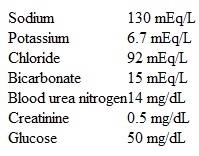 Karyotype analysis shows 46,XX female. Laboratory results would most likely show elevation of which of the following hormones?
 (Multiple Choice)
4.9/5 (89)
(89) A 71-year-old man is admitted to the intensive care unit due to influenza complicated by bacterial pneumonia and acute respiratory distress syndrome. He has been receiving mechanical ventilation for 8 days. The patient completed a course of intravenous antibiotic therapy, and his clinical status has steadily improved. Ventilator settings have been weaned to minimal levels, and he is tolerating daily spontaneous breathing trials. However, the patient remains intubated due to intermittent somnolence and thick secretions requiring frequent suctioning. At night, he is agitated and pulls at his lines, requiring cloth mittens and soft restraints. During the day, the patient is mostly alert and able to communicate by writing on a personal whiteboard. Vital signs are within normal limits. Cough strength is weak, and he has difficulty raising his head from the pillow. Results of serum chemistry are within normal limits, and complete blood count reveals normocytic anemia with hemoglobin of 9.6 g/dL. Which of the following interventions is most strongly indicated at this time to promote recovery and extubation?
(Multiple Choice)
4.9/5 (91)
(91) A 45-year-old man comes to the physician for pain and stiffness in his left shoulder for the past 3 months. His symptoms were mild in the beginning and intermittently affected his daytime activities. The pain and stiffness have worsened in the past month and are constant throughout the day and night. The pain is worse with lying on the shoulder. The patient, a professional painter, recalls no injury and has no other symptoms. He has a history of type 1 diabetes mellitus, depression, and psoriasis. Examination of the left shoulder shows no focal tenderness but global restriction in all directions with both active and passive range of motion. The right shoulder joint has normal range of motion. The remainder of the physical examination is within normal limits. X-ray of the left shoulder is normal without significant osteoarthritis of the glenohumeral joint.
Which of the following is the most likely cause of this patient's shoulder pain?
(Multiple Choice)
4.7/5 (91)
(91) An elderly male is brought to the emergency department by the police when he was found wandering on the street in the night. He is confused, disoriented, and intermittently complaining of generalized abdominal pain and thirst. Any further history is unobtainable. His blood pressure is 110/80 mmHg, pulse is 98/min, temperature is 36.7C (98 F) and respirations are 22/min. There is no abdominal rigidity or rebound tenderness. Laboratory examination shows that his urine is positive for ketones. His plasma glucose level is 167 mg/dL. Other laboratory results are pending.
What is the most likely cause of this patient's condition?
(Multiple Choice)
5.0/5 (81)
(81) A 77-year-old man is brought to the physician by his daughter with a 1-week history of gross hematuria. He has no frequency, urgency, hesitancy, or dribbling. His other medical problems include hypertension, chronic low back pain, and chronic renal insufficiency. The patient's medications include amlodipine, hydrochlorothiazide, and acetaminophen with codeine as needed. He has a 46-pack-year smoking history. Prostate examination shows no abnormalities. Laboratory results are as follows: 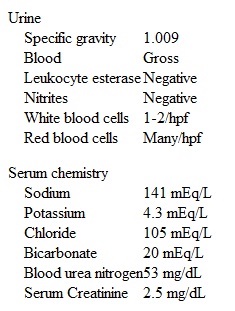 Urine microscopy shows many normal-appearing red cells, but no dysmorphic red cells or casts. Urine culture shows no growth. Prostate-specific antigen is 3.2 ng/mL. Ultrasound of the kidneys shows bilateral cortical atrophy but no other lesions. Which of the following is the most appropriate next step in management of this patient?
 (Multiple Choice)
4.9/5 (94)
(94) A 35-year-old man comes to the office due to weight loss and insomnia. He has been depressed about his troubled marriage and stressed by his wife's complaints about his inability to provide for the family. Lately he has had difficulty concentrating and fears that his productivity at work has fallen. The patient says, "I drag myself into work late because I can't get out of bed. Then I sit and stare at the papers piling up on my desk. I used to enjoy biking and going out with friends, but now I just come straight home from work and lie on the couch. At night, I have started having a couple of drinks to help me fall asleep." Over the past month, the patient has wished that he could go to sleep and not wake up, and has thought that he would be "better off dead." These thoughts last for several minutes when he is lying in bed awake at night. He has no intent or plan to harm himself. The patient has no history of suicide attempt or depression. There is a family history of suicide in a paternal uncle who had depression and substance abuse. The patient used cocaine and marijuana in his 20s but not in the past 8 years. He is going through a divorce and is worried that he will not get joint custody of his 2 children. Vital signs and physical examination are normal, with the exception of a 2.3-kg (5-lb) weight loss. Which of the following is the most appropriate next step in management of this patient?
(Multiple Choice)
4.9/5 (83)
(83) A 25-year-old African-American medical student comes to see you in the office. His girlfriend noticed an area of circular hair loss over the back of his head. He is concerned that he is losing his hair and will be bald soon. He is otherwise in good health and denies any history of smoking, alcohol, or illicit drug use. He has had a monogamous relationship with his girlfriend for the past three years. On examination, there is a 1 cm area of complete, smooth and circular hair loss with distinct margins. There is no scaling or inflammation present in or around the area of hair loss.
Which of the following statements is true regarding the above condition?
(Multiple Choice)
4.9/5 (74)
(74) A 47-year-old man is brought to the emergency department after being injured by a lightning strike 10 minutes ago. He was playing tennis when a thunderstorm suddenly developed. He was struck by cloud-to-ground lightning and thrown several feet by the force of the bolt. Bystanders initiated chest compressions immediately. Emergency medical services arrived within 5 minutes and found the patient in cardiac arrest. On examination, his pupils are dilated and unresponsive to light. The electrical rhythm appears to be asystole. Which of the following is the most appropriate next step in management?
(Multiple Choice)
5.0/5 (80)
(80) An 11-month-old boy is brought to the emergency department following a head injury. About 45 minutes ago, the patient had pulled himself up to stand on the second step of the staircase at home. He attempted to take a step to the side and as his mother approached to grab him, lost his footing and tumbled onto the floor, falling from a height of 0.38 m (15 in). The boy hit his head on the wooden floor and began crying. He did not lose consciousness and has not vomited. The patient was born at 33 weeks gestation. He has no chronic medical conditions. Vital signs are normal. Glasgow Coma Scale is 15. Examination shows a 4 cm hematoma along the right parietal lobe. The anterior fontanel is closed. Neurological examination shows a symmetric face with equal and reactive pupils. The boy reaches out with each hand equally. When the plantar surface of each foot is stroked with a pointed object, the corresponding big toe dorsiflexes while the remaining toes fan out. Which of the following is most concerning for an underlying traumatic brain injury in this patient?
(Multiple Choice)
4.7/5 (69)
(69) A 29-year-old man comes to the emergency department complaining of palpitations, sweating, and severe headache. His symptoms resolve spontaneously by the time he is evaluated. He has had at least 2 similar episodes during the past 2 months. The patient's family history is unremarkable. He does not use tobacco, alcohol, or illicit drugs. His primary care provider saw him after the first episode and prescribed an anxiolytic medication. However, the patient felt drowsy at his job and stopped the medication. Physical examination shows a thin man who appears anxious and diaphoretic. The thyroid is normal to palpation without any obvious nodules. His temperature is 36.7 C (98 F), blood pressure is 126/84 mm Hg, pulse is 86/min, and respirations are 16/min. During his prior emergency department visit for an identical episode, his blood pressure was 150/100 mm Hg and pulse was 120/min. The laboratory results at that time showed normal thyroid function tests.
Which of the following is the most appropriate next step in management?
(Multiple Choice)
4.8/5 (74)
(74) A 70-year-old woman is brought to the emergency department by her son for evaluation of shortness of breath. She has had a sensation of choking since last night. According to her son, for the past several weeks she has had a dry cough at night and has been taking over-the-counter cough drops. The patient has had no chest pain, palpitations, back pain, abdominal symptoms, or lightheadedness. She has a history of hypertension, hyperlipidemia, and type 2 diabetes mellitus. She has been refusing statin therapy, as she heard statins cause multiple side effects. The patient has also refused flu vaccinations over the last several years. Her only hospital admission occurred 6 years ago when she underwent a spinal fusion for lower back pain. She does not use tobacco, alcohol, or illicit drugs. Family history is not significant. Temperature is 36.1 C (97 F), blood pressure is 171/102 mm Hg, pulse is 92/min, and respirations are 34/min. Pulse oximetry is 85% on room air. BMI is 29 kg/m2. Bilateral crackles are heard on lung examination. There are no heart murmurs. ECG shows normal sinus rhythm, increased voltage in the precordial leads, and T-wave inversion in leads V5 and V6. Chest x-ray is shown in the exhibit. 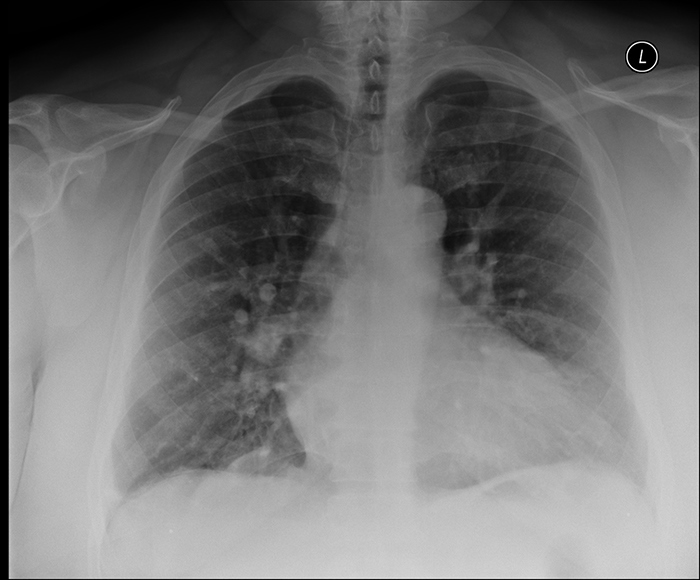 Oxygen is administered via 100% nonrebreather facemask. The patient is placed on noninvasive positive pressure ventilation but still appears somewhat uncomfortable. Laboratory results are as follows:
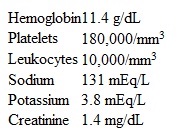 The first troponin I level is negative. Repeat blood pressure is 176/105 mm Hg, pulse is 82/min, and respirations are 24/min. Oxygen saturation is 94%. What is the best next step in management of this patient?
Oxygen is administered via 100% nonrebreather facemask. The patient is placed on noninvasive positive pressure ventilation but still appears somewhat uncomfortable. Laboratory results are as follows:
The first troponin I level is negative. Repeat blood pressure is 176/105 mm Hg, pulse is 82/min, and respirations are 24/min. Oxygen saturation is 94%. What is the best next step in management of this patient? (Multiple Choice)
5.0/5 (77)
(77) A 26-year-old woman, gravida 1 para 0, at 8 weeks gestation is brought to the emergency department by her husband after saying that she wants to die and threatening to hang herself. In the past few weeks, the patient has become increasingly depressed and uninterested in doing anything. She spends most of her time in bed and sleeps 14 hours a day. She has lost 4.5 kg (10 lb) due to refusal to eat or drink. The patient says that food is "polluting my body and allowing my demon child to grow." She has a long history of poorly controlled bipolar disorder with episodes of depression and mania. The patient made 2 suicide attempts during her teens. She takes no medications currently and is not under the care of a therapist or psychiatrist. The patient appears thin, with dry and chapped mucous membranes. Physical examination is otherwise normal. During examination, she makes monosyllabic responses and has slowed movements. The patient is admitted to the psychiatric unit. Which of the following is the most appropriate next step in management?
(Multiple Choice)
4.9/5 (82)
(82) A 42-year-old man comes to the office due to a painless lump under the skin on his right upper back, which he first noticed 3 months ago. He is incidentally noted to have a blood pressure of 180/110 mm Hg. He has no symptoms. The patient has no history of hypertension or other medical conditions and has not seen a physician since high school. He takes no medications, does not use tobacco, and consumes 1 or 2 alcoholic beverages on weekends. Family history is notable for hypertension in his mother and end-stage renal disease in a maternal uncle. The patient exercised regularly until recently, when he started work as a supervisor at a warehouse. He eats fast food at least 3 days a week. Repeat blood pressure measurements after 15 minutes of rest are 180/105 mm Hg on the right arm and 185/110 mm Hg on the left. Temperature is 36.7 C (98.1 F), pulse is 68/min, and respirations are 12/min. BMI is 26.2 kg/m2. Cardiac examination reveals a diffuse and sustained apical impulse with normal heart sounds and no murmurs or gallops. There is a 3-cm, soft, mobile, nontender, subcutaneous mass consistent with a lipoma in the right scapular region. The remainder of the examination, including funduscopy, is normal. Blood cell counts, serum electrolytes, serum creatinine, blood glucose, and urinalysis are within normal limits. The ECG is shown in the exhibit. 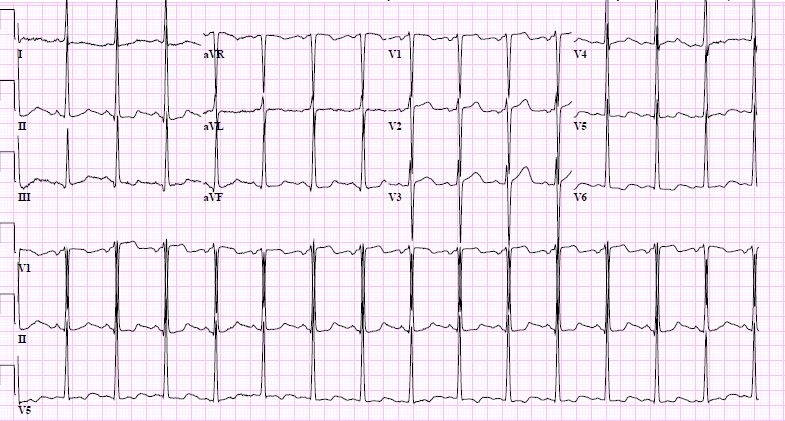 In addition to providing reassurance regarding the patient's skin lesion, which of the following is the most appropriate next step in management?
 (Multiple Choice)
4.9/5 (90)
(90) A 40-year-old woman is brought to the emergency department by paramedics after a motor vehicle collision. She was driving and wearing a seatbelt when her car was hit by another vehicle from the opposite direction. Her car went off the road and hit a tree. When paramedics arrived at the scene, the patient was noted to have an open femur fracture but was alert and oriented. Her medical issues include hyperlipidemia and mitral valve prolapse with mild regurgitation. She takes no medications. The patient undergoes open reduction and internal fixation of the femur fracture. She receives intravenous fluids and pain control postoperatively. The next morning she experiences left-sided chest discomfort and shortness of breath. Temperature is 37.6 C (99.7 F), blood pressure is 120/70 mm Hg, pulse is 100/min, and respirations are 30/min. Pulse oximetry shows 84% on room air. Physical examination reveals an area of tenderness over the left chest wall where the seatbelt was placed. On pulmonary examination, the patient has rales over the left upper lung. A 2/6 holosystolic murmur is present over the cardiac apex. Laboratory results are as follows:
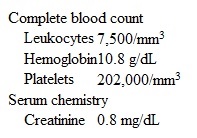 ECG shows sinus tachycardia with no ST-segment or T-wave changes. Chest x-ray shows irregular opacification predominantly of the left upper lung.
Adequate pain control and supplemental oxygen by nasal cannula is provided and the patient's respiratory distress improves. Pulse oximetry shows 96% on 3 L/min supplemental oxygen. Which of the following is the best next step in management of this patient?
ECG shows sinus tachycardia with no ST-segment or T-wave changes. Chest x-ray shows irregular opacification predominantly of the left upper lung.
Adequate pain control and supplemental oxygen by nasal cannula is provided and the patient's respiratory distress improves. Pulse oximetry shows 96% on 3 L/min supplemental oxygen. Which of the following is the best next step in management of this patient? (Multiple Choice)
4.9/5 (73)
(73) Showing 561 - 580 of 1121

Filters
- Essay(0)
- Multiple Choice(0)
- Short Answer(0)
- True False(0)
- Matching(0)