



 Chat with AI
Exam 1: Advanced Clinical Medicine

Exam 1: Advanced Clinical Medicine1 k+ Questions
Exam 2: Foundations of Independent Practice597 Questions
Select questions type


A 46-year-old man is brought to the emergency department by the police after being found unresponsive on a nearby park bench. Previously, the patient was brought to the hospital on several occasions due to acute alcohol intoxication. No other history can be obtained. The patient appears disheveled and has a strong smell of alcohol. Temperature is 36.1 C (97 F), blood pressure is 110/76 mm Hg, and pulse is 84/min. Pulse oximetry shows 98% on ambient air. The patient does not follow instructions and withdraws all extremities to painful stimuli. The mucous membranes are dry, and he has several spider angiomata and bilateral gynecomastia. The lungs are clear to auscultation and heart sounds are normal with no murmur. There is moderate abdominal distension with shifting dullness. The liver edge cannot be palpated. While being evaluated in the emergency department, the patient vomits a large amount of bright red blood. Repeat vital signs show that blood pressure is 100/50 mm Hg and pulse is 110/min. Two large-bore peripheral lines are placed and intravenous fluid is administered. Endoscopy shows esophageal varices with evidence of bleeding, which is treated with band ligation. There is no evidence of gastric or duodenal ulcers. The patient also receives intravenous antibiotics. The bleeding stops and his clinical condition improves. Abdominal ultrasonography shows a nodular, shrunken liver; a patent portal vein; mild splenomegaly; and moderate ascites. The patient is counseled for abstinence from alcohol. At the time of discharge, initiation of which of the following is most appropriate for decreasing the risk of recurrent variceal bleeding in this patient?
(Multiple Choice)
4.9/5  (86)
(86) A 65-year-old man comes to the emergency department 2 hours after the onset of weakness in his left arm and leg. Two months ago, he had a 15-minute episode of left arm weakness that resolved spontaneously. He has had no headache, nausea, vomiting, or difficulty swallowing. His medications include chlorthalidone, lisinopril, and metformin. The patient occasionally takes ibuprofen for muscle cramps and antacids for heartburn. His temperature is 36.7 C (98.0 F), blood pressure is 172/98 mm Hg, and pulse is 83/min with a regular rhythm. Physical examination shows a dense, left-sided hemiparesis. Fingerstick blood glucose is 108 mg/dL. CT scan of the head without contrast shows no signs of intracranial hemorrhage The patient receives appropriate therapy. The next day, neurologic examination shows some improvement of the left-sided weakness. Carotid duplex ultrasound scanning shows bilateral atherosclerotic plaques with no significant stenosis, and an electrocardiogram shows normal sinus rhythm. Which of the following is the most appropriate next step in management of this patient?
(Multiple Choice)
4.7/5 (64)
(64) A 62-year-old woman comes to the physician due to chest and epigastric discomfort over the last 6 months. She feels dull chest pressure while walking uphill at a fast pace. The patient says, "It is unusual. I feel this pressure only once in a while, even when doing the same thing. Sometimes it is worse when I walk fast after a heavy meal." She has a history of nonulcer dyspepsia and acid reflux disease and occasionally takes over-the-counter omeprazole. She has no shortness of breath, palpitations, lightheadedness, lower extremity swelling, or syncope. The patient is physically active and has a very hectic social lifestyle. Medical history includes "borderline" hypertension and anxiety disorder. She stopped taking antihypertensive medications 5 years ago. She is a lifetime nonsmoker. The patient does not use alcohol or illicit drugs. Her mother suffered a stroke at age 70 and her father died of prostate cancer. Blood pressure is 145/90 mm Hg and pulse is 80/min and regular. BMI is 29 kg/m2. No heart murmurs are heard on cardiac auscultation. There are no carotid bruits. The lungs are clear and the rest of the physical examination is unremarkable. Resting ECG shows normal sinus rhythm, normal voltage, and T-wave flattening in leads V5 and V6. Laboratory studies show fasting blood glucose of 102 mg/dL and LDL cholesterol of 110 mg/dL. Which of the following is most appropriate management for this patient's chest pain?
(Multiple Choice)
4.8/5 (79)
(79) A 3-year-old girl is brought to the office by her mother for evaluation of her legs. The mother says, "I have noticed that her knees turn in more than before, and I am concerned that my daughter will be teased for 'walking funny.' Her grandmother insists that she needs special shoes to fix her knock-knees." The patient's father wore "corrective shoes" as a child and "now walks normally." The patient is otherwise healthy and has had no fever, joint pain, or swelling. She is a picky eater and her diet consists mostly of bread, pasta, cheese, and 1 cup of cow's milk a day. The patient is active and "sometimes a bit clumsy" but has never had a fracture or serious injury. She started walking at age 14 months and now can climb up and down stairs while alternating feet. She takes no daily medications or vitamin supplements. Vital signs are normal. Weight and height are at the 60th and 75th percentile, respectively. Physical examination reveals a well-appearing girl with a steady gait, legs swinging outward as she walks. No medial thrust is observed with ambulation. Legs are equal in length. With the legs extended and knees touching, a small gap is present between the ankles. There is mild valgus angulation at the knee. Which of the following is the most appropriate advice regarding this patient's condition?
(Multiple Choice)
4.7/5 (81)
(81) A 45-year-old woman comes to the office for evaluation of a rash. The rash started 3 weeks ago under her breasts and has gradually spread to her chest. There is no associated pruritus. The patient has a history of diabetes, hypertension, and gastroesophageal reflux disease. Her medications include hydrochlorothiazide, metformin, and omeprazole. She has no history of tobacco or alcohol use. The patient's vital signs are within normal limits. Her BMI is 38 kg/m2. Skin examination is shown in the image below. There is no warmth or tenderness around the lesions. 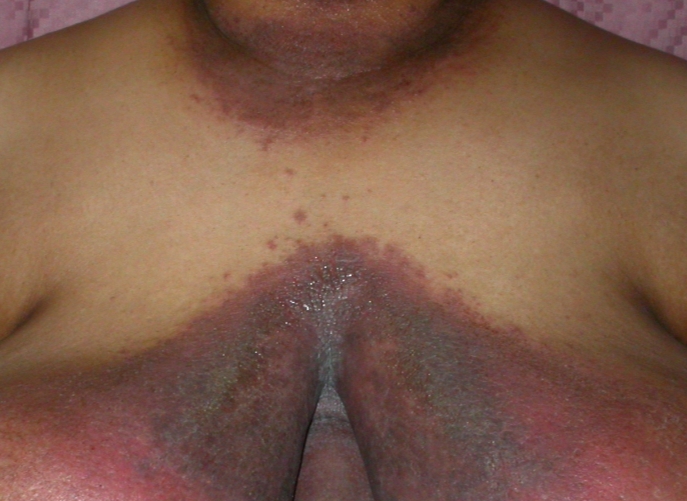 Which of the following is the most likely organism causing this patient's rash?
 (Multiple Choice)
4.9/5 (74)
(74) A 76-year-old man comes to the office for a follow-up visit after a recent admission for acute decompensated heart failure. He reports persistent shortness of breath on mild exertion but has no other symptoms. Medical history includes hypertension, type 2 diabetes mellitus, coronary artery disease, coronary artery bypass grafting 5 years ago, heart failure with reduced ejection fraction (ejection fraction 20%), benign prostate hyperplasia, and osteoarthritis. The patient has been hospitalized 4 times over the last year for acute decompensated heart failure. He had an implantable cardioverter-defibrillator placed 2 years ago. His medications include low-dose aspirin, metoprolol, lisinopril, simvastatin, insulin glargine, spironolactone, empagliflozin, and furosemide. Temperature is 36.7 C, blood pressure is 106/72 mm Hg, pulse is 72/min, and respirations are 16/min. Jugular venous pressure is estimated at 12 cm H2O. Lung examination shows bibasilar crackles. Cardiovascular examination shows regular heart sounds and an audible S3 over the cardiac apex. There is bilateral lower extremity edema. Laboratory evaluation shows a serum sodium concentration of 121 mEq/L and serum creatinine of 1.0 mg/dL. His serum sodium concentration 6 weeks ago was 124 mEq/L and serum creatinine was 0.9 mg/dL. In addition to adjusting the loop diuretic regimen, which of the following is the most appropriate next step in management of this patient's hyponatremia?
(Multiple Choice)
4.9/5 (86)
(86) A 2-year-old boy is brought to the emergency department by his parents after they discovered an abdominal mass while giving him a bath this evening. The mass does not appear to be causing the patient pain. He has had constipation for the last 2 weeks, which the parents have treated with stool softeners. His parents are also concerned that his face and neck become red and that his palms perspire several times a day even when he is cold. The patient has also had decreased energy and a 1.5 kg (3.3 lb) weight loss in the last month despite a normal appetite. He has no chronic medical conditions, has had no surgeries, takes no medications, and has no known allergies. Temperature is 37.2 C (99 F), blood pressure is 140/90 mm Hg, and pulse is 120/min. Physical examination reveals a toddler who appears in no distress. The lungs are clear to auscultation. Heart rate and rhythm are normal; there are no murmurs. The abdomen is soft and nontender; a baseball-sized, nontender, fixed mass is palpable in the right mid-abdomen. Which of the following is the most likely diagnosis for this patient?
(Multiple Choice)
4.7/5 (73)
(73) A 26-year-old man comes to the office due to 2 days of headache, malaise, and myalgia. The patient also has an enlarging, nonpruritic rash on his lower abdomen. He is a graduate student with no significant medical history. The patient is sexually active and uses condoms consistently. He recently returned from a 2-week camping and hiking trip in eastern Pennsylvania. The patient does not use tobacco or illicit drugs but drinks alcohol occasionally. Temperature is 38 C (100.4 F), blood pressure is 126/84 mm Hg, and pulse is 72/min. Mucous membranes are moist with no lesions. No lymphadenopathy is present. The lungs are clear to auscultation, and heart sounds are normal with no murmur. The abdomen is soft, nondistended, and nontender with no hepatosplenomegaly. There is no nuchal rigidity. Skin examination shows a 4-cm, oval, uniformly red, macular rash at the belt line. Which of the following is the best next step in management of this patient?
(Multiple Choice)
4.7/5 (74)
(74) A 2-day-old boy is in the newborn nursery. He was born full term via normal spontaneous vaginal delivery to a 25-year-old woman, gravida 2, para 2. The mother had regular prenatal care and the pregnancy was uncomplicated. She has a history of postpartum lactational mastitis with her first child but feels comfortable breastfeeding her new baby. The boy has normal vital signs and appropriate urine and stool output. On examination, he has small, palpable masses of soft tissue under each nipple. There is some white discharge from both nipples. His circumcised penis is healing well and the testes are descended bilaterally. Which of the following is the most appropriate next step in the management of this neonate?
(Multiple Choice)
4.7/5 (87)
(87) A 24-year-old woman comes to the office for a routine prenatal visit at 32 weeks gestation. Last week, she was evaluated for postcoital spotting. The cervix was closed, and there was no evidence of preterm labor. Nucleic acid amplification testing (NAAT) performed at that visit was positive for Chlamydia trachomatis. Routine NAAT was negative for C trachomatis at the initial prenatal visit. Today, the patient has no vaginal bleeding, leakage of fluid, or contractions. Fetal movement is normal. She has no chronic medical conditions or previous surgeries. The patient does not use tobacco, alcohol, or illicit drugs. She had 3 sexual partners prior to marriage. She has been in a monogamous relationship with her husband for the last 2 years and is sexually active with him. The patient swims at the local pool regularly but stopped after the episode of vaginal bleeding. Blood pressure is 110/70 mm Hg and pulse is 72/min. Fundal height is 32 cm. Fetal heart rate is 140/min by Doppler ultrasound. Urine dipstick is negative for glucose and protein. The patient is concerned about the results and wonders how she acquired the infection during her pregnancy.
Which of the following is the most appropriate statement to explain the results?
(Multiple Choice)
4.9/5 (72)
(72) A 6-month-old boy is brought to the emergency department by his mother during the winter due to 3 days of nasal discharge and cough. His mother states, "He hasn't been breastfeeding well today because he's so congested." The infant has been voiding adequately and has had no vomiting, diarrhea, or skin rash. His older brother attends preschool and is recovering from an upper respiratory illness. The patient has no prior illnesses and no known allergies, and all vaccinations are up to date. He was born at term via an uncomplicated delivery and has met all developmental milestones appropriately. Temperature is 37.5 C (99.5 F), blood pressure is 90/60 mm Hg, pulse is 150/min, and respirations are 50/min. Pulse oximetry shows an oxygen saturation of 93% on room air. Examination reveals moderate respiratory distress with subcostal retractions, coarse breath sounds, and expiratory wheezing bilaterally. Oral mucous membranes are dry, but capillary refill is <2 seconds. The patient is admitted to the hospital and placed on appropriate infection-control precautions. Which of the following is the most appropriate method of diagnosing this patient's condition?
(Multiple Choice)
4.9/5 (74)
(74) A 6-year-old boy is brought to the office by his mother for an annual physical examination. He has had no recent illnesses but has had intermittent pain in his legs during his soccer games for the past 3 months. The patient had no trauma preceding the onset of leg pain, has no numbness or tingling, and is able to walk without a limp. He was born at 38 weeks gestation via a spontaneous vaginal delivery with no complications. The patient has met all developmental milestones, and all of his immunizations are up to date. His father was recently diagnosed with hypertension at age 55, but there is no other significant family history. Temperature is 36.1 C (97 F), blood pressure is 135/88 mm Hg in the right upper extremity, pulse is 110/min, respirations are 24/min, and pulse oximetry is 98% on room air. Weight and height are at the 25th and 50th percentiles, respectively, for age. Physical examination shows a well-appearing boy who has no dysmorphic features and who smiles and fully cooperates. The lungs are clear to auscultation. Heart rate and rhythm are normal. A 2/6 continuous murmur is heard over the left interscapular area. The lower extremities have no swelling, erythema, or tenderness. Further evaluation would most likely show which of the following findings?
(Multiple Choice)
5.0/5 (82)
(82) A 42-year-old woman comes to the office for evaluation of elevated blood pressure. She says, "I checked my blood pressure on a machine at the pharmacy, and it was 160/90 mm Hg. The pharmacist said I should see a doctor." The patient has no history of hypertension and has had no chest pain, headache, or focal weakness or numbness. She notes occasional episodes of pain in her flanks, which she ascribes to muscle tension. The patient has had several urinary tract infections over the course of her life but has no chronic medical problems and takes no medication regularly. She does not use tobacco, alcohol, or illicit drugs. The patient is married and has a son. Her mother has hypertension, her father died at an early age in a motor vehicle collision, and her uncle has renal failure and receives dialysis. Blood pressure is 156/94 mm Hg on the right arm and 152/96 mm Hg on the left arm. Pulse is 80/min and respirations are 16/min. Jugular venous pressure is within normal limits. Breath sounds are normal bilaterally with no crackles. Point of maximal impulse is displaced to the left and down. Heart sounds are normal with no murmur or gallops. The abdomen is soft with bilateral flank fullness. Bowel sounds are active. Laboratory results are as follows. 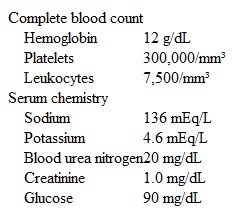 Urinalysis shows dysmorphic erythrocytes and mild proteinuria. ECG shows left ventricular hypertrophy with nonspecific ST-T wave changes. After learning about the disease, the patient becomes worried that her 19-year-old son may also have the same condition. Which of the following is the most appropriate response to the patient?
 (Multiple Choice)
5.0/5 (90)
(90) A group of graduate students conducted a case-control study to evaluate the association between sporadic frontotemporal dementia and thyroid disease. A total of 80 patients with sporadic frontotemporal dementia along with 160 age and sex surrogate informant matched controls participated in the study. Results showed that thyroid disease was associated with frontotemporal dementia with an odds ratio of 2.5 and a 95% confidence interval: 0.9-7.9. The students reported that patients with sporadic frontotemporal dementia were 2.5 times more likely to have thyroid disease compared to patients with no sporadic frontotemporal dementia. They concluded that there is a statistically significant association between sporadic frontotemporal dementia and thyroid disease. Based on this information, which of the following is the best evaluation of the students' conclusion?
(Multiple Choice)
4.7/5 (97)
(97) A 72-year-old woman is brought to the emergency department after a fall. The patient landed on her side and has extensive bruising over the right hip area. She was able to reach her phone and call an ambulance to bring her to the hospital. She says, "I lost my balance on the way to the bathroom. I usually have to get up to go to the bathroom once or twice a night." The patient has no history of lightheadedness, dizziness, or syncope. She leads an active lifestyle and walks 2 miles every day. Her medical problems include type 2 diabetes mellitus, urge incontinence, chronic insomnia, transient ischemic attacks, and osteoarthritis. Her daily medications include aspirin, glyburide, lorazepam, and naproxen. The patient lives alone. She does not use tobacco, alcohol, or illicit drugs. Vital signs are within normal limits. Physical examination and subsequent x-rays reveal a right-sided femoral neck fracture. Neurological examination is normal. Item 1 of 2
Which of the following is the most appropriate intervention to reduce this patient's risk of falls?
(Multiple Choice)
4.8/5 (71)
(71) A 62-year-old Caucasian woman presents to her primary care physician complaining about her facial appearance. She says she dislikes "looking so much worse than all my friends." Specifically, she mentions that the deep wrinkles and brown spots on her face are what she finds most disturbing. Her past medical history is significant for breast cancer, hypothyroidism, and diverticulosis. Her only medications are levothyroxine, tamoxifen, and a multivitamin. She is a divorced mother of two and has recently retired from working as the supervising gardener of a large estate. She has a forty-year history of smoking one pack of tobacco per day and consumes one or two glasses of wine each night. She admits to occasional marijuana usage when she was a younger adult. Examination of her facial skin is remarkable for a general leathery appearance with many deep furrows and wrinkles. The wrinkles are especially prominent on the forehead and at the lateral corners of the eyes. The skin is sallow and has variable pigmentation. The surface texture is rough in areas. There are scattered flesh-colored scaly patches with slightly irregular margins and occasional clusters of what appear to be dilated superficial capillaries and venules.
Which of the following is the most likely diagnosis?
(Multiple Choice)
4.9/5 (77)
(77) A 65-year-old woman comes to the office for evaluation of a rash. The rash started nearly 3 years ago as a single lesion on her back, followed by multiple additional lesions in the same area and elsewhere on her trunk. There is no associated pruritus. The patient has a history of hypertension and gastroesophageal reflux disease. Her medications include hydrochlorothiazide and omeprazole. She has no history of tobacco or alcohol use. Vital signs are within normal limits. Skin examination findings are shown in the image below. There is no warmth or tenderness around the lesions. The remainder of her physical examination is normal. 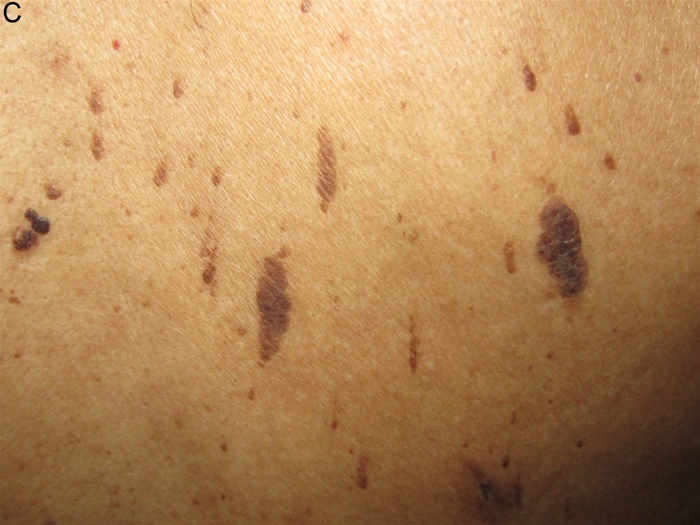 Which of the following is the best next step in management of this patient?
 (Multiple Choice)
4.9/5 (83)
(83) A 52-year-old man comes to the office for a follow-up visit. He had a pre-employment tuberculin skin test done 3 days ago, and had a skin reaction with 16 mm of induration. He has not had any cough, fever, weight loss, night sweats, or recent exposure to patients with tuberculosis. He has a 40-pack-year history of smoking and continues to smoke heavily. He immigrated from South Korea to the United States about 8 years ago. He had BCG vaccination as a child but never had a tuberculin skin test done in the past. A chest x-ray is ordered and shows right upper lobe fibrosis without signs of active tuberculosis. Which of the following is the most appropriate next step in the management of this patient?
(Multiple Choice)
4.9/5 (68)
(68) A 24-year-old woman, gravida 1 para 0, comes to the office at 12 weeks gestation for an initial prenatal visit. She is feeling well and reports no nausea, cramping, or vaginal bleeding. The patient has no chronic medical conditions and has had no previous surgeries. She takes a prenatal vitamin daily. Pap test and sexually transmitted infection screening last year were normal. Family history is not significant. She drank 1 or 2 alcoholic beverages a week prior to pregnancy, but does not use tobacco or illicit drugs. The patient developed a skin rash and difficulty breathing after taking penicillin for streptococcal pharyngitis as a child. Blood pressure is 110/60 mm Hg and pulse is 78/min. BMI is 26 kg/m2. Bimanual examination is consistent with a 12-week-sized uterus. Pelvic ultrasound reveals a singleton intrauterine pregnancy consistent with gestational age. Fetal heart rate is 160/min. Laboratory results from this visit are as follows: 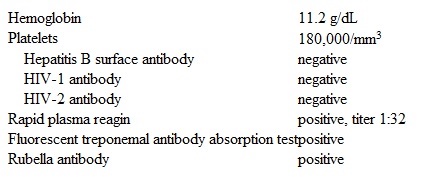 Which of the following is the most appropriate treatment for this patient?
 (Multiple Choice)
4.9/5 (73)
(73) A 62-year-old man comes to the office for follow-up after recent hospitalization. Two weeks ago, the patient went to the emergency department due to a 3-day history of fever, chills, dysuria, urinary frequency, and low back pain. Evaluation showed a tender and swollen prostate, leukocytosis, pyuria, and bacteriuria. Treatment for acute bacterial prostatitis was begun with intravenous antibiotics. Blood and urine cultures returned positive for Escherichia coli sensitive to all tested antibiotics. The patient was discharged after clinical improvement and was prescribed oral ciprofloxacin. He has had no fever, and urinary symptoms have resolved, but over the last 2 days, he has had mild abdominal cramps and 4 or 5 watery bowel movements per day with no blood or mucus. Other medical conditions include hypertension and type 2 diabetes mellitus. On examination, the patient is afebrile, and other vital signs are within normal limits. There is mild periumbilical tenderness, but physical examination is otherwise unremarkable. Laboratory studies show a leukocyte count of 14,500/mm3 and serum creatinine level of 0.9 mg/dL. Stool testing is positive for Clostridioides difficile.
In addition to oral fidaxomicin therapy, which of the following is the most appropriate next step in management of this patient?
(Multiple Choice)
4.7/5 (79)
(79) Showing 141 - 160 of 1121

Filters
- Essay(0)
- Multiple Choice(0)
- Short Answer(0)
- True False(0)
- Matching(0)