



 Chat with AI
Exam 1: Advanced Clinical Medicine

Exam 1: Advanced Clinical Medicine1 k+ Questions
Exam 2: Foundations of Independent Practice597 Questions
Select questions type


A 33-year-old, previously healthy woman is brought to the emergency department in severe respiratory distress. The patient's shortness of breath began abruptly 2 days ago and has progressively worsened. Over the past 6 months she has had loss of appetite, loose stools, and lightheadedness. Temperature is 38.6 C (101.5 F), blood pressure is 178/102 mm Hg, pulse is 120/min, and respirations are 38/min. Pulse oximetry is 86% on nonrebreather mask. Examination shows marked respiratory distress with intercostal and supraclavicular retractions. The skin is diaphoretic and warm. Cardiopulmonary examination reveals diffuse rales, an S3, and a 2/6 systolic ejection murmur over the left sternal border. The extremities have 1+ pitting edema bilaterally. The patient is placed on positive airway pressure ventilation with improvement in oxygen saturation to 94%. ECG shows sinus tachycardia. Chest x-ray reveals a mildly enlarged cardiac silhouette with pulmonary vascular congestion. Echocardiography shows pulmonary hypertension, left atrial enlargement, and a left ventricular ejection fraction of 75%; there are no wall motion abnormalities. Troponin I is 0.06 ng/mL (normal: <0.04 ng/mL). Which of the following is the most appropriate diagnostic step in management of this patient?
(Multiple Choice)
4.7/5  (72)
(72) An 18-year-old woman comes to the office due to pain on urination and "constantly feeling like I have to go to the bathroom even though I go several times every hour." The patient is sexually active with her boyfriend and, since her symptoms began 3 days ago, has felt pain during intercourse but has not had fever, chills, nausea, vomiting, or flank pain. The patient uses condoms consistently during intercourse. Her last menstrual period was 4 weeks ago. She has no chronic medical conditions or surgeries. The patient has no known drug allergies. Temperature is 37.8 C (100 F), blood pressure is 110/70 mm Hg, pulse is 82/min, and respirations are 18/min. Mild suprapubic tenderness is present on abdominal examination. Pelvic examination shows no cervical discharge or cervical motion tenderness. The remainder of the examination is normal. Urinalysis shows positive leukocyte esterase, positive nitrites, and 10 red blood cells/hpf. A decision is made to treat the patient with one week of trimethoprim-sulfamethoxazole.
Prior to initiating treatment, which of the following is the best next step in management of this patient?
(Multiple Choice)
4.9/5 (80)
(80) A 30-year-old man is brought to the emergency department by an ambulance after a gas station attendant noticed the patient disoriented and wandering aimlessly. The patient has had nausea, vomiting, and dizziness. Emergency department records indicate that the patient has a history of schizophrenia, but he cannot remember the names of his medications. He also has limited memory of the previous day. The patient smokes cigarettes occasionally and does not use alcohol or illicit drugs. Temperature is 41.1 C (106 F), blood pressure is 90/60 mm Hg, pulse is 128/min, and respirations are 26/min. The patient is lethargic and appears disheveled and sunburned; he is oriented to person only. The skin and oral mucous membranes are dry. The lungs are clear to auscultation. The heart rhythm is regular with no murmurs. Muscle tone is moderately decreased and reflexes are normal. He moves all extremities to command. Laboratory results are as follows: 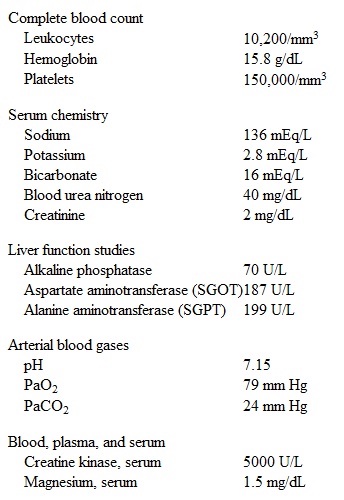 Urine drug screen is positive for methamphetamines. Chest x-ray is clear. CT scan of the head without contrast shows no acute intracranial abnormalities. Which of the following is the most appropriate immediate step in management of this patient?
 (Multiple Choice)
4.8/5 (84)
(84) A 16-year-old boy comes to the office due to fever, fatigue, and myalgia that started 10 days ago. He has felt too tired and achy to get out of bed. His throat is sore, and he has decreased food and fluid intake. The patient has no significant medical history and does not take medications. He does not use tobacco, alcohol, or illicit drugs. He is sexually active. The patient is an excellent student and actively involved in music and sports. Temperature is 38.6 C (101.5 F), blood pressure is 100/60 mm Hg, and pulse is 104/min. Physical examination shows a tired adolescent male. There is no rhinorrhea, tympanic membranes are clear, the lips are dry and cracked, and the tonsils are enlarged and erythematous bilaterally with white exudate. There is bilateral anterior and posterior cervical lymphadenopathy. Cardiopulmonary examination reveals regular tachycardia with normal S1 and S2 as well as clear lungs. The abdomen is soft and nontender; there is no palpable hepatosplenomegaly. Of the following recommendations, which will most reduce the risk of sequelae from this condition?
(Multiple Choice)
4.8/5 (76)
(76) A 2-year-old girl is brought to the office by her parents for a routine well-child visit. The patient speaks >100 words and can use 2-word phrases. She can go up and down stairs and draw a line. The patient takes no medications and has no allergies. Immunizations are up to date. She lives with her parents, grandparents, and 5-year-old brother in a home built in 2003. Height and weight are in the 50th percentile. Physical examination is normal. She is playing with brightly-painted wooden dolls on the floor of the examination room, and her mother says, "These dolls actually used to be her grandmother's when she was a child." Capillary blood collection shows a hemoglobin level of 11 g/dL and a lead level of 11 µg/dL (normal: <5). A venous lead level of 12 µg/dL is confirmed the next day. In addition to education about lead exposure and toxicity prevention, which of the following is the best next step in management of this patient?
(Multiple Choice)
4.8/5 (69)
(69) A 33-year-old woman, gravida 2 para 1, at 33 weeks gestation comes to the emergency department due to continuous leakage of fluid that began 2 hours ago. The fluid is clear and not malodorous, and she has had no contractions or vaginal bleeding. Fetal movement is normal. This pregnancy was complicated by bacterial vaginosis in the first trimester that resolved after a course of antibiotics. Her previous pregnancy ended in a vaginal delivery at 37 weeks gestation after induction of labor for prelabor rupture of membranes. The patient has no chronic medical conditions and has had no previous surgeries. Temperature is 36.7 C (98.1 F), blood pressure is 110/68 mm Hg, and pulse is 92/min. The uterine fundus is nontender. On speculum examination, there is a clear pool of fluid that is nitrazine positive and crystallizes in a fern-like pattern after drying on a slide. The cervix appears visibly closed; digital cervical examination is deferred. The fetal heart rate tracing demonstrates a normal baseline, moderate variability, accelerations, and no decelerations. Transabdominal ultrasound reveals a fetus in vertex presentation and an amniotic fluid index of 3 cm. Which of the following is the best next step in management of this patient?
(Multiple Choice)
4.9/5 (69)
(69) A 27-year-old woman is brought to the emergency department due to a 4-hour history of chest pain that is localized to the middle of the chest and the upper sternal area. She describes it as "intense." The patient has never before experienced a similar pain. She also describes some nausea and a mild occipital headache. She has had no vomiting, abdominal pain, or shortness of breath. A friend who accompanies her to the emergency department says that they attended a party and the patient smoked crack cocaine shortly prior to her episode of chest pain. She did not consume alcohol. The patient has a history of intravenous drug use. She was treated with antibiotics for upper extremity cellulitis 6 months ago. There is no family history of premature coronary artery disease. The patient does not take any medications and has no known drug allergies. On initial evaluation, temperature is 37.8 C (100 F), blood pressure is 204/102 mm Hg on the right arm and 210/104 mm Hg on the left arm, pulse is 102/min and regular, and respirations are 18/min. Oxygen saturation is 99% on room air. The patient appears thin, anxious, and agitated. Heart sounds are normal and no murmurs are heard. Lungs are clear to auscultation bilaterally. The abdomen is soft and nontender. Lower extremity pulses are full and symmetric. There is no peripheral edema. ECG shows sinus tachycardia but is otherwise unremarkable. Portable chest x-ray reveals clear lung fields. Finger-stick blood glucose level is 98 mg/dL.
Which of the following is the most appropriate next step in management of this patient?
(Multiple Choice)
4.9/5 (84)
(84) A 24-year-old man is brought into the emergency department after a seizure an hour ago. The patient's friend, who witnessed the seizure, says, "We were at a party when he fell to the floor suddenly and started to convulse. He was acting strange before the seizure." The patient's seizure spontaneously resolved after approximately 2 minutes. He has no previous history of seizures or medical problems. Temperature is 37.4 C (99.3 F), blood pressure is 140/90 mm Hg, and pulse is 98/min. The patient is somnolent but easily arousable and follows instructions. Bilateral pupils are equal and reactive. The lungs are clear on auscultation, and heart sounds are normal. Muscle strength and deep tendon reflexes are normal. Bilateral plantar reflexes are downgoing. Laboratory results are as follows: 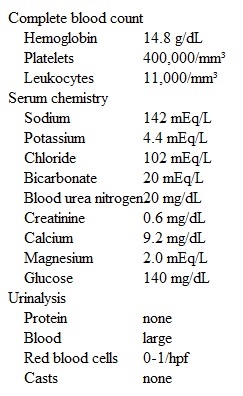 Electrocardiography shows sinus tachycardia. Urine toxicology is positive for phencyclidine. Noncontrast CT scan of the head is normal. Which of the following is most appropriate to prevent an adverse outcome in this patient?
 (Multiple Choice)
4.9/5 (76)
(76) A 26-year-old woman comes to the clinic for routine HIV care. She mentions that she had "low platelets" when she was tested 2 months ago in an emergency department following a minor motor vehicle collision. The patient has no mucosal bleeding and does not bruise easily. Her menses have been normal. Two years ago, she was diagnosed with HIV after attempting to donate blood. The patient has not begun antiretroviral therapy, and she takes a multivitamin daily. Her temperature is 36.9 C (98.4 F), blood pressure is 116/78 mm Hg, pulse is 70/min, and respirations are 14/min. On examination, the patient's nasal and oropharyngeal mucosae appear normal. Her abdomen is nontender and nondistended, but the tip of the spleen is palpable on inspiration. There are no purpura or petechiae. Laboratory results are as follows: 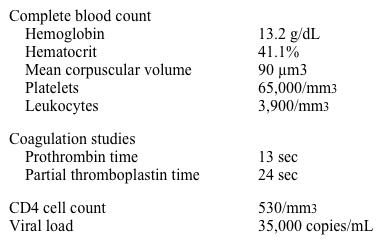 The patient begins antiretroviral therapy with a 3-drug regimen. Viral load and CD4 cell count are monitored as recommended. Assuming she is able to adhere to the 3-drug regimen, which of the following best represents her expected HIV viral load after 6 months of treatment?
 (Multiple Choice)
4.8/5 (80)
(80) A 9-month-old boy is brought to the emergency department by his parents as he is not "acting like himself." The parents report that he has always been a fussy baby and often awakens multiple times a night. However, yesterday he cried the entire night and seemed more tired than usual this morning. The infant typically eats yogurt and formula for breakfast but refused to eat this morning and vomited 3 times. His mother says, "He may have hit his head on the floor after climbing onto and then rolling off the couch 2 days ago. He recently started crawling and often bumps into furniture around the house." The infant was born at term via an uncomplicated vaginal delivery. He was evaluated several times in the emergency department between ages 3 and 5 months for fussiness and was diagnosed with colic. His mother is currently taking antibiotics for bacterial pharyngitis; otherwise, there are no sick contacts or contributory family history. Temperature is 37 C (98.6 F) and pulse is 125/min. Height and weight are at the 75th and 50th percentiles, respectively. On examination, the infant is lethargic. The lungs are clear to auscultation and there are no murmurs. The abdomen is soft and nondistended. A small bruise is present on the buttocks; there are no additional rashes, lesions, or bruises. Item 1 of 2
Which of the following additional findings is most likely present in this patient?
(Multiple Choice)
4.8/5 (75)
(75) A 19-year-old woman comes to the student health center after a sexual assault 2 days ago. She has no fevers, chills, abdominal pain, or abnormal vaginal discharge. The patient was sexually assaulted by a man she has seen multiple times, who also attends the university. Menses are regular and occur every 29 days; her last menstrual period was 2 weeks ago. She has no known medical conditions and has had no surgeries. The patient takes no medications and has no drug allergies. She smokes cigarettes and drinks alcohol socially. There is no family history of any illness. She is sexually active with a long-term male partner, and they use condoms for contraception. The patient has no history of sexually transmitted infections. Temperature is 36.7 C (98 F), blood pressure is 110/70 mm Hg, and pulse is 65/min. BMI is 20 kg/m2. The abdomen is soft and nontender, with no palpable masses. Bruises and abrasions are present over the inner thighs, perineum, and vulva. Pelvic examination reveals a friable cervix that bleeds easily on contact. The vaginal mucosa is erythematous with no evidence of hematoma. The uterus is small and nontender on bimanual examination; no adnexal masses are palpated. Microscopy shows an abundance of polymorphonuclear leukocytes. Urine pregnancy test is negative.
A sexual assault forensic examination is performed and evidence is collected. In addition to providing psychosocial support, which of the following is the most appropriate next step in management of this patient?
(Multiple Choice)
5.0/5 (87)
(87) A 79-year-old man comes to the physician with his daughter for memory loss over the last 8-12 months. She initially noticed that he had trouble with forgetfulness, followed by distractibility and difficulty with word finding and object recognition. The patient is currently dependent on her for most independent activities of daily living, including transportation and finances. He is able to dress, bathe, and toilet himself. His gait has been unstable, and he sometimes seems to get "stuck in a chair." On review of systems, he notes urinary urgency, frequency, and incontinence. He has a history of benign prostatic hyperplasia for which he takes tamsulosin. The patient has no tremor, problems with sleep, weakness, hallucinations, or sensory disturbances. On examination, his vital signs are normal. He is oriented to self only. On mental status examination, he has impairments in language, visuospatial skills, and executive function. His cranial nerves are intact. There is normal bulk and tone of the musculature. His gait is wide based and magnetic. He has decreased stride length and a slow turn requiring several steps. Laboratory results, including TSH and vitamin B12, are normal. Brain imaging is shown in the image below. 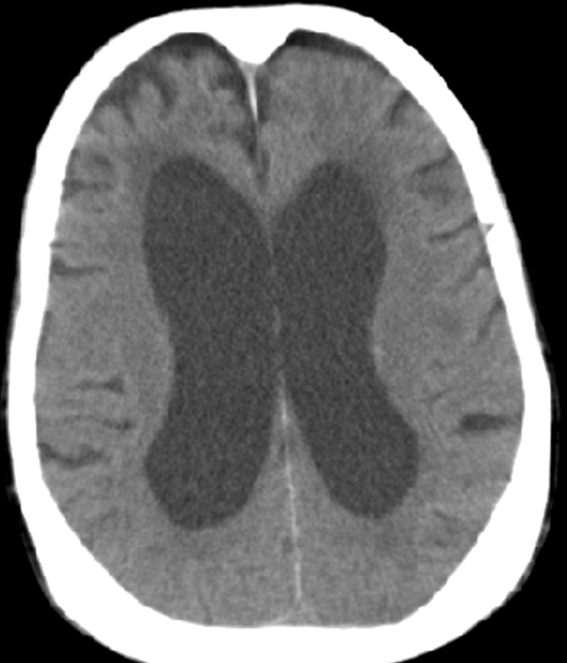 Which of the following is the most appropriate next step in management of this patient?
 (Multiple Choice)
4.8/5 (96)
(96) A 44-year-old man comes to the office due to progressive shortness of breath over the last 6 months. The patient says that lately he has been unable to walk even 2 blocks without stopping to rest. He finds this very unusual as one year ago he used to jog for 2 miles almost daily with no symptoms. The patient reports no chronic health problems and takes no medications. He is a lifetime nonsmoker and does not drink alcohol or use illicit drugs. The patient has no family history of premature cardiovascular disease or sudden cardiac death. Blood pressure is 138/80 mm Hg and pulse is 85/min and regular. BMI is 30 kg/m2. Lungs are clear on auscultation. The point of maximal impulse is displaced to the left. There is normal splitting of S2 with presence of S3. A 3/6 holosystolic murmur is heard at the apex following a click. There are no carotid bruits. There is trace peripheral edema. Transthoracic echocardiogram is performed, which shows left ventricular and left atrial dilation. There is a flail segment of the posterior mitral leaflet with severe eccentric mitral regurgitation. Left ventricular ejection fraction is 55%. There are no other significant valvular abnormalities. Which of the following best describes this patient's condition?
(Multiple Choice)
4.9/5 (76)
(76) A 76-year-old woman, gravida 4 para 4, comes to the office with pelvic pressure and heaviness, lower back pain, and constipation. Her constipation has not improved with daily laxative use. She has no melena, hematochezia, or changes in stool caliber. The patient has hypertension and peptic ulcer disease controlled with oral medications. Surgical history is significant only for an appendectomy. A screening colonoscopy performed 2 years ago was negative. Her mother had coronary artery disease and died from a myocardial infarction. The patient has a 52-pack-year smoking history and occasionally drinks hard liquor. Temperature is 36.7 C (98 F), blood pressure is 140/90 mm Hg, and pulse is 72/min. Pulse oximetry is 98% on room air. BMI is 35 kg/m2. Cardiac examination reveals a normal rate and rhythm; there are no rubs, murmurs, or gallops. Pulmonary examination reveals decreased breath sounds in bilateral lung bases. On pelvic examination, a protrusion of the posterior vaginal wall expands with increased intraabdominal pressure and with standing. The patient is bothered by these symptoms. Which of the following is the most accurate statement regarding this patient's condition?
(Multiple Choice)
4.9/5 (76)
(76) Paramedics bring a 24-year-old man who was involved in a motor vehicle accident to the emergency department of a small community hospital. At the accident scene, the medics noted that he had sustained a traumatic amputation of his right thumb. They were able to retrieve the severed digit and bring it to the hospital. The patient undergoes initial wound care and hemostasis with a compression dressing. The hospital does not have a facility for digit replantation and reconstructive surgery, and a decision is made to transfer the patient to a nearby tertiary care center. Five minutes later, the nurse asks, "How do you want me to preserve his severed digit?"
Which of the following is the most appropriate response?
(Multiple Choice)
4.9/5 (85)
(85) In three months, his repeat hemoglobin level is 19.0 g/dL. His oxygen saturation in the office is 95% on room air. His carboxyhemoglobin level is normal and serum erythropoietin level is elevated. Iron studies and serum folate and vitamin B12 levels are all normal. Urinalysis shows no blood, no RBCs, and trace protein. Which of the following is the best next step in managing this patient?
(Multiple Choice)
4.8/5 (79)
(79) A 60-year-old woman is brought to the emergency department following a motor vehicle accident. She hit a car from her side and claims that she did not see another car coming towards her. This accident took place at a small intersection with little traffic. Her past medical history is significant for Cushing's disease and an intra-abdominal operation 15 years ago for the disease. Physical examination showed a tanned female with normal vital signs. She has a few abrasions on her face and chest. Ophthalmologic examination reveals bitemporal hemianopsia. Her injuries are managed appropriately.
What is the most likely diagnosis?
(Multiple Choice)
4.8/5 (89)
(89) A 45-year-old man is brought to the emergency department by his wife due to progressive lethargy, confusion, and abdominal pain. He has had no hematemesis, melena, or hematochezia. The patient has a history of alcoholic cirrhosis. He had a variceal hemorrhage 2 months ago and has been treated previously for hepatic encephalopathy. The patient takes nadolol, furosemide, spironolactone, and lactulose at home. There have been no changes in his dietary intake, and he has not used any over-the-counter medicines or herbal supplements. He still occasionally drinks alcohol but does not use tobacco or illicit drugs. Temperature is 38 C (100.4 F), blood pressure is 104/60 mm Hg, and pulse is 96/min. The patient is cachectic and somnolent, and he wakes up with painful stimuli. He has a flapping tremor of both hands, and the speech is slurred and incomprehensible. Mucous membranes are dry, and he has scleral icterus. Several spider angiomata are present on the upper torso. The lungs are clear to auscultation, and heart sounds are normal with no murmur. The abdomen is distended and tense with large abdominal wall collaterals. There is a fluid wave and diffuse tenderness but no rebound tenderness. Bowel sounds are decreased. Stool occult blood is negative. Laboratory results are as follows:
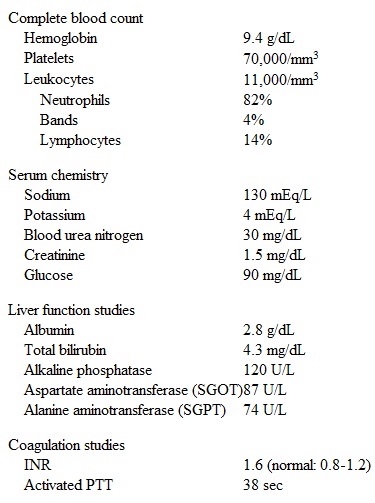 A diagnostic paracentesis is performed, and the ascitic fluid results are as follows:
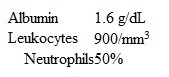 The patient is hospitalized, and appropriate therapy is started. The patient's wife inquires about his overall prognosis. Which of the following is the most useful indicator for 90-day mortality in this patient?
A diagnostic paracentesis is performed, and the ascitic fluid results are as follows: The patient is hospitalized, and appropriate therapy is started. The patient's wife inquires about his overall prognosis. Which of the following is the most useful indicator for 90-day mortality in this patient? (Multiple Choice)
4.7/5 (78)
(78) A 64-year-old man admitted to a rehabilitation facility after right total knee replacement develops sudden-onset chest pain and shortness of breath on postoperative day 5. He has been receiving heparin for prophylaxis of deep vein thrombosis. Two months ago, he was hospitalized for pneumonia and improved with 1 week of antibiotics. Examination shows clear lungs and normal heart sounds. Cardiac enzymes are normal. ECG shows sinus tachycardia. CT angiogram reveals pulmonary embolism. Complete blood count shows platelets of 45,000/mm3. Prior to the knee surgery, his platelet count was 170,000/mm3. Heparin is discontinued and argatroban is started. Which of the following is the best approach for this patient?
(Multiple Choice)
4.9/5 (91)
(91) A 3-year-old girl is brought to the clinic for evaluation of a lump on her left axilla. Her parents first noticed the lump 3 days ago; they placed cold compresses on the mass with no relief. The mass is now tender to the touch but has not changed in size or had any discharge. The patient had a fever a few weeks ago but it resolved after several days; she is otherwise healthy. Immunizations are up to date. She attends day care and has 2 dogs and a kitten at home. Temperature is 37.8 C (100 F). The child is alert and appears in no acute distress. Examination of the axilla shows a warm, tender, mobile left axillary lymph node that is approximately 2 cm (0.8 in) in diameter. Cardiac examination reveals no murmurs. The lungs are clear to auscultation bilaterally. The abdomen is soft, nontender, and without hepatosplenomegaly. The left index finger has a small erythematous, painless papule on the dorsal aspect. Both hands and arms have several superficial linear abrasions. In addition to clindamycin, which of the following is the most appropriate pharmacotherapy for this patient?
(Multiple Choice)
4.9/5 (74)
(74) Showing 981 - 1000 of 1121

Filters
- Essay(0)
- Multiple Choice(0)
- Short Answer(0)
- True False(0)
- Matching(0)