



 Chat with AI
Exam 1: Advanced Clinical Medicine

Exam 1: Advanced Clinical Medicine1 k+ Questions
Exam 2: Foundations of Independent Practice597 Questions
Select questions type


A 3-year-old Caucasian boy is brought to your office by his mother with complaints of irritability and decreased appetite. The mother says that the boy seems weak and has been less active over the last several weeks. The patient regularly spends some time outside the house under the supervision of his older brother, and the brother saw him eating cement and woodwork several times. The patient's past medical history is insignificant. He has no known allergies. All his vaccinations are up-to-date. He received iron and vitamin D supplements. His vital signs are stable. Physical examination reveals a non-distended abdomen with periumbilical tenderness. What is the best next step in the management of this patient?
(Multiple Choice)
4.9/5  (84)
(84) A 58-year-old woman comes to the physician for a preoperative evaluation 2 weeks prior to an elective left knee replacement for severe osteoarthritis. Her other medical problems include hypertension, type 2 diabetes, hyperlipidemia, chronic obstructive pulmonary disease, osteoporosis, and gastroesophageal reflux disease. Her medications include amlodipine, atorvastatin, calcium carbonate, metformin, metoprolol, raloxifene, ramipril, pantoprazole, and daily salmeterol and ipratropium bromide metered-dose inhalers. She has no known drug allergies. She does not use tobacco, alcohol, or illicit drugs. Family history is not significant. Her blood pressure is 144/86 mm Hg, pulse is 62/min, and respirations are 12/min. Her BMI is 29 kg/m2. Physical examination shows left knee crepitus. Her serum creatinine level is 1.0 mg/dL. Which of the following medications should be discontinued now in preparation for the surgery?
(Multiple Choice)
4.7/5 (73)
(73) A 55-year-old woman is admitted to the hospital for vomiting resulting in hypokalemia and acute kidney injury. She has had nausea and vomiting after meals for the last several months; these have become progressively more severe. The symptoms are associated with dull abdominal pain and improve with fasting. Five years ago, the patient was diagnosed with type 2 diabetes mellitus for which she takes insulin. However, she reports often missing doses. Her most recent hemoglobin A1c is 10.1%. The patient has no known allergies. She does not use tobacco, alcohol, or recreational drugs. She is given intravenous hydration with electrolyte repletion, and her symptoms are improved with metoclopramide and ondansetron. In the evening, she calls urgently to the nurse for help. The patient reports sudden inability to move her neck to the left and says there were no preceding symptoms such as numbness, tingling, weakness, or anxiety. Temperature is 36.5 C (97.7 C), pulse is 115/min, blood pressure is 160/100 mm Hg, and respirations are 25/min. The patient is in distress but is able to speak with a normal voice. Auscultation reveals normal S1 and S2 and a regular, fast rhythm. Her neck is in a flexed position and rotated toward the right. The muscles of the neck are tense, but the remainder of the examination is normal. Which of the following is the most appropriate next step in management of this patient?
(Multiple Choice)
4.8/5 (81)
(81) A 13-month-old girl is brought to the office by her maternal grandmother for a well-child visit. The grandmother is the girl's primary caregiver while the parents work full-time. The girl is happy and active, but the grandmother is concerned that she is not yet walking. When she takes the child to the playground, the girl crawls and cruises along the playground equipment. The child wears sunscreen and a wide-brim hat outdoors. Every day, the child is fed expressed breast milk in a cup and eats a variety of foods, including meat, fruit, and dark-green vegetables. She also eats yogurt but refuses to drink cow's milk. The child takes an oral vitamin D supplement daily and no daily medications. Medical history is significant for a cesarean delivery at 39 weeks gestation for breech presentation. Weight and length are at the 65th and 30th percentiles, respectively. Physical examination shows equal leg lengths. Bilateral hip, knee, and ankle joints have full range of motion. When the patient stands with her feet together, a symmetric, mild tibiofemoral outward bend results in a gap between the knees. The child is able to stand for only a few seconds before she falls to the ground and resumes crawling. Which of the following is the best next step in management of this patient?
(Multiple Choice)
4.9/5 (80)
(80) A 30-year-old woman, gravida 1 para 0, at 34 weeks gestation comes to the office for a prenatal visit. The patient reports no abdominal pain, vaginal bleeding, or leakage of fluid. Fetal movement is normal. The patient has had urinary frequency throughout her pregnancy, but it has worsened over the last 4 days and is now associated with dysuria. She has no fevers, chills, nausea, vomiting, back pain, or hematuria. The pregnancy has been uncomplicated. The patient has no history of chronic medical conditions and has had no previous surgery. She takes a daily prenatal vitamin. The patient smokes half a pack of cigarettes a day but does not use alcohol or illicit drugs. Temperature is 36.7 C (98.0 F), blood pressure is 126/78 mm Hg, pulse is 76/min, and respirations are 18/min. BMI is 28 kg/m2. Fetal heart rate is 140/min. On physical examination, the uterus is nontender and fundal height is 34 cm. Suprapubic tenderness is elicited with deep palpation. There is no costovertebral angle tenderness. Laboratory results are as follows: 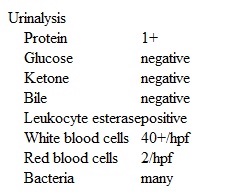 Item 1 of 2 Which of the following is the most appropriate medication for this patient's condition?
 (Multiple Choice)
4.9/5 (76)
(76) A 31-year-old man with diabetes comes to the emergency department with abdominal discomfort, nausea, and vomiting. He has not felt well for the past 2 days and has had intractable vomiting. The patient stopped taking his regular dose of insulin as he was unable to "hold anything down." His initial laboratory results are positive for serum ketones and show blood glucose of 360 mg/dL. In the emergency department, he is started on intravenous normal saline with potassium and a continuous insulin infusion. Five hours after his admission to the intensive care unit, he feels better. Laboratory results are as follows:
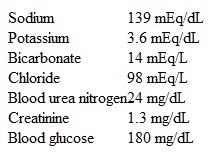 Ten hours after admission, the patient feels better. He has had no vomiting over the last several hours and his abdominal discomfort has subsided. He is tolerating oral fluid. The patient is currently on an insulin infusion and intravenous fluids. Repeat laboratory results are as follows:
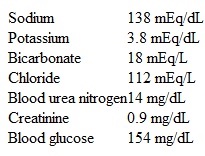 Which of the following is the most appropriate next step in management of this patient?
Ten hours after admission, the patient feels better. He has had no vomiting over the last several hours and his abdominal discomfort has subsided. He is tolerating oral fluid. The patient is currently on an insulin infusion and intravenous fluids. Repeat laboratory results are as follows: Which of the following is the most appropriate next step in management of this patient? (Multiple Choice)
4.7/5 (81)
(81) An 18-year-old high school senior is brought to the emergency room after she was involved in a motor vehicle accident. Upon her arrival to the emergency room, she is minimally responsive, and there is evidence of bleeding from the right side of her head. Her vital signs are as follows: temperature 37.6C (99.6F), blood pressure 182/98 mmHg, heart rate 52 per minute and respiratory rate 6 per minute. Her oxygen saturation is 96% on two liters of oxygen. Her breath smells of alcohol. Physical examination reveals a right pupillary size of 7 mm with minimal response to light. The left pupil is 3 mm with normal pupillary light reflex. The right eye is deviated outwards and downwards. There is bilateral papilledema on funduscopic examination. While in the ER, the patient had an episode of generalized body extension, with adduction and pronation of her upper extremities. There is no evidence of any thoracic or abdominal injuries. Which of the following is the most appropriate next step in the management of this patient?
(Multiple Choice)
4.8/5 (78)
(78) A 40-year-old woman comes to the clinic after noticing a small swelling in the front of her neck. She has no pain, dysphagia, hoarseness, or difficulty breathing. She also has no hyper- or hypothyroid symptoms such as heat or cold intolerance, fatigue, or weight changes. Physical examination shows a mobile nodule in her left thyroid lobe. The patient has no history of neck irradiation or family history of thyroid illness. She currently takes no medications. The rest of the physical examination is unremarkable.
Which of the following is the best next step in evaluation of this patient?
(Multiple Choice)
4.8/5 (70)
(70) A 42-year-old man comes to the office due to insomnia for the past month. He often awakens in the middle of the night anxious about his job performance and is unable to go back to sleep. He says, "I think I'm getting only 5 hours of sleep. All I really need is something to knock me out." The patient is an accountant for a furniture store; he has been very tired at work and has difficulty concentrating from lack of sleep. He adds, "Last month I made several accounting errors. My boss was really understanding about it, but he isn't going to be understanding for long if I keep making mistakes." Further questioning indicates that the patient has not felt like himself for several months. He has been uncharacteristically irritable with his wife and children and has lost interest in going to the gym and socializing with his friends and coworkers. On weekends, he stays in bed until noon and then lies on the couch for the rest of the day. The patient believes it is inevitable that he will lose his job and feels very guilty that he is letting his family down. He has no medical or psychiatric history. There is a family history of Sjögren syndrome in his mother and obesity, hypertension, and heart disease in his father and paternal grandfather. He says, "If I can just get some sleep, maybe things will be better." Physical examination and laboratory test results are unremarkable. Which of the following is the most appropriate next step in management of this patient?
(Multiple Choice)
4.8/5 (84)
(84) A 50-year-old Caucasian female presents to your office with a six month history of periodic involuntary closure of her right eye. The closure is provoked by bright light or cigarette smoke. Her past medical history is significant for osteoarthritis of her left knee. She takes naproxen occasionally. The attempt to check the pupillary reaction induces prolonged closure of the right eye. Otherwise, the neurologic examination is normal. Which of the following is the next best step in the management of this patient?
(Multiple Choice)
4.7/5 (87)
(87) A 46-year-old African-American male has a large pituitary mass, which was seen on a CT scan of his head following a head injury. He denies any symptoms, except for mild erectile impotence. Physical examination reveals a right, upper, temporal, quadrantic field defect. His hormonal profile shows a prolactin level of 5,000 ng/mL (normal 5-20 ng/ml). His IGF-1, TSH, and free T4 levels are normal, while his LH and FSH levels are low. MRI reveals a 2.5 cm pituitary mass abutting, but not elevating, the optic chiasm. What is the most appropriate management for this patient?
(Multiple Choice)
4.7/5 (83)
(83) A 32-year-old woman comes to the office due to 3 days of sore throat and cough productive of white sputum. She has also had malaise, nausea, and headache but no shortness of breath. No close contacts have had similar symptoms. The patient has a history of hypertension and acne; she takes lisinopril and uses benzoyl peroxide cream. She does not use tobacco, alcohol, or illicit drugs. The patient is monogamous with her husband. Family history is significant for chronic kidney disease in her father. She is allergic to penicillin, which causes a rash. Temperature is 38.6 C (101.5 F), blood pressure is 122/70 mm Hg, pulse is 83/min, and respirations are 14/min. Oropharyngeal examination reveals pharyngeal erythema, palatal petechiae, and bilateral white, patchy tonsillar exudates. There are 2 tender, 1.5-cm lymph nodes in the anterior cervical chain. The lungs are clear to auscultation. The abdomen is soft and nontender. No other lymphadenopathy, organomegaly, or rashes are present. The remainder of the physical examination is normal. Which of the following is the most appropriate course of action in management of this patient?
(Multiple Choice)
4.9/5 (74)
(74) A 34-year-old woman comes to the office to discuss a recent diagnosis of HIV infection. The patient recently donated blood and later received a letter indicating a positive HIV test. She has no symptoms besides feeling anxious about the diagnosis. The patient had an episode of chlamydia cervicitis 5 years ago, and HIV testing was negative at that time. She has had several sexual partners in her lifetime but has been in a monogamous relationship for the past year. She drinks 1-2 glasses of wine at social events and does not use tobacco or illicit drugs. Vital signs are within normal limits. Physical examination findings are normal. Laboratory results are as follows: 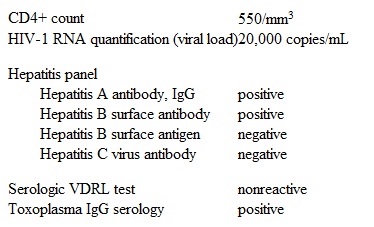 Which of the following is the most appropriate next step in management of this patient?
 (Multiple Choice)
4.9/5 (80)
(80) A 34-year-old man is brought to the emergency department due to 3 weeks of intermittent fever, headache, malaise, and night sweats. Over the last few days, his headaches have worsened, and he has had blurry and double vision. The patient uses injection drugs and was treated for staphylococcal endocarditis 4 years ago. Temperature is 38.1 C (100.6 F), blood pressure is 150/100 mm Hg, pulse is 66/min, and respirations are 18/min. BMI is 18.4 kg/m2. The patient is ill in appearance and somnolent but easily arousable and oriented. There are white plaques on the oropharyngeal mucosa and several skin lesions resembling molluscum contagiosum. There is increased resistance to passive neck flexion. Neurologic examination reveals leftward gaze restriction in the left eye but no other focal weakness or sensory loss. Funduscopy reveals bilateral papilledema. A noncontrast CT scan of the head shows no abnormalities. The patient receives a lumbar puncture; results of the spinal fluid analysis are as follows: 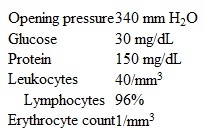 Two weeks after the treatment is started, the patient's symptoms improve and a repeat spinal fluid culture is negative. Which of the following is the best next step in management of this patient?
 (Multiple Choice)
4.9/5 (90)
(90) A 32-year-old male was admitted to the orthopedic department after being involved in a motor vehicle accident. His initial injuries included a transverse fracture of the right femur, tibia, fibula, and a comminuted fracture of the left femur shaft. The secondary survey revealed no other fracture or injuries. Thirty-six hours after admission, the patient complains of shortness of breath. His blood pressure is 112/76 mmHg, heart rate is 95/min, respirations are 34/min, and temperature is 37.9 C (100.1 F). His oxygen saturation on 3L per nasal cannula is 88%. Physical examination reveals a petechial rash on his head, neck, anterior thorax, and axilla. He appears confused. The portable chest x-ray reveals a right lower lobe patchy consolidation. Emergency V/Q scan shows a mottled pattern of sub-segmental perfusion defects with normal ventilation. Which of the following would have prevented this complication in this patient?
(Multiple Choice)
4.8/5 (84)
(84) A 72-year-old woman is being treated in the intensive care unit for lobar pneumonia, septic shock, and respiratory failure with intravenous fluids, antibiotics, vasopressors, and mechanical ventilation. Her condition is improving and she is extubated on day 5. Within a few minutes of extubation, the patient develops stridor and is given intravenous dexamethasone and nebulized epinephrine. Her current examination shows blood pressure of 148/86 mm Hg, pulse of 102/min, and respirations of 30/min. Pulse oximetry shows 94% on nonrebreather mask. She has audible stridor and labored breathing with use of accessory muscles of respiration. Which of the following is the best next step in management of this patient?
(Multiple Choice)
5.0/5 (90)
(90) A study evaluated predictors of adverse outcomes in geriatric patients admitted to the hospital with a hip fracture requiring surgery. The study compared an old multidimensional score (Model 1) with a new classification system (Model 2). The following results were reported: 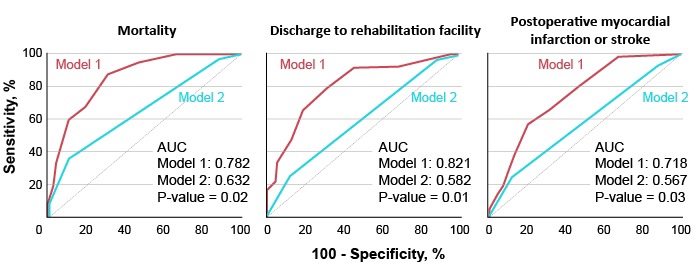 AUC = area under the curve
Which of the following is the best statement about the study results?
AUC = area under the curve
Which of the following is the best statement about the study results? (Multiple Choice)
5.0/5 (77)
(77) A 45-year-old woman comes to the clinic due to blurry vision in the left eye. The patient first noticed some decreased visual acuity 2 days ago and thought she may need a new prescription for her glasses. However, the blurriness has progressively worsened. The patient has no eye pain or foreign body sensation and does not wear contact lenses. Temperature is 36.8 C (98.2 F), blood pressure is 110/78 mm Hg, pulse is 76/min, and respirations are 14/min. On examination, visual acuity is moderately reduced in the left eye. The upper and lower eyelids can fully open and close bilaterally. Corneal esthesiometry reveals decreased sensation of the left cornea. Fluorescein examination shows a large, geographic ulceration and several linear, branched defects overlying the cornea. Dysfunction in which of the following nerves is most likely the cause of this patient's impaired corneal sensation?
(Multiple Choice)
4.8/5 (95)
(95) A 33-year-old woman comes to the office for evaluation of hypercalcemia. She was recently seen in the emergency department for uncomplicated appendicitis and was found to have a serum calcium level of 10.7 mg/dL. The patient underwent a laparoscopic appendectomy and was released the following day. Prior to this, she had not seen a physician in over 7 years. She now feels well and has no other medical problems. The patient has had 2 uneventful pregnancies and her menstrual periods are normal. She is divorced and currently not sexually active. She does not use tobacco, alcohol, or illicit drugs. Her mother has had "a high calcium level for a long time," but the patient does not know if she received any specific treatment. Blood pressure is 123/68 mm Hg and pulse is 87/min with regular rhythm. BMI is 22 kg/m2. Physical examination is normal with well-healing abdominal wounds. Laboratory results are as follows: 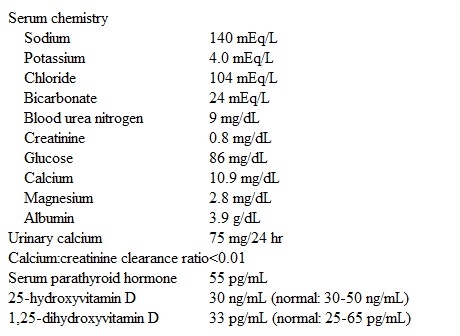 Which of the following is the most appropriate next step in management of this patient?
 (Multiple Choice)
4.9/5 (89)
(89) A 36-year-old man comes to the emergency department due to loss of consciousness. He was standing in a crowded subway station when he felt lightheaded, had a pounding sensation in his chest, and passed out. On awakening, he felt short of breath for a little while and then was "completely fine." He has had no similar episodes, nor chest pain, confusion, tongue biting, or urinary incontinence. The night before, he was at a party with friends and consumed alcohol. Later he was nauseated and had 3 episodes of vomiting and one episode of diarrhea. In the emergency department, blood pressure is 124/68 mm Hg and pulse is 80/min. There is a small laceration above his right eyebrow. Cardiac examination shows normal heart sounds with regular rhythm. The lungs are clear to auscultation. Neurologic examination shows no abnormalities. ECG is shown in the exhibit. 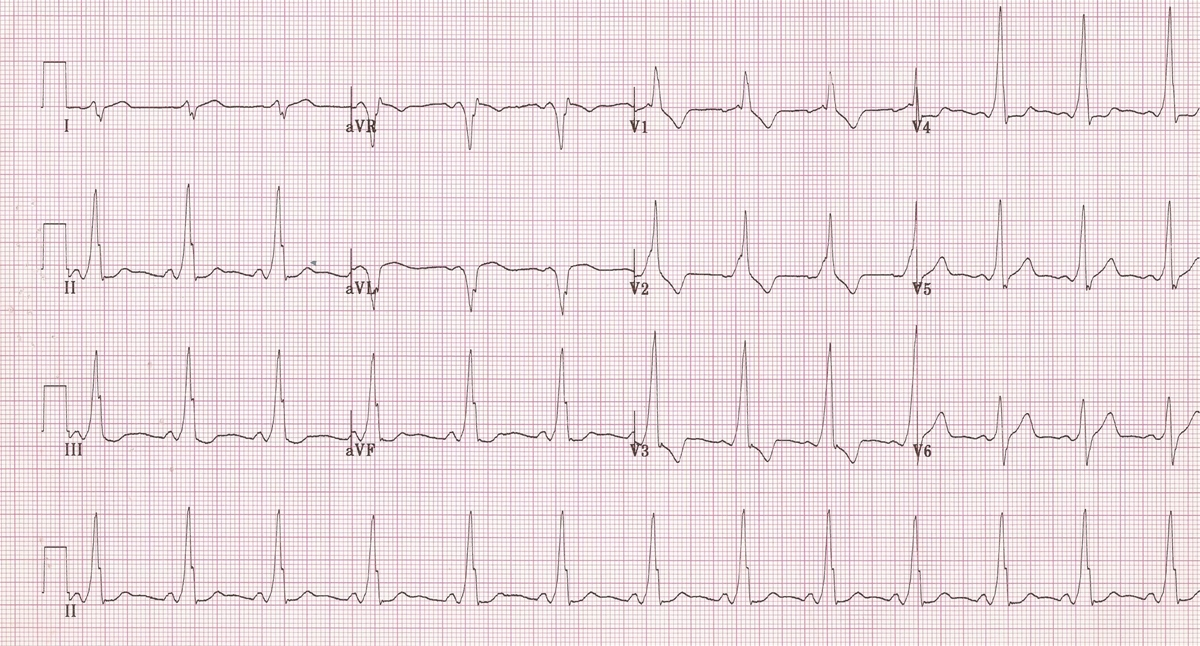 Which of the following is the most likely cause of this patient's syncope?
 (Multiple Choice)
4.8/5 (82)
(82) Showing 821 - 840 of 1121

Filters
- Essay(0)
- Multiple Choice(0)
- Short Answer(0)
- True False(0)
- Matching(0)