



 Chat with AI
Exam 1: Advanced Clinical Medicine

Exam 1: Advanced Clinical Medicine1 k+ Questions
Exam 2: Foundations of Independent Practice597 Questions
Select questions type


A 9-year-old boy is brought to the emergency department for fever and headache. He has had a runny nose, sore throat, and tactile temperatures for the last few days. The patient has a headache that started 2 days ago and has worsened progressively despite taking acetaminophen every 4 hours. After he awoke this morning with vomiting, he appeared confused, which prompted this visit. Two weeks ago, his 4-year-old sister had a febrile illness with rash and mouth sores. The patient has no chronic medical conditions, and immunizations are up to date. Temperature is 39.5 C (103.1 F), blood pressure is 102/62 mm Hg, pulse is 122/min, and respirations are 24/min. He is drowsy but arousable. Pupils are equal and reactive to light, and funduscopic examination is normal. Cardiopulmonary examination is normal. The abdomen is soft and nontender. Bending the patient's neck elicits flexion of his knees and hips. The tone on the right side of the body is increased, and the right arm is weak. Deep tendon reflexes are brisk on the right compared to the left. Which of the following is the best next step in management of this patient?
(Multiple Choice)
4.8/5  (80)
(80) A 46-year-old man comes to the office due to dysuria and a dull, aching pain in the penis and perineal region. The symptoms began 6 months ago and prompted the patient to visit an urgent care center twice. Both times, he received a short course of antibiotics, which improved symptoms temporarily, but they returned within days. The patient has also had pain during ejaculation but no urethral discharge, back pain, abdominal pain, weakness, or incomplete voiding. He is married and monogamous with his wife and has 2 children. He does not use tobacco or illicit drugs but occasionally drinks 1 or 2 beers on weekends. He has no medication allergies and no family history of cancer. Temperature is 37.1 C (98.8 F), blood pressure is 126/84 mm Hg, pulse is 72/min, and respirations are 14/min. Physical examination shows no abdominal or costovertebral angle tenderness. Digital rectal examination reveals a mildly tender prostate that is symmetric and not enlarged. The external genitalia are normal in size and appearance and are nontender to palpation. The most likely diagnosis is discussed with the patient, and he asks what can be done to relieve his symptoms. Which of the following is the most appropriate response to this patient?
(Multiple Choice)
4.9/5 (56)
(56) A 25-year-old African-American medical student comes to see you in the office. His girlfriend noticed an area of circular hair loss over the back of his head. He is concerned that he is losing his hair and will be bald soon. He is otherwise in good health and denies any history of smoking, alcohol, or illicit drug use. He has had a monogamous relationship with his girlfriend for the past three years. On examination, there is a 1 cm area of complete, smooth and circular hair loss with distinct margins. There is no scaling or inflammation present in or around the area of hair loss.
Which of the following is the most likely cause of the above findings?
(Multiple Choice)
4.8/5 (90)
(90) A 60-year-old man is found to have an incidental 3.5-cm abdominal aortic aneurysm on an imaging study. He has no associated symptoms. Past medical history is significant for hypertension, type 2 diabetes, hypercholesterolemia, and hypothyroidism. His medications include aspirin, metformin, glipizide, chlorthalidone, lisinopril, atorvastatin, and levothyroxine. The patient has a 40-pack-year smoking history and continues to smoke 1-2 packs a day. He drinks 3 or 4 glasses of wine daily. His blood pressure is 160/90 mm Hg and pulse is 80/min. Cardiopulmonary examination is within normal limits. Laboratory results are as follows: 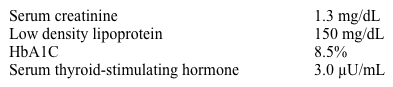 Which of the following interventions would most decrease the likelihood of expansion of this patient's aortic aneurysm?
 (Multiple Choice)
4.8/5 (95)
(95) A 24-year-old woman comes to the office for a routine prenatal visit at 32 weeks gestation. Last week, she was evaluated for postcoital spotting. The cervix was closed, and there was no evidence of preterm labor. Nucleic acid amplification testing (NAAT) performed at that visit was positive for Chlamydia trachomatis. Routine NAAT was negative for C trachomatis at the initial prenatal visit. Today, the patient has no vaginal bleeding, leakage of fluid, or contractions. Fetal movement is normal. She has no chronic medical conditions or previous surgeries. The patient does not use tobacco, alcohol, or illicit drugs. She had 3 sexual partners prior to marriage. She has been in a monogamous relationship with her husband for the last 2 years and is sexually active with him. The patient swims at the local pool regularly but stopped after the episode of vaginal bleeding. Blood pressure is 110/70 mm Hg and pulse is 72/min. Fundal height is 32 cm. Fetal heart rate is 140/min by Doppler ultrasound. Urine dipstick is negative for glucose and protein. The patient is concerned about the results and wonders how she acquired the infection during her pregnancy.
If left untreated, this patient is at increased risk for which of the following pregnancy complications?
(Multiple Choice)
4.9/5 (77)
(77) A 44-year-old male was found to have a fasting finger stick blood glucose level of 110 mg/dl. His fasting blood sugar levels were measured twice in the laboratory, and are 112 and 114 mg/dl, respectively. He denies any symptoms or past medical problems. He does not smoke or drink. He has a strong family history of diabetes mellitus. His physical examination, including weight and blood pressure, is unremarkable. His HDL cholesterol is 42 mg/dl and LDL cholesterol is 128 mg/dl. His HbA1c is 5.9%. Urinalysis is unremarkable. The findings described above put the patient at an increased risk of which of the following?
(Multiple Choice)
4.8/5 (63)
(63) A 21-year-old man is seen in the clinic for a routine checkup. He is a cyclist and was asked by his trainer to see a physician due to a "slow heartbeat." The patient describes intense physical activity in preparation for tournaments and has no symptoms. Specifically, he has no chest pain, shortness of breath, lightheadedness, presyncope, or syncope. His family history is unremarkable. He does not take any medications or use performance-enhancing drugs. Blood pressure is 123/72 mm Hg and pulse is 46/min. No cardiac murmurs are heard in the supine or upright positions. There are no additional heart sounds. The lungs are clear on auscultation. Pulses are full and symmetric, and there is no peripheral edema. ECG shows sinus bradycardia at 48/min. The PR interval is prolonged at 250 msec, consistent with first-degree atrioventricular block. QRS complexes are normal with no repolarization abnormalities, and QTc interval duration is normal at 400 msec. Which of the following is the best next step in management of this patient?
(Multiple Choice)
4.8/5 (87)
(87) A 26-year-old day care worker comes to the clinic after prolonged close contact with a child who has meningococcal meningitis. She has a history of irritable bowel syndrome. The patient's current medications include oral contraceptives and a multivitamin. She is concerned about her risk for acquiring meningitis and asks for advice. Which of the following is the most appropriate next step?
(Multiple Choice)
4.9/5 (91)
(91) A 42-year-old female complains of occasional nagging midabdominal pain. She describes the pain as crampy in quality and states that it is relieved by bowel movements. Sometimes the pain wakes her from sleep. She denies any associated nausea, vomiting, chest pain, fever or weight loss. She is otherwise healthy. Her blood pressure is 130/80 mmHg and her heart rate is 85/min. Physical examination is essentially unremarkable. Abdominal CT scan shows a right-sided adrenal mass measuring 2 cm in diameter. Which of the following is the best next step in managing this patient?
(Multiple Choice)
4.9/5 (81)
(81) A 25-year-old man comes to the office with a 2-month history of fatigue, palpitations, sweating, and heat intolerance. The symptoms are becoming more distressing and are keeping the patient awake at night. The patient has no diplopia, eye pain or redness, decreased vision, neck pain, or proximal muscle weakness. Medical history is unremarkable, and he currently takes no medications. He smoked for approximately a year during college but quit after graduation. The patient drinks alcohol socially but does not use recreational drugs. Family history is positive for hypothyroidism in his mother. Temperature is 36.7 C (98 F), blood pressure is 130/70 mm Hg, pulse is 115/min (regular), and respirations are 18/min. Examination shows an anxious, thin man in no acute distress. There is mild lid lag but no conjunctival erythema or proptosis. Extraocular movements and pupillary reflexes are intact. Mild diffuse nontender enlargement of the thyroid gland is noted. The skin is warm and moist. Cardiac examination is unremarkable except for tachycardia. Neurologic examination shows a fine hand tremor and brisk symmetrical reflexes but is otherwise unremarkable. Laboratory tests show normal complete blood count, basic metabolic profile, and urinalysis. Thyroid function test results are as follows: 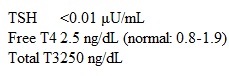 Radioactive iodine uptake at 24 hours is 36% (normal: 8%-25%), and scan shows a diffuse uptake pattern. Serum thyroid-stimulating immunoglobulin level is mildly elevated.
Which of the following is the best next step in management of this patient?
Radioactive iodine uptake at 24 hours is 36% (normal: 8%-25%), and scan shows a diffuse uptake pattern. Serum thyroid-stimulating immunoglobulin level is mildly elevated.
Which of the following is the best next step in management of this patient? (Multiple Choice)
4.8/5 (73)
(73) A 32-year-old woman, gravida 1 para 0, at 19 weeks gestation comes to the emergency department due to vaginal pressure and spotting. Over the last few days, the patient has had clear vaginal discharge for which she has used sanitary napkins. Today she has had increasing pelvic pressure and has noticed blood spots on the sanitary napkins. She has had no cramping or pelvic pain; fetal movement has been normal. The patient's pregnancy was previously uncomplicated; initial prenatal laboratory testing was normal. She was scheduled to have an anatomy ultrasound later in the week. The patient has no chronic medical conditions and has had no previous surgeries. She takes a prenatal vitamin daily and acetaminophen as needed for headaches. She was treated for Chlamydia trachomatis cervicitis at age 20. She does not use tobacco, alcohol, or illicit drugs. Temperature is 36.7 C (98.1 F), blood pressure is 110/70 mm Hg, pulse is 65/min, and respirations are 18/min. Fetal heart rate is 145/min by Doppler ultrasound. Speculum examination shows amniotic membranes bulging at the vaginal introitus. There is no blood or pooling of fluid in the vaginal vault. Nitrazine paper does not turn blue on application of the vaginal discharge. The cervix is 3 cm dilated and 100% effaced on digital examination. Item 1 of 2 Which of the following is the most likely diagnosis in this patient?
(Multiple Choice)
4.8/5 (73)
(73) A 63-year-old man with a history of locoregionally advanced squamous cell carcinoma of the oropharynx is admitted to the hospital for cancer-related pain of the mouth and throat. The pain has slowly increased over the last several days and has limited his ability to eat and drink. The patient has felt weak and believes he is dehydrated. He was diagnosed with cancer 4 months ago and has received several cycles of chemotherapy and radiation therapy, the last of which occurred a week ago. He has been told that his tumor is unresectable. On admission, temperature was 36.1 C (97 F), blood pressure was 105/60 mm Hg, pulse was 108/min, and respirations were 12/min. BMI was 17 kg/m2. Physical examination showed periorbital wasting, dry mucous membranes, and sloughing of the oral mucosa. Absolute neutrophil count was 350/mm3. The patient was admitted to a medical floor and given intravenous pain control; total parenteral nutrition was initiated via a central venous catheter for malnutrition. On day 4 of hospitalization, the patient has a temperature of 39.1 C (102.4 F) and has developed right eye pain and light sensitivity. Funduscopic examination reveals several large, glistening, off-white lesions with indistinct borders. The lesions are 3-dimensional and extend from the chorioretinal surface into the vitreous. A vitreous haze is present and visual acuity is decreased. Which of the following treatment options is likely to be of greatest benefit for this patient's condition?
(Multiple Choice)
4.7/5 (90)
(90) A 28-year-old man with a history of bipolar I disorder is brought to the emergency department after being pulled over by police for driving erratically. The police report indicates that the patient appeared alcohol-intoxicated and refused to cooperate with questions, stating, "I have the skills of a race car driver and a need for speed." He has been on lithium for years and says he has been adherent. The patient has a history of bilateral knee injuries sustained in an accident when he jumped from a high ledge. He has no other medical history. The emergency physician contacts the outpatient psychiatrist, who reports that the patient has been treated with lithium for the past 3 years. He had a therapeutic lithium level and appeared stable at his last visit 2 weeks ago. The patient is re-interviewed when he is sober. He felt upset after his girlfriend left him and was turned down for a job, and so decided to "get drunk." He is apologetic for driving recklessly and says he intends to follow up with his outpatient psychiatrist. Although the patient admits to a history of crack cocaine use, he currently uses no illicit substances other than marijuana on weekends. Temperature is 37.2 C (99 F), blood pressure is 140/80 mm Hg, and pulse is 88/min. Physical examination is normal. The patient is alert, and his speech is nonpressured. Urine toxicology screen is negative for illicit substances. On further questioning, the patient acknowledges that he has been feeling very depressed since losing his job and breaking up with his girlfriend. He has struggled with suicidal thoughts on and off and admits that his previous jump from a ledge was a suicide attempt that occurred during a period of severe depression. He has had no suicidal thoughts for over a year until tonight, when he started drinking. Which of the following questions is the most important to ask the patient at this time?
(Multiple Choice)
4.9/5 (64)
(64) A 36-year-old woman, gravida 3 para 2, at 32 weeks gestation comes to the emergency department due to abdominal pain. The patient's symptoms started a day ago as mild right-sided abdominal pain. Since then, the pain has become increasingly severe and is accompanied by fever, heartburn, and diarrhea. The patient has had no contractions, vaginal bleeding, or leakage of fluid. Fetal movement is normal. The pregnancy has been uncomplicated. She has no chronic medical conditions and has had no surgeries. The patient takes a daily prenatal vitamin and does not use tobacco, alcohol, or illicit drugs. Temperature is 38.9 C (102 F), blood pressure is 140/80 mm Hg, and pulse is 112/min. Fetal heart rate monitor shows a baseline of 160/min, moderate variability, and no decelerations. Tocometry shows no contractions. Cardiopulmonary examination reveals tachycardia but a regular rhythm and no rubs. The lungs are clear to auscultation. Abdominal examination reveals tenderness throughout the right lower quadrant and flank but no uterine fundal or costovertebral angle tenderness. There is no rebound or guarding. McBurney point is nontender. Pelvic examination reveals no adnexal masses or tenderness. Laboratory results are as follows: 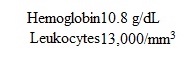 Inadequate treatment would put this patient at increased risk for which of the following complications?
 (Multiple Choice)
4.7/5 (80)
(80) A 36-year-old African American woman comes to the emergency department and complains of a severe, throbbing headache that began several hours ago. She also has acute onset of blurred vision and nausea. She took acetaminophen, which did not provide any relief. She was diagnosed with Raynaud phenomena a few years ago. She recently started having heartburn, for which she takes over-the-counter ranitidine. Her temperature is 36.7C (98.0F), blood pressure is 200/110 mm Hg, and pulse is 94/min. Pulse oximetry showed 94% in room air. There is no abdominal bruit. Ophthalmologic examination demonstrates bilateral papilledema. The laboratory results are as follows: CBC
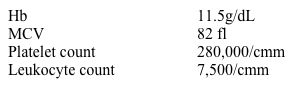 Serum
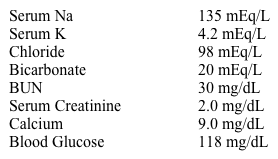 All her routine laboratory values were completely normal six months ago. Her blood pressure during her previous visits was always <140/80 mm Hg. What is the most likely diagnosis of this patient?
Serum
All her routine laboratory values were completely normal six months ago. Her blood pressure during her previous visits was always <140/80 mm Hg. What is the most likely diagnosis of this patient? (Multiple Choice)
4.8/5 (81)
(81) A 64-year-old woman comes to the physician because she has had bilateral foot numbness and burning for the past three months. The symptoms are especially bothersome at night. She has a history of hypertension, coronary artery disease, and type 2 diabetes mellitus. She had an anterior wall myocardial infarction two years ago, which was treated with angioplasty and stenting of the left anterior descending artery. An echocardiogram obtained one year ago revealed an ejection fraction of 40%. She does not use tobacco, alcohol, or drugs. Her medications include metoprolol, furosemide, glyburide, atorvastatin, aspirin, and enalapril. She has been on oral hypoglycemic medications for the last ten years. Her blood pressure is 142/82 mmHg and her heart rate is 63/min. Her BMI is 34 kg/m2. Physical examination shows intact skin over both feet and 2+ peripheral pulses. The patient returns two months later for follow-up. She has persistent symptoms and complains of poor sleep. Her last HbA1c was 7.9% and creatinine was 0.9 mg/dL. Urinalysis shows trace proteinuria. Which of the following is the best management option for this patient?
(Multiple Choice)
4.8/5 (73)
(73) A 4-year-old girl is brought to the emergency department due to fever and lethargy. Her parents say she has been withdrawn and less playful over the last 2 weeks. She has also had several days of low-grade fever and headaches. Since yesterday morning, the patient has mostly slept and seems to be increasingly confused. She has no significant prior medical problems and is up to date with recommended vaccinations. Her grandfather, who is visiting the family from South Asia, is being evaluated for cough; otherwise, the patient has no sick contacts. The family has a pet cat. Temperature is 38 C (100.4 F). The patient is somnolent and responds to painful stimuli. There is resistance to passive neck flexion. Her right eye is deviated medially, and funduscopic examination reveals several ill-defined, raised, yellow-white nodules near the bilateral optic discs. CT scan of the head reveals basilar meningeal enhancement. Lumbar puncture is performed, and cerebrospinal fluid analysis results are as follows: 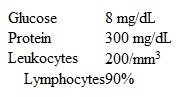 Item 1 of 2 Which of the following is most likely to yield the diagnosis in this patient?
 (Multiple Choice)
5.0/5 (78)
(78) A 78-year-old woman comes to the office with a scab in her left ear that she first felt 2 weeks ago. The lesion is slightly painful. There have been no changes in hearing or recent trauma to the ear. The patient lives alone and cannot see the lesion. Medical history includes essential hypertension. Ear examination is shown in the exhibit. 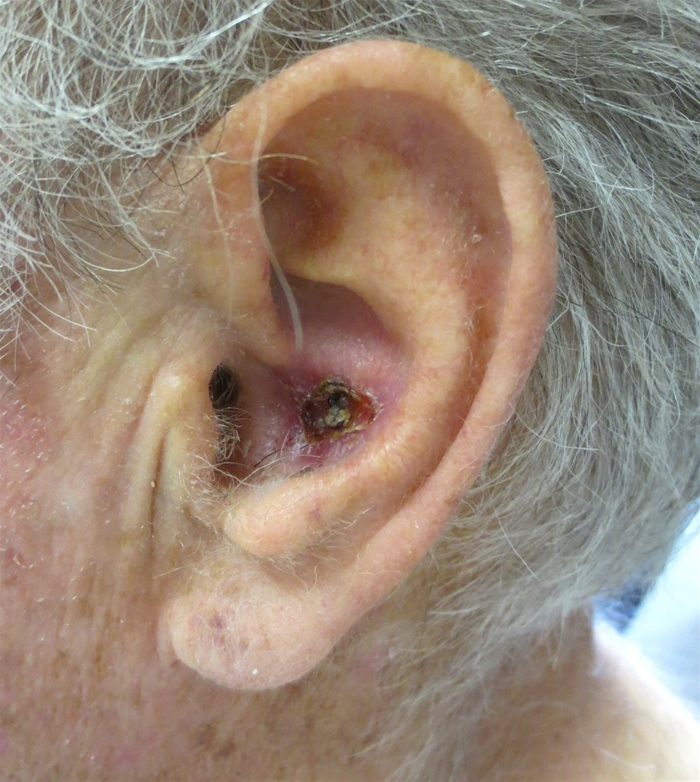 The external auditory meatus and tympanic membrane are normal. There is no lymphadenopathy in the head or neck. Biopsy shows invasive squamous cell carcinoma. Which of the following is the most appropriate treatment for this patient's condition?
 (Multiple Choice)
4.8/5 (88)
(88) A 29-year-old woman comes to the emergency department with lower abdominal pain that woke her up 7 hours ago and has not been relieved by acetaminophen. Movement and deep inspiration make the pain worse. The patient has no chronic medical conditions. She underwent a laparoscopic appendectomy at age 14. She is sexually active and uses condoms for contraception. The patient's last menstrual period was 5 weeks ago, but she has had intermittent vaginal spotting the last few days. She smokes a pack of cigarettes daily but does not use alcohol or illicit drugs. The patient has no known drug allergies. Temperature is 37.2 C (99 F), blood pressure is 84/60 mm Hg, pulse is 124/min, and respirations are 18/min. Cardiac examination shows tachycardia with a normal rhythm; there are no murmurs. The lungs are clear to auscultation bilaterally. Bowel sounds are decreased, and the abdomen is diffusely tender and rigid, with rebound and guarding. Pelvic examination shows cervical motion tenderness and diffuse uterine and adnexal tenderness. Laboratory results are as follows:  In addition to appropriate supportive care, which of the following is the best next step in management of this patient?
 (Multiple Choice)
4.9/5 (75)
(75) A 56-year-old woman comes to the emergency department with sudden-onset, severe pain on the left side of her abdomen. It is accompanied by nausea. The pain waxes and wanes in intensity, and she cannot find a comfortable position. Her temperature is 36.7 C (98 F), blood pressure is 140/90 mm Hg, and pulse is 104 /min. BMI is 28 kg/m2. The cardiopulmonary examination is normal. There is no costovertebral angle tenderness. Serum creatinine and urine analysis are within normal limits. A CT scan of the abdomen shows an 8-mm stone in the left mid ureter with no hydronephrosis. The patient is started on normal saline at 100 mL/hr and receives analgesics. Her pain and nausea improve substantially. Which of the following is the most appropriate next step in management?
(Multiple Choice)
5.0/5 (83)
(83) Showing 321 - 340 of 1121

Filters
- Essay(0)
- Multiple Choice(0)
- Short Answer(0)
- True False(0)
- Matching(0)