



 Chat with AI
Exam 1: Advanced Clinical Medicine

Exam 1: Advanced Clinical Medicine1 k+ Questions
Exam 2: Foundations of Independent Practice597 Questions
Select questions type


A 75-year-old man is admitted to the intensive care unit due to septic shock and acute respiratory distress syndrome. The patient's medical history is significant for relapsed refractory multiple myeloma and malignant bone pain requiring long-term opioid therapy. Despite a prolonged course of mechanical ventilation, his condition deteriorates; he is transitioned to comfort-oriented care in accordance with his advance directive. The patient is extubated to a simple oxygen face mask. Morphine is administered intravenously to ease air hunger, and glycopyrrolate is given to reduce heavy secretions. Thirty minutes later, he is gurgling loudly. Pulse is 118/min and respirations are 8/min. Oxygen saturation is 90%. Examination reveals a cachectic, obtunded man with irregular, rattling respirations. Pupils are pinpoint bilaterally. Skin is diaphoretic. In addition to suctioning the oropharynx, what is the most appropriate next step in management at this time?
(Multiple Choice)
4.8/5  (71)
(71) A 48-year-old man comes to the emergency department due to a 3-day history of worsening low back pain. He had no significant trauma to account for the pain, which started after he drove 12 hours in a day while returning from vacation. The patient says, "As long as I stay in bed or in a recliner, it's okay, but if I twist, bend over, or stand up too fast the pain is excruciating." He has tried using a heating pad with no relief. Medical history is unremarkable, and he takes no medications. Vital signs are normal. Examination shows reduced lumbar lordosis and tenderness in the right midlumbar paraspinal area. Motor strength, reflexes, and sensation in the lower extremities are normal. With the patient supine and the knee extended, lifting the right leg over 60 degrees elicits achy pain in the posterior thigh. Which of the following is the most appropriate next step in management?
(Multiple Choice)
4.8/5 (73)
(73) A 58-year-old male presents to your clinic with a two-month history of a change in voice. He has had no stridor or respiratory difficulty, and denies hemoptysis, dysphagia, odynophagia, weight loss, or otalgia. His past medical history is significant for 38 pack years of cigarette smoking. His voice is slightly hoarse (raspy). He has no palpable lymphadenopathy in the neck. Fiberoptic laryngoscopy reveals a 4 mm diameter, exophytic, cauliflower-shaped and beige-colored mass on the mid free margin of the left true vocal cord. A neck CT scan is negative for lymph node enlargement. You refer the patient to an otolaryngologist, whose biopsy of the lesion reveals stage T1a (limited to one vocal cord) squamous cell carcinoma. A metastatic survey is negative. Regarding his treatment, you inform the patient that he will at least require which of the following?
(Multiple Choice)
4.9/5 (94)
(94) A 63-year-old man comes to the office due to shortness of breath on mild exertion over the last 6 months. He has no chest pain, syncope, palpitations, or weight loss. The patient has ischemic cardiomyopathy, and he underwent coronary artery bypass grafting a year ago. He is receiving guideline-based optimal pharmacotherapy for heart failure. He appears comfortable at rest with no significant respiratory distress. Blood pressure is 122/80 mm Hg and pulse is 62/min and regular. Oxygen saturation is 96% on room air. S3 is heard at the apex. Scattered bibasilar crackles are heard at the lung bases. Abdominal examination is unremarkable. There is 1+ lower extremity edema bilaterally. Laboratory results are as follows: 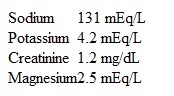 Transthoracic echocardiography shows left ventricular dilation with a left ventricular ejection fraction of 25%. Which of the following ECG findings would be an indication for further management in this patient?
 (Multiple Choice)
4.8/5 (82)
(82) A 24-year-old man comes to the office for a follow-up visit. His paternal grandfather died at age 45 from Huntington disease. The patient says, "I don't know if my father has the condition because whenever I bring it up he shuts down and doesn't want to talk about it. I know that if my father has the disease I could be at risk and so could my sister, who is 2 years younger. I don't want to spend the next 20 years worrying about whether I will get sick." The physician educates the patient about the course and genetics of Huntington disease and orders genetic testing at the patient's request. The results are positive for Huntington disease. Despite the physician's recommendation that the patient consider disclosing these results to family members, he refuses, stating that he prefers to keep this information from his family, which includes his father, sister, and wife. The patient explains that he doesn't want them to worry. Which of the following is the most appropriate course of action?
(Multiple Choice)
4.9/5 (55)
(55) A 17-year-old girl comes to the office for an annual physical examination. The patient learned about the association between sexual activity and cervical cancer and wonders when she should undergo Pap testing. She became sexually active 2 years ago and has had 4 sexual partners. The patient received the human papillomavirus vaccination series at age 11. She uses condoms and depot medroxyprogesterone acetate for contraception and has gained 5 kg (11 lb) during the 2 years she has taken the medication. The patient has been amenorrheic for over a year. She had a negative screen for sexually transmitted infections a year ago. The patient has seasonal allergies but no other chronic medical conditions. She does not use tobacco, alcohol, or illicit drugs. Vital signs and general physical examination are within normal limits. A urine gonorrhea and chlamydia nucleic acid amplification test is collected. Urine pregnancy test is negative. Which of the following is the best next step in management of this patient?
(Multiple Choice)
4.9/5 (90)
(90) A 4-year-old girl is brought to the office due to a cat bite. Her parents say that the girl and her friend were attempting to dress up the family's cat when it bit the patient on the right thumb. The bite occurred approximately an hour ago. The parents washed the girl's thumb with soap and water before bringing her to the office. The cat has been with the family since it was a kitten and is fully vaccinated. The girl has a history of anaphylaxis following peanut and soy exposure, and her parents carry injectable epinephrine. Vital signs are within normal limits. The patient has minimal pain. Examination reveals a single puncture wound on the pad of the right thumb. There is no erythema, drainage, or tenderness to palpation. Range of motion is normal. The remainder of the examination is unremarkable. Which of the following is the best next step in management of this patient?
(Multiple Choice)
4.9/5 (75)
(75) A 10-year-old boy is brought to the emergency department due to low-grade fever over the last 3 days that has not resolved with acetaminophen. For the last 2 days, the patient has also had a diffuse headache that is now severe and associated with nausea. Today he is weak and has diffuse myalgias and arthralgias but is able to bear weight and walk with some assistance. However, he has no photophobia, vomiting, or diarrhea. The patient returned from a family camping trip in North Carolina a week ago, and no other family members have symptoms. He has no chronic medical conditions, and his immunizations are up to date. Temperature is 38.8 C (101.8 F) and pulse is 100/min. The patient appears lethargic. Oropharyngeal mucosa and tympanic membranes are normal. The neck is supple. The lungs are clear to auscultation. Cardiac examination reveals no rubs or murmurs. The abdomen is soft and nontender. Skin examination shows a macular, erythematous rash and few petechiae on bilateral wrists and ankles. There are no other skin lesions. Joints have a full range of motion and no overlying erythema. Kernig and Brudzinski signs are both negative. Laboratory results are as follows: 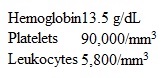 Which of the following is the best therapy option for this patient?
 (Multiple Choice)
4.9/5 (81)
(81) A 40-year-old man comes to the nephrology clinic for follow-up due to poststreptococcal glomerulonephritis. He initially had gross hematuria and edema associated with hypertension and required treatment with a diuretic. Two weeks prior to the onset of symptoms, the patient had acute pharyngitis that resolved without treatment. At the time of diagnosis, the serum C3 level was decreased, and the antistreptolysin O titer was elevated. Which of the following factors most likely indicates a poor long-term prognosis for this patient's condition?
(Multiple Choice)
5.0/5 (85)
(85) A 31-year-old man comes to the office with his wife, who is threatening to leave him if he does not get help. The patient was recently fired from his job as a computer programmer due to frequent lateness and absences caused by his elaborate morning showering ritual. He feels compelled to clean each part of his body in a specific order while counting to 27. If he misses a body part or makes a mistake in counting, he must start over. His wife adds that he often takes 3 showers in a row because "he won't accept that the towels I give him were just cleaned. It has become extremely difficult to live with him." Once dressed, the patient must go out of his way to take a certain route to work to avoid "dirty" street corners that may soil or contaminate his clothes. He says, "I know it makes no sense, but I can't get rid of the thought that my clothes are splattered with urine. Once this idea takes hold, I have to go home and change." The patient became concerned with cleanliness as a young teen and wonders whether this was inherited from his mother, whom he describes as "a control freak." He says, "I know I need help but prefer not to take medication if possible." After 12 weeks of twice-weekly therapy, the patient has made some improvement but still has significant anxiety and difficulty changing his rituals. Although he is better able to resist counting, he continues to shower excessively and still changes his clothes several times a day. The patient was offered a new job but turned it down when he learned that it would require him to share a computer keyboard with coworkers. He and his wife are frustrated that he has not made more progress. The patient is now more receptive to the idea of taking medication. His other medical problems include obesity and premature ejaculation. He takes no medication other than acetaminophen as needed. Physical examination is normal. Which of the following medications is the most appropriate next step in management of this patient?
(Multiple Choice)
4.9/5 (72)
(72) A 2-year-old boy is brought to the emergency department by his grandmother due to abdominal pain and lethargy. The grandmother reports that he was playing calmly last night when he suddenly began screaming and holding his abdomen. The pain resolved after several minutes, but the patient has had 5 additional episodes of sudden-onset, severe pain since then. Today, the grandmother notes that he has no interest in eating or drinking and has been "sleeping all day" but intermittently awakens in pain. The patient has also had several episodes of nonbloody, nonbilious emesis and "fewer wet diapers than usual." He has had no fever, diarrhea, or recent infections. He is an otherwise healthy child with no prior hospitalizations or chronic medical conditions. The patient takes no medications, and his immunizations are up to date. Temperature is 37 C (98.6 F), blood pressure is 90/56 mm Hg, pulse is 160/min, and respirations are 24/min. During the examination, the boy is sleeping and arouses briefly. The abdomen has hypoactive bowel sounds and diffuse mild tenderness to palpation. He is circumcised, with both testes descended and with intact cremasteric reflexes. Immediately after the examination, the child passes blood in his diaper, as shown in the image below. 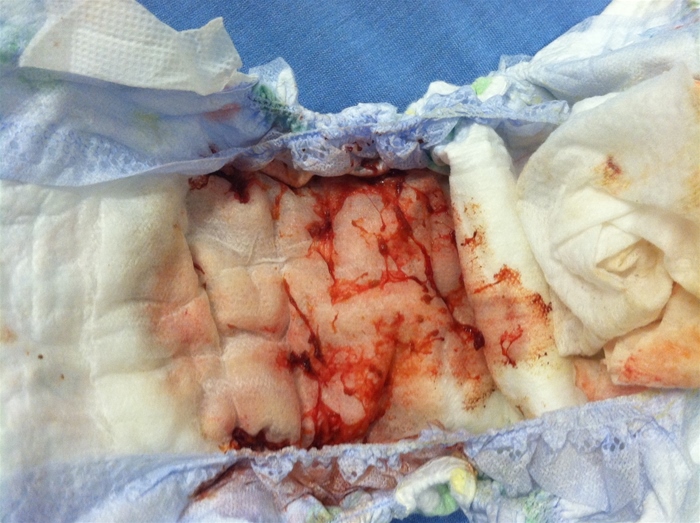 The appropriate procedure is performed and the intussusception is reduced successfully. After about an hour of rest, the patient experiences acute onset of severe abdominal pain. Which of the following is the best next step in immediate management of this patient?
 (Multiple Choice)
4.9/5 (81)
(81) A 14-year-old girl comes to the office accompanied by her mother for an annual examination. The patient's medical problems include acne, for which she takes clindamycin. When seen alone for examination, she is shy and quiet. The patient says everything is "going okay." She does not have a boyfriend and is not sexually active. When asked about drug and alcohol use, she says, "No, but I have tried alcohol and marijuana a few times at parties." Physical examination is normal other than mild acne, which has improved since her last visit. Following the examination, the physician informs the mother that everything is fine, renews the patient's clindamycin prescription, and asks if she has any questions. With the daughter present, the mother replies, "I remember what it's like to be a teenager, but she is really impossible to deal with now. I can't get her up on time in the morning because she stays up late on her computer. She no longer wants to spend time with the family. In the morning, she refuses to eat breakfast and then sleeps during the entire drive to school. I worry because her school friends use drugs. I think they are a bad influence and now her grades are falling. I don't know how she will get into a decent college. We warned her that she wouldn't be allowed to go on the family vacation if she doesn't improve her grades, but she doesn't seem to care."
Which of the following is the most appropriate next step in response to the mother's concerns?
(Multiple Choice)
4.7/5 (70)
(70) A 49-year-old man comes to the physician to discuss poor sexual performance. He has been unable to sustain erections for the past year. In the last 2 months, he has not had any erections at all, including at night or when he wakes up in the morning. Past medical history is significant for type 2 diabetes mellitus, hyperlipidemia, and chronic exertional buttock and thigh pain. His medications include insulin detemir and atorvastatin. The patient works as a truck driver and leads a sedentary lifestyle. He has smoked 1½ packs of cigarettes daily for the past 30 years. His blood pressure is 134/68 mm Hg and pulse is 78/min. His BMI is 32 kg/m2. Heart sounds are normal. There is no evidence of sensory loss over the lower extremities. Which of the following is the best next step in management of this patient?
(Multiple Choice)
4.9/5 (71)
(71) An asymptomatic 48-year-old Caucasian female with a history of hypothyroidism is being evaluated for abnormal liver function tests. She has no other medical problems. She takes thyroxine for the hypothyroidism. She takes no herbal medication. She never smoked or used IV drugs, and rarely drinks alcohol. Her family history is unremarkable. Her blood pressure is 120/80 mmHg, pulse is 72/min, temperature is 36.7C (98F) and respirations are 14/min. The physical examination is normal, except for mild, painless hepatomegaly. The initial lab test results are as follows:
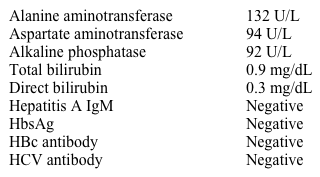 What is the most appropriate next step in the management of this patient?
 (Multiple Choice)
4.8/5 (74)
(74) A 28-year-old man comes to the office for a health maintenance visit. He has no history of serious illness but reports periodic headaches over the last several years that often respond to acetaminophen. Occasionally the headaches are severe enough to necessitate taking a sick day from work. He cannot recall specific triggers but notes that the headaches are usually unilateral. The patient does not use tobacco or illicit drugs. He drinks alcohol socially and 2-3 cups of coffee daily. He is a software engineer and often works at a computer 10-12 hours a day. His sister has a history of migraines. Vital signs are within normal limits. Physical examination, including neurological examination, is normal. The patient returns to the office 2 weeks later and reports "on and off" headaches almost every day since his last visit. The headaches are predominantly behind his left eye and are so severe that his left eye becomes watery and his forehead feels sweaty. The headaches occur at approximately the same time each day and improve after resting in a dark, quiet room for about an hour. Physical examination shows no abnormalities. Which of the following is the most likely diagnosis?
(Multiple Choice)
4.9/5 (84)
(84) A 24-year-old woman comes to the physician with 2 days of progressive leg weakness and paresthesias. Today, she could not void urine. She has no significant medical history, except for an upper respiratory tract infection 2 weeks ago. The patient takes no medications and does not use illicit drugs. Her blood pressure is 110/70 mm Hg and pulse is 80/min. Physical examination shows bilateral lower-extremity weakness, decreased reflexes, and decreased pain sensation up to the level of the umbilicus. Sensations are intact in the dermatomes above the umbilicus. Bladder catheterization shows a volume of 500 mL. Which of the following is the best next step in management of this patient?
(Multiple Choice)
5.0/5 (85)
(85) A study evaluated the accuracy of using midstream urine (MSU) culture to identify the causative pathogen in patients with uncomplicated cystitis. Women ages 18-49 with symptoms of cystitis provided MSU specimens for culture. The investigators also collected urine by means of a urethral catheter for culture, which served as the gold standard for confirming the causative pathogen. Bacterial growth was determined in colony forming units per mL. Correlation coefficients (r) were calculated for several organisms by comparing the logarithm of bacterial growth in urethral catheter specimens to that of bacterial growth in MSU specimens. The following plots were reported: 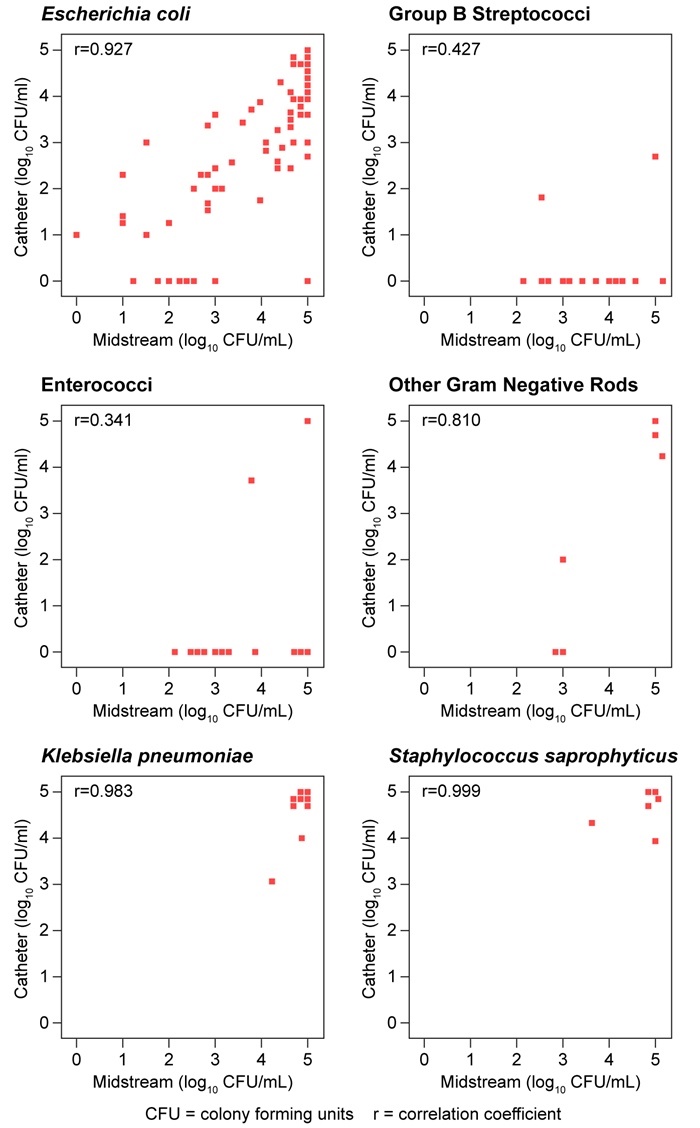 Which of the following organisms identified by MSU most likely has the lowest positive predictive value in revealing the causative pathogen for cystitis?
 (Multiple Choice)
5.0/5 (85)
(85) A 25-year-old man is brought to the emergency department due to high-grade fever, chills, myalgias, and skin rash, which started on the day of admission. He also had nausea and 3 episodes of profuse watery diarrhea and is now feeling lightheaded. Two days ago, he underwent corrective surgery for a deviated nasal septum but otherwise has no other past medical history. The patient has not traveled recently and has not been around sick contacts. He does not use illicit drugs. His temperature is 39.4 C (103 F), blood pressure is 85/50 mm Hg, and pulse is 116/min. Oxygen saturation is 98% on room air. He is lethargic but has no focal weakness or nuchal rigidity. Examination shows clear lung fields and tachycardia with normal first and second heart sounds. The abdomen is soft and nontender. There is nasal packing in both nostrils. Skin examination shows a diffuse, red, macular rash that also involves the palms and soles. 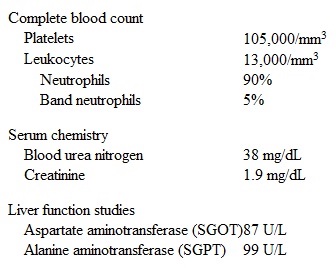 Blood cultures are sent. Item 1 of 2 Which of the following is the most likely cause of this patient's symptoms?
 (Multiple Choice)
4.9/5 (72)
(72) A 7-year-old boy is brought to the emergency department by paramedics after being attacked by a dog. Approximately an hour ago, the boy was playing in a park near his house when he tried to separate 2 stray dogs that were fighting. The dogs assaulted the patient, dragged him to the ground, and bit him multiple times on the upper extremities and face. His parents were able to drive the dogs away. The boy is otherwise healthy and up to date on immunizations. Temperature is 37.1 C (98.8 F) and pulse is 138/min. The child is inconsolable; intravenous morphine and midazolam are administered to allow examination of his wounds. Multiple, deep bite wounds are found on the dorsal forearms bilaterally. There is also a 6-cm, macerated wound overlying the left mandible extending to the left ear. The upper extremity wounds are actively bleeding and contain specks of dirt and grass. Pressure is applied, and hemostasis of all wounds is achieved. The wounds are copiously irrigated and cleaned, and rabies prophylaxis is initiated. The mother asks about tetanus and says, "Please do everything you can for him! My husband was bitten by a dog last year and received several shots for tetanus." Which of the following is the most appropriate response?
(Multiple Choice)
4.7/5 (76)
(76) A 54-year-old woman comes to the physician with blood in the urine for a week. It initially occurred once daily, but the frequency increased to twice daily yesterday. The patient has a history of diabetes, osteoarthritis in her knees, and menopause 5 years ago. Her medications include daily metformin and ibuprofen as needed. She has a 30-pack-year smoking history and drinks 1 or 2 beers daily. Her mother had a history of kidney stones and died of breast cancer. She lives with her husband, and her last sexual encounter was approximately 10 days ago. Vital signs are within normal limits. Examination shows no abnormalities. Which of the following is the most appropriate next step in management of this patient?
(Multiple Choice)
4.9/5 (87)
(87) Showing 241 - 260 of 1121

Filters
- Essay(0)
- Multiple Choice(0)
- Short Answer(0)
- True False(0)
- Matching(0)