



 Chat with AI
Exam 1: Advanced Clinical Medicine

Exam 1: Advanced Clinical Medicine1 k+ Questions
Exam 2: Foundations of Independent Practice597 Questions
Select questions type


A 66-year-old man is found to have bilateral breast enlargement during a routine office visit. The patient reports no breast pain/discomfort, headaches, or vision abnormalities but has had decreased libido and "low energy" for the past several months. Medical problems include hypertension, hyperlipidemia, and osteoarthritis. The patient takes chlorthalidone, simvastatin, and acetaminophen as needed. He does not use over-the-counter or herbal supplements. The patient drinks 1 or 2 alcoholic beverages during social events and does not use tobacco or illicit drugs. He is married and has several adult children. Family history is notable for breast cancer in a maternal aunt. Vital signs are within normal limits. BMI is 32 kg/m2. Examination shows normal body hair distribution and no skin rash. Breast examination reveals 2-cm, round, and firm tissue behind the areolas bilaterally with no overlying skin changes or nipple discharge. There are no enlarged lymph nodes. External genitalia are normal in size and appearance, and no testicular masses are present. The remainder of the physical examination is normal. Laboratory results are as follows: 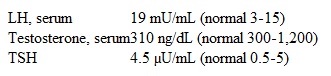 Serum chemistry panel and liver aminotransferases are within normal limits, and serum testosterone level is unchanged on repeat testing. Which of the following is the most likely explanation for this patient's breast abnormality?
 (Multiple Choice)
4.8/5  (77)
(77) A 73-year-old man comes to the emergency department with fever and chest discomfort. He was hospitalized with right lower-lobe pneumonia 3 months ago and improved with antibiotics. He has since had an intermittent cough and a 4.5-kg (10-lb) weight loss. The patient is a life-long nonsmoker. He has a long history of Parkinson's disease with gait instability along with hypertension and acid-reflux disease. His temperature is 38.3 C (101 F), blood pressure is 122/70 mm Hg, heart rate is 105/min, and respirations are 24/min. Examination shows upper-extremity rigidity, resting tremor, mild dysarthria, and frequent drooling. Lung examination shows crackles and dullness at the right base. Extremities are warm to the touch. The white blood cell count is 13,500/µL. Chest x-ray shows a right middle-lobe infiltrate. Intravenous antibiotics are started. Which of the following tests is most helpful in evaluating this patient?
(Multiple Choice)
4.8/5 (80)
(80) A 59-year-old man comes to the office for a routine wellness examination. The patient's medical history includes chronic bronchitis, hypertension, hypertriglyceridemia, and basal cell carcinoma. He smokes a pack of cigarettes per day, with a total 40-pack-year history. The patient typically consumes 1 or 2 cans of beer each night. Family medical history is remarkable for heart disease and diabetes mellitus. The patient had a normal screening colonoscopy 5 years ago. A chest x-ray from a year ago shows changes consistent with chronic bronchitis.
The patient says he enjoys smoking very much and is reluctant to stop because he has smoked since age 19. He asks about the benefits of smoking cessation. What is the most appropriate response by the physician?
(Multiple Choice)
4.8/5 (65)
(65) A 15-month-old boy is brought to the emergency department by ambulance after an episode of "jerking movements" at home. The patient was sitting in the living room with his toys when he suddenly developed uncontrollable rhythmic jerking of his extremities that lasted approximately 2 minutes. His eyes deviated leftward, and he was nonresponsive during this event. The patient did not hit his head before or after the incident. He creeps but has not begun crawling or pulling to stand. The patient says "mama" but speaks no other words. Growth parameters are at the 50th percentile for age and sex. His vital signs are within normal limits. Physical examination shows hypopigmented lesions on the patient's back. Cardiopulmonary examination is unremarkable. Item 1 of 2 Which of the following tests should be performed in evaluation of this patient?
(Multiple Choice)
4.9/5 (77)
(77) A 24-year-old female maintained on methimazole for the treatment of Graves disease comes to your office after having a positive urine pregnancy test. She complains of mild nausea, but does not have any other symptoms. Her last menstrual period was five weeks ago. She was diagnosed with Graves disease approximately eight months ago. Her clinical symptoms of hyperthyroidism have markedly improved since starting methimazole. She is married and has no children. She does not smoke or drink alcohol. Her mother has hypothyroidism. She takes no other medications. She has no medication allergies. Her menstrual cycles were previously regular. Physical examination reveals a mildly enlarged, smooth, non-tender thyroid gland. Thyroid function tests performed last week showed a TSH of 0.7 mU/L and total T4 of 15.2 μg/dL (normal 4 to 12 μg/dL). What is the best next step in this patient's management?
(Multiple Choice)
4.9/5 (67)
(67) A 17-year-old male presents to the office because he had an episode of cola-colored urine. He appears scared and says that he ran 12 miles two days ago as a part of 'a run for heart disease awareness.' His past medical history is insignificant. He denies any recent upper respiratory or skin infections. He does not smoke or consume alcohol, and says that he has never used any recreational drugs. His father has hypertension and coronary artery disease. His temperature is 37.2 C (98.9 F), blood pressure is 118/76 mmHg and pulse is 78/min. His BMI is 23 kg/m2. The physical examination is unremarkable. Urinalysis is positive for blood; there are numerous (100+) RBCs/hpf. Urine sediment did not show any RBC casts. Which of the following is the most appropriate next step in management?
(Multiple Choice)
4.9/5 (88)
(88) A 27-year-old woman comes to the physician with a 1-year history of periodic irritability, anger, tension, and sleep disturbance. The symptoms begin predictably a week before her periods and resolve with menstrual bleeding. She has increased appetite, headaches, breast tenderness, and ankle swelling before her periods. The symptoms are severe enough to impair her performance at work. The patient's past medical history is insignificant. Her cycles are regular and last 29 days. She has no intermenstrual bleeding or vaginal discharge. She has never been pregnant. The patient does not use tobacco, alcohol, or illicit drugs. She has been sexually active with 1 partner for the last 3 years and uses condoms for contraception. The physician prescribes fluoxetine 20 mg/day. The patient returns after 4 months and says that her symptoms have not improved significantly. She stopped taking fluoxetine 5 days back. The patient returns in 6 months and says that she feels much better. Her symptoms are less disabling, and she is able to work without significant discomfort. She is concerned about the long-term prognosis and future risk of other disorders that may be associated with her condition. The patient is at increased risk for which of the following?
(Multiple Choice)
4.7/5 (80)
(80) A 65-year-old woman is brought to the emergency department by paramedics after falling on a snow-covered sidewalk. The patient fell backward onto her hands while trying to maintain her balance and immediately felt a sharp, excruciating pain in her right arm. She also notes mild tenderness and bruising on the right flank and right buttock. The patient has a history of osteoporosis and hypertension and takes valsartan, alendronate, and a vitamin D supplement. She does not use tobacco, alcohol, or illicit drugs. In the emergency department, radiograph reveals a displaced fracture of the right distal radius. The patient is admitted to the hospital and undergoes open reduction and internal fixation of the radius fracture. On postoperative day 2, she reports severe, constant, burning pain over her right flank. The postsurgical pain in the right arm is mild and well controlled with low-dose morphine as needed. Temperature is 37.8 C (100 F), blood pressure is 145/84 mm Hg, pulse is 97/min, and respirations are 16/min. Mucous membranes are moist and the oropharynx is without lesions. Cardiopulmonary auscultation reveals clear lungs and normal heart sounds. The abdomen is soft, nontender, and nondistended. The right flank is tender to light touch with a rash over the area, as shown in the exhibit. 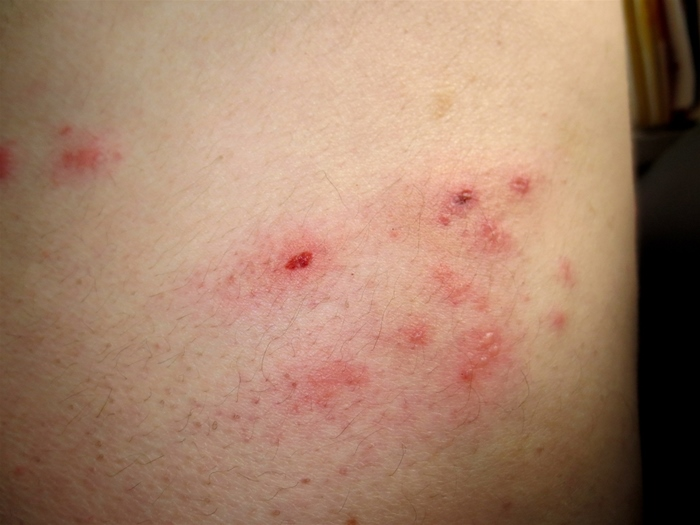 The surgical wound is healing normally without signs of infection.
What is the most appropriate treatment for this patient?
The surgical wound is healing normally without signs of infection.
What is the most appropriate treatment for this patient? (Multiple Choice)
4.9/5 (77)
(77) A previously healthy 30-year-old woman is admitted to the hospital. She complains of a rash over her ankles that started 2 weeks ago and slowly spread up to her knees. The patient has no other medical problems and takes no regular medications. Her vital signs are within normal limits. Physical examination shows fine petechiae and purpura around her ankles and lower legs. There is no lymphadenopathy or hepatosplenomegaly. Laboratory results are as follows:
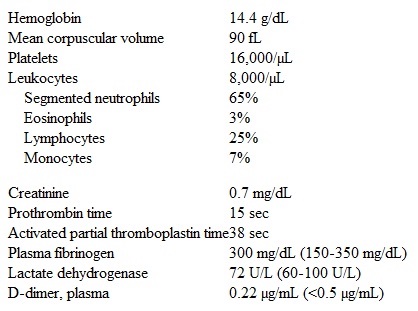 Peripheral blood smear shows thrombocytopenia. After reviewing the laboratory results, the admitting resident orders 6 units of random donor platelet transfusion. The following day, the platelet count is 10,000/µL.
Which of the following is the most likely cause of the drop in the platelet count?
Peripheral blood smear shows thrombocytopenia. After reviewing the laboratory results, the admitting resident orders 6 units of random donor platelet transfusion. The following day, the platelet count is 10,000/µL.
Which of the following is the most likely cause of the drop in the platelet count? (Multiple Choice)
4.8/5 (94)
(94) A previously healthy 28-year-old Caucasian woman comes to the physician because of fatigue, arthralgias, and chest pain over the past 6 months. She has had a 2.3-kg (5-lb) weight loss during this period. She denies any recent travel or sick contacts. Her past medical history is insignificant. She takes no medications and has no known drug allergies. She is sexually active and uses condoms for contraception. She has never been pregnant. She does not use tobacco, alcohol, or drugs. Her mother has rheumatoid arthritis. Her temperature is 37.2 C (99 F), blood pressure is 122/77 mm Hg, and pulse is 78/min. Physical examination shows a faint facial rash. The lungs are clear to auscultation with mildly decreased breath sounds at the left lung base. The abdomen is soft and non-tender. There is no organomegaly. There is no peripheral edema. Neurologic examination is unremarkable.
Item 1 of 3
Which of the following tests is most likely to be positive in this patient?
(Multiple Choice)
4.7/5 (82)
(82) A 6-week-old boy is brought to the office by his father due to concerns about constipation. His father states, "He used to pass 4 or 5 soft, yellow stools every day. About 2 weeks ago, this decreased to twice a day, and since last week it has gone down to only one large, soft, yellow bowel movement every 1-2 days. I've also noticed that he spits up after he eats. I had surgery for pyloric stenosis when I was 5 weeks old, and I'm concerned that my baby has the same problem." The patient is fed pumped breast milk every 2-3 hours and does not drink formula. He has 6-8 wet diapers a day. He was born at 39 weeks gestation by vaginal delivery and received deep suctioning for meconium-stained amniotic fluid. Hospital course was significant for jaundice at age 36 hours, which resolved after a day of phototherapy. Birth weight was 3 kg (6.6 lb, 25th percentile) and length was 50 cm (19.7 in, 50th percentile); he is at the 50th percentile for length and weight today. Physical examination shows an awake and alert infant. The anterior fontanelle is open and flat, and the oral mucosa is moist with no thrush. The abdomen is soft, nontender, and nondistended. Testes are descended bilaterally. The anus is located halfway between the posterior border of the scrotum and the tip of the coccyx. There are no anal fissures or tags. Skin shows no jaundice, and capillary refill is <2 seconds. Which of the following is the most appropriate course of action in management of this patient?
(Multiple Choice)
4.8/5 (84)
(84) The patient proceeds with breast implant surgery. She comes to see you a few weeks later for a follow-up visit. She is planning to get pregnant, and is concerned about the adverse effects of silicone on the baby. Which of the following is the most appropriate response?
(Multiple Choice)
4.8/5 (84)
(84) A 25-year-old man comes to the emergency department with pain in his right hand and wrist. A few hours earlier, he fell forward and landed on his outstretched right hand while playing football. He could not continue playing due to intolerable pain. The patient has no other medical problems and does not use tobacco, alcohol, or illicit drugs. Examination shows mild swelling in the dorsum of the right hand with preserved range of motion. Right hand grip strength is reduced. There is severe tenderness on palpation of the radial dorsal aspect of the wrist. An x-ray of the wrist reveals no evidence of dislocation or fracture. After receiving analgesic therapy, the patient reports that the pain in his wrist is almost gone. Which of the following is the most appropriate next step in management of this patient?
(Multiple Choice)
4.9/5 (81)
(81) A 65-year-old female with a past medical history of essential hypertension, type 2 diabetes mellitus, peripheral vascular disease, coronary artery disease, and dyslipidemia presents with epigastric pain for the past two months. The pain is described as, "crampy, dull, and sometimes goes to the back." The pain is worse after eating. Four weeks of over-the-counter omeprazole did not relieve her pain. She also complains of an 8 lb weight loss and decreased desire to eat. Her bowel habits are normal. She had a two-vessel coronary artery bypass surgery three years ago. Her medications include glipizide, metformin, simvastatin, and lisinopril. She also takes naproxen for occasional headaches as needed. She is an ex-smoker with a 42 pack-year smoking history. Her temperature is 36.7C (98F), blood pressure is 172/86 mm Hg, pulse is 90/min, and respirations are 16/min. There is a right-sided carotid bruit. Her abdomen is soft and non-tender. Ultrasound of the abdomen shows a normal gallbladder without any stones. An upper endoscopy shows mild esophagitis and mild antral erythema. A CT scan of the abdomen demonstrates diffuse aortic atherosclerosis. Screening colonoscopy done eight years ago was unremarkable. Which of the following is the most appropriate course of action?
(Multiple Choice)
4.8/5 (84)
(84) A new, randomized, placebo-controlled trial studied the association between treatment with 250,000 IU cholecalciferol for 4 months following hip fracture surgery and incidence of falls. Results showed that at month 4 after surgery, 7 (6.3%) patients in the treatment group reported >1 falls compared to 23 (21.2%) in the placebo group (p < 0.01); there was a relative risk reduction of 70.3%. Treatment with 250,000 IU cholecalciferol for 4 months costs $100 per patient. Based on this information, how much would it cost to treat enough patients after hip surgery with 250,000 IU cholecalciferol to prevent >1 falls during the first 4 months of therapy?
(Multiple Choice)
4.8/5 (72)
(72) A 29-year-old woman comes to the physician 24 hours after unprotected intercourse with an individual who just learned that he is HIV-positive. She is frightened and wants to "do something." The patient's past medical history is insignificant. She has had 2 sexual partners in the past year and used condoms for every sexual encounter before this episode. She has never been tested for HIV or other sexually transmitted diseases. The patient has no known allergies. Physical examination findings are normal. Immediate HIV and pregnancy tests are negative. Which of the following is the best next step in management of this patient?
(Multiple Choice)
4.9/5 (76)
(76) A 34-year-old woman, gravida 1 para 0, comes to the office at 35 weeks gestation for a routine prenatal visit. The patient reports good fetal movement and has no contractions, vaginal bleeding, or leakage of fluid. She has type 2 diabetes mellitus that was managed with oral medication prior to pregnancy. She was started on an insulin regimen during her first trimester due to poor glycemic control. This pregnancy has also been complicated by fetal growth restriction diagnosed at 28 weeks gestation when fundal height measured 24 cm and ultrasound revealed an estimated fetal weight at the 3rd percentile for gestational age. Since the diagnosis, the patient has been followed with weekly ultrasounds. She does not use tobacco, alcohol, or illicit drugs. Blood pressure is 130/80 mm Hg and pulse is 92/min. BMI is 34 kg/m2. The fetal heart rate is 150/min by bedside Doppler. Fundal height is 31 cm. An ultrasound prior to the patient's appointment revealed a fetus in vertex presentation with oligohydramnios. Doppler studies of the umbilical artery showed a new onset of reversed end diastolic flow. A nonstress test showed moderate variability; there are no accelerations. A 2-hour postprandial blood glucose level is 155 mg/dL. A Group B Streptococcus rectovaginal culture has not yet been collected. Which of the following is the best next step in management of this patient?
(Multiple Choice)
4.8/5 (75)
(75) A 6-year-old boy is brought to the office for chronic bedwetting. He was fully toilet trained for daytime by age 4 but has never consistently stayed dry overnight. In the past 6 months, his parents have tried several behavioral modifications, with fluid intake restricted for 2 hours prior to bedtime and the patient voiding prior to going to sleep. His parents also implemented a reward system, but he still wets the bed frequently. The patient says, "I feel really embarrassed. I want to go to a sleep-away camp next year but my parents won't let me." The boy has regular soft bowel movements without stooling accidents. He has no other medical problems and takes no medication. Vital signs are appropriate for age. Physical examination and urinalysis are unremarkable. His mother says, "I'm really tired of washing the sheets every other day. What else do you suggest?" Which of the following is the most appropriate advice regarding this patient's condition?
(Multiple Choice)
4.9/5 (85)
(85) A 40-year-old man is brought to the emergency department for sudden onset of headaches, diaphoresis, and loss of consciousness. His wife states that he was previously in his usual state of health. His past medical history is unremarkable. He works as a physician assistant and does not smoke or drink alcohol. On physical examination, the patient is diaphoretic and comatose. His fingerstick blood glucose level is 45 mg/dL. The patient is given 50% dextrose intravenously and then regains consciousness. He says that he is currently dealing with a great deal of work- and relationship-related stress. Laboratory test results on the blood sample drawn prior to dextrose administration are as follows:
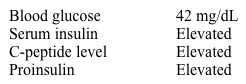 Which of the following is the best next step in management of this patient?
 (Multiple Choice)
4.8/5 (81)
(81) A 1-week-old boy is brought to the office by his parents to establish primary care. The infant was born at 38 weeks gestation to a 31-year-old woman, gravida 3 para 2, via scheduled repeat cesarean delivery. The infant weighed 3.2 kg (7 lb 1 oz, 50th percentile) at birth and had an unremarkable nursery course. The infant was discharged home at age 3 days and has been breastfeeding exclusively. He is voiding and stooling normally. Yesterday, the parents were notified of an abnormal result from newborn screening. Today, the infant weighs 3.21 kg (7 lb 1 oz). Physical examination is normal. Laboratory studies reveal a T4 level of 6 µg/dL (normal: 10-22 for the first week after birth) and a TSH level of 46 µU/mL. Which of the following is the most appropriate statement for this patient's parents?
(Multiple Choice)
4.8/5 (72)
(72) Showing 841 - 860 of 1121

Filters
- Essay(0)
- Multiple Choice(0)
- Short Answer(0)
- True False(0)
- Matching(0)