



 Chat with AI
Exam 1: Advanced Clinical Medicine

Exam 1: Advanced Clinical Medicine1 k+ Questions
Exam 2: Foundations of Independent Practice597 Questions
Select questions type


A 64-year-old man comes to the office due to shortness of breath for the last 6 months. He describes his lifestyle as active but says, "I can't catch my breath when I walk fast or climb the stairs. Six months ago, I felt completely fine." He has no symptoms at rest or at night, and he has had no palpitations, chest pain, lightheadedness, syncope, or lower extremity swelling. The patient has a history of hypertension and diet-controlled type 2 diabetes mellitus. He also takes over-the-counter antacid for occasional heartburn. He is a lifetime nonsmoker and drinks beer over the weekend. The patient has no family history of heart attacks or sudden cardiac death, but his grandfather had a stroke in his 60s. Blood pressure is 149/86 mm Hg and pulse is 88/min and regular. Oxygen saturation is 97% on room air. Lungs are clear on auscultation. No heart murmurs are heard. There is no peripheral edema. ECG shows normal sinus rhythm, voltage criteria for left ventricular hypertrophy, and T-wave inversion in leads V5 and V6. Creatinine is 0.9 mg/dL and complete blood count is unremarkable. Echocardiogram shows a dilated left ventricle with ejection fraction of 38%. Which of the following is the best next step in management of this patient?
(Multiple Choice)
5.0/5  (79)
(79) A 73-year-old man comes to the office due to pain and restriction of movement in his left hip joint for the last 6 months. He has been taking over-the-counter acetaminophen 2-3 times a day, although this does not give any significant relief from this pain. His medical history is significant for type 2 diabetes mellitus and hypertension. He is currently on metformin, hydrochlorothiazide, and atenolol. His father has hypertension and gout. He has a 30-pack-year history of smoking, but he quit smoking 10 years ago. He has a history of alcohol abuse during his early 20s. Currently, he drinks a glass of wine over the weekends. Physical examination reveals restricted movement in his left hip joint, with pain on passive flexion. The rest of the physical examination is unremarkable. X-ray of his left hip joint and pelvis reveals thickening of outer cortex of his left proximal femur with mild bowing. Sclerotic lesions are also present on the left ischial bone. Technetium bone scan shows an increased uptake in the frontal bone, left scapula, left ischium, and whole of his left proximal femur. A basic metabolic profile, including calcium and creatinine levels, is unremarkable. What is the most appropriate treatment for this patient?
(Multiple Choice)
4.8/5 (83)
(83) A 20-month-old boy is brought to the emergency department by ambulance after a single, generalized, tonic-clonic seizure that lasted for approximately 5 minutes. The seizure was witnessed by his grandmother who immediately placed the child onto the floor and turned him on his side. The seizure stopped spontaneously a few minutes prior to the arrival of emergency services. The patient has never had a seizure before. He has had a cough and runny nose for the last 3 days and developed a fever today. His appetite has decreased, but he is drinking and voiding adequately. The patient's vaccinations are up to date, and he takes no daily medications. Developmentally, the patient walks well, can eat with a spoon, and is able to speak 10-15 words. Temperature is 38.7 C (101.7 F), blood pressure is 98/66 mm Hg, pulse is 116/min, and respirations are 28/min. Pulse oximetry is 98% on room air. The child is well appearing and playing quietly with toys. The pupils are equal and briskly reactive to light. Tympanic membranes are clear bilaterally, and posterior pharynx is injected slightly without exudate. The neck is supple. Cardiopulmonary examination is normal. Muscle tone is normal and strength is full bilaterally. Deep tendon reflexes are 2+ and symmetric in the upper and lower extremities. There are no rashes or petechiae. An antipyretic is administered, and his temperature decreases to 37.8 C (100 F). Which of the following is the best next step in management of this patient?
(Multiple Choice)
4.8/5 (72)
(72) A 54-year-old homeless man is brought to the emergency department by the police after he was found to be confused and disheveled. The patient is unable to provide a medical history and has no prior hospital record. Temperature is 36.5 C (97.7 F), blood pressure is 110/60 mm Hg, pulse is 90/min, and respirations are 16/min. The patient is thin and appears ill, with temporal muscle wasting. The mucous membranes are dry. The lungs are clear to auscultation, and heart sounds are normal with no murmur. The abdomen is soft, nontender, and nondistended. The patient is disoriented and unable to recognize where he is or state the date. Bilateral pupils are equal and reactive to light, but extraocular motion is restricted on leftward gaze. No obvious motor weakness is present. Deep tendon reflexes are reduced and plantar responses are flexor. The patient has no neck rigidity, but his gait is markedly ataxic. Laboratory results are as follows: 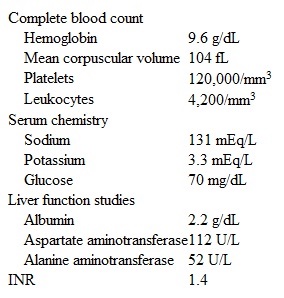 Item 1 of 2 Which of the following is the best next step in management of this patient's confusion?
 (Multiple Choice)
4.9/5 (84)
(84) A 62-year-old Caucasian man comes to the physician because of progressive weight loss and right lower extremity weakness for the last two months. On further questioning, he tells you that he has been having frequent leg cramps in the right leg. These cramps are most prominent in the morning, after he wakes up. He also has difficulty with swallowing and chewing. He denies any problems with bowel or bladder function. His other medical problems include hypertension and hypercholesterolemia. He does not use tobacco. His family history is not significant. His vital signs are within normal limits. The physical examination reveals weakness in his right lower leg, atrophy and fasciculation of the thigh and calf muscles, a hyperactive knee jerk, and tongue fasciculations. The rest of his neurological examination, including the sensory examination, is normal.
Which of the following treatment has been shown to be beneficial in these patients?
(Multiple Choice)
4.9/5 (80)
(80) A 35-year-old man comes to the office for evaluation of an enlarged testicle. His partner first noticed the enlargement 2 weeks ago. The patient feels well and has had no fever, dysuria, urethral discharge, or scrotal trauma. He has a history of HIV infection and has been on antiretroviral therapy for 2 years. His most recent CD4 count was 550/mm3, and he has never had an HIV-related infection. The patient does not use tobacco, alcohol, or illicit drugs. Temperature is 36.7 C (98.1 F), blood pressure is 120/70 mm Hg, and pulse is 72/min. No lymphadenopathy is present. The lungs are clear to auscultation, and heart sounds are normal. The abdomen is soft, nontender, and nondistended with no masses or hepatosplenomegaly. Testicular examination reveals a diffusely enlarged and hard right testicle with no distinct nodules and negative transillumination. The left testis is normal. Which of the following is the most appropriate next step in management of this patient?
(Multiple Choice)
4.9/5 (75)
(75) A 56-year-old woman comes to the office due to abnormal gallbladder imaging. Three weeks ago, she went to the emergency department due to cough and fever. Chest radiography revealed right upper quadrant calcifications in the gallbladder region but no acute lung findings. Since then, the patient's cough and fever have resolved, and she feels well. She has no history of gallstones and has had no abdominal pain, nausea, vomiting, jaundice, or clay-colored stool. The patient has a history of hypertension and takes lisinopril. She does not use tobacco, alcohol, or illicit drugs. Vital signs are within normal limits. BMI is 28.5 kg/m2. Physical examination reveals no abnormalities. CT scan of the abdomen reveals several small gallstones with no biliary duct dilation. Patchy areas of gallbladder wall calcification are present without edema or masses. Which of the following is the best recommendation for this patient?
(Multiple Choice)
4.8/5 (72)
(72) A 3-year-old girl is brought to the emergency department due to pain and fever. Two days ago, she developed mild abdominal and back pain. Her fever began yesterday morning and reached a maximum of 40.1 C (104.2 F) last night. Over the last 8 hours, she had 6 episodes of emesis but has since tolerated a few sips of water. The girl has a history of constipation since the start of toilet training at age 2 and has "pellet-like" stools once a week. She has frequent urinary accidents during the day and night. She takes no medications and has no other medical problems. Immunizations are up to date. Temperature is 40 C (104 F), blood pressure is 90/60 mm Hg, pulse is 110/min, and respirations are 20/min. Physical examination shows a tired-appearing girl with dry mucous membranes. She has right costovertebral tenderness. The abdomen is soft, nontender, and nondistended. The remainder of the examination is unremarkable. Laboratory results are as follows: 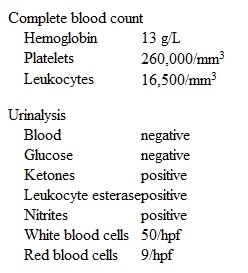 A 20-mL/kg normal saline bolus is administered. The patient has another episode of emesis and an additional void in the emergency department. Item 1 of 2 Which of the following best describes the appropriate management plan for this patient?
 (Multiple Choice)
4.9/5 (72)
(72) A 42-year-old man comes to the emergency department due to 4 days of nausea, skin rash, progressive weakness, and decreased urine output. For the past few months he has also had fatigue, tingling in his hands and feet, and occasional joint pains. The patient has had no fever, chest pain, dysuria, hematuria, or diarrhea. He has no chronic medical problems and takes no medication. The patient does not use tobacco or alcohol but used injection drugs during his early 20s. Temperature is 37.6 C (99.8 F), blood pressure is 150/90 mm Hg, pulse is 92/min, and respirations are 16/min. BMI is 24.8 kg/m2. Mucous membranes are dry with no lesions. Cardiopulmonary auscultation is normal. The liver edge is palpable 2 cm below the right costal margin. Bilateral ankle reflexes are absent. He has mild, bilateral, lower-extremity pitting edema and a palpable, nonblanchable, purpuric rash on both legs. There is no joint swelling or erythema. Laboratory results are as follows:
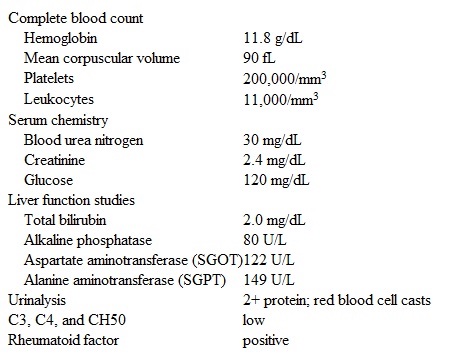 The diagnosis is established and the patient's renal function stabilizes with initial therapy. Which of the following is most appropriate for the long-term management of this patient?
 (Multiple Choice)
4.9/5 (77)
(77) A 62-year-old man is brought to the emergency department with substernal pain and mild shortness of breath over the last 2 hours. En route he was given sublingual nitroglycerin twice with significant relief of pain. He also received chewable aspirin. The patient currently rates the pain as 1-2 out of 10. His past medical history is significant for hypertension and active smoking. He has no history of bleeding. The patient's father died of a heart attack at age 56. Blood pressure is 154/90 mm Hg and pulse is 110/min. He is not in respiratory distress. No murmurs are heard. Lungs are clear to auscultation. The initial electrocardiogram (ECG) is shown in the Exhibit.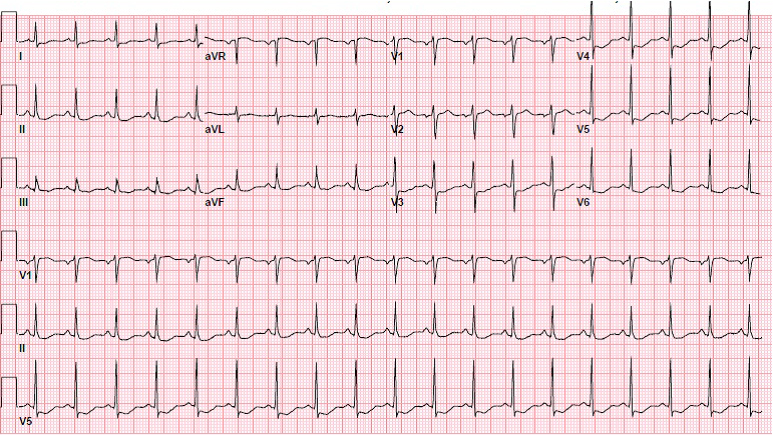 Which of the following is the best next step in management of this patient?
 (Multiple Choice)
4.8/5 (83)
(83) A group of cardiologists hypothesized that a new ACE inhibitor improves outcomes among patients with left ventricular dysfunction whether they have heart failure or not. The cardiologists assessed the role of the new ACE inhibitor in patients who were at high risk for cardiovascular events but who did not have left ventricular dysfunction or heart failure. A total of 8,560 high-risk patients (age ≥55) with evidence of vascular disease or diabetes plus one other cardiovascular risk factor but with no known history of heart failure were randomly assigned at a ratio of 1:1 to receive the new ACE inhibitor or placebo for a mean of 5 years. The primary outcome was death from cardiovascular causes. A total of 261 patients assigned to receive the new ACE inhibitor (6.1%) died from cardiovascular causes, compared to 346 patients assigned to receive placebo (8.1% percent) (relative risk = 0.75; p < 0.05). Which of the following conclusions can be drawn from these results?
(Multiple Choice)
4.8/5 (77)
(77) A 26-year-old man comes to the office after discovering a nontender lump on his neck while taking a shower. The patient has occasional heartburn and takes over-the-counter esomeprazole several times a week. He otherwise feels well and considers himself healthy. The patient has been sexually active with a single female partner over the last year. He has no history of recent travel and no pets. The patient has a 5-pack-year smoking history. He also smokes marijuana most days and drinks alcohol on the weekends. Temperature is 37.2 C (99 F), blood pressure is 120/70 mm Hg, pulse is 72/min, and respirations are 12/min. BMI is 20 kg/m2. Oropharyngeal examination shows a 2-cm white plaque on his right inner cheek that is easily scraped off with a tongue depressor, revealing underlying hyperemia. A 2.5-cm mildly tender anterior cervical node is palpated on the right side along with several bilateral, <1-cm, rubbery submandibular nodes. No skin lesions are present. Cardiopulmonary auscultation reveals clear lung fields and normal heart sounds. The abdomen is soft and nontender, and neurologic examination is normal. Which of the following is the most appropriate next step in management of this patient?
(Multiple Choice)
4.9/5 (73)
(73) A 35-year-old woman comes to the office with episodic abdominal pain. After dinner a day ago, she had intense epigastric pain that lasted 30-40 minutes, was dull with radiation to the back and right shoulder, and was accompanied by nausea and difficulty catching her breath. The pain resolved spontaneously after an hour and she did not seek medical care. The patient has had 2 similar episodes of lesser intensity in the past 6 months that resolved spontaneously. She has a history of migraine headaches treated with sumatriptan as needed. She does not use tobacco or illicit drugs. The patient has consumed 1 or 2 glasses of wine daily for the past 10 years. Her father died of pancreatic cancer at age 75, and her mother died of breast cancer at age 65. Vital signs are within normal limits. BMI is 35 kg/m2. Abdominal examination reveals normoactive bowel sounds without tenderness or guarding. The liver span is 8 cm and there is no palpable spleen. The remainder of the examination is within normal limits.
Which of the following is the best next step in management of this patient?
(Multiple Choice)
4.9/5 (75)
(75) A 56-year-old woman in the emergency department waiting room develops shortness of breath and generalized itching. She was eating a cookie when the symptoms started. The patient is allergic to peanuts and believes the cookie contained them. She has a history of emphysema and a 20-pack-year smoking history. Temperature is 36.7 C (98.1 F), blood pressure is 88/60 mm Hg, pulse is 124/min, and respirations are 26/min. Pulse oximetry is 92% on room air. The patient is using the accessory muscles of her neck and shoulder girdle and is exhaling through pursed lips. There is no tongue swelling or stridor. Bilateral wheezes are present on lung auscultation. Skin examination is shown in the exhibit. 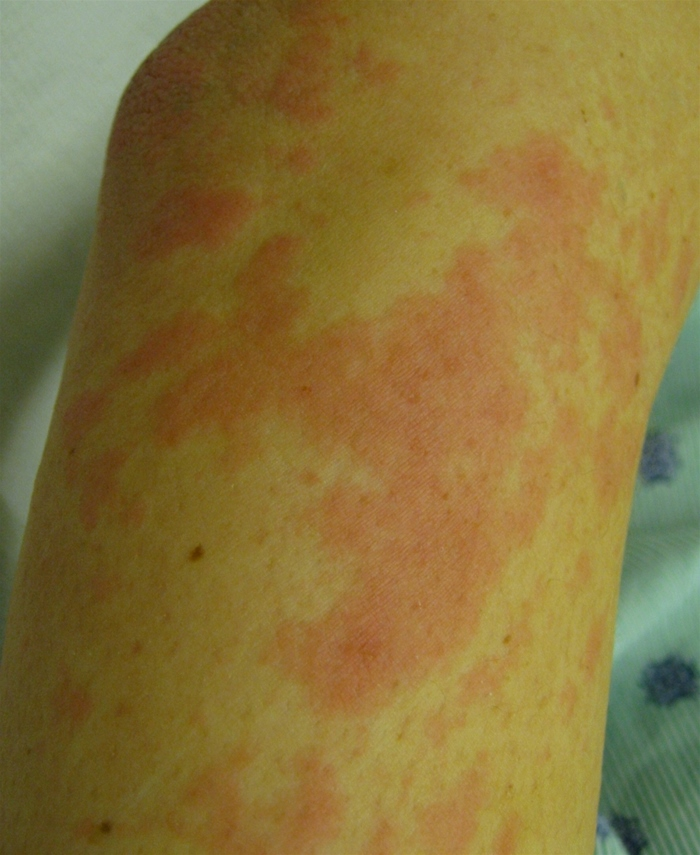 The patient is given an intramuscular injection of epinephrine. Ten minutes later, there is no significant change in her condition. Which of the following is the best next step in management of this patient?
 (Multiple Choice)
4.9/5 (73)
(73) A 42-year-old man comes to the office due to a painless lump under the skin on his right upper back, which he first noticed 3 months ago. He is incidentally noted to have a blood pressure of 180/110 mm Hg. He has no symptoms. The patient has no history of hypertension or other medical conditions and has not seen a physician since high school. He takes no medications, does not use tobacco, and consumes 1 or 2 alcoholic beverages on weekends. Family history is notable for hypertension in his mother and end-stage renal disease in a maternal uncle. The patient exercised regularly until recently, when he started work as a supervisor at a warehouse. He eats fast food at least 3 days a week. Repeat blood pressure measurements after 15 minutes of rest are 180/105 mm Hg on the right arm and 185/110 mm Hg on the left. Temperature is 36.7 C (98.1 F), pulse is 68/min, and respirations are 12/min. BMI is 26.2 kg/m2. Cardiac examination reveals a diffuse and sustained apical impulse with normal heart sounds and no murmurs or gallops. There is a 3-cm, soft, mobile, nontender, subcutaneous mass consistent with a lipoma in the right scapular region. The remainder of the examination, including funduscopy, is normal. Blood cell counts, serum electrolytes, serum creatinine, blood glucose, and urinalysis are within normal limits. The ECG is shown in the exhibit.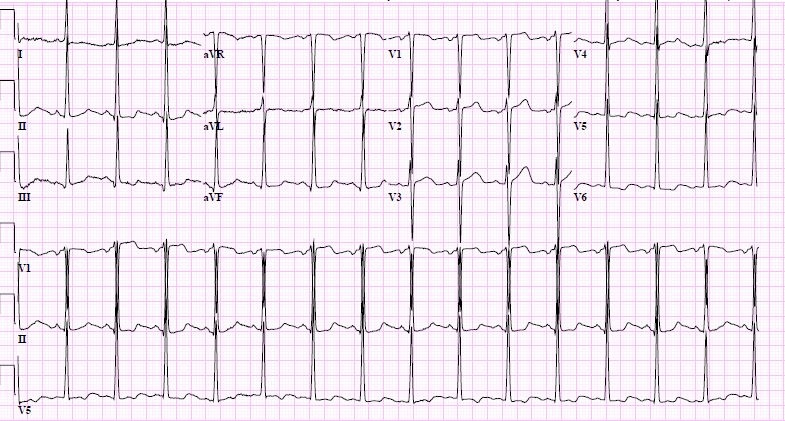 Which of the following additional tests is most appropriate for this patient?
 (Multiple Choice)
4.9/5 (79)
(79) A 54-year-old woman is evaluated for abdominal discomfort. She has been feeling weak for the past 7 days. The patient is not eating well due to nausea and has noticed that her urine has become darker. She has a history of hypertension and generalized anxiety disorder. Her medications include amlodipine and chlorthalidone. For the past 4 months she has also been using ginseng as an energy booster and kava kava to control her anxiety. Two months ago, the patient started using Gingko biloba in an attempt to improve her memory. She states that she had been feeling better, less anxious, and more alert until last week. The patient does not use tobacco, alcohol, or illicit drugs. Examination shows mild jaundice. Heart sounds are normal and lung sounds are clear. The liver is palpable 2 cm below the costal margin and tender. Neurologic examination reveals no abnormalities. Her laboratory tests are as follows: 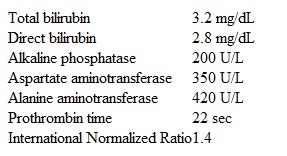 Which of the following is the most likely cause of the patient's disease?
 (Multiple Choice)
4.7/5 (79)
(79) A 45-year-old woman comes to the physician for evaluation of lesions on her chest and axillae. She initially noticed a small papule at her right axilla 6 months ago, followed by additional lesions in the same area extending toward her right breast. There is no associated pain, erythema, discharge, or pruritus. The patient is concerned about the number of lesions and requests further evaluation. She has a history of asthma treated with an albuterol inhaler as needed. She does not use tobacco or alcohol. Her vital signs are within normal limits. Skin examination of the right axillary region is shown below. The remainder of her physical examination is normal. 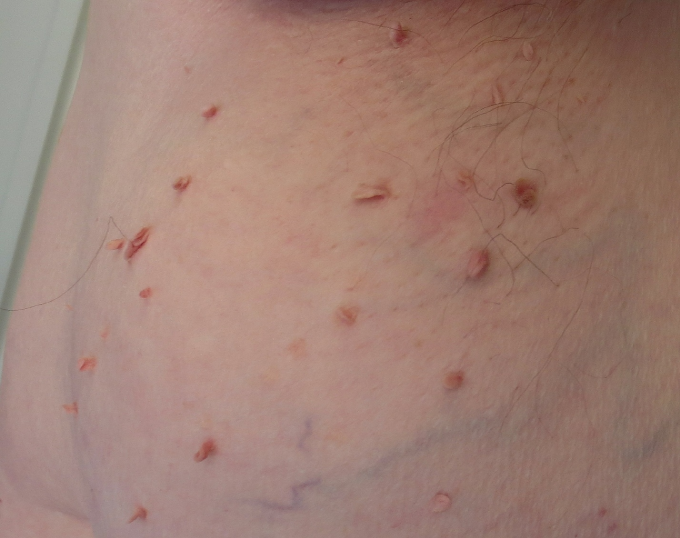 Which of the following is associated with this patient's skin condition?
 (Multiple Choice)
4.8/5 (95)
(95) A 16-year-old girl comes to the office due to joint pain lasting several days. The patient says, "My hands and knees feel stiff when I wake up, and those joints are painful throughout the day." The symptoms are improving, but she still has significant discomfort with daily activities. The patient has never before had such symptoms. A mildly pruritic rash on her face, arms, and legs developed around the same time as the joint symptoms. Last week, the patient had an upper respiratory infection with fever and myalgias that resolved quickly without intervention. She has seasonal allergies for which she uses a glucocorticoid intranasal spray as needed. She does not use tobacco, alcohol, or illicit drugs. The patient is not in a relationship and has never been sexually active. Temperature is 37.2 C (99 F). She appears well and is sitting comfortably on the examination table. Cardiopulmonary examination is normal. Examination of the hands shows mild symmetric swelling of the proximal interphalangeal and metacarpophalangeal joints; there is no warmth or erythema. Bilateral knees have a full range of motion, mild tenderness to palpation, and no swelling. Strength and sensation are symmetric and intact throughout, and distal pulses are strong bilaterally. There is a faint, erythematous, reticular rash on both arms and legs.
Which of the following is the most likely diagnosis for this patient?
(Multiple Choice)
4.9/5 (91)
(91) A 46-year-old previously healthy man comes to the hospital due to a day of pleuritic chest pain and dyspnea. The patient has had right leg swelling for the past week. He has smoked a pack of cigarettes daily for 12 years and works as a truck driver. Cardiopulmonary examination is within normal limits with the exception of tachycardia. The right lower extremity is swollen and tender up to the mid thigh. CT pulmonary angiography shows a right-sided pulmonary embolism, and duplex venous ultrasound reveals a thrombus in the right femoral vein. The patient is admitted to the hospital and started on low-molecular-weight heparin therapy. During morning rounds, he suddenly becomes unresponsive and has no palpable pulses despite electrical activity consistent with sinus bradycardia at 50/min on the cardiac monitor. Advanced cardiac life support measures, including external chest compressions and endotracheal intubation, are implemented. After 4 minutes of chest compressions, he is still pulseless and the monitor shows sinus bradycardia. Which of the following is the best next step in management of this patient?
(Multiple Choice)
4.9/5 (78)
(78) A 7-year-old girl is brought to the clinic by her mother due to vaginal spotting. The mother first noted a small amount of malodorous, yellow discharge on the patient's underwear 2 weeks ago and noticed a small amount of blood yesterday. The patient has no incontinence, dysuria, hematuria, or abdominal pain. She has no chronic medical conditions and takes no daily medications. Vital signs are normal. BMI is at the 60th percentile for age. Physical examination reveals a well-appearing girl in no acute distress. The abdomen is soft, nontender, and nondistended. External pelvic examination reveals purulent vaginal discharge with a small streak of blood. There are no visible lacerations or ecchymoses. The remainder of the examination is unremarkable. Which of the following is the most likely diagnosis in this patient?
(Multiple Choice)
4.7/5 (82)
(82) Showing 1101 - 1120 of 1121

Filters
- Essay(0)
- Multiple Choice(0)
- Short Answer(0)
- True False(0)
- Matching(0)