



 Chat with AI
Exam 1: Advanced Clinical Medicine

Exam 1: Advanced Clinical Medicine1 k+ Questions
Exam 2: Foundations of Independent Practice597 Questions
Select questions type


A 22-year-old woman is brought to the office by her mother because "she has been passing out." The patient's first episode occurred about a year ago when she split up with her boyfriend. A more recent episode was also provoked by strong emotion. Both episodes were preceded by nausea, light-headedness, weakness, and blurred vision, lasted about a minute, and ended with rapid recovery of consciousness. The patient sustained no significant injuries in either episode. She is concerned because one of her childhood friends passed out and died while playing football. Medical history is otherwise insignificant. The patient takes no medications and does not use alcohol or illicit drugs. She has no family history of early coronary artery disease, cardiomyopathy, or sudden cardiac death. Blood pressure is 110/70 mm Hg while supine and 108/70 mm Hg while standing. Physical examination findings are within normal limits. ECG reveals no abnormalities. Complete blood count and serum chemistries are within normal limits. Which of the following is the best next step in management of this patient?
(Multiple Choice)
4.7/5  (84)
(84) A 52-year-old Caucasian woman comes to the office for a routine follow-up visit. She complains of weakness and fatigue for the past two weeks. She 'feels tired' even while doing minor household chores. She denies fever or any changes in appetite or weight. Three months ago, she underwent surgery for carcinoma of the breast and has been on chemotherapy ever since. She is a retired nurse and lives at home with her husband. She was diagnosed with hypertension twenty years ago. Her current therapy includes cyclophosphamide, methotrexate, 5-flurouracil, ondansetron, atenolol and famotidine. Her vital signs are within normal limits. Examination is unremarkable, except for moderate pallor. Rectal examination shows no abnormalities. Her lab results reveal the following: 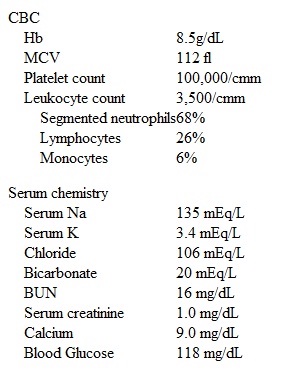 The stool test for occult blood is negative. Which of the following is most likely responsible for her condition?
 (Multiple Choice)
4.8/5 (93)
(93) A 23-year-old man is evaluated for a murmur discovered at a health fair. His past medical history is insignificant, and he feels well with no cardiac symptoms. The patient plays soccer and jogs regularly. His immediate family is healthy. Blood pressure is 122/70 mm Hg and pulse is 72/min. A 2/6 midsystolic murmur is heard at the left sternal border. The femoral pulses are full, and there is no brachial-femoral pulse delay. Echocardiography shows bicuspid aortic valve with a mildly increased gradient and no dilation of the aortic root. Which of the following is the best next step in management of this patient?
(Multiple Choice)
4.8/5 (82)
(82) A 64-year-old woman comes to the physician because she has had bilateral foot numbness and burning for the past three months. The symptoms are especially bothersome at night. She has a history of hypertension, coronary artery disease, and type 2 diabetes mellitus. She had an anterior wall myocardial infarction two years ago, which was treated with angioplasty and stenting of the left anterior descending artery. An echocardiogram obtained one year ago revealed an ejection fraction of 40%. She does not use tobacco, alcohol, or drugs. Her medications include metoprolol, furosemide, glyburide, atorvastatin, aspirin, and enalapril. She has been on oral hypoglycemic medications for the last ten years. Her blood pressure is 142/82 mmHg and her heart rate is 63/min. Her BMI is 34 kg/m2. Physical examination shows intact skin over both feet and 2+ peripheral pulses.
Which of the following is the most appropriate next step in managing this patient?
(Multiple Choice)
4.8/5 (76)
(76) A 2-week-old girl is admitted to the hospital for dehydration and vomiting. She had an uncomplicated vaginal delivery at home and did not undergo newborn screening. Breastfeeding has been difficult due to the newborn's lethargy and frequent vomiting. The mother has no medical problems, took no medications during the pregnancy, and had normal prenatal laboratory results. Family history is significant for a brother who died at age 1 month from severe dehydration several years ago. The newborn has a 2-year-old sister who is healthy. Vital signs show hypotension and tachycardia. Examination shows a sunken fontanelle and ambiguous genitalia. The rest of the examination is unremarkable. Abdominal x-ray, abdominal ultrasound, and upper gastrointestinal studies are normal. Karyotype analysis is pending. Serum chemistry results are as follows: 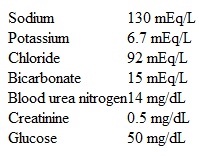 A deficiency of which of the following is the most common cause of this patient's presentation?
 (Multiple Choice)
4.8/5 (88)
(88) A 70-year-old man comes to the physician for pain and stiffness of his neck, shoulders, and hips for the last 3 months. His stiffness is worse in the morning and lasts 1-2 hours. He also complains of general malaise and a recent weight loss of 3.17 kg (7 lb). The patient has no headache, scalp tenderness, visual symptoms, or jaw claudication. Examination shows no overt synovitis at the joints, with normal passive range of motion. The arteries of the scalp, neck, and extremities are normal on palpation without any tenderness. Laboratory results are as follows: 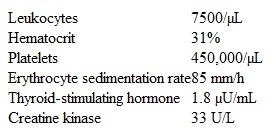 Which of the following is the most appropriate next step in management of this patient?
 (Multiple Choice)
4.8/5 (89)
(89) A 24-year-old man is brought to the emergency department by his girlfriend due to progressive weakness. They have been on a cross-country road trip for the past month. While traveling through the midwestern United States 2 weeks ago, the patient developed diarrhea, nausea, and vomiting. He rested, drank fluids, and improved spontaneously after 2-3 days. However, the patient had persistent fatigue, and 4 days ago they had to stop traveling as his legs became too weak to press down the brake pedal. He is now unable to get out of bed. The patient has also had tingling of the hands and feet as well as shortness of breath. He has had no fever, chills, abdominal pain, or recurrent diarrhea. The patient has no prior medical problems and takes no medications. He does not use tobacco, alcohol, or illicit drugs. Temperature is 37.7 C (99.8 F), blood pressure is 120/70 mm Hg, pulse is 90/min, and respirations are 20/min. Pulse oximetry shows 98% on ambient air. The patient is awake, alert, and speaking in full sentences but develops a weak cough after taking a sip of water. The lungs are clear to auscultation and heart sounds are normal. The abdomen is soft and nontender. Neurologic examination shows symmetric bilateral lower extremity weakness. Deep tendon reflexes are absent at the knees and ankles, and 1+ in the biceps and triceps. Cranial nerve examination and sensation are normal, and he has no neck rigidity. There is no skin rash or lymphadenopathy. The patient is told that the diarrheal illness may have triggered his current condition, and he becomes upset that he did not seek medical attention earlier. He inquires about the course and prognosis of his current condition. Which of the following is the most accurate statement?
(Multiple Choice)
4.9/5 (92)
(92) A 48-year-old man is brought to the emergency department for what his wife describes as "bizarre behavior" for the last two days. His past medical history is significant for cirrhosis secondary to chronic hepatitis C infection. His daily medications are spironolactone, lactulose, and furosemide. He is an ex-heroin user. Examination shows a drowsy but restless patient. His blood pressure is 94/56 mmHg and heart rate is 112/min with a regular rhythm. The abdomen is distended, soft, and non-tender to palpation. Shifting dullness is present. There is no peripheral edema. Laboratory tests show the following:
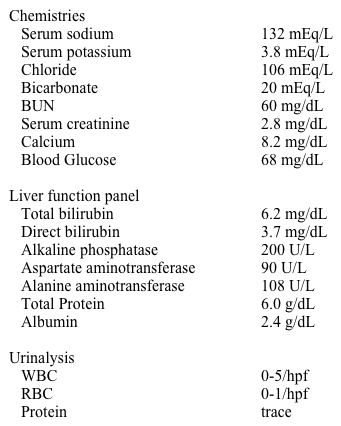 The peritoneal fluid is sampled yielding 12 WBCs/mm3 and an albumin of 1.0 mg/dL. Renal ultrasound shows no evidence of hydronephrosis. Which of the following is the best next step in managing this patient?
 (Multiple Choice)
4.8/5 (80)
(80) A pharmaceutical company plans to conduct a study to evaluate the efficacy of the addition of a novel conjugated anti-CD22 monoclonal antibody (mAb) to frontline therapy in adults age 18-39 with newly diagnosed precursor B-cell acute lymphoblastic leukemia (ALL). Researchers will assess the adverse reactions associated with treatment with the anti-CD22 mAb. A total of 1,200 patients newly diagnosed with CD22 positive B-cell ALL will be randomized to either frontline chemotherapy or intravenous infusion of the mAb given on days 1, 8, and 15. All participants will undergo bone marrow aspirate and biopsy on day 28. The study's primary outcome measure will be event-free survival, and its secondary outcome will include disease-free survival, overall survival, and complete response. Which of the following best describes this type of study?
(Multiple Choice)
4.8/5 (70)
(70) A 27-year-old woman, gravida 3 para 1 aborta 1, at 20 weeks gestation comes to the office as she is concerned that she might be at risk for hemolytic disease. She just learned that her sister-in-law's second baby has hydrops fetalis due to Rh(D) incompatibility and is concerned that this could happen to her second baby as well. The patient's pregnancy has been uncomplicated to date. The patient is Rh(D) positive and her husband is Rh(D) negative. Their 3-year-old son is healthy, and he is Rh(D) positive. A year prior, the patient had a missed abortion requiring suction curettage. She has no chronic medical problems and no other surgeries. The patient is taking a prenatal vitamin and does not use tobacco, alcohol, or illicit drugs. Vital signs are normal. Fetal anatomic ultrasound a week prior demonstrated an echogenic intracardiac focus but no other abnormalities. Which of the following is the most accurate statement to the patient regarding hemolytic disease due to Rh(D) incompatibility?
(Multiple Choice)
4.7/5 (74)
(74) A 23-year-old man newly diagnosed with bipolar disorder was admitted to the psychiatry unit 3 days ago. Since admission, he has spent all of his time at the nurses' station trying to convince the staff to discharge him. His speech is very loud and difficult to interrupt. He states that his roommate is "hitting" on him because of his good looks, and refuses to eat the food because it is not up to his standards. In addition, he is worried that he will miss his meeting with the President, which he says may cause the country to be forced into war. Despite attempts to redirect the patient, he becomes progressively more agitated and starts to verbally threaten the staff. He bangs on the desk at the nurses' station and throws a chair down the hallway. The patient is given emergency intramuscular haloperidol to decrease his agitation. A few hours later, the patient approaches the nurses' station screaming, "Something is wrong. Look what you did to me! I have been poisoned! Get me out of here immediately before I die!" Examination shows sustained upward deviation of the eyes and tilting of the neck to the right side. Which of the following is the most appropriate course of action?
(Multiple Choice)
4.8/5 (89)
(89) A 31-year-old man comes to the physician due to exertional shortness of breath over the last year. He gets short of breath after running 1-2 miles but feels mostly fine with daily activities. He has no chest pain, palpitations, or fainting spells. He also has no past medical history and takes no medications. There is no family history of sudden death. His blood pressure is 147/90 mm Hg, pulse is 77/min, and body mass index is 22 kg/m2. The apical precordial impulse is hyperdynamic. S1 and S2 are normal and a fourth heart sound is heard. He has a 2/6 systolic murmur at the left sternal border which increases with Valsalva. The lungs are clear to auscultation. An echocardiogram shows interventricular septal thickness of 1.8 cm (normal <1.1 cm) and posterior left ventricular wall thickness of 0.9 cm (normal <1.1 cm). Left ventricular ejection fraction is 75%. There is systolic anterior motion of the mitral valve. At rest, his peak instantaneous left ventricular outflow gradient is 25 mm Hg; however, it is 65 mm Hg after exercise. Holter monitoring for 24 hours shows no abnormalities. Which of the following is the best next step in the management of this patient?
(Multiple Choice)
4.8/5 (85)
(85) A 46-year-old man comes to the physician's office for a pruritic rash. The patient was in his usual state of health until 2 months ago, when dark red lesions appeared over his wrists. The lesions progressed, and a few weeks later he developed similar lesions on his lower legs. This morning, the patient saw some "white lines" in his mouth and called for an urgent appointment. He has no fevers, chills, weight loss, or diarrhea. The patient has a history of hypertension, which is controlled with lisinopril. He does not use tobacco or alcohol, but has a remote history of intravenous drug use. Physical examination shows multiple, discrete violaceous papules and plaques over the flexural surfaces of the patient's wrists and lower legs as shown in the image below. Examination of the buccal mucosa shows whitish lacy streaks with a slight background erythema. The rest of his physical examination is unremarkable. 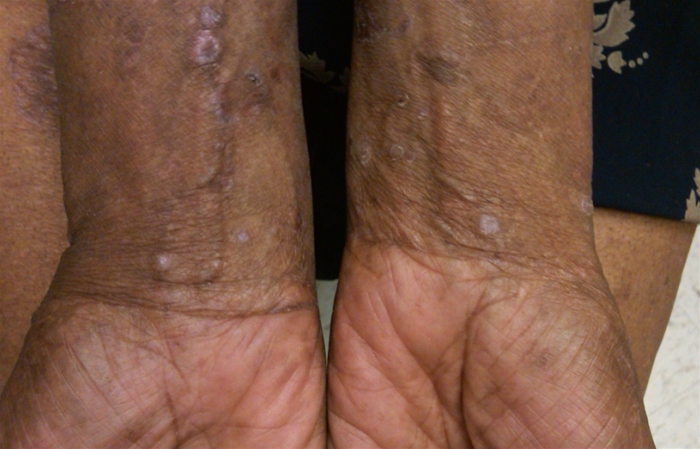 Which of the following is the best next step in diagnosing this patient's condition?
 (Multiple Choice)
4.8/5 (87)
(87) A 24-month-old boy is brought to the office by his parents for a routine well-child visit. The mother is concerned about his language development. However, his father says, "I started talking late when I was a kid. I used to be shy, so I'm not concerned." The boy lives with his parents and 5-year-old sister, who speak both English and Spanish at home. He can say 5-8 words in Spanish and seems to enjoy playing alongside his older sibling, but he does not play directly with her. The boy can run well and walk up and down stairs without assistance. His diet typically consists of milk, pasta, chicken nuggets, and fruit. Full-term gestation as well as labor and delivery were uncomplicated. Routine newborn screen and hearing screen were normal at birth. He had an episode of otitis media 5 months ago that was treated with antibiotics. Growth has been consistent along the 25th and 60th percentiles for height and weight, respectively. Physical examination shows a nondysmorphic and alert boy. Pneumatic otoscopy shows gray, mobile tympanic membranes. Skin examination reveals two café au lait spots on the lower back. The rest of the examination is unremarkable. During the visit, the boy is observed smiling and shows his parents a line he drew on a piece of paper. Which of the following is the most appropriate response to the parents?
(Multiple Choice)
4.9/5 (91)
(91) A 45-year-old man comes to the clinic for follow-up of hypertension. He was diagnosed 6 months ago and prescribed antihypertensive therapy. The patient is an ex-smoker with a 25-pack-year history; he quit smoking 2 years ago. Medical history includes a laparoscopic cholecystectomy 5 years ago after an episode of acute cholecystitis. He eats a well-balanced diet, walks 2-3 miles daily, and does not consume alcohol. His father had a heart attack at age 62, and his mother died of a stroke at age 67. Blood pressure is 140/88 mm Hg and pulse is 67/min. BMI is 30 kg/m2. Physical examination is unremarkable. Fasting laboratory results are as follows: 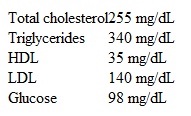 Which of the following is the best next step in management of this patient?
 (Multiple Choice)
4.9/5 (72)
(72) A 42-year-old woman comes to the office due to episodic diarrhea over the past several months. The patient describes large-volume, watery diarrhea accompanied by flatulence, typically a few hours after a meal. She has had no fever, abdominal pain, blood in stools, or nocturnal diarrhea. The patient has a history of Hashimoto thyroiditis and takes levothyroxine. She drinks a glass of wine every evening with dinner but does not use tobacco or illicit drugs. The patient says she tries to eat a healthy diet despite a busy work schedule, frequently consuming fruits, vegetables, fish, and low-fat dairy products. Vital signs are within normal limits. The abdomen is soft, nondistended, and nontender with no hepatosplenomegaly. Bowel sounds are normal. The remainder of the examination shows no abnormalities. Stool testing for occult blood is negative, and blood cell counts, serum electrolytes, and TSH levels are within normal limits. Which of the following is the most appropriate response to the patient regarding her symptoms?
(Multiple Choice)
4.9/5 (84)
(84) A 47-year-old-man comes to the physician for a lesion on his foot. He has a 2-month history of an enlarging, painful, and thickened papule on the plantar surface of his left great toe. The patient attempted treatment for 2 weeks with a "corn pad" without relief. He has no prior history of similar lesions, and his past medical history is unremarkable. 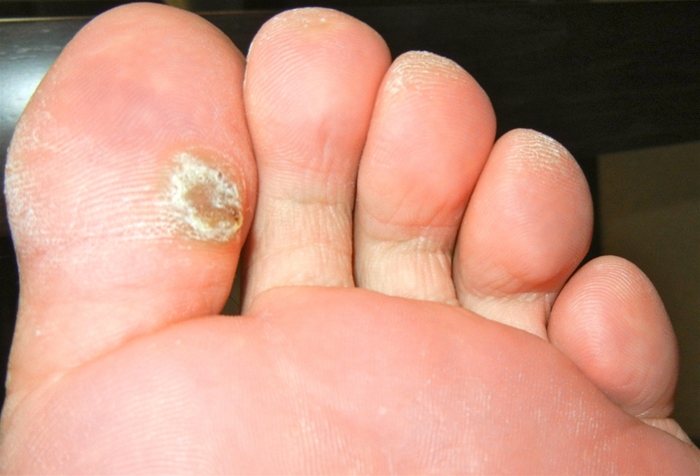 Which of the following is the best next step in management of this patient?
 (Multiple Choice)
4.7/5 (84)
(84) A 31-year-old woman is brought to the emergency department due to fever, chills, abdominal pain, and urinary frequency for the past 5 days. She vomited twice today, and her symptoms have become progressively worse. The patient reports increased malodorous vaginal discharge but no abnormal vaginal bleeding. She has no associated dysuria, hematuria, diarrhea, constipation, or sick contacts. The patient has no chronic medical conditions or previous surgeries. Her last menstrual period was a week ago. She is sexually active and uses oral contraceptives. The patient has no known drug allergies. Temperature is 38.9 C (102 F), blood pressure is 100/60 mm Hg, pulse is 110/min, and respirations are 18/min. Physical examination shows a pale and diaphoretic woman. The abdomen is soft, diffusely tender, and nondistended; no rebound tenderness or rigidity is present. Bowel sounds are increased. There is no splenomegaly, costovertebral angle tenderness, or tenderness to palpation of the lower back. On pelvic examination, there is light yellow discharge at the external cervical os and tenderness on lateral movement of the cervix. Laboratory results are as follows: 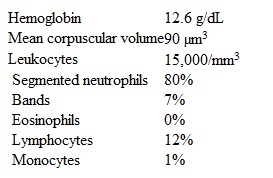 Urinalysis results are unremarkable. Urine pregnancy test is negative. Pelvic ultrasonography shows a small uterus with no adnexal masses. Which of the following is the most appropriate next step in management of this patient?
 (Multiple Choice)
4.8/5 (70)
(70) A 40-year-old man comes to the office with concern of HIV infection. The patient had unprotected anal intercourse with a new partner during a business trip a month ago. A few days after the encounter, the patient learned that the partner was HIV positive. The patient immediately visited an urgent care clinic and was tested for HIV using a combination p24 antigen/HIV-antibody immunoassay. Although the test was negative and he has no symptoms, the patient feels anxious about the possibility of infection. He has no prior medical problems and takes no medication. The patient drinks alcohol on social occasions but does not use tobacco or illicit drugs. Temperature is 37.1 C (98.8 F), blood pressure is 130/70 mm Hg, and pulse is 80/min. No oropharyngeal erythema, exudate, or ulcers are present. Lung auscultation is unremarkable and heart sounds are normal. The abdomen is soft and nontender with no organomegaly. Bowel sounds are normal. No anal ulcers are present and genital examination is normal.
Which of the following is the most appropriate next step in management of this patient's concern about HIV infection?
(Multiple Choice)
4.9/5 (94)
(94) A 4-year-old boy is brought to the office due to snoring. For the past 5 months, his mother has heard loud snoring at night, with pauses in his breathing followed by gasping for air. Medical history is significant for 2 episodes of otitis media that resolved with antibiotic therapy. The patient is up to date with vaccinations. He attends day care 5 days a week. His father smokes outside the home. The family has a cat. Height is at the 40th percentile and weight is at the 15th percentile. On physical examination, the patient appears well. The tympanic membranes are clear with no middle ear effusion. The nose is clear with no rhinorrhea. Oral examination shows good dentition and tonsillar hypertrophy. The lungs are clear to auscultation and heart sounds are normal. Which of the following is the best next step in management?
(Multiple Choice)
4.8/5 (78)
(78) Showing 661 - 680 of 1121

Filters
- Essay(0)
- Multiple Choice(0)
- Short Answer(0)
- True False(0)
- Matching(0)