



 Chat with AI
Exam 1: Advanced Clinical Medicine

Exam 1: Advanced Clinical Medicine1 k+ Questions
Exam 2: Foundations of Independent Practice597 Questions
Select questions type


A 14-year-old girl is brought to the emergency department by her parents for the evaluation of left knee pain that started 2 hours ago. The girl landed on her left foot after jumping to spike the ball at a volleyball game and immediately felt an excruciating pain in her left knee. Her father says, "Her knee is very swollen, and I had to carry her here because she isn't able to put any weight on her left leg." The patient had no prior injury to the leg. Medical history is significant for systemic lupus erythematosus, which has been well controlled on daily hydroxychloroquine for the past year. The patient received a course of high-dose glucocorticoids last year, when she was initially diagnosed, but none since. She is also taking calcium and vitamin D supplements. Vital signs are normal. The patient is crying and in moderate distress due to pain. On physical examination, there is diffuse swelling and tenderness in the anterior left knee. Passive extension and flexion of the left knee does not elicit pain or a palpable click along the joint line; however, the patient is unable to extend the left knee against resistance or raise the leg off the examination table without assistance. With the knee flexed at 30 degrees, there is minimal anterior movement of the tibia in relation to the femur. Valgus stress to the left knee does not reveal an increased laxity. The patient has 2+ pedal pulses bilaterally and sensation is intact.
Which of the following is the most likely explanation for the findings in this patient?
(Multiple Choice)
4.9/5  (85)
(85) A 15-year-old girl is brought to the office for evaluation of lower abdominal pain associated with her menses that has occurred over the past few months. She describes the pain as "dull" and "crampy" and radiating to her back and lower thighs. The pain is associated with nausea and bloating, and the patient vomited twice during her last menstrual cycle. She has tried using a heating pad with minimal relief of symptoms. The patient "dreads" her periods and has missed several days of school due to the pain and vomiting. She has had no dysuria, diarrhea, abnormal vaginal discharge, or abdominal pain between periods. Her menses started at age 14, have occurred every month, and last 5 days. When interviewed alone, she reports that she had a boyfriend last year but is not currently in a relationship and has never had sexual intercourse. The patient has no chronic medical conditions and takes no daily medications. Her immunizations, including the human papillomavirus vaccine, are up to date. She does not use tobacco, alcohol, or illicit drugs. The patient's aunt was diagnosed with endometrial cancer at age 40 and has been in remission for several years. Temperature is 37 C (98.6 F), blood pressure is 110/60 mm Hg, and pulse is 68/min. BMI is 25 kg/m2. Cardiopulmonary examination is normal. The abdomen is soft and nondistended. Pelvic examination reveals normal external female genitalia and a small, nontender uterus without masses. On speculum examination, a small amount of clear discharge is seen throughout the vaginal vault. The cervix is nulliparous and has no lesions or areas of friability. Which of the following is the best next step in management of this patient?
(Multiple Choice)
4.8/5 (68)
(68) A 76-year-old Caucasian male comes to see you in the office. He complains that he has visible and palpable tortuous swelling on both of his lower legs. It is associated with mild leg heaviness and cramping, especially in the evening. His symptoms are worse with prolonged standing, and improve with leg elevation. He has a past medical history of hypertension, hyperlipidemia, benign prostatic hyperplasia, and degenerative joint disease of both knees. On examination of his lower legs, you notice a few scattered palpable veins consistent with a diagnosis of varicose veins. There is no edema, chronic skin hyperpigmentation, or leg ulcers. Peripheral pulses are full and equal on both sides. Which of the following is the most appropriate next step in the management of this patient?
(Multiple Choice)
4.9/5 (71)
(71) A 31-year-old woman, gravida 1 para 0, at 19 weeks gestation comes to the office to discuss results of a serum alpha-fetoprotein (AFP) screening. The patient has been followed since her seventh week of pregnancy, when gestational age was confirmed with transvaginal ultrasound. Since learning that women should start taking folic acid prior to becoming pregnant to avoid congenital defects, she has been concerned about the possibility of having a baby with a neural tube defect. Because she started taking folic acid after the first trimester and one of her friends has a child with spina bifida, she requested testing of her AFP levels. The patient has no chronic medical conditions or previous surgeries. Family history is not significant. She does not use tobacco, alcohol, or illicit drugs. Vitals signs are within normal limits. The uterus is palpable below the umbilicus. Fetal heart rate is 155/min by bedside Doppler ultrasound. The serum AFP level is slightly elevated at 3.0 MoMs (normal: <2.5). A repeat AFP is elevated at 3.1 MoMs. Which of the following is the most appropriate next step in management of this patient?
(Multiple Choice)
4.8/5 (86)
(86) A 57-year-old woman comes to the office due to discomfort in her right hand. She reports that periodically her fingers "feel numb, with some tingling, sort of like they fell asleep." When the patient shakes her hands, normal sensation is partially restored. The symptoms are more often present at night but are occasionally experienced during the daytime as well. She has not had abnormalities of sensation on the dorsal surfaces of her hands, and she reports no shoulder or neck pain. There is no history of injury to the upper extremities. Medical history is notable for irritable bowel syndrome, mitral valve prolapse, degenerative knee arthritis, and hypertension controlled with lisinopril. She also takes an over-the-counter fiber supplement. The patient works as a bookkeeper. She does not use tobacco, alcohol, or illicit drugs. Vital signs are normal. BMI is 32 kg/m2. Neurologic examination shows no sensory loss, muscle weakness, or muscle atrophy in the right upper extremity.
Which of the following is most likely in this patient?
(Multiple Choice)
4.8/5 (75)
(75) A 38-year-old woman comes to the office due to dyspnea on exertion for the past 6 months. She says, "I get out of breath even when I walk less than a block at my usual pace. I climb stairs very slowly." A year ago, the patient was able to walk 10-12 blocks without any limitations. She has no chest pain, palpitations, syncope, cough, or hemoptysis. She has no medical problems. The patient saw a doctor 2 years ago and had a routine physical that did not show any abnormalities. She does not use tobacco, alcohol, or illicit drugs. Her mother has a history of breast cancer and "blood clots" in her legs. Her father had a stroke. The patient takes no prescription or over-the-counter medications. She has no known drug allergies. On examination, she appears comfortable at rest. Temperature is 36.7 C (98 F), blood pressure is 143/91 mm Hg, pulse is 84/min, and respirations are 16/min. Pulse oximetry shows 94% saturation on room air. BMI is 34 kg/m2. On cardiac auscultation there is a prominent S2 but no murmurs or additional sounds. The lungs are clear. Peripheral pulses are full and no finger or toe clubbing is present. There is no peripheral edema. Chest-x ray reveals prominent pulmonary arteries but no infiltrates. ECG reveals normal sinus rhythm with right axis deviation.
Which of the following is the most appropriate next step in management of this patient?
(Multiple Choice)
4.8/5 (75)
(75) A 45-year-old woman with a history of chronic menorrhagia is hospitalized for an elective hysterectomy. Her preoperative hemoglobin is 7 g/dL. She is transfused with 2 units of packed red blood cells. Two hours after starting the transfusion, the patient reports chills and malaise. Her temperature is 38.8 C (102 F), blood pressure is 120/76 mm Hg, pulse is 100/min, and respirations are 18/min. The transfusion is stopped, and she receives acetaminophen. Direct antiglobulin test and plasma free hemoglobin level are negative. Urinalysis is within normal limits. The reaction resolves 6 hours after the transfusion began. Which of the following actions could have prevented this reaction?
(Multiple Choice)
4.8/5 (88)
(88) An 84-year-old man comes to the physician with persistent dyspnea despite being treated with optimal medical therapy for congestive heart failure with low left ventricular ejection fraction. A recently published randomized clinical trial compared an angiotensin-neprilysin inhibitor (ANi) to an angiotensin-converting enzyme inhibitor (ACEi) in patients who have heart failure with a reduced ejection fraction. The following results were reported: 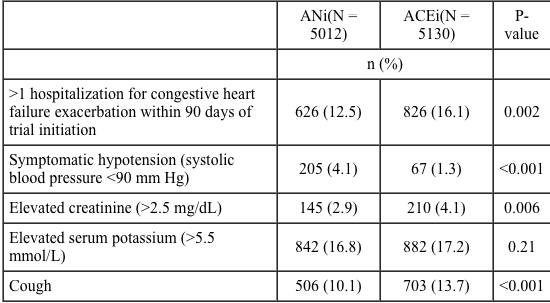 The investigators also reported the following results for patients in the angiotensin-neprilysin inhibitor (ANi) and angiotensin-converting enzyme inhibitor (ACEi) groups:
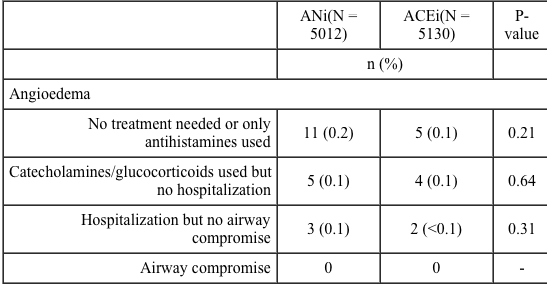 Which of the following is the best interpretation of these results
The investigators also reported the following results for patients in the angiotensin-neprilysin inhibitor (ANi) and angiotensin-converting enzyme inhibitor (ACEi) groups:
Which of the following is the best interpretation of these results (Multiple Choice)
4.9/5 (79)
(79) A 52-year-old man is being evaluated due to upper abdominal discomfort, nausea, and frequent heartburn for the past 6 months. His symptoms are partially relieved with over-the-counter antacids. The patient has had no chest pain, dysphagia, odynophagia, vomiting, black or bloody stools, or weight loss. He has a history of hypertension and mild intermittent asthma. He has a 20-pack-year smoking history but quit 3 years ago. BMI is 32.8 kg/m2. Upper gastrointestinal endoscopy shows moderate esophagitis with velvety, reddish mucosa extending from the gastroesophageal junction into the distal esophagus and mild antral gastritis. Biopsy results are consistent with Barrett esophagus without dysplasia. Antral mucosal biopsies do not show evidence of Helicobacter pylori infection. He is started on proton pump inhibitor therapy. Which of the following is the best next step in management of this patient?
(Multiple Choice)
4.9/5 (88)
(88) A 4-year-old girl is brought to the emergency department due to fever and lethargy. Her parents say she has been withdrawn and less playful over the last 2 weeks. She has also had several days of low-grade fever and headaches. Since yesterday morning, the patient has mostly slept and seems to be increasingly confused. She has no significant prior medical problems and is up to date with recommended vaccinations. Her grandfather, who is visiting the family from South Asia, is being evaluated for cough; otherwise, the patient has no sick contacts. The family has a pet cat. Temperature is 38 C (100.4 F). The patient is somnolent and responds to painful stimuli. There is resistance to passive neck flexion. Her right eye is deviated medially, and funduscopic examination reveals several ill-defined, raised, yellow-white nodules near the bilateral optic discs. CT scan of the head reveals basilar meningeal enhancement. Lumbar puncture is performed, and cerebrospinal fluid analysis results are as follows: 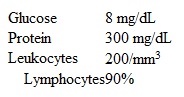 The patient's cerebrospinal fluid samples are sent for acid-fast bacilli staining and culture. The parents note that the patient's grandfather also tested positive for sputum acid-fast bacilli. Which of the following is most accurate about the management of this child?
 (Multiple Choice)
4.9/5 (94)
(94) A 26-year-old Italian-American man comes to your office for the evaluation of low back pain. He has had this pain for the last eight months, and it is progressively getting worse. The pain is worse in the morning and gets better as the day progresses. He denies any history of trauma in the past. He works as a chef at a local restaurant. His father and uncles also have "back problems." His physical examination reveals a limited range of motion of his lumbosacral spine and markedly reduced chest expansion. The rest of his physical and musculoskeletal examination is unremarkable. If the initial evaluation shows mild disease, what would you do to monitor the disease activity?
(Multiple Choice)
4.8/5 (69)
(69) A 38-year-old woman comes to the office for follow-up after recent hospitalization. The patient went to the emergency department 2 weeks ago after several episodes of coffee-ground emesis. She had intermittent, burning, epigastric pain over the past several months prior to hospitalization. At that time, upper gastrointestinal endoscopy revealed a duodenal ulcer, and the patient was discharged on pantoprazole therapy. The patient reports improvement in abdominal pain and has had no further hematemesis, hematochezia, or melena. She has no other medical problems and in the past has taken only ibuprofen for occasional aches and pains. The patient does not use tobacco, alcohol, or illicit drugs and has no allergies. Family history is notable for gastric cancer in her father. Temperature is 36.5 C (97.7 F), blood pressure is 124/78 mm Hg, and pulse is 82/min. Cardiopulmonary examination is normal. The abdomen is nondistended, soft, and nontender. Gastric and duodenal biopsies performed during the endoscopy show chronic antral gastritis with presence of Helicobacter pylori but no evidence of malignancy. The patient returns to the office a month after completing the prescribed treatment. She reports that she initially felt better but has had intermittent recurrence of the abdominal pain. She also has had occasional nausea but no vomiting, hematemesis, hematochezia, or melena. Which of the following is the best next step in management of this patient?
(Multiple Choice)
4.9/5 (83)
(83) A 43-year old man comes to the physician with a 2-day history of blistering and severe itching on his hand. He developed a superficial burn on his index finger from hot candle wax 1 week ago and has been treating the burn with a topical ointment containing neomycin, polymyxin B, and bacitracin. His past medical history is significant for irritable bowel syndrome with chronic diarrhea. The patient is not taking any prescription medications and has no known drug allergies. On examination, he has faint erythema of the skin between the index and middle fingers, several vesicles and small bullae are present as shown in the image below: 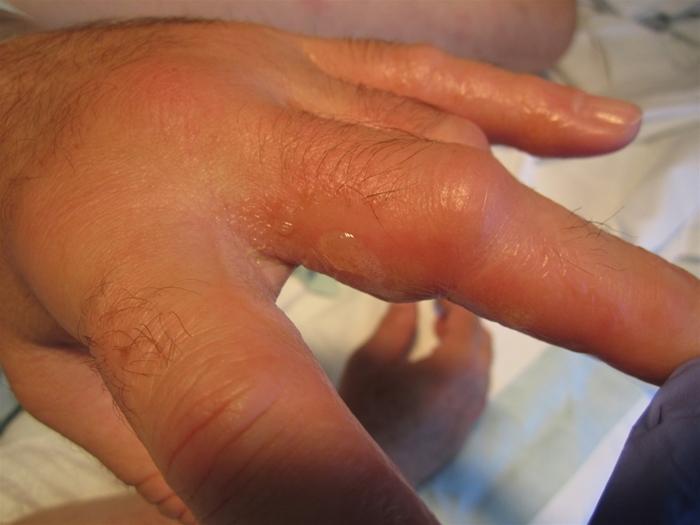 Which of the following is the most appropriate next step in management of this patient's skin disorder?
 (Multiple Choice)
4.8/5 (84)
(84) Imaging studies show the presence of colonic dilatation with some air-fluid levels. There is no pneumoperitoneum. Initial evaluation shows:
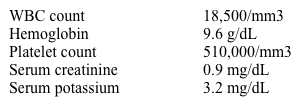 Stool studies are negative for C. difficile toxin. At this point, the patient is most likely to benefit from which of the following?
 (Multiple Choice)
4.9/5 (71)
(71) A 3-year-old boy is brought to the clinic by his mother for evaluation of fever and rash. He was bitten by an insect yesterday, resulting in an itchy red "bump" on his right thigh. The lesion has rapidly enlarged and become tender to the touch. The mother says, "My son awoke from his nap today with fever and chills, so I am worried that he has an infection. I rubbed a steroid medication from the drugstore on his skin, but he says it is still painful." The patient has no chronic medical conditions and takes no medications. He has no known allergies. Temperature is 39.5 C (103.1 F). Examination reveals an uncomfortable-appearing boy sitting in his mother's lap. Cardiopulmonary examination is normal. Skin examination reveals an 8-cm area of bright-red, tense, and warm skin on the right upper thigh that is well demarcated and raised relative to the surrounding, unaffected skin. No fluctuance or discharge is noted. Three tender 1.5-cm right inguinal lymph nodes are present. The remainder of the examination is unremarkable. Which of the following is the most likely diagnosis?
(Multiple Choice)
4.9/5 (69)
(69) A previously healthy 13-month-old boy is brought to the emergency department by ambulance after an episode of "jerky movements all over" that lasted 2 minutes. The movements occurred when the patient's father had just put him in his crib at naptime. The child has had fever, nasal congestion, and "eye redness" for the past day. Review of systems is otherwise negative. The patient was born full term, takes no medications, and has received all recommended vaccinations. His father has a history of a febrile seizure during childhood and a cousin with developmental delays. Temperature is 39.2 C (102.5 F), pulse is 120/min, and respirations are 22/min. Examination shows an awake, well-appearing boy resting on his father's lap. The anterior fontanelle is closed, and there is clear rhinorrhea and nasal congestion. The neck is supple with full range of motion. Auscultation reveals no adventitious sounds and no murmurs. The abdomen is soft and nontender. The extremities have full range of motion, and deep tendon reflexes are 2+ throughout. The soles of the feet are firmly stroked, causing the big toe to move upward, and the other toes fan out. Which of the following is the most accurate statement regarding this patient's prognosis?
(Multiple Choice)
4.9/5 (75)
(75) A 62-year-old man with hypertension and heart failure comes to the office for follow-up 2 weeks after hospital discharge for acute decompensated heart failure. The patient becomes short of breath after walking 1 block or climbing a flight of stairs but does not have orthopnea, cough, or hemoptysis. Current medications include metoprolol succinate, sacubitril-valsartan, furosemide, and spironolactone. Blood pressure is 128/76 mm Hg and pulse is 80/min. Oxygen saturation is 95% on room air. Jugular venous pressure is estimated at 8 cm H2O. Lungs are clear to auscultation, and an S3 is heard at the apex. There is trace peripheral edema. Echocardiography shows left ventricular ejection fraction of 30%, mild mitral regurgitation, and mild pulmonary hypertension. The patient's serum creatinine is 1.2 mg/dL, and serum potassium is 5.0 mEq/L. Which of the following is the best additional therapy for this patient?
(Multiple Choice)
4.9/5 (78)
(78) A 45-year-old man comes to the physician for pain and stiffness in his left shoulder for the past 3 months. His symptoms were mild in the beginning and intermittently affected his daytime activities. The pain and stiffness have worsened in the past month and are constant throughout the day and night. The pain is worse with lying on the shoulder. The patient, a professional painter, recalls no injury and has no other symptoms. He has a history of type 1 diabetes mellitus, depression, and psoriasis. Examination of the left shoulder shows no focal tenderness but global restriction in all directions with both active and passive range of motion. The right shoulder joint has normal range of motion. The remainder of the physical examination is within normal limits. X-ray of the left shoulder is normal without significant osteoarthritis of the glenohumeral joint. An appropriate diagnosis is made after the patient is evaluated. Which of the following is the best next step in management of this patient?
(Multiple Choice)
4.7/5 (76)
(76) A 74-year-old man is brought to the emergency department after being found outside early on New Year's morning. His medical history is unknown. Temperature is 31.5 C (88.7 F), blood pressure is 75/50 mm Hg, pulse is 55/min, and respirations are 8/min and shallow. On examination, the patient is unresponsive. Initial laboratory results are as follows: 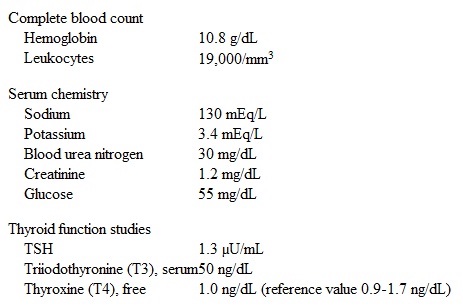 Blood alcohol level is undetectable and urine drug screen is negative. Plasma cortisol and ACTH levels are normal. Chest x-ray reveals a right lower lobe infiltrate. The patient is placed on mechanical ventilation, pressor support, warm intravenous fluids, and broad-spectrum antibiotics. Blood cultures are pending. His vital signs improve rapidly with rewarming. Which of the following is the best next step in management of this patient's thyroid abnormalities?
 (Multiple Choice)
4.9/5 (88)
(88) A group of rheumatologists wants to investigate 8 candidate rheumatoid arthritis (RA) susceptibility loci to identify whether single nucleotide polymorphisms (SNPs) are associated with RA in a given population. Eight SNPs (MTHFR C677T, MTHFR A1298C, TGFβ1 T869C, TNFB A252G, VDR ApaI, VDR BsmI, VDR FokI, VDR TaqI) are tested by genotyping patients with RA (n = 105) and unrelated patients without RA (n = 80) as controls. Which of the following is the most appropriate null hypothesis for this study?
(Multiple Choice)
4.9/5 (89)
(89) Showing 1021 - 1040 of 1121

Filters
- Essay(0)
- Multiple Choice(0)
- Short Answer(0)
- True False(0)
- Matching(0)