



 Chat with AI
Exam 1: Advanced Clinical Medicine

Exam 1: Advanced Clinical Medicine1 k+ Questions
Exam 2: Foundations of Independent Practice597 Questions
Select questions type


A 33-year-old woman comes to the office due to fatigue over the last 6 months. She attributes this to her stressful work environment but still wants to be "checked up." The patient has no significant medical history, and her only medication is an oral contraceptive. She has had no abdominal pain, back pain, vomiting, diarrhea, or leg swelling. The patient drinks 1 or 2 glasses of wine on most days of the week but does not use tobacco or illicit drugs. Vital signs are normal. Today, her weight is 64 kg (141 lbs), and the patient reports she weighed 68 kg (150 lbs) 3 months ago. The liver edge is palpable 2 cm below the right costal margin. Laboratory results are as follows: 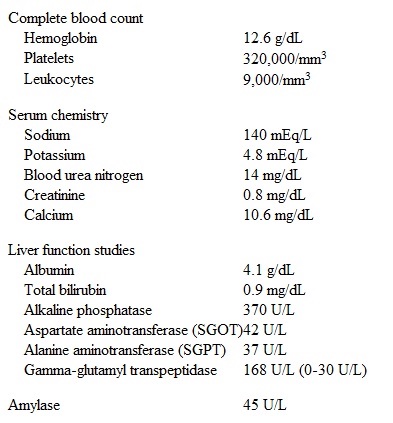 Abdominal ultrasound confirms mild hepatomegaly; the pancreas is not well visualized. Chest x-ray reveals bilateral hilar fullness but no parenchymal opacities. Which of the following is the most likely cause of the abnormal liver function studies in this patient?
 (Multiple Choice)
4.8/5  (91)
(91) A 25-year-old man is brought to the emergency department due to high-grade fever, chills, myalgias, and skin rash, which started on the day of admission. He also had nausea and 3 episodes of profuse watery diarrhea and is now feeling lightheaded. Two days ago, he underwent corrective surgery for a deviated nasal septum but otherwise has no other past medical history. The patient has not traveled recently and has not been around sick contacts. He does not use illicit drugs. His temperature is 39.4 C (103 F), blood pressure is 85/50 mm Hg, and pulse is 116/min. Oxygen saturation is 98% on room air. He is lethargic but has no focal weakness or nuchal rigidity. Examination shows clear lung fields and tachycardia with normal first and second heart sounds. The abdomen is soft and nontender. There is nasal packing in both nostrils. Skin examination shows a diffuse, red, macular rash that also involves the palms and soles. 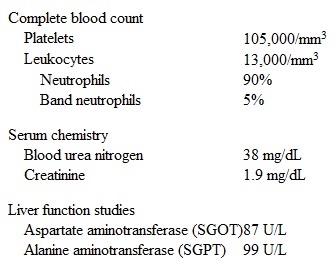 Blood cultures are sent. Which of the following is the most important next step in the treatment of this patient?
 (Multiple Choice)
4.9/5 (96)
(96) A 55-year-old man comes to the office due to hearing loss and a feeling of fullness in the right ear. He took a few days of antibiotics leftover from his daughter's ear infection but had no improvement. The patient has had no pain or fever. Physical examination shows a normal, translucent tympanic membrane with a clear, amber-colored effusion in the right middle ear. The remainder of the examination, including left ear examination, is normal. He is treated with antihistamines, oral decongestants, and nasal corticosteroids. The patient returns 3 months later and has had no change in symptoms. Physical examination is also unchanged. The patient has no other medical conditions. Which of the following is the most appropriate statement regarding management of this patient's condition?
(Multiple Choice)
4.7/5 (84)
(84) A 43-year-old woman comes to the office for an initial evaluation. The patient recently moved to the area for a new job and is worried about her poor health. She explains that she had to call in sick several times this past month because either "I felt too exhausted" or "I was lightheaded and had an upset stomach." The patient has a history of hypothyroidism, chronic headaches, insomnia, and dysmenorrhea. She describes a long history of fatigue, but previous doctors have assured her that her hypothyroidism is well controlled with medication. She also describes chronic problems with urinary frequency; stomach bloating; and dry, itchy skin. The patient is worried about her symptoms and wonders if all the doctors she has seen may have "missed something." Her medications include levothyroxine, daily multivitamins, and zolpidem and naproxen as needed. The patient does not smoke or use illicit drugs. She stopped drinking alcohol a year ago as it made her symptoms worse. Blood pressure is 110/70 mm Hg, pulse is 84/min, and respirations are 12/min. Physical examination is normal. T4 is 10 µg/dL and TSH is 1.3 µU/mL.
Which of the following is the most likely diagnosis in this patient?
(Multiple Choice)
4.8/5 (81)
(81) A 68-year-old man comes to the office due to recurrent episodes of dizziness. His medical problems include hypertension, coronary artery disease, asthma, type 2 diabetes mellitus, and hypercholesterolemia. He is retired and lives alone. He does not use tobacco, alcohol, or drugs. Medications include aspirin, enalapril, isosorbide mononitrate, simvastatin, glyburide, and metformin. Temperature is 36.7 C (98 F), blood pressure is 125/80 mm Hg in the decubitus position and 100/70 mm Hg in the standing position, pulse is 86/min in the decubitus position and 92/min in the standing position, and respirations are 14/min. Examination shows no abnormalities. Which of the following is the most effective strategy to manage this patient's symptoms?
(Multiple Choice)
4.7/5 (80)
(80) A 65-year-old woman is brought to the emergency department by paramedics after falling on a snow-covered sidewalk. The patient fell backward onto her hands while trying to maintain her balance and immediately felt a sharp, excruciating pain in her right arm. She also notes mild tenderness and bruising on the right flank and right buttock. The patient has a history of osteoporosis and hypertension and takes valsartan, alendronate, and a vitamin D supplement. She does not use tobacco, alcohol, or illicit drugs. In the emergency department, radiograph reveals a displaced fracture of the right distal radius. The patient is admitted to the hospital and undergoes open reduction and internal fixation of the radius fracture. On postoperative day 2, she reports severe, constant, burning pain over her right flank. The postsurgical pain in the right arm is mild and well controlled with low-dose morphine as needed. Temperature is 37.8 C (100 F), blood pressure is 145/84 mm Hg, pulse is 97/min, and respirations are 16/min. Mucous membranes are moist and the oropharynx is without lesions. Cardiopulmonary auscultation reveals clear lungs and normal heart sounds. The abdomen is soft, nontender, and nondistended. The right flank is tender to light touch with a rash over the area, as shown in the exhibit. 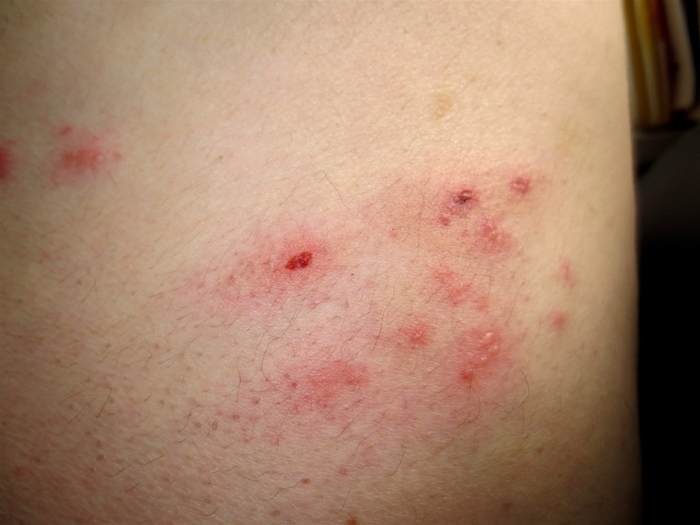 The surgical wound is healing normally without signs of infection. A diagnosis of herpes zoster is made and the patient is started on oral valacyclovir. The patient's nurse comes to the office due to concern that she may have been exposed. The nurse is pregnant and in her first trimester. She reports a history of varicella as a child and has never received a varicella or zoster immunization. What is the most appropriate treatment for this nurse?
 (Multiple Choice)
4.7/5 (78)
(78) A 54-year-old man comes to the emergency department after an episode of syncope. While he was watching television 30 minutes ago, he experienced sudden-onset chest pressure followed by a syncopal episode. He regained consciousness within a minute but continues to have chest "heaviness" and shortness of breath. Two days ago, the patient returned home from an extended car trip. He has a history of hypertension, osteoarthritis, and prostate cancer treated with brachytherapy. He is a former smoker with a 15-pack-year history and does not use alcohol or illicit drugs. Temperature is 38.3 C (100.9 F), blood pressure is 81/50 mm Hg, pulse is 110/min and regular, respirations are 26/min, and pulse oximetry is 92% on room air. The lungs are clear to auscultation. Cardiac examination shows a nondisplaced point of maximal impulse, with no murmurs but an accentuated pulmonic component of S2. Laboratory results are as follows:
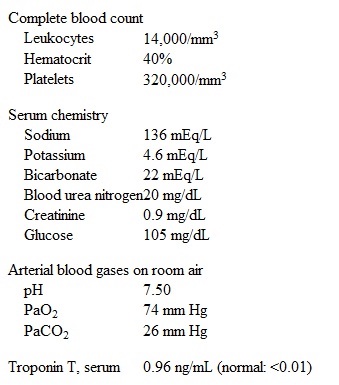 ECG shows sinus tachycardia with nonspecific ST-segment and T-wave changes. CT angiography reveals filling defects in the bilateral main pulmonary arteries. Blood pressure after multiple fluid boluses is 85/60 mm Hg and pulse is 108/min.
Which of the following findings in this patient is most predictive of increased 30-day mortality?
ECG shows sinus tachycardia with nonspecific ST-segment and T-wave changes. CT angiography reveals filling defects in the bilateral main pulmonary arteries. Blood pressure after multiple fluid boluses is 85/60 mm Hg and pulse is 108/min.
Which of the following findings in this patient is most predictive of increased 30-day mortality? (Multiple Choice)
4.9/5 (89)
(89) A 40-year-old man comes to the clinic after having an abnormal laboratory evaluation during a blood donation program. He had hepatitis B serologies as follows: 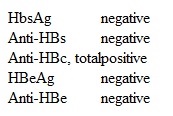 The patient has the same results on repeat testing at the office. He is concerned that he has a serious liver disease that needs to be treated. What is the next best step in management of this patient?
 (Multiple Choice)
4.9/5 (81)
(81) A 36-year-old woman comes to the office due to a 6-month history of lethargy and poor sleep. She has non-restorative sleep with frequent awakening throughout the night. The patient has also had a loss of appetite and decreased interest in day-to-day activities. In addition, she has had irregular menses, with infrequent, heavy, painless menstrual bleeding. There is no associated weight change, fever, cough, dyspnea, palpitations, abdominal pain, constipation, cold intolerance, or dry skin. Past medical history is unremarkable, and the patient takes no medications. She has a 10-pack-year smoking history, drinks alcohol socially, and does not use recreational drugs. Family history is positive for Graves disease in a sister and hypertension in her father. On examination, her blood pressure is 136/90 mm Hg, pulse is 78/min, and BMI is 27 kg/m2. The thyroid gland is diffusely enlarged and firm on palpation. Cardiopulmonary examination is normal, with no pedal edema. No focal neurological deficits are noted. Laboratory results show TSH of 9 μU/mL (normal 0.35-4.5 μU/mL), free T4 of 1.2 ng/dL (normal 0.8-1.8 ng/dL), and anti-thyroid peroxidase antibody present in high titers. Repeat TSH level is 8.8 μU/mL. Which of the following is the best next step in this patient's care?
(Multiple Choice)
4.8/5 (75)
(75) A 46-year-old female comes with a two-week history of intermittent epigastric abdominal pain and nausea. The pain gets better after a light meal or a cup of milk. The symptoms often occur at night. She has never had these symptoms before. She is currently not taking any medications. Endoscopy reveals a small duodenal ulcer in the bulbar area. The serology test for Helicobacter pylori is positive. You decide to manage the patient with triple drug therapy. Which of the following is the most appropriate next step to confirm the eradication of H. pylori infection in this patient?
(Multiple Choice)
4.7/5 (67)
(67) A 22-year-old college student comes to the office due to a 1-week history of right lower leg pain. She has mild dull pain at rest that becomes sharp and "bothersome" with exercise. She is an avid runner and has been preparing for an upcoming marathon event for the past 2 months. Her shoe has recently been bothering her, especially on the lateral side of the right foot. The patient has no other medical problems or history of recent trauma. Physical examination shows point tenderness and localized swelling over the right lower tibial border.
Which of the following is most likely to be seen on plain x-rays of the right lower extremity?
(Multiple Choice)
5.0/5 (83)
(83) A 9-year-old boy is brought to the office by his parents due to knee pain. His mother states, "He started having occasional left knee pain with mild swelling 2 weeks ago, but the pain and swelling have worsened over the last 5 days." The patient plays basketball but has had no recent trauma. Last week, he had a runny nose and sore throat that resolved on their own. The patient has had no fever, headaches, or chest pain. His mother notes that he has been sleeping "a little more than usual" over the last month. The patient recalls a tick bite 3 months ago during a camping trip in Pennsylvania. He does not remember developing a rash at that time. The patient has congenital hearing loss for which he wears a hearing aid. He takes no daily medications and has no known allergies. Temperature is 36.7 C (98 F) and blood pressure is 100/70 mm Hg. Physical examination shows a well-appearing child with a moderately swollen, warm, and mildly tender left knee. There is no erythema. Minimal pain is elicited with full extension of the knee. The patient is able to stand and bear weight. Sensation is intact. Capillary refill in the bilateral lower extremities is brisk. There is a small bruise on his right knee but no rashes or petechiae. Laboratory results are as follows:
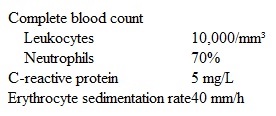 A left knee arthrocentesis is performed, and synovial fluid analysis reveals a white blood cell count of 24,000/mm³ with 85% neutrophils.
Which of the following tests is most likely to diagnose this patient's condition?
A left knee arthrocentesis is performed, and synovial fluid analysis reveals a white blood cell count of 24,000/mm³ with 85% neutrophils.
Which of the following tests is most likely to diagnose this patient's condition? (Multiple Choice)
4.9/5 (79)
(79) A 22-year-old woman comes to the physician with her husband for intermittent dizziness, weakness, and unsteady gait for the last several weeks. She has also had visual loss and pain in the right eye that worsens with eye movement for the past 2 days. A year ago, the patient had tingling and numbness of her right hand accompanied by unsteadiness, which improved spontaneously after 3-4 days. She has no other medical problems and does not take any medications. The patient has no significant social or family history. Her temperature is 37.2 C (99 F), blood pressure is 122/80 mm Hg, pulse is 82/min, and respirations are 16/min. On neurologic examination, her right eye has diminished visual acuity and an afferent pupillary defect. She also has a right arm intention tremor. Both lower extremities have spastic paresis, hyperreflexia, and positive Babinski sign. The patient returns to the physician due to painful muscle spasms. She has frequent episodes of pain and stiffness in both legs, especially when rising from her bed. She has tried home stretching exercise without significant relief. The patient is afebrile and has no new neurological deficits. Increased muscle tone is noted in the lower extremities. Laboratory evaluation, including electrolytes, is normal. Which of the following is the most appropriate next step in managing this patient's current symptoms?
(Multiple Choice)
4.9/5 (86)
(86) A newborn boy is evaluated on arrival in the nursery. He was born 3 hours ago by spontaneous vaginal delivery at 40 weeks gestation after an uncomplicated pregnancy. Apgar scores were 9 at 1 minute and 10 at 5 minutes after birth. His mother has no significant medical history and does not take any medications. Temperature is 36.7 C (98 F), pulse is 124/min, and respirations are 26/min. He is awake, alert, and active with a strong cry. His head is normocephalic and atraumatic with an open flat anterior fontanelle. Pupils are equal and reactive to light and accommodation, and red reflexes are present bilaterally. The nares are patent, there is no cleft lip or palate, and the pharynx is not erythematous. Clavicles are intact without crepitus. S1 and S2 are normal without murmurs, and lungs are clear to auscultation bilaterally. The abdomen is soft, nontender, and nondistended with normal bowel sounds and no organomegaly. Femoral pulses are normal and symmetrical. All extremities move spontaneously and there is no edema. There are no rashes, skin lesions, or jaundice, but the complexion appears ruddy with generalized erythema. Blood samples obtained from the heel through simple prick method reveal a hematocrit of 70%.
What is the most appropriate next step in management of this patient?
(Multiple Choice)
4.8/5 (79)
(79) You are the current "on call physician" for your group, when you receive a call regarding one of your nursing home patients. The nurse reports that one patient has been acting strangely for the last few hours and is agitated at times. This patient is an 82-year-old female who has been in the nursing home for the last two years, and has always been very pleasant. You know her very well from your recent nursing home visit. She has a past medical history of hypertension, diabetes mellitus, osteoporosis, and Alzheimer's dementia. Her daily medications are amlodipine, metformin, calcium - vitamin D, and donepezil. You are concerned that something is not right with the patient.
A CT scan of the patient's head is normal. Initial lab studies reveal the presence of a urinary tract infection with mild prerenal azotemia. You start the patient on empiric antibiotic therapy and intravenous fluids; however, the patient's mental status remains unchanged. You provide a bedside sitter for the patient for constant supervision. The sitter reports that the patient is very combative now. She has been trying to get out of bed and has twice attempted to pull her IV line out. She resisted the physical restraints that the nurse was trying to apply. Frequent orientation and reassurance has not improved her behavior. Which of the following is the most appropriate next step in the management of this patient?
(Multiple Choice)
4.8/5 (74)
(74) A 25-year-old man comes to the emergency department after being stung by a wasp on his right arm 30 minutes ago. He reports generalized itching and mild local pain. He has no other medical conditions. Temperature is 36.7 C (98.1 F), blood pressure is 122/81 mm Hg, pulse is 108/min, and respirations are 22/min. Pulse oximetry is 94% on room air. Examination shows a 2 × 2 cm, erythematous, elevated, warm, and mildly tender area on the right arm. Multiple wheals are visible on the trunk and extremities. There is no tongue swelling or stridor. Bilateral wheezes are present on lung auscultation. The remainder of the examination is normal. Which of the following is the most appropriate next step in management of this patient?
(Multiple Choice)
4.8/5 (81)
(81) An 8-year-old boy is brought to the physician for sore throat and fever that began yesterday. He has no rhinorrhea, congestion, cough, or facial pain but has been complaining of abdominal pain. He took acetaminophen with no relief of throat or abdominal pain. The boy's past medical history is significant for 2 episodes of otitis media during infancy. He has no medication allergies. Physical examination shows enlarged tonsils with exudates and tender anterior cervical lymphadenopathy. The rapid antigen test for Streptococcus pyogenes is positive. Which of the following is the appropriate duration and rationale for treatment for this patient?
(Multiple Choice)
4.8/5 (88)
(88) A 55-year-old man comes to the office for a routine checkup. The patient was diagnosed with type 2 diabetes mellitus 3 years ago, and treatment was initiated with metformin and lifestyle modification. Liraglutide was added to his medical regimen a year ago due to inadequate glycemic control. The patient reports no symptoms other than the occasional "feelings of low blood sugar" when he skips a meal. Blood glucose readings during those episodes have been 60-70 mg/dL. He also takes atorvastatin for hyperlipidemia and low-dose aspirin. The patient smoked a pack of cigarettes daily for 30 years but quit when he was diagnosed with diabetes. He does not use alcohol or recreational drugs. Blood pressure is 128/80 mm Hg, pulse is 76/min, and respirations are 14/min. BMI is 27.5 kg/m2. Physical examination shows normal heart and lung sounds and normal pulses in the extremities. There are no lower extremity ulcers or calluses, and vibration and sensory function is intact. Pressure testing with a 10-g monofilament is normal. Laboratory results are as follows: 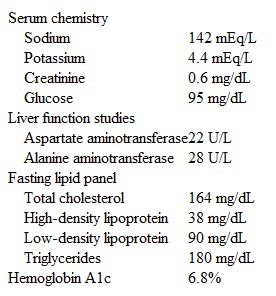 Urinalysis is negative for protein, glucose, cells, or casts, and ECG shows no abnormalities. Which of the following is the most appropriate next step in management of this patient?
 (Multiple Choice)
4.7/5 (92)
(92) A 4-month-old boy is brought to the office by his father due to a severe diaper rash that has been present for 4 days and is progressively worsening. His mother has been applying over-the-counter barrier cream to the rash with each diaper change but has seen no improvement. The child attends day care, and the day care attendant advised that the rash be evaluated to "make sure it is not contagious to other children." The patient was recently admitted to the hospital for pneumonia, requiring parenteral antibiotics and intravenous fluids. He was discharged a week ago and still has a mild cough but is otherwise playful with normal appetite. The patient was born at 38 weeks gestation without complications. Weight and height are at the 65th percentile. Temperature is 36.7 C (98 F). Physical examination shows a well-appearing, interactive infant. Skin examination shows multiple erythematous, confluent, papular lesions in the diaper area, including the genitalia, buttocks, perineum, and genitocrural folds. There are also several isolated, bright-red papules with scaling beyond the diaper area on the inner thighs. There are no lesions on the chest, abdomen, or extremities. The lungs are clear to auscultation. Which of the following is the most appropriate pharmacotherapy for this patient?
(Multiple Choice)
4.8/5 (80)
(80) A 19-year-old woman is brought to the emergency department by her mother due to suspected drug poisoning. The patient has severe depression treated with fluoxetine and lives with her mother and grandparents. The patient suddenly became ill at home earlier today and developed nausea and vomiting. Her mother suspects the patient may have intentionally ingested a substance to harm herself as her grandparents' medicine cabinet door was found open. On further questioning, the patient states that she swallowed a handful of one of the medications in the cabinet but does not specify further. Her grandparents' medical conditions include anxiety, seasonal allergies, coronary artery disease, and chronic back pain. The patient's mother does not know the specific names and dosages of the medications. Currently, the patient reports nausea and dizziness and has vomited 3 times since arriving at the emergency department. She has smoked a pack of cigarettes daily for the past 5 years and drinks 1 or 2 beers occasionally. She has a history of prior ecstasy use but has no recent use of illicit drugs. Temperature is 38.1 C (100.6 F), blood pressure is 100/55 mm Hg, pulse is 110/min, and respirations are 28/min. Pulse oximetry shows 99% saturation on ambient air. Examination reveals an awake, agitated young woman with dry mucous membranes. The pupils are 4 mm bilaterally and reactive to light. Heart sounds are normal and the lungs are clear to auscultation. The abdomen is soft, nontender, and nondistended; bowel sounds are normoactive. Motor and sensory deficits are absent, and the patient is fully oriented. A 12-lead ECG shows sinus tachycardia. Chest x-ray reveals clear lung fields and no cardiomegaly. The patient is given intravenous fluids and is placed on continuous ECG monitoring. Laboratory tests are ordered. Laboratory results are as follows:
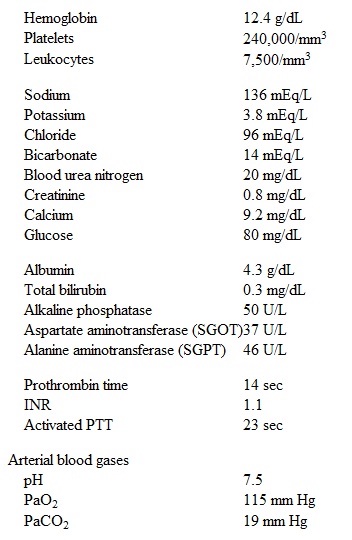 The results of a urine drug screen are pending.
Item 2 of 2
Which of the following is the most appropriate next step in management of this patient?
The results of a urine drug screen are pending.
Item 2 of 2
Which of the following is the most appropriate next step in management of this patient? (Multiple Choice)
4.7/5 (75)
(75) Showing 281 - 300 of 1121

Filters
- Essay(0)
- Multiple Choice(0)
- Short Answer(0)
- True False(0)
- Matching(0)