



 Chat with AI
Exam 1: Advanced Clinical Medicine

Exam 1: Advanced Clinical Medicine1 k+ Questions
Exam 2: Foundations of Independent Practice597 Questions
Select questions type


A 36-year-old white female with systemic lupus erythematosus was seen in your clinic. She has been on prednisone for lupus nephritis for the past year. Decreasing the dose of prednisone below 10 mg per day appears to be associated with an increase in proteinuria. She is currently on no other medications except for birth control pills. She denies any symptoms. She has normal menstrual cycles and is sexually active with one partner. She has no children. Because of a fear of weight gain, she has been restricting dairy products in her diet. She avoids sunlight due to a fear of skin cancer. She is concerned about bone loss secondary to prednisone use. Which of the following should be given to prevent bone loss in this patient?
(Multiple Choice)
4.8/5  (75)
(75) A 26-year-old male graduate student under treatment for depression comes to the office for follow-up. Two weeks earlier, he was evaluated for symptoms of depressed and irritable mood, loss of appetite, low energy, and impaired concentration. He had no motivation to work on his thesis and was sleeping 12-14 hours a day. Physical examination and laboratory studies were unremarkable. The patient was agreeable to a trial of medication and was started on fluoxetine 20 mg. At today's visit, he reports feeling irritable and anxious, but notes that his energy is much improved. He is now staying up almost all night to work on his thesis and says, "I've had some fascinating insights into my research that I never thought of before." The patient has been adherent with his medication and has no other medical problems. He denies substance use apart from 2 beers he drank at a party 3 nights ago. Mental status examination shows mildly pressured speech and tense affect. The patient interrupts the physician several times to ask inappropriate questions about the physician's personal life. No delusions or hallucinations are elicited. He has no suicidal ideation.  Following discontinuation of fluoxetine, the patient continues to experience increased energy and decreased need for sleep. He is unable to focus on his research due to racing thoughts and stops attending classes because, "There is no need to study when you already know the truth." The patient is admitted to a psychiatric unit. Urine toxicology is negative, and routine laboratory values are within normal range. Lithium is started and titrated to a level of 1.1 mEq/L (therapeutic window: 0.6-1.2 mEq/L). Nursing reports indicate that the patient sleeps 2-3 hours a night and laughs inappropriately. He makes inappropriate sexual and threatening comments to the staff and does not respond to redirection. On mental status examination, he is pacing; has loud, pressured speech; and claims that he is on the verge of an important breakthrough that will revolutionize the Internet. Which of the following is the most appropriate next step in management of this patient?
 (Multiple Choice)
4.9/5 (64)
(64) A 2-year-old boy is brought to the emergency department by his grandmother due to abdominal pain and lethargy. The grandmother reports that he was playing calmly last night when he suddenly began screaming and holding his abdomen. The pain resolved after several minutes, but the patient has had 5 additional episodes of sudden-onset, severe pain since then. Today, the grandmother notes that he has no interest in eating or drinking and has been "sleeping all day" but intermittently awakens in pain. The patient has also had several episodes of nonbloody, nonbilious emesis and "fewer wet diapers than usual." He has had no fever, diarrhea, or recent infections. He is an otherwise healthy child with no prior hospitalizations or chronic medical conditions. The patient takes no medications, and his immunizations are up to date. Temperature is 37 C (98.6 F), blood pressure is 90/56 mm Hg, pulse is 160/min, and respirations are 24/min. During the examination, the boy is sleeping and arouses briefly. The abdomen has hypoactive bowel sounds and diffuse mild tenderness to palpation. He is circumcised, with both testes descended and with intact cremasteric reflexes. Immediately after the examination, the child passes blood in his diaper, as shown in the image below. 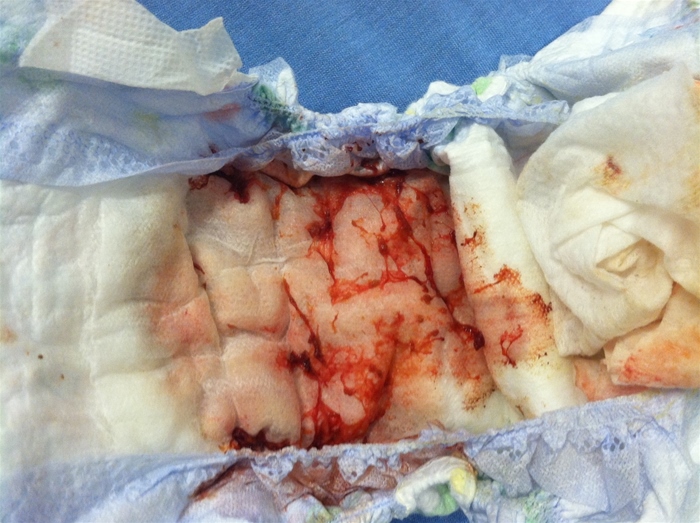 X-ray of the abdomen reveals dilated loops of bowel and no free air. Which of the following is the best next step in management of this patient?
 (Multiple Choice)
4.9/5 (75)
(75) A 65-year-old woman is brought to the emergency department by her son. The patient lives alone and works as a librarian. The son became concerned 2 days ago when "she didn't sound right and seemed somewhat confused over the phone." When he arrived at her home this morning, the patient was disoriented and her speech was slurred. Medical history is significant for diabetes mellitus controlled with metformin. The son says that a "mood disorder" runs in the family and that she has taken lithium, escitalopram, and risperidone for the past several years. A month ago, the patient was diagnosed with hypertension and arthritis, and treatment with chlorthalidone and acetaminophen was initiated. She does not use tobacco, alcohol, or illicit drugs. Temperature is 36.1 C (97 F), blood pressure is 150/90 mm Hg, pulse is 52/min, and respirations are 16/min. Physical examination shows coarse hand tremor and an unstable gait. The patient is oriented to person but not to time or place. Item 1 of 2
Which of the following is the most likely cause of this patient's symptoms?
(Multiple Choice)
4.8/5 (72)
(72) A 32-year-old woman, gravida 3 para 2, at 12 weeks gestation comes to the office to initiate prenatal care. The patient has had some fatigue and breast tenderness but no vaginal bleeding or abdominal pain. The patient's prior pregnancies ended with painless spontaneous vaginal deliveries at 20 and 21 weeks gestation. She has no chronic medical conditions and takes no daily medications. Four years ago, she underwent a cold knife cone procedure for high-grade cervical intraepithelial neoplasia. All her subsequent Pap and human papillomavirus results have been normal. Blood pressure is 110/60 mm Hg. BMI is 24 kg/m2. Pelvic examination reveals a 12-week-sized uterus with a closed cervix and no adnexal masses or tenderness. Speculum examination shows a nonfriable cervix with no visible lesions. Transvaginal ultrasound shows an 12-week intrauterine gestation; the fetus has a normal heart rate. The patient asks about preventing another preterm delivery. Which of the following is the best management option for this patient?
(Multiple Choice)
4.9/5 (84)
(84) A 36-year-old woman comes to the office due to type 1 diabetes mellitus. She was initially diagnosed 20 years ago and is treated with a combination of long- and short-acting insulin analogues. A month ago, the patient had an episode of severe hypoglycemia with near loss of consciousness that required the administration of a home glucagon kit by her husband. Since then, she has felt normal. Review of the patient's continuous glucose-monitoring system shows multiple glucose excursions <50 mg/dL in the past week; however, none of these episodes was associated with tremor, sweating, or altered mental status. Hemoglobin A1c is 7.8%. Which of the following interventions is most likely to restore hypoglycemic awareness in this patient?
(Multiple Choice)
4.8/5 (99)
(99) A 42-year-old woman comes to the office for evaluation of elevated blood pressure. She says, "I checked my blood pressure on a machine at the pharmacy, and it was 160/90 mm Hg. The pharmacist said I should see a doctor." The patient has no history of hypertension and has had no chest pain, headache, or focal weakness or numbness. She notes occasional episodes of pain in her flanks, which she ascribes to muscle tension. The patient has had several urinary tract infections over the course of her life but has no chronic medical problems and takes no medication regularly. She does not use tobacco, alcohol, or illicit drugs. The patient is married and has a son. Her mother has hypertension, her father died at an early age in a motor vehicle collision, and her uncle has renal failure and receives dialysis. Blood pressure is 156/94 mm Hg on the right arm and 152/96 mm Hg on the left arm. Pulse is 80/min and respirations are 16/min. Jugular venous pressure is within normal limits. Breath sounds are normal bilaterally with no crackles. Point of maximal impulse is displaced to the left and down. Heart sounds are normal with no murmur or gallops. The abdomen is soft with bilateral flank fullness. Bowel sounds are active. Laboratory results are as follows. 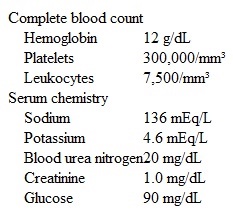 Urinalysis shows dysmorphic erythrocytes and mild proteinuria. ECG shows left ventricular hypertrophy with nonspecific ST-T wave changes. Imaging reveals enlarged kidneys with multiple bilateral cysts. Which of the following is the best management for this patient?
 (Multiple Choice)
4.8/5 (93)
(93) A 70-year-old man is brought to the emergency department by his daughter due to 2 days of fever, chills, shortness of breath, and cough productive of yellow-green sputum. According to the daughter, the patient appeared lethargic and mildly confused this morning and refused to eat breakfast as he wanted to stay in bed. He regularly sees a physician and is up to date on vaccinations, including the annual flu vaccine. The patient has a history of hypertension and type 2 diabetes mellitus. He currently takes hydrochlorothiazide, lisinopril, and metformin. He smokes a pack of cigarettes a day and drinks alcohol occasionally. The patient lives alone but his daughter lives nearby. Temperature is 39.4 C (103 F), blood pressure is 104/62 mm Hg, pulse is 118/min, and respirations are 28/min. Pulse oximetry shows 86% on room air but improves to 93% on 2 L of oxygen. He appears mildly lethargic. Bronchial breath sounds and crackles are heard over the right middle and lower chest fields. Heart sounds are normal. Neurological examination shows no focal deficits. Complete blood count shows a leukocyte count of 17,000/mm3 with 80% neutrophils. Blood glucose is 100 mg/dL. Chest x-ray reveals consolidation in the right middle and lower lobes. Blood cultures are obtained. Which of the following is the best next step in management of this patient?
(Multiple Choice)
4.9/5 (82)
(82) A 28-year-old man comes to the physician due to pain in his left earlobe. He pierced his earlobe to be able to wear earrings 3 months ago. The puncture wound never healed well, and he has experienced itching and sharp pains there ever since. His medical history is otherwise unremarkable. He is currently not taking any medications. On physical examination, there is excessive scar tissue formation on the earlobe at the site of the piercing as shown. 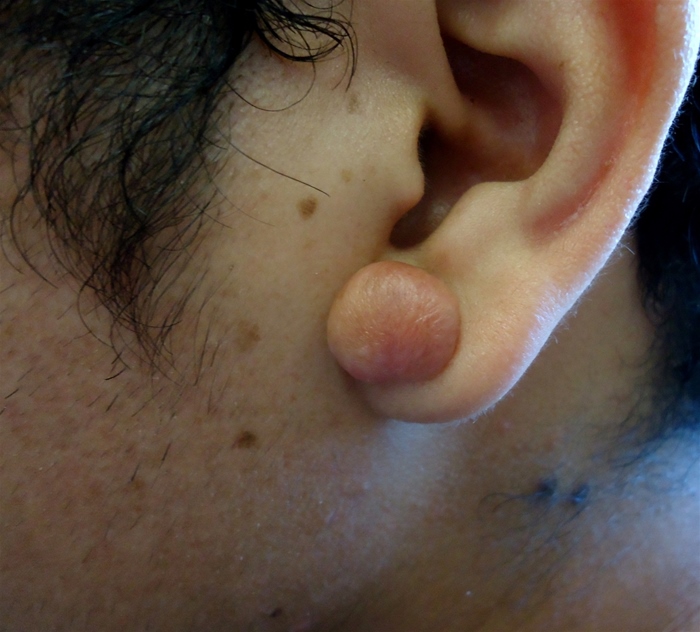 Prior to treatment, what potential complications should be reviewed with the patient?
 (Multiple Choice)
4.9/5 (87)
(87) A 56-year-old man comes to the clinic for follow-up. The patient has a history of end-stage renal disease due to hypertensive nephropathy and underwent renal transplantation 2 weeks ago. The surgery had no complications and he had good initial graft function. The patient has no other medical conditions. His immunosuppression medications include prednisone, tacrolimus, and mycophenolate sodium. The patient does not use tobacco, alcohol, or illicit drugs. Vital signs are normal. BMI is 31.8 kg/m2. Physical examination shows a healing lower abdominal surgical scar with no erythema or drainage. Fasting serum chemistry reveals the following: 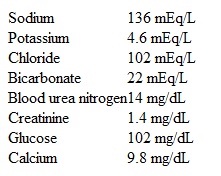 Which of the following is this patient at greatest risk of developing within the next several months?
 (Multiple Choice)
4.9/5 (83)
(83) A 16-year-old girl, gravida 1 para 0, at 40 weeks gestation comes to the emergency room with her mother due to several hours of contractions and increasing rectal pressure. The patient's pregnancy has been uncomplicated. She has no chronic medical conditions and has had no previous surgeries. She takes a daily prenatal vitamin and does not use tobacco, alcohol, or illicit drugs. Vital signs are normal. The fetal heart rate tracing is category 1. The tocometer shows contractions every 2-3 minutes. On digital cervical examination, the cervix is 10 cm dilated, with the fetal head at −1 station and in occiput anterior position. The patient is admitted and instructed to start pushing. An hour after pushing, she receives oxytocin to increase the strength and frequency of the contractions. Despite 3 hours of correct pushing technique, significant maternal effort, and frequent contractions, the fetal vertex does not descend past −1 station. Fetal heart rate monitoring continues to show a category 1 tracing. The patient feels fatigued, but her mother encourages her to continue pushing. In most states, which of the following is the best next step in management of this patient?
(Multiple Choice)
4.8/5 (72)
(72) An 18-year-old man comes to the physician for daytime sleepiness lasting several months. The patient recently started college, has difficulty staying awake during classes, and often falls asleep suddenly even though he "gets a good night's sleep." He typically goes to bed at 2 am and sleeps until at least 9 am, usually later. The patient's sleep pattern at night is fragmented. He wakes frequently but is usually able to go back to sleep within a few minutes. He does not snore or wake up gasping. The patient feels like "someone is in the room with me when I'm just falling asleep and I sometimes hear my name being called." His past medical history is otherwise insignificant. The patient does not use tobacco or alcohol. Blood pressure is 120/70 mm Hg and heart rate is 70/min. His body mass index is 23 kg/m2. Which of the following is the best initial therapy for this patient?
(Multiple Choice)
4.8/5 (81)
(81) A 58-year-old man comes to the office due to low motivation and loss of interest. He says, "I love my family and work is okay, but I'm just not able to enjoy anything anymore. On weekends, I sit on the couch all day and avoid my friends. I prefer to be alone." The patient has a history of hypertension, hypercholesterolemia, and coronary heart disease. Family history is significant for a father with cardiovascular disease and mother with osteoporosis and breast cancer. The patient's uncle died following a myocardial infarction at age 62. After a full evaluation, the patient is diagnosed with major depressive disorder. Treatment options, including psychotherapy and antidepressants, are discussed, but the patient is reluctant to consider either treatment. He says, "With my schedule I have no time for therapy and I don't like to talk about these things. I am also concerned about the effects of medication on my heart. I don't want to die at such a young age like my uncle did." Which of the following is the most accurate statement when counseling the patient?
(Multiple Choice)
4.9/5 (76)
(76) An 8-year-old boy with hemophilia A is brought to the emergency department after his family was in a minor motor vehicle accident. The child was restrained in the back seat on the passenger side when the car was hit on the driver's side. The airbag deployed and the boy lost consciousness for approximately 15 seconds. The patient has a headache but no nausea or vomiting. His temperature is 36.7 C (98 F), blood pressure is 114/66 mm Hg, pulse is 88/min, and respirations are 16/min. Physical examination shows a 2-cm right frontal hematoma. No other signs of trauma are seen. Neurological examination is within normal limits. Which of the following is the best next step in the management of this child's condition?
(Multiple Choice)
4.9/5 (61)
(61) A 72-year-old man comes to the emergency department due to progressive shortness of breath and cough productive of yellowish sputum. The patient says, "I have been feeling breathless for the past several months while mowing the lawn or walking around the house, but it has been worse over the last 3 days." He has had no chest pain or leg swelling but notes that his heart "has been racing." The patient has a history of hypertension, peptic ulcer disease, and osteoarthritis. He was hospitalized for pneumonia a year ago and required intravenous antibiotics. Six months ago, the patient underwent a cardiac stress test for chest discomfort, which was unremarkable. The patient has smoked a pack of cigarettes daily for 45 years. Blood pressure is 160/90 mm Hg, pulse is 148/min, and respirations are 26/min. He is speaking in partial sentences and using accessory muscles of respiration but is alert and cooperative. There is no jugular venous distension or heart murmurs, rub, or gallops, but the heart sounds are irregular. Lung auscultation reveals bilateral rhonchi and expiratory wheezes. Arterial blood gases while breathing 2 L of oxygen via nasal cannula reveal PO2 of 66 mm Hg, PCO2 of 52 mm Hg, and pH 7.33. ECG shows narrow QRS complexes with distinct P waves of different morphologies and variable PR segments and R-R intervals. Chest x-ray reveals no pulmonary infiltrates or consolidation. Inhaled bronchodilators and systemic glucocorticoids are administered. The patient's dyspnea has improved after initial treatment in the emergency department, but he continues to have palpitations. Pulse is 125/min and irregular. Blood pressure is 140/88 mm Hg and respirations are 16/min. Oxygen saturation is 92% on 2 L oxygen via nasal cannula. ECG findings are unchanged from the time of admission. Laboratory results are as follows:
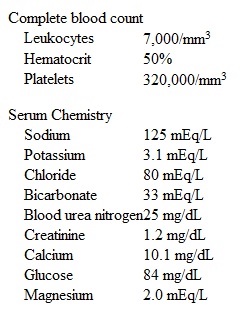 Which of the following is the most appropriate next step in management of this patient?
 (Multiple Choice)
4.8/5 (83)
(83) A 16-year-old girl, gravida 1 para 0, at 10 weeks gestation comes to the office for an initial prenatal visit. The patient reports mild nausea and vomiting in the morning but is able to drink and eat small meals in the afternoon. She had vaginal spotting a week ago, but the bleeding has resolved. The patient has no chronic medical conditions and has had no surgery. She takes a prenatal vitamin daily. She was using oral contraceptive pills imperfectly but stopped when she realized she was pregnant. The patient's mother had 3 pregnancies, all of which ended in uncomplicated vaginal deliveries at term. The patient has no known drug allergies and does not use tobacco, alcohol, or illicit drugs. Blood pressure is 110/60 mm Hg and pulse is 68/min. BMI is 24 kg/m2. Speculum examination shows a closed cervix and no vaginal bleeding or lesions. Bimanual examination reveals a 10-week-size uterus and no adnexal masses. A pelvic ultrasound confirms a 10-week intrauterine gestation with normal fetal heart rate. This patient is at increased risk for which of the following pregnancy complications?
(Multiple Choice)
5.0/5 (73)
(73) A 60-year-old man with a history of chronic obstructive pulmonary disease comes to the office due to hemoptysis. For the past several days, he has had increasing cough with greenish-yellow sputum. He also had 2 episodes of blood-streaked sputum, which prompted the clinic visit. The patient has mild dyspnea but no fever or chest pain. His other medical problems are peripheral vascular disease and osteoarthritis. His current medications include aspirin, inhaled fluticasone and salmeterol, and ipratropium. He continues to smoke 1/2 pack of cigarettes daily and drinks alcohol occasionally. The patient had a screening CT scan 2 years ago that was negative for lung mass. His father died of lung cancer. Blood pressure is 140/95 mm Hg and heart rate is 100/min. The patient's pulse oximetry shows 95% on room air. Lung auscultation reveals bilateral expiratory wheezing. The initial workup reveals no significant abnormality. The patient is started on glucocorticoid therapy and additional inhaled albuterol. Which of the following is the best next step in management?
(Multiple Choice)
4.9/5 (80)
(80) A 7-year-old boy is brought to the emergency department by his parents due to left eye swelling and redness. The patient has had left eye pain for 2 days and the pain worsened today. He has no symptoms in his right eye. He has allergic rhinitis, for which he takes intranasal steroids. The patient developed sinusitis approximately 3 weeks ago and was treated with amoxicillin-clavulanate. He has no other medical conditions and has had no surgeries. The patient's mother was diagnosed with left leg deep vein thrombosis after a recent transatlantic flight. Temperature is 39.2 C (102.5 F), blood pressure is 102/70 mm Hg, pulse is 94/min, and respirations are 18/min. The left eyelid is erythematous, tender, and swollen. The conjunctiva is hyperemic. Movement of the left eye causes pain. Visual acuity and pupillary reaction are normal bilaterally. Purulent mucus is draining from the nose, and nasal turbinates are swollen and erythematous. Examination of the right eye is unremarkable, and facial sensation is intact. Item 1 of 3 Which of the following findings is most concerning in this patient?
(Multiple Choice)
4.9/5 (91)
(91) A 40-year-old woman comes to the clinic after noticing a small swelling in the front of her neck. She has no pain, dysphagia, hoarseness, or difficulty breathing. She also has no hyper- or hypothyroid symptoms such as heat or cold intolerance, fatigue, or weight changes. Physical examination shows a mobile nodule in her left thyroid lobe. The patient has no history of neck irradiation or family history of thyroid illness. She currently takes no medications. The rest of the physical examination is unremarkable. After performing the appropriate investigation, a diagnosis of papillary thyroid cancer is made. Which of the following is the best next step in management of this patient?
(Multiple Choice)
4.9/5 (81)
(81) A 29-year-old woman, gravida 2 para 0 aborta 1, at 34 weeks gestation comes to the office for a routine prenatal visit. She reports no abdominal pain, leakage of fluid, or vaginal bleeding. There is normal fetal movement. Since her last visit 2 weeks ago, she has developed severe pruritus on her abdomen, which has not responded to over-the-counter moisturizers. The patient has had no recent contact with anyone who has had a fever, rash, or pruritus. She was diagnosed with gestational diabetes mellitus that is well controlled with an insulin regimen. Earlier in the pregnancy, she had an episode of vulvar candidiasis that was treated with a topical antifungal. The patient has no chronic medical problems or previous surgeries. She takes prenatal vitamins daily and has no allergies. The patient does not use tobacco, alcohol, or illicit drugs. Temperature is 36.7 C (98 F) and blood pressure is 100/70 mm Hg. BMI is 31 kg/m2. Fetal heart rate is 145/min and fundal height is 35 cm. Physical examination shows prominent abdominal striae and several red linear excoriations on the abdominal wall unrelated to the striae. Laboratory results are as follows: 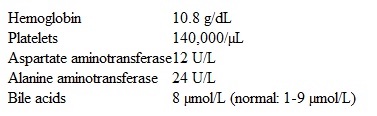 Item 1 of 3 Which of the following is the most likely diagnosis in this patient?
 (Multiple Choice)
4.9/5 (73)
(73) Showing 801 - 820 of 1121

Filters
- Essay(0)
- Multiple Choice(0)
- Short Answer(0)
- True False(0)
- Matching(0)