



 Chat with AI
Exam 1: Advanced Clinical Medicine

Exam 1: Advanced Clinical Medicine1 k+ Questions
Exam 2: Foundations of Independent Practice597 Questions
Select questions type


A 16-year-old boy comes to the office due to an itchy rash on his back and shoulders. The rash has been present for the last 3 months, but he has had similar symptoms intermittently in other body areas over the last 10 years. The patient has no fever and has had no recent illnesses. Current medications include daily cetirizine for seasonal allergies and topical benzoyl peroxide for acne. Vital signs are normal. On skin examination, there are excoriated lichenified plaques on the back and right shoulder, as shown in the exhibit. 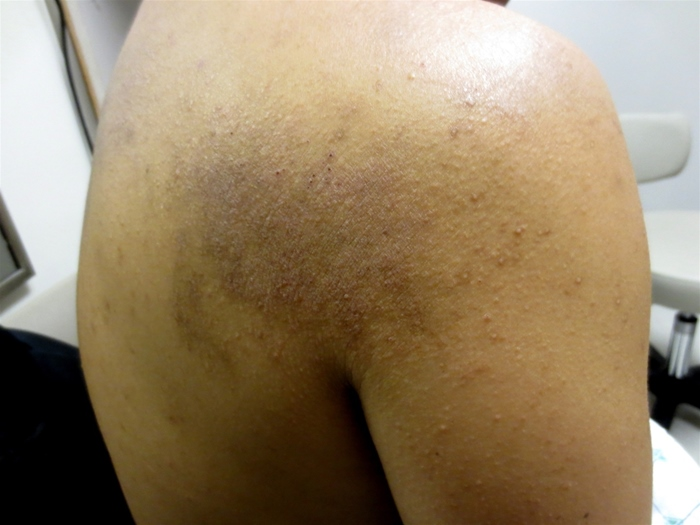 Which of the following is the most appropriate advice to reduce this patient's symptoms?
 (Multiple Choice)
4.8/5  (82)
(82) A 32-year-old female is seen for a follow-up visit six months after undergoing total thyroidectomy and central neck dissection for medullary thyroid cancer. Pathology results revealed that the tumor was 3 cm in diameter, and 3 of 18 dissected nodes were positive for malignancy. The fasting serum calcitonin level before surgery was 250 ng/ml (normal < 4ng/ml). The postoperative course was uncomplicated, and she was then started on levothyroxine 0.15 mg/d. The repeat TSH level obtained after 8 weeks was normal. The physical examination revealed no abnormal neck masses. The rest of the examination is also unremarkable. Her current calcitonin level is 120 ng/ml. What is the next best step in the management of this patient?
(Multiple Choice)
4.9/5 (75)
(75) An 8-year-old boy is brought to the emergency room by paramedics with a reported ingestion about four hours ago. The patient had an accidental ingestion of "antifreeze" after mistaking it for a beverage in the garage.
Item 1 of 2
Which of the following physical signs would be consistent with the history of "antifreeze" ingestion?
(Multiple Choice)
4.9/5 (73)
(73) A 10-year-old girl is brought to the emergency department for evaluation of a bite wound. Last night, the girl had a fight with her 12-year-old stepbrother, who bit her on the forearm. This morning, the girl's arm "looks worse." The stepbrother is HIV-positive and acquired it from his mother at birth. He takes antiretroviral therapy; his most recent CD4 count was 1100 cells/µL, and his HIV viral load was undetectable. The patient has no known medical problems, and takes no medications. Her vital signs are normal. Examination shows 2 deep puncture wounds on the left forearm. There is warmth, erythema, and swelling around the bite marks. The skin is mildly tender to palpation. No fluctuance is palpated.
The patient is at greatest risk for developing an infection from which of the following organisms?
(Multiple Choice)
4.9/5 (78)
(78) A 9-year-old boy and his 5-year-old sister are brought to the office by their mother. The boy has been sad and has cried frequently since the family dog was hit by a car and died 10 days ago. His mother says, "The other day he had a severe stomachache and did not want to go to school. I later learned from his teacher that he was very embarrassed after crying in front of his classmates. I am also worried that he has been asking to sleep in my bed. He hasn't done that in years." In contrast, his sister is cheerful and acts as though nothing has happened. The mother says, "She doesn't seem sad at all. She's excited about her upcoming birthday party this weekend and plans to set a place for the dog at the table." Neither child has a history of medical or psychiatric problems or takes any medications. Their developmental and growth milestones are normal. Which of the following is the most appropriate response to the mother's concerns?
(Multiple Choice)
4.8/5 (76)
(76) A 65-year-old man is brought to the emergency department with a 2-hour history of sharp, stabbing chest pain under his sternum. The patient was working outside in the yard when the symptoms started. The pain reached its maximum intensity within a few minutes and is now radiating to his upper back and shoulders. His medical history is significant for hypertension for the past 10 years. The patient has smoked 1.5 packs of cigarettes daily for the last 40 years. Blood pressure is 185/104 mm Hg in the right arm and 120/62 mm Hg in the left arm, pulse is 106/min and regular, and respirations are 18/min. Lungs are clear to auscultation bilaterally. Cardiovascular examination reveals a regular heart rhythm with an early diastolic murmur heard at the right sternal border. ECG shows sinus tachycardia and T-wave inversion in leads V5 and V6. Bedside transesophageal echocardiogram in the emergency department confirms ascending aortic dissection with extension into the left subclavian artery. In addition to pain control, what is the best next step in management of this patient?
(Multiple Choice)
5.0/5 (63)
(63) A 29-year-old man comes to the physician with nodules under his arm. He reports a 6-month history of slowly enlarging nodules in his right axilla associated with mild discomfort. He has a history of chronic obesity but is otherwise healthy. The patient has a 10-pack-year smoking history and does not drink alcohol. Skin examination shows swollen, nodular lesions in his right axilla with moderate scarring and mild tenderness to palpation. He has no other significant skin lesions. 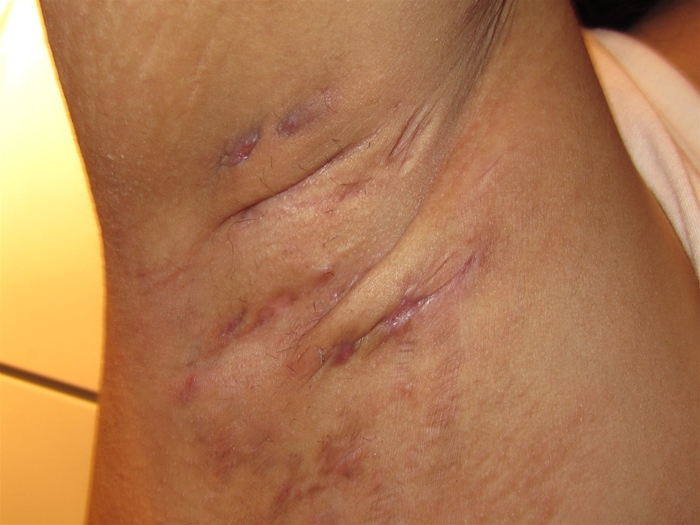 Which of the following is the best next step in management of this patient?
 (Multiple Choice)
4.9/5 (74)
(74) A 29-year-old woman comes to the office for evaluation of hypercalcemia. Her serum calcium was 12.1 mg/dL on routine laboratory investigations performed for a life insurance application. The patient feels well and has had no excessive urination, bone pain, abdominal pain, headache, or constipation. Medical history is significant for upper gastrointestinal hemorrhage a year ago; the bleed was due to a large gastric ulcer, for which she is currently taking an oral proton pump inhibitor. She has a 10-pack-year smoking history but does not use alcohol or illicit drugs. The patient's menstrual cycles are regular; she has never been pregnant, is sexually active with one partner, and uses barrier contraception to prevent pregnancy. The patient's mother underwent parathyroid surgery for symptomatic hypercalcemia and takes a pill twice a week for an unspecified pituitary tumor. Blood pressure is 128/80 mm Hg and pulse is 78/min. BMI is 27 kg/m2. Neck examination is unremarkable. A few small subcutaneous lipomas are present on the patient's back. The rest of her physical examination is unremarkable. Laboratory results are as follows: 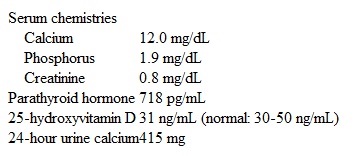 Bone mineral density by DXA is normal. Which of the following is the best next step in management of this patient?
 (Multiple Choice)
4.9/5 (85)
(85) A 52-year-old woman is brought to the emergency department due to a 2-day history of fever, chills, abdominal pain, nausea, and vomiting. Her husband says that she has become progressively confused and lethargic today. The patient has a history of dyspepsia and underwent laparoscopic cholecystectomy 2 years ago but still has occasional upper abdominal discomfort. Medical history also includes hyperlipidemia and diet-controlled diabetes mellitus. The patient recently started taking herbal supplements to help lose weight. She drinks alcohol at social events but does not use tobacco or illicit drugs. There is no history of recent travel, but the family had a barbecue lunch before her symptoms started. Other family members who consumed the same food are asymptomatic. Temperature is 39.4 C (103 F), blood pressure is 90/50 mm Hg, pulse is 126/min, and respirations are 20/min. BMI is 34 kg/m2. The patient has scleral icterus and dry mucous membranes. The lungs are clear to auscultation and cardiac examination is normal with the exception of tachycardia. There is marked right upper quadrant and epigastric tenderness without rebound tenderness. The patient has no rash or enlarged lymph nodes. She is somnolent but wakes to touch; otherwise, her neurologic examination is unremarkable. Laboratory results are as follows: 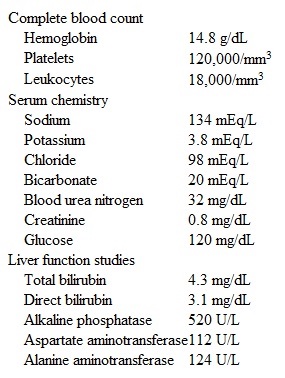 Abdominal ultrasonography reveals fatty infiltration of the liver, postcholecystectomy changes, and dilated biliary ducts and common bile duct. Which of the following is the most likely cause of this patient's current condition?
 (Multiple Choice)
4.8/5 (75)
(75) An 8-year-old girl is brought to the physician for abnormal behavior. She has been acting inappropriately, crying, and laughing without apparent reason for the past 2 weeks. At school, she was restless and easily distracted. Last week, her parents noted strange movements of the girl's hands that improved when she slept. On the day before presentation, her parents noticed rapid jerking movements of her face and feet. The girl has had minor, self-resolving upper respiratory infections but has otherwise been healthy. She takes no medications and her vaccinations are up-to-date. Examination shows an alert and cooperative girl with normal vital signs. Facial grimacing and tongue fasciculations are seen. The lungs are clear to auscultation and a II/VI holosystolic murmur is heard at the apex. When the girl speaks, distinct changes in the volume and pitch of her voice are noted. Muscular tone is mildly decreased globally. Pronator sign is positive, and the relaxation phase of the patellar reflex is delayed. The child's diagnosis is discussed with her parents, who would like to know more about treatment of the condition. Which of the following is the most appropriate medication for this patient?
(Multiple Choice)
4.8/5 (65)
(65) A 29-year-old man comes to the emergency department due to sudden-onset chest pain over the past hour. He says, "I have this pressure and squeezing in my chest that does not go away." He has never before had such symptoms. His medical history is insignificant. The patient smokes 2 packs of cigarettes daily and consumes alcohol occasionally. He uses cocaine and had "one shot" several hours ago. His family history is significant for a stroke in his father and a heart attack in his mother. Temperature is 36.7 C (98 F), blood pressure is 140/90 mm Hg, pulse is 112/min, and respirations are 24/min. ECG shows 2-mm ST-segment elevation in leads I, aVL, and V4-V6. The patient receives oxygen by mask, aspirin, and diazepam. He is given sublingual nitroglycerin and started on nitroglycerin infusion. Portable chest x-ray reveals a normal heart contour and clear lung fields. Twenty minutes later, he still has chest pain and his ECG is unchanged. The patient requests that he be given something to alleviate his chest discomfort. His initial troponin I level is undetectable. What is the best next step in management of this patient?
(Multiple Choice)
4.9/5 (66)
(66) A 29-year-old man comes to the emergency department complaining of palpitations, sweating, and severe headache. His symptoms resolve spontaneously by the time he is evaluated. He has had at least 2 similar episodes during the past 2 months. The patient's family history is unremarkable. He does not use tobacco, alcohol, or illicit drugs. His primary care provider saw him after the first episode and prescribed an anxiolytic medication. However, the patient felt drowsy at his job and stopped the medication. Physical examination shows a thin man who appears anxious and diaphoretic. The thyroid is normal to palpation without any obvious nodules. His temperature is 36.7 C (98 F), blood pressure is 126/84 mm Hg, pulse is 86/min, and respirations are 16/min. During his prior emergency department visit for an identical episode, his blood pressure was 150/100 mm Hg and pulse was 120/min. The laboratory results at that time showed normal thyroid function tests. The patient is placed on appropriate preoperative medications and is taken for surgical removal of the tumor. During the procedure, he rapidly becomes hypotensive. His blood pressure falls from 110/89 mm Hg to 80/50 mm Hg. Which of the following is the most appropriate therapy for this patient's hypotension?
(Multiple Choice)
4.7/5 (90)
(90) A 28-year-old woman, gravida 1 para 1, comes to the office for a postpartum check-up 3 weeks following a cesarean delivery due to cephalopelvic disproportion. She is accompanied by her husband who expresses concern that his wife is crying frequently and having difficulty adjusting to being a new mother. He says, "She was so happy to get pregnant. Apart from the gestational diabetes and having to watch her diet, she was fine through much of the pregnancy. Now, she seems stressed and anxious and not as happy about the baby as I expected." The baby is doing well and had a normal check-up at the pediatrician. The patient describes mild discomfort at the incision site, tension headaches, poor appetite, and fatigue from frequent nighttime awakenings to breastfeed. She says, "I have no energy and feel guilty that I can't even enjoy the baby." The patient spends her time searching the internet for baby care advice but has difficulty remembering what she has read. She worries about the baby's health and fears "I'm a bad mother." Her medical problems include obesity and gastroesophageal reflux. The patient has no past psychiatric history. Family history is significant for alcohol abuse and type 2 diabetes in the patient's father and anxiety disorder in the mother. Physical examination is normal. Hemoglobin is 12.5 g/dL and TSH is 2.1 µU/mL. Her oral glucose tolerance test is within the normal range. Mental status examination reveals a depressed and anxious mood and a tearful affect. The patient has no thoughts of suicide or of harming the baby. Which of the following is the most likely diagnosis?
(Multiple Choice)
4.9/5 (73)
(73) A 42-year-old woman comes to the office due to 6 months of worsening headaches. The patient has had occasional headaches in the past, but lately "they seem to be getting out of control" and are often throbbing. She also has constant, pressure-like headaches localized behind the forehead and eyes. The patient takes acetaminophen and ibuprofen and recently began taking them on a daily basis. The medications often make her nauseated, and she has had several episodes of vomiting. The patient also has blurry vision but no muscle weakness, syncope, or seizures. She experiences a considerable amount of stress at work and says that she "cannot afford to slow down." Medical history is significant for irritable bowel syndrome and chronic back pain. She smokes a pack of cigarettes daily. The patient's mother suffered from migraines and had surgery for a meningioma. Her father died of a drug overdose. Blood pressure is 155/98 mm Hg and pulse is 83/min. BMI is 27 kg/m2. Chest examination is unremarkable. Abdominal examination shows mild periumbilical tenderness. There is no muscle weakness, and the deep tendon reflexes are symmetric. There is no hand tremor. Romberg test is negative. Funduscopic findings are shown in the image below. 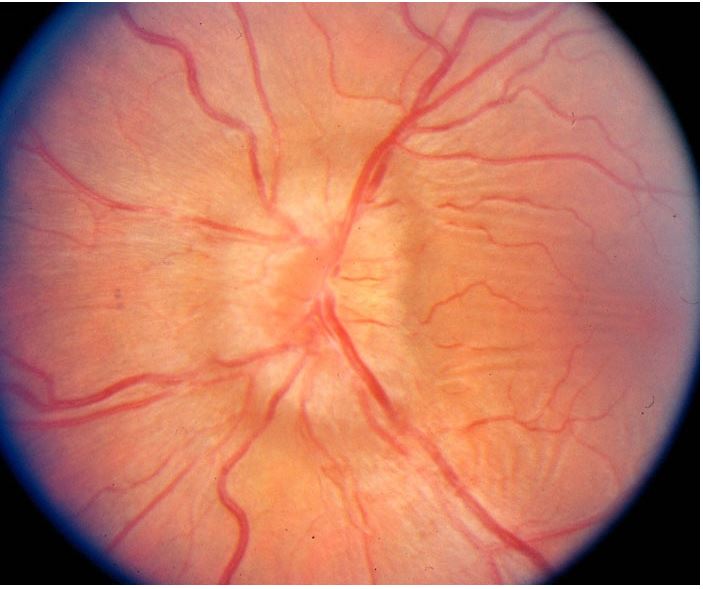 Which of the following is the most appropriate next step in management of this patient?
 (Multiple Choice)
4.7/5 (90)
(90) A 26-year-old woman, gravida 0 para 0, comes to the community health center for an annual physical examination. She is concerned, as her grandmother recently died of metastatic breast cancer at age 68. The patient states, "Ever since my grandmother died, I have been worried about breast cancer. I think I need a mammogram." She has no chronic medical conditions and has had no surgeries. Her periods are regular, every 28 days with 4 days of moderate bleeding; the last menstrual period was 2 weeks ago. Menarche was at age 13. The patient is sexually active without contraception and planning a pregnancy within the year. Other than breast cancer in her paternal grandmother, family history is noncontributory. The patient takes a daily prenatal vitamin and does not use tobacco, alcohol, or illicit drugs. Temperature is 36.7 C (98 F), blood pressure is 110/70 mm Hg, and pulse is 70/min. BMI is 20 kg/m2. Breast examination shows no masses bilaterally, and the right breast is slightly larger than the left. No nipple discharge, skin dimpling, rash, or lymphadenopathy is present. She notes that the breast asymmetry has been present since puberty. Which of the following is the most appropriate response to this patient?
(Multiple Choice)
4.9/5 (79)
(79) A 39-year-old man comes to the emergency department due to an episode of chest pain. He says, "I had dinner and 2 hours later started to get this discomfort in the middle of the chest. It felt dull and annoying." The pain lasted for 2 hours, waxed and waned in intensity, and did not radiate. The patient did not have any back pain, dyspnea, palpitations, or lightheadedness, and has never had similar pain episodes. After the pain subsided, his wife insisted that he go to the emergency department. Currently, he has no pain or discomfort and wants to return home. The patient does have occasional heartburn and takes over-the-counter antacids. Medical history is otherwise unremarkable. The patient has smoked a pack of cigarettes a day for the past 10 years. He does not drink alcohol or use illicit drugs. He has no known medication allergies. His father died suddenly in his sleep at age 55. His older brother is healthy. Blood pressure is 138/86 mm Hg and pulse is 89/min and regular. BMI is 28 kg/m2. There are no heart murmurs or additional sounds. No carotid bruits are heard. Abdominal examination is unremarkable. ECG shows normal sinus rhythm with nonspecific T-wave changes in leads II and III. Chest x-ray is normal. Which of the following is the best next step in management of this patient?
(Multiple Choice)
4.7/5 (92)
(92) A 68-year-old man with chronic obstructive pulmonary disease (COPD) comes to the clinic due to a 9-kg (20-lb) weight loss over the last 2 years. He describes his appetite as "all right" but does say that he is eating less. The patient reports poor taste, fatigue, chronic dyspnea, productive cough, and occasional nausea. He also reports insomnia most nights of the week with poor concentration during the day. He has no night sweats, fevers, chills, dysphagia, change in bowel habits, blood in the stool, or dysphoria. He has had 3 hospitalizations for COPD exacerbation over the past 2 years during which he was treated with short courses of prednisone. The patient has smoked 2 packs of cigarettes daily for 42 years. He reports feeling "bad" for smoking all these years and is trying to quit but says, "It's just very hard." The patient lives alone and often feels lonely. His other medical problems include hypertension and hyperlipidemia. His last colonoscopy was 5 years ago and included removal of 2 hyperplastic polyps. He does not use alcohol or recreational drugs. Family history is not significant. Temperature is 36.7 C (98 F), blood pressure is 130/80 mm Hg, pulse is 80/min, and respirations are 18/min. BMI is 17 kg/m2. Pulse oximetry shows 91% on ambient air. Physical examination reveals moist mucous membranes, normal jugular venous pressure, and distant S1 and S2. Lung examination reveals prolonged expiration, increased resonance to percussion bilaterally, and increased anterior-to-posterior diameter of the chest. The abdomen is soft and nontender. There is no hepatomegaly, splenomegaly, or masses. Testing of the stool for occult blood is negative. No edema or lymphadenopathy is present. Neurologic examination is within normal limits. The patient's affect is normal. Laboratory results are as follows: 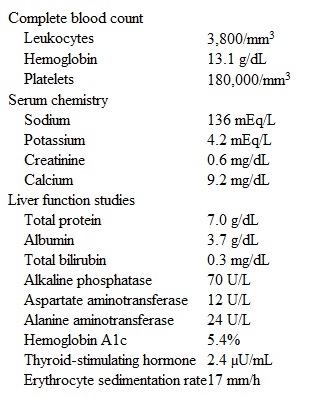 Chest x-ray reveals hyperexpansion of bilateral lung fields with diaphragmatic flattening. Which of the following is the most likely cause of this patient's weight loss?
 (Multiple Choice)
4.9/5 (73)
(73) A 12-year-old boy is brought to the emergency department due to unsteadiness, weakness, and falls. The patient recently went on a week-long family camping and hiking trip to the mountains in Washington State. On returning home to California 2 days ago, he experienced a sense of fatigue and a tingling sensation in his fingers. Yesterday, the patient started having bilateral leg weakness and is now unable to walk without assistance; he sways from side to side when standing and then falls to the floor. The patient has had no fever, headache, joint pain, or skin rash and has no history of recent respiratory or gastrointestinal illness. Vital signs are within normal limits. He is alert and active but can stand only briefly before requiring assistance. There is no increased resistance to neck flexion. Cranial nerve examination is normal and sensation is not impaired. Muscle strength is 4/5 in the upper extremities and 2/5 in the lower extremities. Deep tendon reflexes are absent at the knees and ankles but are normal elsewhere. Finger-to-nose testing shows dysmetria of the arms. Diagnostic intervention reveals significant findings. Which of the following is most likely to improve this patient's condition?
(Multiple Choice)
4.8/5 (67)
(67) A 72-year-old woman is found to be severely short of breath at her skilled nursing facility. The patient was recently hospitalized for vertebral osteomyelitis and discharged 2 weeks ago to complete a 6-week course of piperacillin-tazobactam via a peripherally inserted central venous catheter. Her dyspnea began only with exertion but is now also present at rest. Medical history includes coronary artery disease with ischemic cardiomyopathy, chronic obstructive pulmonary disease, and chronic kidney disease. She has had 2 hospitalizations for heart failure over the last year; noninvasive positive-pressure ventilation was required. Paramedics observe the patient to be obtunded with agonal respirations and rales throughout the bilateral lung fields. Oxygen saturation is 72% on room air. She is intubated and transferred to the emergency department. On arrival, the patient is minimally responsive to stimuli. Temperature is 36.7 C (98 F), blood pressure is 115/65 mm Hg, and pulse is 110/min and regular. The patient's oxygen saturation is 88% on 100% inspired oxygen. BMI is 19 kg/m2. The trachea is midline. On physical examination, rales are heard on the right side and markedly decreased breath sounds on the left side of the chest. S3 is heard. There is 2+ bilateral peripheral edema. A chest x-ray reveals the following: 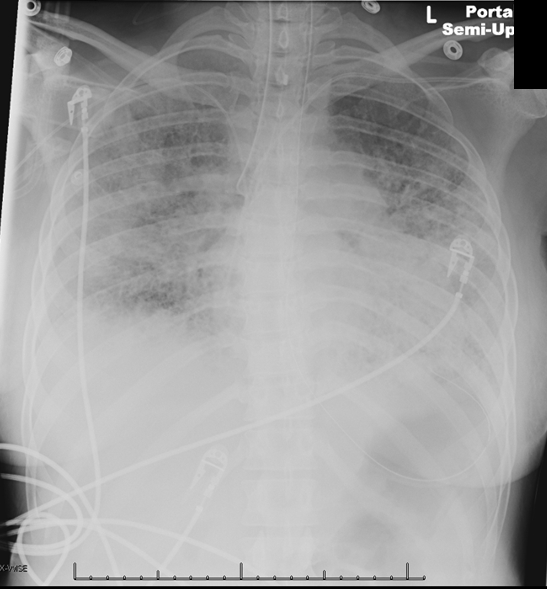 Which of the following is the most appropriate next step in management of this patient?
 (Multiple Choice)
4.9/5 (85)
(85) A 55-year-old man comes to the office for a medical evaluation for life insurance. The patient feels well and has no chronic health issues. He takes no prescription medications but recently began taking over-the-counter supplements, which have improved his energy level. The patient has smoked a pack of cigarettes a day for 30 years but is trying to cut down. He drinks alcohol occasionally and does not use illicit drugs. Family history is notable for non-Hodgkin lymphoma in his brother. Temperature is 37 C (98.6 F), blood pressure is 140/90 mm Hg, pulse is 80/min, and oxygen saturation is 99% on ambient air. The patient's complexion is ruddy. There are no skin rashes or mucosal lesions. The lungs are clear to auscultation and heart sounds are normal. The abdomen is soft and nontender with no hepatosplenomegaly. Laboratory results are as follows:
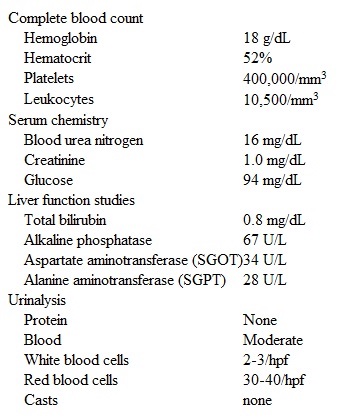 In addition to recommendation for smoking cessation, which of the following is the best next step in management of this patient?
 (Multiple Choice)
4.9/5 (77)
(77) Showing 221 - 240 of 1121

Filters
- Essay(0)
- Multiple Choice(0)
- Short Answer(0)
- True False(0)
- Matching(0)