



 Chat with AI
Exam 1: Advanced Clinical Medicine

Exam 1: Advanced Clinical Medicine1 k+ Questions
Exam 2: Foundations of Independent Practice597 Questions
Select questions type


A 22-year-old woman is brought to the emergency department after overdosing on benzodiazepines. On presentation, her speech is slurred and her gait is unsteady. She is admitted to the hospital and improves with supportive care. When questioned later, she states that she had wanted to die because her boyfriend of 4 months ended their relationship a week ago. Currently she is less depressed and no longer suicidal, and feels that "he was the worst person for me." The patient describes "mood swings" since she was a teenager characterized by feelings of severe depression lasting from a few hours to several days. She has a history of 2 suicide attempts involving medication overdose. The patient has been treated with fluoxetine but stopped taking it 6 months ago because "it didn't seem to make a difference in how low I was feeling."
Which of the following is the most likely diagnosis?
(Multiple Choice)
4.8/5  (77)
(77) A 40-year-old man comes to the office for evaluation after his 52-year-old brother was diagnosed with colon cancer. Family history is otherwise negative for malignancy. The patient feels well and has experienced no abdominal pain, diarrhea, hematochezia, or unexpected weight loss. He has a sedentary lifestyle, and his diet includes a preponderance of processed foods and red meat with minimal fruits and vegetables. Medical history is unremarkable; he takes no medications. The patient has a 20-pack-year history and drinks 1 or 2 alcoholic beverages most days. Vital signs are normal. BMI is 28 kg/m2. Physical examination shows no abnormalities. Which of the following is the most appropriate response to this patient regarding his risk for colon cancer?
(Multiple Choice)
4.8/5 (91)
(91) A 28-year-old male presents with polyuria and polydipsia. Lately, he has been getting up at least six times during the night to urinate. He denies any past medical problems. He is currently on no medications. His family history is unremarkable. He migrated from India four years ago. He chews tobacco, but does not smoke. He denies alcohol use. Physical examination reveals a blood pressure of 160/94 mmHg. He weighs 165 pounds and is 5' 7" tall. The thyroid gland is normal to palpation. There is no abdominal bruit. The rest of the physical examination is unremarkable. His potassium level is 3.2 mEq/L. Hypokalemia is confirmed on repeat testing. What is the next best step in the evaluation of this patient?
(Multiple Choice)
4.8/5 (87)
(87) A 25-year-old man comes to the emergency department with pain in his right hand and wrist. A few hours earlier, he fell forward and landed on his outstretched right hand while playing football. He could not continue playing due to intolerable pain. The patient has no other medical problems and does not use tobacco, alcohol, or illicit drugs. Examination shows mild swelling in the dorsum of the right hand with preserved range of motion. Right hand grip strength is reduced. There is severe tenderness on palpation of the radial dorsal aspect of the wrist. Subsequent assessment confirms a nondisplaced scaphoid fracture. The patient is managed by a short arm cast and returns to his physician for follow-up in 2 weeks. Inadequate management of this injury is most likely to produce which of the following potential complications?
(Multiple Choice)
4.9/5 (91)
(91) A 27-year-old man comes to the emergency department with sudden onset of shortness of breath. He ran out of his asthma medication 10 days ago. He has been intubated twice in the past 6 months due to severe asthma exacerbations. On physical examination, his temperature is 37.2 C (99 F), blood pressure is 142/64 mm Hg, heart rate is 110/min, and respirations are 28/min. His oxygen saturation is 84% on room air and improves to 94% on nonrebreather mask. The patient is alert but appears to be in respiratory distress with some use of accessory muscles of respiration. His lung examination shows equal, bilateral air entry with diffuse wheezing throughout both lung fields. His peak expiratory flow rate is 60% of his personal best, based on his prior admissions. While in the emergency department, the patient's respirations become more labored. He is now markedly diaphoretic and has visible suprasternal retractions. He appears exhausted and drowsy. Repeat vital signs are temperature of 37.2C (99 F), blood pressure of 110/74 mm Hg, pulse of 106/min, and respirations of 10/min. His oxygen saturation is 95% on nonrebreather mask. Lung examination shows bilaterally equal but markedly reduced air entry with minimal wheezing on both sides. The patient is not able to follow instructions to use the peak flow meter. Which of the following is the most important next step in management?
(Multiple Choice)
5.0/5 (82)
(82) A 62-year-old man is hospitalized for an elective coronary artery bypass graft surgery. The patient has been having exertional chest pain and was found to have a left main coronary artery disease. Other medical issues include hypertension, hyperlipidemia, and stage 3 chronic kidney disease. The patient is a retired financial advisor with a 50-pack-year smoking history. He undergoes the surgery without operative complications and is successfully extubated the next day. Postoperative medications include atorvastatin, metoprolol, and morphine. On the third postoperative day, the patient is found to be progressively drowsy, lethargic, and difficult to rouse. Temperature is 36.1 C (97 F), blood pressure is 110/68 mm Hg, pulse is 112/min and irregular, and respirations are 9/min and shallow. Examination shows flat neck veins and mild bibasilar lung crackles. Pupils are 1 mm and equal. The patient withdraws all extremities equally to pain. ECG shows atrial fibrillation with rapid ventricular response. Fingerstick glucose level is 125 mg/dL. Laboratory results are as follows: 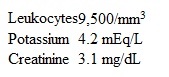 The laboratory findings are not significantly changed compared to preadmission values. Which of the following is the most appropriate next step in management of this patient's altered mental status?
 (Multiple Choice)
4.8/5 (86)
(86) A 22-year-old woman comes to the physician with her husband for intermittent dizziness, weakness, and unsteady gait for the last several weeks. She has also had visual loss and pain in the right eye that worsens with eye movement for the past 2 days. A year ago, the patient had tingling and numbness of her right hand accompanied by unsteadiness, which improved spontaneously after 3-4 days. She has no other medical problems and does not take any medications. The patient has no significant social or family history. Her temperature is 37.2 C (99 F), blood pressure is 122/80 mm Hg, pulse is 82/min, and respirations are 16/min. On neurologic examination, her right eye has diminished visual acuity and an afferent pupillary defect. She also has a right arm intention tremor. Both lower extremities have spastic paresis, hyperreflexia, and positive Babinski sign. Four months later, the patient comes to the physician for a routine visit and asks for advice regarding pregnancy. She has been taking her medication regularly. Which of the following is the most appropriate response?
(Multiple Choice)
4.9/5 (82)
(82) A 25-year-old African-American medical student comes to see you in the office. His girlfriend noticed an area of circular hair loss over the back of his head. He is concerned that he is losing his hair and will be bald soon. He is otherwise in good health and denies any history of smoking, alcohol, or illicit drug use. He has had a monogamous relationship with his girlfriend for the past three years. On examination, there is a 1 cm area of complete, smooth and circular hair loss with distinct margins. There is no scaling or inflammation present in or around the area of hair loss.
Which of the following is the most appropriate treatment for this condition?
(Multiple Choice)
4.9/5 (71)
(71) A 35-year-old woman comes to the office with episodic abdominal pain. After dinner a day ago, she had intense epigastric pain that lasted 30-40 minutes, was dull with radiation to the back and right shoulder, and was accompanied by nausea and difficulty catching her breath. The pain resolved spontaneously after an hour and she did not seek medical care. The patient has had 2 similar episodes of lesser intensity in the past 6 months that resolved spontaneously. She has a history of migraine headaches treated with sumatriptan as needed. She does not use tobacco or illicit drugs. The patient has consumed 1 or 2 glasses of wine daily for the past 10 years. Her father died of pancreatic cancer at age 75, and her mother died of breast cancer at age 65. Vital signs are within normal limits. BMI is 35 kg/m2. Abdominal examination reveals normoactive bowel sounds without tenderness or guarding. The liver span is 8 cm and there is no palpable spleen. The remainder of the examination is within normal limits. The patient refuses the suggested therapy and does not follow up with a health care provider. She returns to the emergency department 6 months later with recurrent persistent abdominal pain that has waxed and waned for the past 30 hours. She also has nausea and an episode of vomiting. Temperature is 36.7 C (98 F), blood pressure is 136/80 mm Hg, and pulse is 100/min. She had mild icterus. The abdomen is tender in the right upper quadrant without guarding or rebound. Laboratory results are as follows:
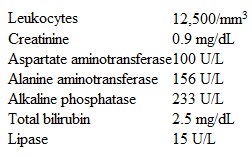 Abdominal ultrasound shows a mildly distended gallbladder with multiple stones, no pericholecystic fluid, and an enlarged common bile duct of 1.1 cm (normal: <0.6). Which of the following is the best next step in management of this patient?
 (Multiple Choice)
4.9/5 (72)
(72) A 32-year-old woman is brought to the emergency department after she was found wandering aimlessly in the street. She lives in a homeless shelter and has not received medical care in several years. The patient has no chronic medical problems or previous surgeries. She has a history of intravenous drug use and 16-pack-year cigarette use. Temperature is 37.2 C (99 F), blood pressure is 120/60 mm Hg, and pulse is 94/min. BMI is 19 kg/m2. On examination, the patient is mildly agitated, but oriented to person and place. Her sclerae are icteric. The mucous membranes are moist, but there is evidence of poor oral hygiene and multiple dental caries. There are scattered bilateral petechial lesions on the extremities and trunk. Cardiac, abdominal, and neurologic examinations are unremarkable. Bimanual pelvic examination reveals a uterus consistent with 14 weeks gestation. Laboratory results are as follows: 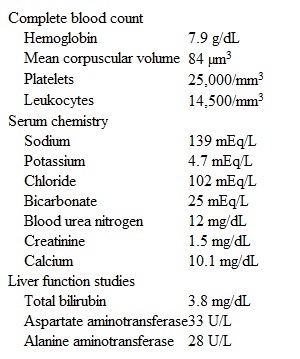 Urine pregnancy test is positive. Which of the following is the most likely diagnosis?
 (Multiple Choice)
4.9/5 (80)
(80) A 36-year-old woman comes to the office due to worsening pain and swelling of her left third finger. The symptoms began 3 days ago with redness at the lateral margin of the fingernail. The patient recently received a manicure at a new salon. She has had no similar symptoms in the past. The patient is a laboratory technician and uses gloves regularly while working. She was treated for a positive tuberculin skin test 10 years ago, but her medical history is otherwise unremarkable. The patient smokes a pack of cigarettes daily, drinks 2-4 beers on weekend nights, and does not use illicit drugs. Temperature is 36.6 C (97.9 F), blood pressure is 128/76 mm Hg, and pulse is 68/min. Examination shows erythema, edema, and tenderness of the lateral nail fold of the left third finger. There is no fluctuance, and the nail appears normal. The remainder of the examination shows no abnormalities. Which of the following is the best next step in management of this patient's condition?
(Multiple Choice)
4.9/5 (73)
(73) A 26-year-old woman comes to the physician for routine health maintenance examination. She states that she is very dissatisfied with her general physical appearance and is planning to have breast implant surgery. However, she is worried because she read on the Internet about an association between silicone breast implants and the development of diseases and wants her physician's opinion.
Item 1 of 4
Which of the following is the most appropriate response to address her concerns about breast implant surgery?
(Multiple Choice)
5.0/5 (78)
(78) A 55-year-old woman comes to the emergency department with progressively worsening severe back pain and difficulty walking for the last 2 weeks. The pain is at the mid-thoracic level and wraps around her upper abdomen in a band-like fashion. She also has weakness, numbness, and tingling in both lower extremities. No bowel or bladder dysfunction is reported. The patient completed treatment for non-Hodgkin's lymphoma 8 months ago with chemotherapy and radiation therapy. On physical examination, her temperature is 36.7 C (98 F), blood pressure is 110/80 mm Hg, and pulse is 94/min. Neurological examination shows motor strength of 3/5 in both lower extremities. The patellar and Achilles reflexes are brisk and Babinski reflex is upgoing bilaterally. Which of the following are the most appropriate next steps in management of this patient?
(Multiple Choice)
4.8/5 (85)
(85) A 28-year-old nurse comes to the occupational health clinic 30 minutes after an accidental needle stick following a blood draw from a patient who is HIV positive. The patient is on antiretroviral therapy for a drug-sensitive virus, has an undetectable viral load, and has no history of viral hepatitis. The nurse has no chronic medical issues and takes no medications. Her immunizations, including hepatitis B, are up-to-date. Laboratory results are as follows: 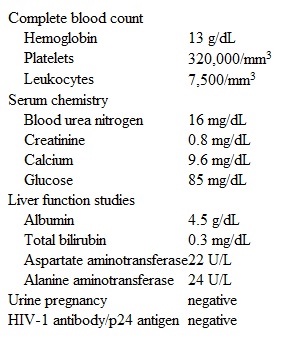 Which of the following is most appropriate next step in management of this nurse?
 (Multiple Choice)
5.0/5 (84)
(84) A 22-year-old primigravida comes to the office at 12 weeks gestation for her first prenatal visit. The patient was unaware that she was pregnant until last week, when she went to the emergency department for persistent vomiting; an ultrasound confirmed an intrauterine pregnancy. The patient has irregular menstrual cycles due to polycystic ovary syndrome. Nine months ago, she stopped taking oral contraceptives due to intolerable side effects; she did not inform her provider. The patient also has a history of idiopathic seizures beginning in childhood and receives valproate monotherapy. She states, "I just read in one of those maternity books that seizure medications can be bad for my baby. Should I stop now? I have not had a seizure in a long time." Her last seizure occurred a year ago after an attempt to change her medication regimen; she was hospitalized for aspiration pneumonia afterward. The patient does not use tobacco, alcohol, or illicit drugs. There is no family history of congenital abnormalities. This patient's pregnancy was uneventful and she delivered a healthy baby. She has heard about the benefits of breastfeeding and asks if she can breastfeed while taking her medication. Which of the following is the most appropriate response to this patient?
(Multiple Choice)
4.8/5 (74)
(74) A 36-year-old woman comes to the clinic for smoking cessation counseling. She has smoked 2 packs of cigarettes daily for 18 years. The patient has tried to quit multiple times but failed. She works as a corporate attorney and has 2 important cases she is closing this month. The patient says, "Every time I try to quit smoking, I start shaking really badly. I can't sleep, and I get very anxious, depressed, and frustrated. I can't seem to concentrate, which is bad because my job is very demanding. I need to perform well and show my boss that I can handle the more difficult cases she gives me. I'm also concerned about gaining weight if I stop smoking." The patient is recently married. Her husband does not smoke and has asthma, which is worsened by her smoking. The patient feels motivated to stop but concerned about her ability to do so. She has a history of a seizure disorder but discontinued anticonvulsant therapy 5 years ago after a few years of being seizure free. She also has a history of depression successfully treated with psychotherapy in her 20s. Which of the following is the most appropriate next step in management of this patient?
(Multiple Choice)
4.9/5 (71)
(71) A 52-year-old woman comes to the emergency department with left leg pain and swelling. She is a commercial truck driver and first noticed the swelling 3 days ago. The patient initially attributed the swelling to a long haul truck ride as she often gets mild "puffiness" of her ankles by the end of the day. However, the swelling has persisted and now involves her entire left leg below the knee. She has discomfort with walking but no chest pain, palpitations, syncope, or difficulty breathing. The patient has a history of hypothyroidism and hypertension and takes levothyroxine and hydrochlorothiazide. She has also been on menopausal hormone therapy using estrogen-progestin for intractable hot flashes. She smokes a pack of cigarettes daily and drinks 2 beers each night. Temperature is 37.2 C (99 F), blood pressure is 134/89 mm Hg, and pulse is 78/min. BMI is 31 kg/m2. Extremity examination reveals a normal right leg and pitting edema and warmth over the left lower leg. ECG shows normal sinus rhythm, and chest x-ray is normal with no infiltrates. Serum creatinine level is 0.7 mg/dL. Duplex ultrasound of the lower extremities reveals noncompressibility of the left popliteal and femoral veins.
Which of the following is the best next step in management of this patient?
(Multiple Choice)
4.8/5 (82)
(82) A 36-year-old man comes to the emergency department due to acute pain in his left foot. He was previously feeling well but suddenly woke from sleep with severe pain at the base of his great toe. The patient has type 1 diabetes mellitus complicated by peripheral sensory neuropathy and proliferative retinopathy. He also has end-stage renal disease due to diabetic nephropathy, for which he underwent cadaveric renal transplant 18 months ago. The patient's diabetes is controlled by an insulin pump. His other medications include lisinopril, amlodipine, cyclosporine, mycophenolate, and prednisone (5 mg/day). Temperature is 37.3 C (99.1 F), blood pressure is 126/84 mm Hg, and pulse is 88/min. Physical examination shows an erythematous, swollen, warm, and tender left first metatarsophalangeal joint. Range of motion testing is limited by severe pain. There is a moderate hammertoe deformity at the third toe but no abnormal calluses. Posterior tibial and dorsalis pedis pulses are easily palpable. Bedside capillary glucose is 184 mg/dL. Examination of joint aspirate confirms the presence of crystals. Leukocyte count in the synovial fluid is 30,000/mm3. Gram stain is negative for organisms. Which of the following is the most appropriate drug for management of acute monoarthritis in this patient?
(Multiple Choice)
4.7/5 (82)
(82) A 59-year-old obese woman with a history of type 2 diabetes mellitus and chronic obstructive pulmonary disease (COPD) is admitted with COPD exacerbation. Management is complicated by difficulty controlling the patient's blood glucose, with levels of 100-300 mg/dL throughout the day. On her second hospital day, a 7 x 3 cm abscess of her left buttock is found and requires incision and drainage. Following the procedure, the surgeon instructs the overnight hospitalist to obtain serial ultrasound examinations to monitor the abscess. During the course of signing out, the hospitalist expresses concern about the patient's fluctuating blood sugars, provides details on the status of her COPD, and mentions the drainage of the abscess but forgets to mention the need for follow-up ultrasound examination. Due to this oversight, the abscess is not reexamined for several days and worsens significantly, requiring more extensive surgical intervention. Following a review of the adverse outcome, the hospital administration forms a committee to improve patient handoffs between medical staff members. Which of the following interventions would most significantly improve the quality of patient handoffs?
(Multiple Choice)
4.8/5 (86)
(86) A 65-year-old white woman comes to the physician for acute mid-thoracic back pain. Seven days ago, she slipped and fell in her driveway and has had the back pain ever since. The pain is described as deep-seated, boring in quality, and non-radiating, and has not improved with over-the-counter pain medications. Her past medical history is significant for chronic obstructive pulmonary disease (COPD) treated with fluticasone, salmeterol, and ipratropium inhalers, and hypertension treated with lisinopril and hydrochlorothiazide. She has had occasional brief courses of oral glucocorticoids for COPD exacerbations. The patient has a 30-pack-year smoking history and quit approximately 5 years ago. She experienced menopause when she was 48 years old. Her mammogram and Pap smear were negative 6 months ago. Her mother and 2 sisters have osteoporosis. Examination shows tenderness over the mid-thoracic vertebrae. The rest of the examination is unremarkable. The complete blood count, basic metabolic panel, calcium, and phosphorus are within normal limits. Plain radiographs of the thoracic spine reveal a compression fracture in the 10th and 11th vertebrae.
In addition to pain control, what is the best next step in management of this patient?
(Multiple Choice)
4.8/5 (76)
(76) Showing 581 - 600 of 1121

Filters
- Essay(0)
- Multiple Choice(0)
- Short Answer(0)
- True False(0)
- Matching(0)