



 Chat with AI
Exam 1: Advanced Clinical Medicine

Exam 1: Advanced Clinical Medicine1 k+ Questions
Exam 2: Foundations of Independent Practice597 Questions
Select questions type


A seven-year-old female is being evaluated in the pediatric clinic for short stature. Her medical records reveal that she was small at birth. When she was approximately two years of age, her parents noticed that she was not growing as much as her peers. Her height and weight are below the 5th percentile on the normal growth chart. Her projected height is more than 2 standard deviations below her mid-parental height. She has short fourth metacarpal bones bilaterally and multiple nuchal folds. Her carrying angles in the upper extremities are increased. A diagnosis of Turner syndrome is suspected. Karyotyping is performed and the result is 45, XO. At this time, which of the following is necessary in the management of this patient?
(Multiple Choice)
4.8/5  (76)
(76) A 32-year-old man is brought to the emergency department after a motor vehicle accident that resulted in severe head injuries. The patient was unresponsive and hypotensive when paramedics arrived at the scene. He was intubated on-site and given aggressive intravenous fluids. Neurologic imaging reveals multiple cortical contusions, brain hemorrhage, and diffuse axonal injury. The patient is admitted to the intensive care unit. Three days later, he continues to require mechanical ventilation. Temperature is 36.7 C (98 F), blood pressure is 100/45 mm Hg, and pulse is 62/min. Sedation is held, and the patient is examined. There is no response to stimuli of any type. Brainstem reflexes are absent. The ventilator is temporally disconnected to assess for spontaneous respiration. No spontaneous breathing movements are visualized, and arterial blood gas results after 10 minutes are consistent with a positive apnea test, confirming brainstem failure. The patient is declared brain-dead. His wife informs the medical team that the patient always wanted to donate his organs in the event of unexpected death. Which of the following is an important component of care to maximize the viability of this patient's organs for donation?
(Multiple Choice)
4.9/5 (89)
(89) A 25-year-old man comes to the office due to decreased libido, fatigue, and weight gain. For the last few months, the patient has been unable to attain a satisfactory erection during intercourse with his girlfriend. He has had no headaches, blurred vision, fever, nausea, or vomiting. The patient has had no significant prior medical problems and takes no prescription medications but does take several over-the-counter supplements to boost his metabolism. He does not use alcohol, tobacco, or illicit drugs. His mother was treated for non-Hodgkin lymphoma, and his father has no major medical problems. Blood pressure is 130/70 mm Hg and pulse is 56/min. The patient appears fit and well-built with no significant abnormalities noted on examination. Laboratory results are as follows: 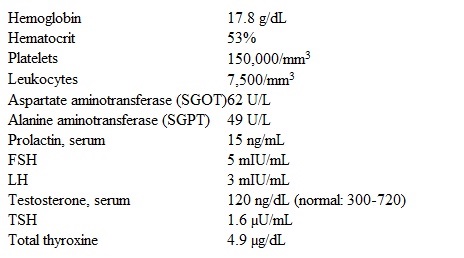 Which of the following is the most appropriate next step in management?
 (Multiple Choice)
4.9/5 (70)
(70) A 48-year-old woman comes to the office after abnormal serum liver chemistry results were found during a life insurance medical evaluation. She has no chronic medical issues and takes no medications. The patient says she has felt excessively tired lately, which she attributes to menopause. She has had no hot flashes, changes in sleep pattern, anorexia, or weight loss. The patient does not use tobacco, alcohol, or illicit drugs. She works in an accounting firm. Her father died at age 62 from an unknown liver disease. Vital signs are within normal limits. BMI is 30 kg/m2. She has small bilateral xanthelasmata but no scleral icterus. The thyroid is not enlarged. Cardiopulmonary examination is unremarkable. The abdomen is soft and nontender with no hepatosplenomegaly. She has no skin rash. Current laboratory results are as follows: 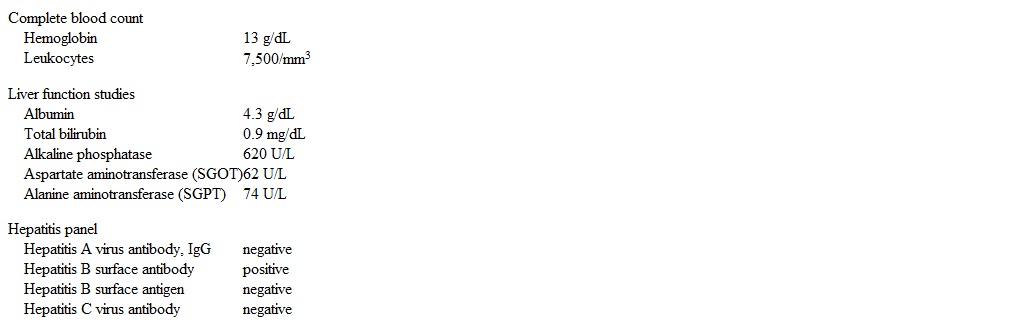 Abdominal ultrasonography reveals a normal-sized liver and no gallstones. Intrahepatic and common bile ducts are normal.
Which of the following is most likely to help establish the diagnosis in this patient?
Abdominal ultrasonography reveals a normal-sized liver and no gallstones. Intrahepatic and common bile ducts are normal.
Which of the following is most likely to help establish the diagnosis in this patient? (Multiple Choice)
4.7/5 (82)
(82) A 53-year-old man comes to the office due to newly diagnosed hypertension. The patient has no symptoms. Medical history is significant for type 2 diabetes mellitus. He has a 50-pack-year smoking history and has consumed 1 or 2 cans of beer daily for the past 25 years. Blood pressure is 150/95 mm Hg and pulse is 80/min. Height is 183 cm (6 ft) and weight is 109 kg (240.3 lb). BMI is 32.5 kg/m2. Physical examination is normal. The physician recommends medication and lifestyle changes to lower blood pressure and decrease the risk of future cardiovascular events. Which of the following nonpharmacologic measures would be the most effective in decreasing this patient's blood pressure?
(Multiple Choice)
4.9/5 (73)
(73) A 48-year-old woman comes to the office after abnormal serum liver chemistry results were found during a life insurance medical evaluation. She has no chronic medical issues and takes no medications. The patient says she has felt excessively tired lately, which she attributes to menopause. She has had no hot flashes, changes in sleep pattern, anorexia, or weight loss. The patient does not use tobacco, alcohol, or illicit drugs. She works in an accounting firm. Her father died at age 62 from an unknown liver disease. Vital signs are within normal limits. BMI is 30 kg/m2. She has small bilateral xanthelasmata but no scleral icterus. The thyroid is not enlarged. Cardiopulmonary examination is unremarkable. The abdomen is soft and nontender with no hepatosplenomegaly. She has no skin rash. Current laboratory results are as follows: 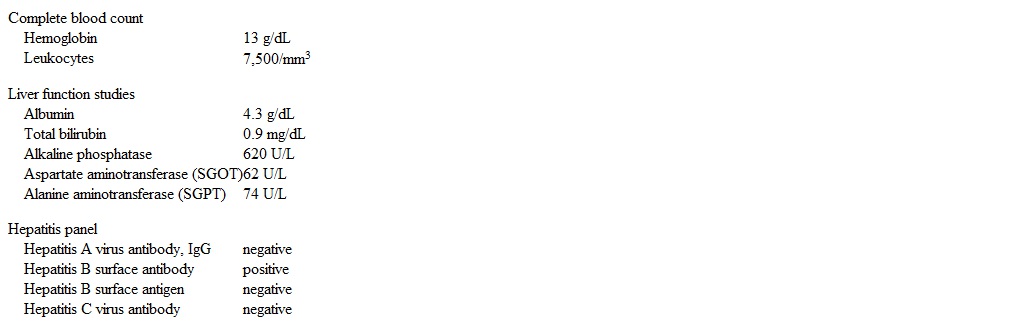 Abdominal ultrasonography reveals a normal-sized liver and no gallstones. Intrahepatic and common bile ducts are normal. Which of the following may be helpful to slow the progression of this patient's disease?
 (Multiple Choice)
4.9/5 (73)
(73) A 70-year-old woman is brought to the emergency department by her son for evaluation of shortness of breath. She has had a sensation of choking since last night. According to her son, for the past several weeks she has had a dry cough at night and has been taking over-the-counter cough drops. The patient has had no chest pain, palpitations, back pain, abdominal symptoms, or lightheadedness. She has a history of hypertension, hyperlipidemia, and type 2 diabetes mellitus. She has been refusing statin therapy, as she heard statins cause multiple side effects. The patient has also refused flu vaccinations over the last several years. Her only hospital admission occurred 6 years ago when she underwent a spinal fusion for lower back pain. She does not use tobacco, alcohol, or illicit drugs. Family history is not significant. Temperature is 36.1 C (97 F), blood pressure is 171/102 mm Hg, pulse is 92/min, and respirations are 34/min. Pulse oximetry is 85% on room air. BMI is 29 kg/m2. Bilateral crackles are heard on lung examination. There are no heart murmurs. ECG shows normal sinus rhythm, increased voltage in the precordial leads, and T-wave inversion in leads V5 and V6. Chest x-ray is shown in the exhibit. 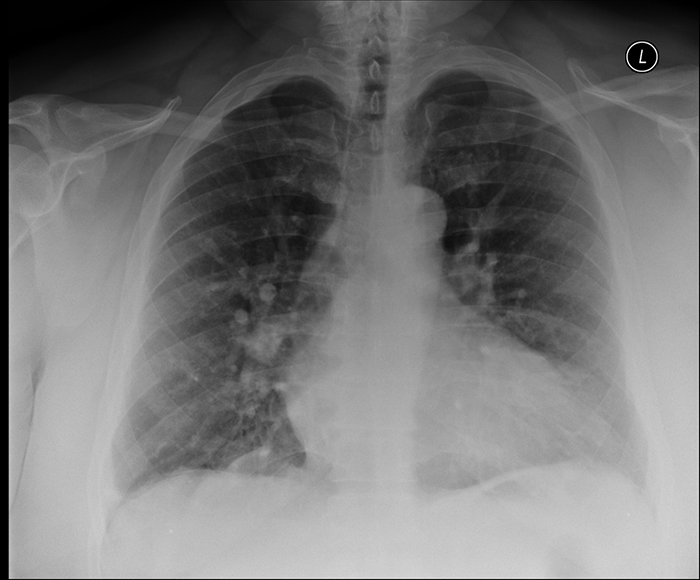 Oxygen is administered via 100% nonrebreather facemask. The patient is responding well to treatment. The second troponin I level is negative. Which of these tests is the most appropriate next step in management of this patient?
 (Multiple Choice)
4.9/5 (88)
(88) A 59-year-old man comes to the office due to cough and mild dyspnea. His symptoms began 10 days ago with nasal congestion and a sore throat, which improved spontaneously after a few days. However, the cough, productive of white sputum, has persisted. He has also had an episode of blood-streaked sputum. The patient has a history of hypertension and stable coronary artery disease. He is a current smoker with a 20-pack-year history. The patient is a car salesman and has not traveled recently. Temperature is 36.7 C (98.1 F), blood pressure is 110/72 mm Hg, and respirations are 18/min. Lung examination shows scattered wheezes bilaterally. Chest x-ray demonstrates no parenchymal infiltrate or consolidation, but a 2-cm peripherally located nodule is present in the left lower lobe. No prior chest imaging is available.
Which of the following is the most appropriate initial step in management of this patient?
(Multiple Choice)
4.8/5 (79)
(79) A previously healthy 30-year-old woman is admitted to the hospital. She complains of a rash over her ankles that started 2 weeks ago and slowly spread up to her knees. The patient has no other medical problems and takes no regular medications. Her vital signs are within normal limits. Physical examination shows fine petechiae and purpura around her ankles and lower legs. There is no lymphadenopathy or hepatosplenomegaly. Laboratory results are as follows:
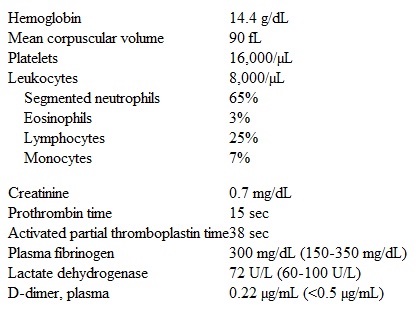 Peripheral blood smear shows thrombocytopenia. After reviewing the laboratory results, the admitting resident orders 6 units of random donor platelet transfusion. The following day, the platelet count is 10,000/µL.
Which of the following is the most appropriate next step in management of this patient?
Peripheral blood smear shows thrombocytopenia. After reviewing the laboratory results, the admitting resident orders 6 units of random donor platelet transfusion. The following day, the platelet count is 10,000/µL.
Which of the following is the most appropriate next step in management of this patient? (Multiple Choice)
4.7/5 (86)
(86) A 26-year-old Italian-American man comes to your office for the evaluation of low back pain. He has had this pain for the last eight months, and it is progressively getting worse. The pain is worse in the morning and gets better as the day progresses. He denies any history of trauma in the past. He works as a chef at a local restaurant. His father and uncles also have "back problems." His physical examination reveals a limited range of motion of his lumbosacral spine and markedly reduced chest expansion. The rest of his physical and musculoskeletal examination is unremarkable. Which of the following conditions is associated with the patient's diagnosis?
(Multiple Choice)
4.8/5 (82)
(82) A 17-year-old girl comes to the office for evaluation of pain in her right hip and groin. She first noticed the pain approximately 3 months ago during a scuba class. The patient initially felt an intermittent ache in the right hip and groin that she attributed to carrying heavy scuba gear. She recently started competitive rowing, and the pain has become more intense and constant. She sometimes experiences a "clicking" sensation in the right hip. The patient has had no swelling or stiffness of the knees, feet, hands, or elbows. However, she now has difficulty exercising due to the pain; ibuprofen and ice provide no relief. The patient was adopted at age 18 months from a developing country and has no known medical problems. She lives with her parents and a cat. BMI is 20 kg/m2. The patient is afebrile and vital signs are normal. The left side of the pelvis drops when she bears weight on the right leg. She stands on her right toes with her left foot flat on the ground. During supine examination, the right hip has decreased abduction. Which of the following is the most likely cause of this patient's condition?
(Multiple Choice)
4.9/5 (73)
(73) A 16-year-old girl is brought to the office due to abdominal pain over the last 4 months. The patient does not eat lunch due to the intermittent, periumbilical pain that recurs nearly every day, typically beginning mid-morning and lasting 2-3 hours. The patient is an honors student and has missed several days of school due to the pain; she is worried that she will lose weight and not have enough energy for gymnastics practices. She passes 1 or 2 soft stools daily, which does not relieve the pain. The patient has had no associated bloating, flatulence, vomiting, or changes in bowel patterns. Height, weight, and BMI are at the 25th percentile, unchanged from last year. Temperature is 36.7 C (98 F), blood pressure is 110/70 mm Hg, and pulse is 80/min. The patient is alert and appears well. The abdomen has normal bowel sounds and is soft and nontender with no palpable masses. No rebound or guarding is noted. Stool is negative for occult blood. Which of the following is the best next step in evaluation of this patient's abdominal pain?
(Multiple Choice)
4.8/5 (104)
(104) A 47-year-old man comes to the office with his wife due to a gradually decreasing sex drive and difficulty sustaining an erection during sexual intercourse over the past 1-2 years. They have had satisfying sexual interactions in the past and have 2 teenage children. On questioning, the patient is unable to recall any spontaneous nocturnal erections of late. Medical history is otherwise unremarkable and he takes no medications. He does not use tobacco or alcohol. Family history is significant for diabetes mellitus in his father and uncle. Temperature is 37 C (98.6 F), blood pressure is 126/84 mm Hg, pulse is 74/min, and respirations are 14/min. The patient has a dark complexion with sparse body hair. The thyroid is normal to palpation. Lung auscultation and heart sounds are normal. The abdomen is nondistended, soft, and nontender, with the liver edge palpable 1 cm below the right costal margin. External genitalia appear normal, with a mild decrease in testicular volume. Visual fields are full to confrontation. Laboratory results are as follows: 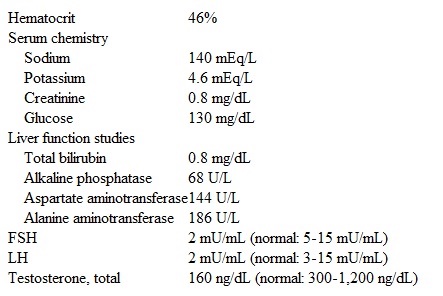 Which of the following is the best management strategy for this patient?
 (Multiple Choice)
4.8/5 (75)
(75) A 63-year-old man with a history of locoregionally advanced squamous cell carcinoma of the oropharynx is admitted to the hospital for cancer-related pain of the mouth and throat. The pain has slowly increased over the last several days and has limited his ability to eat and drink. The patient has felt weak and believes he is dehydrated. He was diagnosed with cancer 4 months ago and has received several cycles of chemotherapy and radiation therapy, the last of which occurred a week ago. He has been told that his tumor is unresectable. On admission, temperature was 36.1 C (97 F), blood pressure was 105/60 mm Hg, pulse was 108/min, and respirations were 12/min. BMI was 17 kg/m2. Physical examination showed periorbital wasting, dry mucous membranes, and sloughing of the oral mucosa. Absolute neutrophil count was 350/mm3. The patient was admitted to a medical floor and given intravenous pain control; total parenteral nutrition was initiated via a central venous catheter for malnutrition. On day 4 of hospitalization, the patient has a temperature of 39.1 C (102.4 F) and has developed right eye pain and light sensitivity. Funduscopic examination reveals several large, glistening, off-white lesions with indistinct borders. The lesions are 3-dimensional and extend from the chorioretinal surface into the vitreous. A vitreous haze is present and visual acuity is decreased. Item 1 of 2
What is the most likely cause of this patient's ocular pain?
(Multiple Choice)
4.7/5 (66)
(66) A 3-year-old boy is brought to the office due to bloody stools. Two days ago, the stools were small, soft, and blood-streaked; today, the stools increased in frequency and volume, and he began having crampy abdominal pain. The child has had decreased intake of solid foods but is drinking sips of water and juice without vomiting. He has been urinating, but not as frequently as his baseline. The parents report that he has been more tired and "clingy" but is otherwise acting appropriately. The family recently attended a relative's birthday party, after which several other guests had similar symptoms. The patient had an ear infection 2 months ago that was treated with a course of antibiotics. He is currently not taking any medications. Temperature is 38.1 C (100.5 F), blood pressure is 100/60 mm Hg, and pulse is 114/min. On examination, the boy is tired-appearing but follows commands appropriately. His lips are dry but the buccal mucosa is moist, and there is no erythema of the pharynx. Heart sounds are regular and no murmurs are present. Capillary refill time is 2 seconds. Abdominal examination demonstrates hyperactive bowel sounds and generalized tenderness to palpation. Stool culture for bacteria is obtained. Which of the following is the most appropriate next step in management of this patient?
(Multiple Choice)
4.9/5 (85)
(85) A 60-year-old woman is brought to the emergency department following a motor vehicle accident. She hit a car from her side and claims that she did not see another car coming towards her. This accident took place at a small intersection with little traffic. Her past medical history is significant for Cushing's disease and an intra-abdominal operation 15 years ago for the disease. Physical examination showed a tanned female with normal vital signs. She has a few abrasions on her face and chest. Ophthalmologic examination reveals bitemporal hemianopsia. Her injuries are managed appropriately.
What is the next best step in the management of this patient?
(Multiple Choice)
4.8/5 (79)
(79) An 18-month-old boy is brought to the office for right ear pain. About 4 weeks ago, he had fever and right ear pain and was prescribed a 10-day course of high-dose amoxicillin for acute otitis media; he completed the course and had a normal follow-up visit 2 weeks ago. While on the medication, he experienced improvement in his symptoms. For the past 3 days, he has been tugging on his right ear and crying; he developed fever today. He has no nasal congestion, neck stiffness, cough, emesis, or other symptoms. He is otherwise healthy and takes no medications. His immunizations are up to date. Temperature is 38.5 C (101.3 F), blood pressure is 108/66 mm Hg, pulse is 96/min, and respirations are 21/min. Physical examination demonstrates an alert, uncomfortable child. Pupils are equal and reactive; the conjunctivae are injected bilaterally and have purulent discharge. There is no rhinorrhea or sinus tenderness. The external ears appear normal and are not painful to manipulation; there is no drainage in the external canal. The right tympanic membrane is erythematous, bulging, and immobile on pneumatic air insufflation. The left tympanic membrane appears normal. Both mastoids are nontender and nonerythematous. The neck is nontender and has full range of motion. Cardiopulmonary examination is normal. An appropriate diagnosis is made, and the treatment options are discussed with the patient's mother. What is the most appropriate next step in management of this boy's condition?
(Multiple Choice)
4.9/5 (86)
(86) A 78-year-old healthy, Chinese-American man is brought to the emergency department because of hallucinations, delusions, and aggressive behavior, according to his nephew. He has had these symptoms for the past six days. He denies fever, chills, decreased vision, headaches, or abdominal pain. His other medical problems include hypertension, coronary artery disease, and osteoporosis. He does not use tobacco or drink alcohol. He is a vegan. He lives alone. His medications include aspirin, hydrochlorothiazide, enalapril, acetaminophen, and diclofenac. He has no known drug allergies. His blood pressure is 141/88 mmHg, pulse is 100/min, temperature is 37.2 C (99 F), and respirations are 14/min. Examination shows dry mucus membranes and a loud second heart sound. The abdomen is soft, nontender, and non-distended. Bowel sounds are mildly increased. There is no rebound tenderness or rigidity. The range of motion of the spine is normal and without pain. There is no scoliosis or excessive kyphosis of the back. There is no tenderness to palpation of the lower back. The mental status examination reveals an agitated, elderly man with delusional ideation and bizarre behavior. There are no motor or sensory focal deficits, and no meningeal signs. The patient's labs reveal: 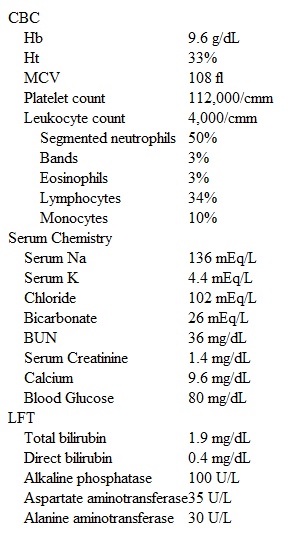 His chest-x ray and urinalysis results are normal. Which of the following is the most appropriate pharmacotherapy?
 (Multiple Choice)
4.8/5 (85)
(85) A 62-year-old hospitalized man is evaluated for new-onset, right lower extremity pain. The patient underwent bypass surgery for 3-vessel coronary artery disease 2 months ago. He arrived at the emergency department 2 nights ago due to recurrent chest pains. At that time, ECG showed sinus rhythm with no ST-segment changes, but cardiac troponin I levels were elevated. The patient was initiated on unfractionated heparin, antiplatelet agents, a beta blocker, and a nitrate. A coronary angiogram was performed via the radial artery; it revealed graft insertion site stenosis and was treated with stenting. Postintervention echocardiography revealed left ventricular ejection fraction of 50% with no regional wall motion abnormalities. This morning, the patient had new, sudden-onset, right lower extremity pain. He has never had pain in that extremity before. The patient has a history of hypertension, hyperlipidemia, and type 2 diabetes mellitus. Current medications include aspirin, clopidogrel, rosuvastatin, metoprolol, losartan, isosorbide mononitrate, basal-bolus insulins, and subcutaneous heparin at a prophylactic dose. The patient is a former smoker with a 30-pack-year history. Temperature is 37.6 C (99.7 F), blood pressure is 138/84 mm Hg, pulse is 96/min, and respirations are 18/min. Physical examination reveals normal jugular venous pressure, clear lungs, no heart murmurs, and a soft, nontender abdomen. The right leg is tender and cool to the touch when compared to the left leg. Right lower extremity distal pulses are diminished, but capillary refill is intact. Left leg examination is normal with the exception of healed scars from previous saphenous vein harvesting. Neurological examination is normal. Laboratory results are as follows:
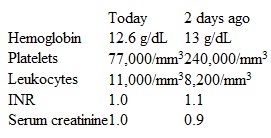 Which of the following is the most likely cause of this patient's leg pain?
 (Multiple Choice)
4.8/5 (91)
(91) A 41-year-old man is brought to the emergency department by ambulance after a motor vehicle accident. He was driving a car with his 6-year-old daughter in the back seat when they were broadsided by a large truck traveling at high speed. The patient is conscious during transit to the emergency department. He appears oriented to date and time, and informs paramedics that he is a Jehovah's Witness and does not want blood transfusions for himself or his daughter. Soon after, he begins moaning and writhing and is clearly in distress. He complains of feeling nauseated and thirsty. A facemask is placed to administer 100% oxygen. Initial assessment indicates his temperature is 37 C (98.6 F), blood pressure is 100/58 mm Hg, pulse is 132/min and thready, and respirations are 34/min. There are numerous lacerations on his scalp, trunk, abdomen, and extremities. The patient's skin is cool and clammy. Chest auscultation shows tachypnea and tachycardia but is otherwise normal. His abdomen is diffusely tender to palpation and guarding is present. Rectal examination is normal. The patient's blood pressure begins to drop rapidly and approaches 60/15 mm Hg. The trauma surgeon advises that an immediate exploratory laparotomy is warranted to ascertain the source of the internal bleeding. Hemoglobin is 5.5 g/dL. The patient's 6-year-old daughter was also severely injured in the accident. She suffered a significant crush injury to her chest and is now unconscious and bleeding profusely. At initial assessment, her temperature was 37 C (98.6 F), blood pressure was 72/38 mm Hg, pulse was 154/min, and respirations were 42/min. While her chest wound is examined externally, her blood pressure declines precipitously. Two large-bore intravenous catheters are inserted and fluids are administered aggressively, but the child becomes increasingly hemodynamically unstable. Her hemoglobin is 6 g/dL. She is intubated and chest tubes are placed. Which of the following is the most appropriate next step?
(Multiple Choice)
4.8/5 (90)
(90) Showing 261 - 280 of 1121

Filters
- Essay(0)
- Multiple Choice(0)
- Short Answer(0)
- True False(0)
- Matching(0)