



 Chat with AI
Exam 1: Advanced Clinical Medicine

Exam 1: Advanced Clinical Medicine1 k+ Questions
Exam 2: Foundations of Independent Practice597 Questions
Select questions type


A 55-year-old man comes to the emergency department with palpitations that began earlier this morning. He was having tea when he suddenly started to experience fluttering in his chest. He tried walking around and taking deep breaths, but the feeling did not subside. The patient has previously felt his "'heart skipping a beat" but had never sustained palpitations as he did today. He has no lightheadedness, blurry vision, muscle weakness, chest pain, or shortness of breath. The patient has hypertension that is well controlled with valsartan and amlodipine. He does not use tobacco, alcohol, or illicit drugs. He has no drug allergies. His father had a stroke at age 65 and his mother has congestive heart failure. On initial evaluation, the patient appears anxious and in mild discomfort due to palpitations. Blood pressure is 140/80 mm Hg and respirations are 19/min. Jugular venous pressure is estimated at 2 cm H2O. Cardiac auscultation reveals no murmurs. Lungs are clear to auscultation. The abdomen is soft, nontender, and non-distended. Neurologic examination shows no abnormalities. The patient is placed on a telemetry monitor, and a 12-lead ECG is performed. What is the most appropriate next step in management of this patient?
(Multiple Choice)
4.9/5  (76)
(76) A 65-year-old man comes to the emergency department due to severe headache localized to the left frontal temporal region that began 4 hours ago. At the onset of the headache, he also had transient vision impairment in the left eye, which has now resolved. The patient has never had similar symptoms previously. Medications are acetaminophen for arthritis and metformin for recently diagnosed type 2 diabetes mellitus. He lives in rural Connecticut, smokes a pack of cigarettes per day, and does not use alcohol or illicit drugs. Temperature is 36.7 C (98.1 F), blood pressure is 152/96 mm Hg, and pulse is 89/min. Pulse oximetry shows 99% on room air. Physical examination findings are shown in the exhibit. 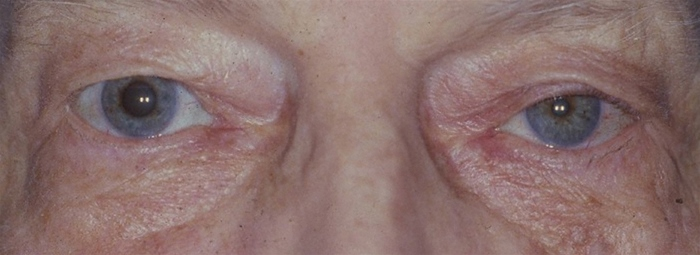 Laboratory studies are as follows:
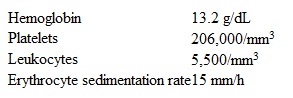 A noncontrast CT scan of the head shows no intracranial hemorrhage or mass lesion. Which of the following is the most appropriate next step in management of this patient?
Laboratory studies are as follows: A noncontrast CT scan of the head shows no intracranial hemorrhage or mass lesion. Which of the following is the most appropriate next step in management of this patient? (Multiple Choice)
4.9/5 (81)
(81) A 14-year-old boy is brought to the emergency department for evaluation of severe scrotal pain. Half an hour ago, the patient was accidentally hit in the scrotum during wrestling practice. He applied ice and took acetaminophen, neither of which relieved the pain. He has not tried urinating due to fear of the pain. The patient underwent a right orchiopexy as an infant due to unilateral cryptorchidism but has no chronic medical conditions. Temperature is 36.7 C (98.1 F), blood pressure is 114/76 mm Hg, and pulse is 108/min. Abdominal examination is unremarkable. There is moderate bruising on the right hemiscrotum but not on the medial thigh or perineum. The right testis is exquisitely tender to palpation but has normal contours. Bilateral testes retract with stroking of the medial thigh. The penis has no blood at the meatus or open wounds. Intravenous morphine provides significant pain relief, and the patient is able to urinate spontaneously. Urinalysis results are as follows:  Which of the following is the best next step in management of this patient?
 (Multiple Choice)
5.0/5 (76)
(76) A 9-year-old girl is evaluated due to a neck mass. The patient first noticed the swelling 2 weeks ago after a viral respiratory illness. The lesion is mildly tender and is not enlarging. She has not had heat or cold intolerance or recent change in appetite or weight. The patient has no other medical conditions. Vital signs are within normal limits. Physical examination shows a 2x2 cm, soft mass in the midline just above the thyroid cartilage. The mass moves superiorly when she is instructed to swallow. There are no other palpable neck masses. The remainder of the examination reveals no abnormalities. Serum TSH is within normal limits.
Which of the following is the most appropriate diagnostic test to obtain prior to treatment of this patient's neck lesion?
(Multiple Choice)
4.8/5 (78)
(78) A 37-year-old man is brought to the emergency department by ambulance 20 minutes after he was hit by a motor vehicle while crossing the street. At the scene of the accident, he was awake, alert, and in considerable distress. On initial assessment, temperature is 36.7 C (98 F), blood pressure is 154/88 mm Hg, pulse is 108/min, and respirations are 31/min. There is an open fracture of the right femur. Chest radiograph shows several fractured ribs. Medical history is significant for opioid use disorder. The patient has undergone a drug rehabilitation program and successfully tapered off all opioids 2 years ago. He is given acetaminophen and ketorolac but continues to rate his pain as 6-7 on a scale of 0-10. Which of the following is the most appropriate next step in management of this patient's acute pain?
(Multiple Choice)
4.9/5 (70)
(70) A 16-year-old boy is brought to the office by his mother for a routine well visit. The patient has been doing well in school and has not been in the office over the past year for any sick visits. His mother says, "My son has had a girlfriend for the last few months, and I wonder if boys can receive the human papillomavirus vaccine. I am friends with his girlfriend's mother and heard that she received the vaccine a few years ago." The patient takes no daily medications and has no known drug allergies. The mother leaves the room for the examination, and the patient says that he is considering vaginal intercourse with his girlfriend. His parents have talked with him about abstinence and the importance of using a condom if having sex. The patient was sexually active with a previous girlfriend and used condoms every time. He is not sexually active with males and has never been tested for sexually transmitted infections. There is no family history of cancer. Physical examination shows no skin lesions, including in the genital area. The penis is circumcised with no visible discharge. The testes are descended bilaterally with no erythema or masses. Counseling about the prevention of pregnancy and sexually transmitted infections is provided. Which of the following is the most appropriate recommendation about the human papillomavirus vaccine in this patient?
(Multiple Choice)
4.9/5 (84)
(84) A 42-year-old man comes to the emergency department due to 4 days of nausea, skin rash, progressive weakness, and decreased urine output. For the past few months he has also had fatigue, tingling in his hands and feet, and occasional joint pains. The patient has had no fever, chest pain, dysuria, hematuria, or diarrhea. He has no chronic medical problems and takes no medication. The patient does not use tobacco or alcohol but used injection drugs during his early 20s. Temperature is 37.6 C (99.8 F), blood pressure is 150/90 mm Hg, pulse is 92/min, and respirations are 16/min. BMI is 24.8 kg/m2. Mucous membranes are dry with no lesions. Cardiopulmonary auscultation is normal. The liver edge is palpable 2 cm below the right costal margin. Bilateral ankle reflexes are absent. He has mild, bilateral, lower-extremity pitting edema and a palpable, nonblanchable, purpuric rash on both legs. There is no joint swelling or erythema. Laboratory results are as follows:
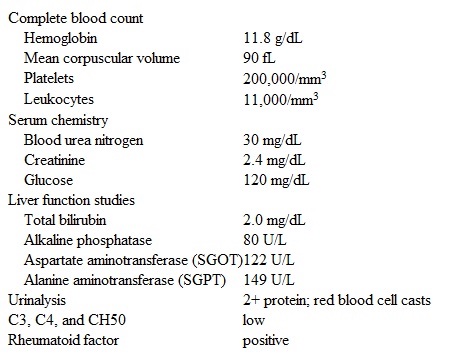 Which of the following is most helpful in establishing the cause of this patient's renal dysfunction?
 (Multiple Choice)
4.9/5 (76)
(76) A 35-year-old woman comes to the office due to hot flashes. Her last menstrual period was a year ago, and she began having hot flashes 4 months ago. The patient's symptoms have become progressively worse and are starting to interfere with sleep and normal daily activities. Medical history is notable for Hodgkin lymphoma, for which she underwent treatment with chemotherapy and radiation 18 months ago. Family history is unremarkable. The patient lives with her husband and 2 children, and underwent a tubal ligation after the delivery of her second child 5 years ago. She does not use tobacco or alcohol. Current medications include calcium and vitamin D supplements. Blood pressure is 110/70 mm Hg and pulse is 80/min. BMI is 19 kg/m2. Physical examination, including breast and pelvic examination, is unremarkable. Laboratory results show a normal complete blood count and basic metabolic panel. LH is 25 mU/mL (normal, 3-20 mU/mL) and FSH is 56 mU/mL (normal, 0.8-13 mU/mL). Bone density using DXA reveals a Z-score of -2.5 at the lumbar spine and -1.7 at the hip. Which of the following is the most appropriate treatment for this patient?
(Multiple Choice)
4.9/5 (73)
(73) A 19-year-old woman is brought to the emergency department by her mother due to suspected drug poisoning. The patient has severe depression treated with fluoxetine and lives with her mother and grandparents. The patient suddenly became ill at home earlier today and developed nausea and vomiting. Her mother suspects the patient may have intentionally ingested a substance to harm herself as her grandparents' medicine cabinet door was found open. On further questioning, the patient states that she swallowed a handful of one of the medications in the cabinet but does not specify further. Her grandparents' medical conditions include anxiety, seasonal allergies, coronary artery disease, and chronic back pain. The patient's mother does not know the specific names and dosages of the medications. Currently, the patient reports nausea and dizziness and has vomited 3 times since arriving at the emergency department. She has smoked a pack of cigarettes daily for the past 5 years and drinks 1 or 2 beers occasionally. She has a history of prior ecstasy use but has no recent use of illicit drugs. Temperature is 38.1 C (100.6 F), blood pressure is 100/55 mm Hg, pulse is 110/min, and respirations are 28/min. Pulse oximetry shows 99% saturation on ambient air. Examination reveals an awake, agitated young woman with dry mucous membranes. The pupils are 4 mm bilaterally and reactive to light. Heart sounds are normal and the lungs are clear to auscultation. The abdomen is soft, nontender, and nondistended; bowel sounds are normoactive. Motor and sensory deficits are absent, and the patient is fully oriented. A 12-lead ECG shows sinus tachycardia. Chest x-ray reveals clear lung fields and no cardiomegaly. The patient is given intravenous fluids and is placed on continuous ECG monitoring. Laboratory tests are ordered. Item 1 of 2
Which of the following is the most likely cause of this patient's condition?
(Multiple Choice)
5.0/5 (89)
(89) A 28-year-old woman, gravida 2 para 0 aborta 2, comes to the office for follow-up after a suction curettage 2 weeks ago for an empty gestational sac. The patient has had light vaginal spotting since the procedure, but no heavy vaginal bleeding or passage of clots. She has had no fever, abdominal pain, or abnormal vaginal discharge. The patient has no chronic medical conditions and has had no previous surgeries. A year ago, she had a left-sided ectopic pregnancy that was treated with methotrexate. She has no history of sexually transmitted infections. Family history is noncontributory. The patient does not use tobacco, alcohol, or illicit drugs. She has no drug allergies. Temperature is 36.7 C (98 F) and blood pressure is 120/60 mm Hg. BMI is 24 kg/m2. Pelvic examination shows a nontender, 6-week-sized uterus and no adnexal masses or tenderness. Speculum examination reveals scant dark blood in the vaginal vault but no active bleeding or abnormal discharge. The pathology report indicates hyperplastic and hydropic trophoblastic villi but no fetal tissue, consistent with a hydatidiform mole. In addition to starting contraception, which of the following is the most appropriate next step in management of this patient?
(Multiple Choice)
4.8/5 (82)
(82) A 43-year-old woman comes to the office due to 2 days of frequent "runny stools." She has not noticed blood or mucus in her stool but has had nausea, abdominal cramping, and malaise. Yesterday, the patient returned from a week-long vacation in Honduras, where she saw notable sights, snorkeled in the Caribbean Sea, and ate food from street vendors. Her medical history is significant for obesity, hypercholesterolemia, and gastroesophageal reflux disease. The patient takes atorvastatin and omeprazole and has not recently used antibiotics. She does not smoke tobacco or drink alcohol. Temperature is 37.8 C (100 F), blood pressure is 130/80 mm Hg, pulse is 80/min, and respirations are 12/min. BMI is 31 kg/m2. The patient appears uncomfortable. The abdomen is soft and mildly tender but no guarding, rigidity, or rebound tenderness is present. The remainder of the physical examination is normal. Laboratory results are as follows: 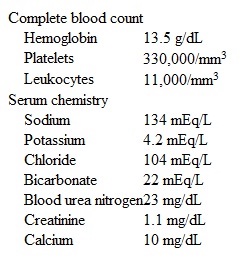 Which of the following pathogens is the most likely cause of this patient's symptoms?
 (Multiple Choice)
4.9/5 (82)
(82) A 27-year-old woman comes to the office for an infertility evaluation. She has been unable to conceive despite 2 years of frequent unprotected intercourse with her husband. The patient had a progestin-containing intrauterine device for 5 years, during which time she was amenorrheic. The intrauterine device was removed 2 years ago, but since then her periods have occurred every 2-4 months. The patient has no chronic medical conditions and has had no previous surgery. She had Chlamydia trachomatis cervicitis as a teenager but no other sexually transmitted infections. Pap tests, including the most recent a year ago, have all been normal. She takes a prenatal vitamin daily and does not use tobacco, alcohol, or illicit drugs. The patient is a graduate student and works at the university library. Blood pressure is 100/50 mm Hg and pulse is 68/min. BMI is 33 kg/m2. Terminal hair is noted above the upper lip. Breast examination shows terminal hair around the areola but no masses or discharge. The abdomen is soft and obese with no masses or tenderness. Nodulocystic acne is noted over the upper back. Pelvic examination shows a small, mobile uterus and no adnexal masses. TSH and FSH levels are normal but total testosterone level is elevated. The husband's semen analysis is normal. A hysterosalpingogram shows bilateral intraabdominal spill from the fallopian tubes. Which of the following is the best next step in management of this patient?
(Multiple Choice)
4.8/5 (72)
(72) A physician receives a call from a parent about a 3-year-old boy who started choking and gagging suddenly while playing with a small toy just a moment ago. The boy is conscious but appears "blue" and is unable to speak. In addition to advising an immediate call to 911, which of the following is the best recommendation?
(Multiple Choice)
4.8/5 (88)
(88) A 28-year-old previously healthy man comes to the office with his girlfriend after having intermittent headaches, dizziness, and fatigue for the last several weeks. He has also had insomnia and trouble concentrating. She reports that he is irritable, argumentative, and very sensitive to noise. The patient was involved in a fight 6 weeks ago during which he was hit on the head and "blacked out" for a few minutes. According to his girlfriend, he consumes several hard drinks over the weekend but rarely drinks "in excess." His blood pressure is 130/80 mm Hg and pulse is 76/min. Cardiopulmonary examination is unremarkable. Muscle power is 5/5 in the bilateral upper and lower extremities, sensation is intact, and reflexes are 2+ throughout. The patient is oriented and has normal memory but is anxious. His hemoglobin is 14.2 gm/dL, creatinine is 0.8 mg/dL, and liver function tests are normal. MRI of the head is normal. Urine toxicology screen is positive for cannabinoids but negative for cocaine and opioids. Which of the following is the most likely diagnosis?
(Multiple Choice)
4.9/5 (78)
(78) A 19-year-old man comes to the student health center due to 2 days of burning pain during urination. He has also had itching of the urethral meatus but no urinary discharge, fever, chills, or rash. The patient has no chronic medical conditions and takes no medications. He had unprotected sexual intercourse with a new female partner a week ago. The patient has smoked a pack of cigarettes daily since age 14. He drinks alcohol on weekends and does not use illicit drugs. Vital signs are within normal limits. There is scant, watery urethral discharge at the urethral meatus. There are no genital ulcers, rashes, erythema, or inguinal lymphadenopathy. Urethral swab is performed, and Gram stain of the urethral fluid reveals many neutrophils but no organisms. Nucleic acid amplification tests of the urine are sent for Chlamydia trachomatis and Neisseria gonorrhoeae.
This patient's symptoms are most likely to respond to which of the following?
(Multiple Choice)
4.8/5 (77)
(77) A 29-year-old woman, gravida 1 para 0, comes to the emergency department at 33 weeks gestation with contractions. The patient was seen in the emergency department 5 days ago for preterm contractions. At that time the tocometer showed contractions every 5 minutes. Her cervix was found to be closed, long, and posterior. Nucleic acid amplification testing of the cervix for Neisseria gonorrhea and Chlamydia trachomatis, rectovaginal culture for Group B Streptococcus, and a urine culture were all negative. After several hours the contractions subsided. A reexamination of the cervix showed no change and the patient was discharged. Today, the patient has had contractions of increasing intensity every 3 minutes but no vaginal bleeding or rupture of membranes. She has no medical problems or previous surgery. The patient has no drug allergies and takes a prenatal vitamin daily. She does not use tobacco, alcohol, or illicit drugs. Temperature is 36.7 C (98 F), blood pressure is 110/70 mm Hg, and pulse is 88/min. Fetal heart rate monitoring shows no abnormalities. Tocometer shows contractions every 3 minutes. A pelvic examination shows the cervix to be 5 cm dilated. A bedside ultrasound confirms a vertex presentation. Which of the following is the best next step in management of this patient?
(Multiple Choice)
4.8/5 (72)
(72) A 52-year-old Caucasian woman presents to the office for the evaluation of a constant left groin pain. The pain started spontaneously about a week ago and is gradually progressive. It is worse with walking and weight bearing. She has a past medical history of systemic lupus erythematosus, chronic renal insufficiency, and hypertension. She has been maintained on 20 mg/day of prednisone for eight months. Attempts to decrease the dose of prednisone in the past have caused a flare of lupus activity. She does not smoke or drink alcohol. On physical examination, she walks with a limp. There is marked discomfort and limitation of the range of motion on the left side.
Which of the following is the most sensitive imaging modality to diagnose the patient's condition?
(Multiple Choice)
4.9/5 (77)
(77) A 54-year-old man is brought by his wife to the emergency department of a rural hospital due to chest discomfort. The pain began approximately an hour ago while he was mowing the lawn. He describes the chest pain as feeling "like a pickup truck is right on top of me." The patient took an aspirin at home, but the pain has not improved. He has a history of hypertension, chronic constipation, and onychomycosis. He smokes a pack of cigarettes a day and consumes 1-3 alcoholic drinks a night; he does not use illicit drugs. Temperature is 37.7 C (99.9 F), blood pressure is 142/90 mm Hg, pulse is 106/min, and respirations are 21/min. Oxygen saturation is 96% on room air. Weight is 115 kg (253.5 lb) and height is 175 cm (5' 9"). BMI is 37.4 kg/m2. The patient appears uncomfortable and is diaphoretic. There is diffuse mild chest tenderness to palpation. Cardiac auscultation reveals a low-pitched sound at the apex just before S1. No edema of the extremities is evident. The remainder of the examination is unremarkable. The patient is given nitroglycerin, which improves the pain but does not relieve it. Which of the following findings on ECG most strongly indicates the need for tenecteplase?
(Multiple Choice)
4.9/5 (95)
(95) A 75-year-old woman is admitted to the intensive care unit due to worsening shortness of breath. Medical history is significant for systolic heart failure with a left ventricular ejection fraction of 10% on recent echocardiogram. Evaluation reveals acute hypoxic respiratory failure due to cardiogenic pulmonary edema. The patient also has a history of three-vessel coronary artery disease, diabetes mellitus, and chronic kidney disease. Her heart disease is not amenable to any intervention or surgery due to her poor functional status, and she has been treated with maximal medical therapy as tolerated. She was hospitalized a month ago due to an exacerbation of congestive heart failure and was discharged to a nursing facility after responding to treatment. The patient has limited mobility and requires assistance for activities of daily living. In the intensive care unit, her symptoms slowly improve with noninvasive positive-pressure ventilation, ionotropic therapy, and intravenous diuretic treatment, but her kidney function gradually deteriorates. The critical care physician and nephrologist recommend that all treatments be stopped and that the patient receive comfort care only. The patient's son agrees and says, "The time has come to let go." The patient, however, wants "everything to be done" and even to receive cardiorespiratory resuscitation if required. Which of the following is the most appropriate course of action?
(Multiple Choice)
4.9/5 (91)
(91) A previously healthy 20-year-old man is brought to the emergency department for fever, dysphagia, drooling, and poor coordination. The symptoms started last week with mild fever, throat pain, and malaise. He was able to eat some food but is afraid to drink any fluids as he feels his "throat closing up." The patient, an anthropology student, went on a school trip 2 months ago during which he explored several caves. He took several over-the-counter analgesic medications without relief. He does not recall any bites, scratches, or animal exposures. The patient has received all standard immunizations and takes no medications. He is febrile and tachycardic. Examination shows dehydration, lethargy, and ataxia. Drool is pooling in his mouth. No pharyngeal erythema or exudates are seen. The patient's family is concerned about his prognosis. Which of the following is the most accurate response?
(Multiple Choice)
4.7/5 (71)
(71) Showing 81 - 100 of 1121

Filters
- Essay(0)
- Multiple Choice(0)
- Short Answer(0)
- True False(0)
- Matching(0)