



 Chat with AI
Exam 1: Advanced Clinical Medicine

Exam 1: Advanced Clinical Medicine1 k+ Questions
Exam 2: Foundations of Independent Practice597 Questions
Select questions type


A 79-year-old woman is hospitalized after a fall that resulted in a left femoral neck fracture. She tripped over her dog while cleaning her home, hit her head on a bookshelf, and landed on her left side. Prior to this she had been in her usual state of health; her other medical issues include obesity, type 2 diabetes mellitus, hypertension, chronic kidney disease, and hypothyroidism. The patient lives at home by herself. She has smoked a pack of cigarettes daily for 38 years. She drinks alcohol every weekend. Results of the patient's initial workup in the emergency department demonstrated the left femoral neck fracture, creatinine of 2.0 mg/dL, and a negative noncontrast head CT. She was admitted to the hospital and the following day underwent surgical repair. The procedure was uncomplicated. However, on postoperative day 3 the patient is noted to be uncomfortable and mildly agitated. She is unable to coherently explain her symptoms. Current medications include prophylactic subcutaneous heparin, insulin glargine, omeprazole, hydrocodone, and levothyroxine. Temperature is 37.7 C (99.9 F), blood pressure is 104/68 mm Hg, pulse is 114/min, and respirations are 28/min. Pulse oximetry is 86% on room air. Examination shows equal round and reactive pupils. Lung examination demonstrates decreased breath sounds at the bilateral bases. Heart rhythm is regular with normal S1 and S2. The surgical incision shows no surrounding erythema or purulent drainage. The patient follows commands and moves all extremities except the left leg. Laboratory results are as follows:
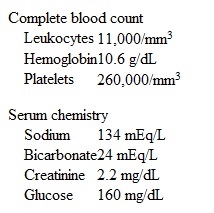 Troponin I is undetectable. Chest x-ray shows slight bibasilar atelectasis without focal consolidation, pleural effusion, or pulmonary edema. ECG shows sinus tachycardia but is otherwise unremarkable.
Which of the following is the most appropriate next step in management of this patient?
Troponin I is undetectable. Chest x-ray shows slight bibasilar atelectasis without focal consolidation, pleural effusion, or pulmonary edema. ECG shows sinus tachycardia but is otherwise unremarkable.
Which of the following is the most appropriate next step in management of this patient? (Multiple Choice)
4.7/5  (80)
(80) An 82-year-old woman comes to the office due to a day of low-grade fever and rash. Two days ago, the patient began having stabbing pain in her left flank. Over the following day, this area became itchy and red. The patient tried over-the-counter topical hydrocortisone and lidocaine but had no relief. She has a history of hypothyroidism, type 2 diabetes mellitus, rheumatoid arthritis, and osteoporosis. She was recently hospitalized for sepsis secondary to a urinary tract infection and discharged on oral ciprofloxacin that she completed yesterday. The patient has no history of drug allergy but noticed a "strange taste in my mouth" after taking ciprofloxacin. Her other medications include low-dose aspirin, alendronate, levothyroxine, glipizide, low-dose prednisone, calcium, and vitamin D supplementation. She does not smoke, consume alcohol, or use illicit drugs. Temperature is 37.8 C (100 F), blood pressure is 124/72 mm Hg, pulse is 92/min, and respirations are 14/min. Examination of her left flank shows bright patchy erythema, excoriations, and several fluid-filled blisters. The appropriate treatment was initiated. Over the next 24 hours, the patient has progressive pain in the area of the skin lesions and is admitted to the hospital for pain control. On reexamination, the rash has progressed and now also involves the right flank and lower back. The rash is patchy with bright red erythema and blisters without crusting. Which of the following is the most appropriate strategy to reduce the risk of exposure to health care personnel?
(Multiple Choice)
4.8/5 (82)
(82) A 25-year-old woman is brought to the emergency department after her boyfriend called police and reported that she was threatening to kill herself. They had been arguing when the woman suddenly grabbed a kitchen knife, waved it in the air, and threatened to stab herself. The patient says to the emergency physician, "I didn't mean what I said. This is all a big misunderstanding. I don't know why my boyfriend overreacted. We both had a little too much to drink tonight. I'm sure you know how that can get! I got upset when we were arguing and I just said something stupid. I have no intention of killing myself." The patient has no psychiatric history. She drinks socially and smokes marijuana. She does not use any other drugs or prescription medications. Vital signs are within normal limits. Examination shows no abnormalities. On mental status examination, the patient is alert with loud, slightly slurred speech. She says her mood is "fine" and denies any suicidal ideation, intent, or plan. The physician reassesses the patient several hours later. She says, "I am so embarrassed. I never should have said that. I lose control of myself when I am drunk." The patient explains that she and her boyfriend are having relationship difficulties and she is afraid that he will leave her. She reaffirms that she has never received any psychiatric treatment, although she took an intentional overdose of sleeping pills when she was 18 and wanted to die after breaking up with her boyfriend. The patient has a family history of depression and thinks that her maternal uncle may have committed suicide, although "my family never talks about it." She has been feeling depressed and describes difficulties with sleep and concentration. Her appetite is decreased and she has lost 3.17 kg (7 lb) over the past month. The patient works at a coffee shop and is a part-time student at a local community college. She is thinking of dropping out of school as she has no interest in the classes and her grades are poor. Apart from her boyfriend, she has few friends and is estranged from her family. Which of the following is this patient's strongest risk factor for suicide?
(Multiple Choice)
4.8/5 (75)
(75) A 53-year-old woman comes to the office with a 6-month history of pain and tightness in the neck, posterior shoulders, and buttocks. The pain is aggravated by exertion, stress, and lack of sleep. She also has fatigue and insomnia. The patient has had intermittent constipation but no other bowel or bladder problems or daytime somnolence. Vital signs are normal. Examination shows widespread symmetric tenderness to firm palpation over muscles and bony prominences. Spinal motion is normal. Strength is 5/5 and deep tendon reflexes are 2+ in all extremities. There are no sensory deficits, rashes, or areas of joint swelling or tenderness. Recent laboratory testing shows a normal complete blood count and erythrocyte sedimentation rate. Based on these findings, what is the most appropriate next step in evaluation of this patient?
(Multiple Choice)
4.9/5 (86)
(86) A 54-year-old Caucasian chef presents to clinic complaining about "a new problem with really bad dizziness." She says that when she first sat up in bed this morning, she suddenly felt very unstable and as if her body was spinning in space. She was overcome by nausea but did not vomit, and then the episode passed after approximately one minute. She had similar episode when she was working in the restaurant kitchen. She has not been ill recently or in contact with any ill people to her knowledge. Her past medical history is significant for mild chronic obstructive pulmonary disease and ulcerative colitis. Current medications include albuterol, prednisone, mesalamine, and ibuprofen. She has a remote thirty pack-year history of cigarette smoking and drinks alcohol only on social occasions. Her temperature is 36.8C (98F), blood pressure is 124/72 mm Hg (sitting) and 120/68 mm Hg (standing), pulse is 75/min, and respirations are 14/min. Positional nystagmus is noted on physical examination. Which of the following measures is the most appropriate course of action?
(Multiple Choice)
4.7/5 (67)
(67) An 11-month-old girl is brought to the physician with a rash on her abdomen and cheeks that is exacerbated by constant scratching. Her abdomen and cheeks are frequently itchy, red, and scaly. Crusted lesions are present sometimes. The rash has worsened this summer, especially after bathing. There is a family history of chronic, pruritic rashes in paternal cousins and allergy symptoms in the father. Her height and weight are both tracking along the 50th percentiles. Examination shows a blanching, erythematous, scaly rash on her abdomen, back, and face. Physical examination is otherwise normal. Her parents are very concerned about the rash. Which of the following is the most appropriate response?
(Multiple Choice)
4.8/5 (85)
(85) A 26-year-old man comes to the office accompanied by his wife, who says, "He needs help with a major anger problem that has been going on for years. Every time I talk to a man, he becomes irrationally angry and jealous. Whenever I am delayed due to traffic, he interrogates me about where I have been. Last week, we had a big fight because he accused me of being unfaithful when I had to work late." The patient says, "I'm only here because of my wife. I can't have her turning against me too, though I'm sure she wishes she were with someone else." The patient apologizes to his wife for his angry outbursts and attributes his behavior to being under stress at work. He feels that his boss treats him unfairly and that his coworkers might be "setting me up to look bad." He adds, "I had to leave my last job when I discovered that people were talking behind my back and the supervisor was deliberately giving me all the bad shifts." The patient has no significant medical or psychiatric history. He does not use alcohol or illicit drugs because he likes to "keep my head clear so I can anticipate when someone is trying to mess with me." He acknowledges feeling depressed and anxious about his work situation and that he sometimes can't sleep because "I am up at night thinking about my problems." The patient's maternal uncle was diagnosed with major depression and he thinks his maternal grandfather died in a "mental hospital." On examination, the patient is alert and guarded. Although non-spontaneous, he is cooperative in answering questions. He describes his mood as "down." He has no suicidal thoughts or auditory hallucinations. Which of the following is the most likely diagnosis?
(Multiple Choice)
4.8/5 (63)
(63) An 8-year-old girl is brought to the physician for abnormal behavior. She has been acting inappropriately, crying, and laughing without apparent reason for the past 2 weeks. At school, she was restless and easily distracted. Last week, her parents noted strange movements of the girl's hands that improved when she slept. On the day before presentation, her parents noticed rapid jerking movements of her face and feet. The girl has had minor, self-resolving upper respiratory infections but has otherwise been healthy. She takes no medications and her vaccinations are up-to-date. Examination shows an alert and cooperative girl with normal vital signs. Facial grimacing and tongue fasciculations are seen. The lungs are clear to auscultation and a II/VI holosystolic murmur is heard at the apex. When the girl speaks, distinct changes in the volume and pitch of her voice are noted. Muscular tone is mildly decreased globally. Pronator sign is positive, and the relaxation phase of the patellar reflex is delayed.
Which of the following is the most likely diagnosis?
(Multiple Choice)
4.8/5 (79)
(79) A 68-year-old man comes to the emergency department with persistent abdominal pain. Three days ago, the patient received a CT scan of the abdomen and pelvis for abdominal pain and was diagnosed with acute diverticulitis. Since then, he has taken ciprofloxacin and metronidazole, but his symptoms have not improved. The patient has continued nausea, decreased appetite, malaise, and constant left lower quadrant abdominal pain. He has a history of hypertension, hyperlipidemia, and gout. He is a former smoker and occasionally drinks alcohol. Several benign polyps were removed during a colonoscopy 8 years ago. Temperature is 38 C (100.4 F), blood pressure is 140/80 mm Hg, pulse is 102/min, and respirations are 18/min. Abdomen is soft and nondistended, with significant left lower quadrant tenderness but no rebound guarding. Bowel sounds are decreased. Rectal examination reveals left-sided tenderness and negative occult blood stool. Laboratory results are as follows: 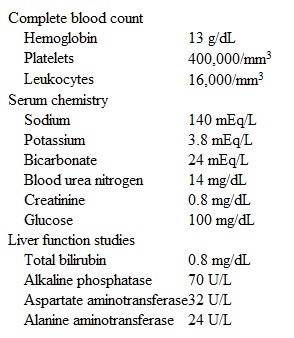 Which of the following is the best next step in management of this patient?
 (Multiple Choice)
4.9/5 (79)
(79) A 25-year-old man comes to the office with a 2-month history of fatigue, palpitations, sweating, and heat intolerance. The symptoms are becoming more distressing and are keeping the patient awake at night. The patient has no diplopia, eye pain or redness, decreased vision, neck pain, or proximal muscle weakness. Medical history is unremarkable, and he currently takes no medications. He smoked for approximately a year during college but quit after graduation. The patient drinks alcohol socially but does not use recreational drugs. Family history is positive for hypothyroidism in his mother. Temperature is 36.7 C (98 F), blood pressure is 130/70 mm Hg, pulse is 115/min (regular), and respirations are 18/min. Examination shows an anxious, thin man in no acute distress. There is mild lid lag but no conjunctival erythema or proptosis. Extraocular movements and pupillary reflexes are intact. Mild diffuse nontender enlargement of the thyroid gland is noted. The skin is warm and moist. Cardiac examination is unremarkable except for tachycardia. Neurologic examination shows a fine hand tremor and brisk symmetrical reflexes but is otherwise unremarkable. Laboratory tests show normal complete blood count, basic metabolic profile, and urinalysis. Thyroid function test results are as follows: 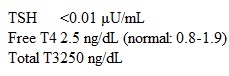 Radioactive iodine uptake at 24 hours is 36% (normal: 8%-25%), and scan shows a diffuse uptake pattern. Serum thyroid-stimulating immunoglobulin level is mildly elevated. Treatment options are explained to the patient. Six weeks later, he returns to the office and says that his symptoms have resolved. Blood pressure is 120/80 mm Hg and pulse is 82/min. Eye examination reveals no lid lag. The thyroid examination is unchanged, and the rest of the examination is unremarkable. Which of the following tests is most likely to be helpful in this patient?
 (Multiple Choice)
4.8/5 (82)
(82) A 25-year-old woman, gravida 1 para 0, comes to the office to establish prenatal care. The patient reports no nausea or vomiting, abdominal pain, or vaginal bleeding. However, over the past year, she has experienced progressive shortness of breath "during usual daily activities" and has noticed that her fingers turn blue with exertion. The patient has an unrepaired congenital ventricular septal defect and pulmonary hypertension, and has heart failure that is managed with diuretics. She had an episode of unprotected intercourse 2 months ago but is not currently sexually active. The patient does not use tobacco, alcohol, or illicit drugs. Blood pressure is 110/80 mm Hg, pulse is 104/min, and respirations are 24/min. Pulse oximetry shows 89% on room air. BMI is 23 kg/m2. A transvaginal ultrasound reveals a 6-week intrauterine gestation with a normal fetal heart rate. Recent echocardiogram showed an ejection fraction of 25%. The patient asks how her medical condition and pregnancy should be managed. Which of the following is the most appropriate recommendation?
(Multiple Choice)
4.7/5 (87)
(87) A 33-year-old woman comes to the office for a contraception prescription. The patient previously used oral contraceptive pills for menstrual regulation and acne treatment, but she frequently forgot to take them, resulting in an unintended pregnancy 2 years ago. During her pregnancy, she gained 36.3 kg (80 lb) and has been unable to return to her prepregnancy weight. Her postpartum course was complicated by severe postpartum depression requiring a brief hospitalization, and she does not want to become pregnant again. The patient has not been sexually active since the delivery but recently started a new relationship. She has no other chronic medical conditions and no previous surgeries. The patient has had normal routine Pap testing. Her menses occur every 45-90 days with 5-6 days of heavy bleeding and passage of large clots. The patient's mother has type 2 diabetes mellitus and her paternal grandmother had ovarian cancer. She does not use tobacco, alcohol, or illicit drugs. BMI is 33 kg/m2. Physical examination is normal. Serum chemistries, prolactin, and TSH levels are normal. Urine pregnancy test is negative. Pelvic ultrasound reveals a small anteverted uterus and multifollicular ovaries bilaterally. Which of the following is the best contraceptive option for this patient?
(Multiple Choice)
4.9/5 (73)
(73) A 54-year-old man comes to the office for a routine follow-up visit. He feels well and has had no ongoing symptoms but has noticed a slow increase in his weight over the past year. He says, "When the nurse weighed me around this time last year I was 74.8 kg (165 lb) and now I am 82.5 kg (182 lb). I don't know what's causing that; my diet hasn't changed." The patient was diagnosed with HIV a year ago and initiated on antiretroviral therapy, which improved his CD4 count and viral load. He has no other chronic medical problems and has tested negative for hepatitis B and C viruses. His father had coronary artery disease and died of a myocardial infarction at age 55. The patient has a 28-pack-year smoking history and continues to smoke a pack of cigarettes daily. He used intravenous drugs in the past but is currently not using alcohol or illicit drugs. Temperature is 36.5 C (97.7 F), blood pressure is 112/72 mm Hg, pulse is 76/min, and respirations are 16/min. BMI is 26.9 kg/m2. There is adipose tissue deposition on the back of the neck. Abdominal examination reveals increased girth without a substantial increase in subcutaneous fat and palpable hepatomegaly with a soft, nontender liver edge. No striae, bruising, or skin atrophy are present.
Which of the following is most likely to be associated with this patient's condition?
(Multiple Choice)
4.8/5 (94)
(94) A 48-year-old man comes to the office for intractable lower extremity bone pain. He has end-stage renal disease due to focal segmental glomerulosclerosis and has been on hemodialysis 3 times a week for the past 4 years. Approximately 3 months ago, adjustments in his medications and hemodialysis regimens were made after the patient was found to have high serum calcium, phosphorus, and parathyroid hormone levels; however, these adjustments did not lead to any significant improvements in laboratory values. Temperature is 36.9 C (98.4 F), blood pressure is 190/100 mm Hg, and pulse is 88/min. Oral examination shows pallor of the mucous membranes. Lungs have decreased sounds at both bases. Cardiovascular examination shows a 2/6 systolic ejection murmur at the left upper sternal border and a palpable thrill over an arteriovenous fistula in the left forearm. Laboratory results are as follows: 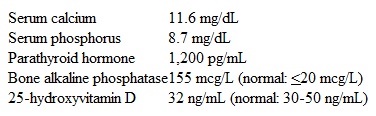 Chest x-ray reveals cardiomegaly with calcification of the ascending aorta. Which of the following treatments would be most beneficial for this patient's current condition?
 (Multiple Choice)
5.0/5 (89)
(89) A 2-year-old girl is brought to the emergency department due to sudden refusal to move her right arm for the past hour. Her mother says that this started immediately after she grabbed her daughter by the right wrist to prevent her from falling out of a chair, but there was no other trauma. The patient is an active girl who likes to run and play at the beach and playground. She takes no medications and her vaccinations are up to date. The girl lives with her parents, who work at home as writers. She does not attend day care or have other caregivers. Temperature is 36.7 C (98 F) and pulse is 94/min. On physical examination, the girl holds her right arm close to her body with the forearm pronated. No swelling or focal point tenderness of her upper extremities is elicited, but she winces when supination of her right arm is attempted. Radial pulse is 2+ bilaterally, and there is no pallor, cyanosis, or ecchymosis. Which of the following is the most appropriate next step in management of this patient?
(Multiple Choice)
4.9/5 (86)
(86) A 25-year-old man comes to the employee health center for a physical examination prior to starting work as a patient care technician in a community hospital. The patient's family immigrated to the United States from Eastern Europe when he was a toddler. He received a medical evaluation prior to immigrating, but the records are not available. The patient has had no fevers, chills, night sweats, weight loss, cough, or fatigue. He has no chronic medical problems and takes no medications. He consumes alcohol occasionally but does not use tobacco or illicit drugs. The patient went on a 2-month backpacking trip through Central and South America a year ago. His immunization records are up to date. He has a small scar in the right deltoid area and notes that he received a bacillus Calmette-Guérin vaccination as an infant. The patient has no other abnormalities on physical examination. The patient's interferon-gamma release assay (IGRA) is positive. He is asymptomatic and feels well. Chest x-ray reveals no abnormalities. Which of the following is the next most appropriate step in management of this patient?
(Multiple Choice)
4.7/5 (68)
(68) A 64-year-old man comes to the emergency department due to 2 days of nausea, vomiting, and abdominal distension. The patient has no abdominal pain. He has hypertension, hypercholesterolemia, coronary artery disease, and congestive heart failure. The patient also has chronic back pain due to a compression fracture 6 months ago. Medications include aspirin, oxycodone, furosemide, losartan, vitamin D, calcium gluconate, and simvastatin. Temperature is 36.7 C (98 F), blood pressure is 130/70 mm Hg, and pulse is 92/min. The abdomen is distended but soft and nontender. There is no rebound tenderness or rigidity. Bowel sounds are decreased. There is 1+ peripheral edema. Laboratory results are as follows: 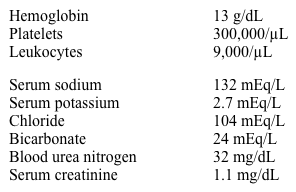 An electrocardiogram (ECG) shows normal sinus rhythm. Abdominal x-rays show diffuse bowel distension with a gas pattern in the colon and rectum. Which of the following is the most appropriate next step in management of this patient?
 (Multiple Choice)
4.8/5 (84)
(84) A 74-year-old woman is brought to the emergency department from a skilled nursing facility due to a positive stool PCR test for Clostridioides difficile. The patient was discharged from the hospital to the nursing facility 10 days ago after treatment for urinary tract infection and septic shock. She developed C difficile-associated diarrhea during the hospitalization and completed a course of oral fidaxomicin therapy 3 days ago. This treatment resolved the diarrhea, nausea, and abdominal pain; yesterday, the patient had an episode of bloating, nausea, and loose stool after a meal at the nursing facility, prompting repeat stool testing. Since then, she has had no additional abdominal pain, nausea, vomiting, or diarrhea. Other medical conditions include hypertension, hyperlipidemia, ischemic stroke with residual left hemiparesis, and gastroesophageal reflux. Temperature is 37 C (98.6 F), blood pressure is 130/68 mm Hg, and pulse is 84/min. The abdomen is soft, nondistended, and nontender, with normoactive bowel sounds in all quadrants. Rectal examination shows soft, brown stool negative for occult blood. Leukocyte count is 7,100/mm3.
The patient has no diarrhea or other gastrointestinal symptoms while in the emergency department. Prior to discharge, she asks if there is any way to prevent Clostridioides difficile-associated diarrhea in the future. In addition to minimizing antibiotic use, which of the following is most likely to prevent recurrent episodes of the disease in this patient?
(Multiple Choice)
4.8/5 (62)
(62) A 62-year-old man comes to the office for follow-up after recent hospitalization. Two weeks ago, the patient went to the emergency department due to a 3-day history of fever, chills, dysuria, urinary frequency, and low back pain. Evaluation showed a tender and swollen prostate, leukocytosis, pyuria, and bacteriuria. Treatment for acute bacterial prostatitis was begun with intravenous antibiotics. Blood and urine cultures returned positive for Escherichia coli sensitive to all tested antibiotics. The patient was discharged after clinical improvement and was prescribed oral ciprofloxacin. He has had no fever, and urinary symptoms have resolved, but over the last 2 days, he has had mild abdominal cramps and 4 or 5 watery bowel movements per day with no blood or mucus. Other medical conditions include hypertension and type 2 diabetes mellitus. On examination, the patient is afebrile, and other vital signs are within normal limits. There is mild periumbilical tenderness, but physical examination is otherwise unremarkable. Laboratory studies show a leukocyte count of 14,500/mm3 and serum creatinine level of 0.9 mg/dL. Stool testing is positive for Clostridioides difficile.
The patient returns to the office 3 weeks later and says that he took oral fidaxomicin as prescribed but stopped a week ago after the abdominal cramps and diarrhea improved. Since yesterday, he has had intermittent lower abdominal discomfort and several episodes of watery bowel movements. The patient reports no urinary symptoms and continues to take trimethoprim-sulfamethoxazole for the prostatitis. Temperature is 37.2 C (99 F), blood pressure is 122/80 mm Hg, and pulse is 85/min. Physical examination shows mild tenderness in the left lower quadrant with no guarding or rebound tenderness and normal bowel sounds. Laboratory studies show a leukocyte count of 14,300/mm3. Which of the following is the most likely cause of this patient's symptoms?
(Multiple Choice)
4.9/5 (86)
(86) A 10-year-old girl is brought to the emergency department for evaluation of a bite wound. Last night, the girl had a fight with her 12-year-old stepbrother, who bit her on the forearm. This morning, the girl's arm "looks worse." The stepbrother is HIV-positive and acquired it from his mother at birth. He takes antiretroviral therapy; his most recent CD4 count was 1100 cells/µL, and his HIV viral load was undetectable. The patient has no known medical problems, and takes no medications. Her vital signs are normal. Examination shows 2 deep puncture wounds on the left forearm. There is warmth, erythema, and swelling around the bite marks. The skin is mildly tender to palpation. No fluctuance is palpated. The wound is irrigated thoroughly with saline and local wound care is provided. Which of the following is the most appropriate next step in management of this patient?
(Multiple Choice)
4.8/5 (97)
(97) Showing 481 - 500 of 1121

Filters
- Essay(0)
- Multiple Choice(0)
- Short Answer(0)
- True False(0)
- Matching(0)