



 Chat with AI
Exam 1: Advanced Clinical Medicine

Exam 1: Advanced Clinical Medicine1 k+ Questions
Exam 2: Foundations of Independent Practice597 Questions
Select questions type


A 46-year-old woman with a history of hypertension and type 2 diabetes mellitus is traveling out of state for work. While out jogging, she slips and falls and fractures her ankle. The patient belongs to an employer-sponsored private health insurance plan which has an annual deductible of $3,000. Prior to this incident, she had paid $3,000 this year to other health care providers for covered health care expenses. The patient visits an in-network urgent care provider, where she receives an x-ray, an injection of pain medication, and a cast on her injured ankle. Three months later, the patient receives a bill from the urgent care facility stating that she owes $1,000 for services rendered. Which of the following is most accurate?
(Multiple Choice)
4.8/5  (84)
(84) A 67-year-old man comes for follow-up of coronary artery disease. He is currently feeling well. Three months ago, he was hospitalized for chest pain; coronary angiography revealed 85% narrowing in the mid right coronary artery, and a drug-eluting stent was placed. In addition, TSH was noted to be low. The patient now walks 2-3 miles a day without angina, dyspnea, or lower extremity claudication. He states, "I am very happy that I lost 5 lb since my hospitalization. I also gave up smoking and drinking. I feel like I got my life back." Current medications include aspirin, clopidogrel, metoprolol, lisinopril, and atorvastatin. The patient's father died from a heart attack at age 56, and his mother has osteoporosis and hypertension. Blood pressure is 134/76 mm Hg and pulse is 65/min. BMI is 28 kg/m2. Physical examination, including examination of the thyroid gland, is normal. Repeat thyroid function results are as follows: 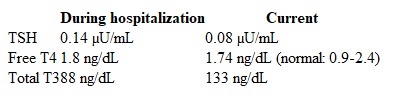 Radioactive iodine uptake is increased, with a homogeneous distribution on thyroid scan. Which of the following is the most appropriate management for this patient?
 (Multiple Choice)
4.8/5 (76)
(76) A 26-year-old woman is brought to the emergency department due to lower abdominal pain for the past 2 days. She reports intractable nausea and vomiting over the last day, but has no fever, chills, sick contacts, or diarrhea. She recently had an hCG injection in preparation for an egg retrieval for infertility treatment. The patient has a history of polycystic ovarian syndrome and has had no surgeries. Family history is noncontributory. She takes a daily prenatal vitamin and does not use tobacco, alcohol, or illicit drugs. Blood pressure is 90/50 mm Hg and pulse is 110/min. BMI is 35 kg/m2. Physical examination shows a distended abdomen with normal bowel sounds and diffuse lower abdominal tenderness to deep palpation. There is no rebound, guarding, or costovertebral angle tenderness. Urine pregnancy test is positive. Transvaginal ultrasound shows bilateral ovarian enlargement with multiple cysts measuring up to 8 x 8 cm and intraabdominal fluid consistent with ascites. Doppler shows preserved blood flow to both ovaries. Which of the following is the most likely cause of this patient's condition?
(Multiple Choice)
4.9/5 (83)
(83) A 4-year-old boy is brought to the emergency department by his mother due to refusing to walk since this morning. The patient started having right groin pain 2 days ago after T-ball practice, and his mother noticed him "walking funny" yesterday. She says, "I had to carry him here because he says it hurts too much to walk." The mother has witnessed no recent falls or injuries, and the symptoms have not improved with acetaminophen. The patient has had upper respiratory symptoms for the last 2 weeks and was diagnosed with viral pharyngitis a week ago. He has a history of atopic dermatitis that is controlled with low-dose topical corticosteroids. Immunizations are up to date. He takes no medications and has no known allergies. Temperature is 38.6 C (101.5 F). The patient appears tired but nontoxic. The posterior pharynx is clear and without exudates. The lungs are clear to auscultation. On examination of the right hip, the patient cries and resists passive movement. There is decreased range of motion of the right hip. Dry, erythematous patches are noted on the bilateral forearms. Laboratory findings show a white blood cell count of 14,000/mm3 and a C-reactive protein of 4.0 mg/L (normal: <3.0 mg/L). Which of the following is the best next step in management of this patient's condition?
(Multiple Choice)
4.9/5 (86)
(86) A 32-year-old woman, gravida 3 para 2, at 38 weeks gestation is admitted to labor and delivery for contractions and vaginal spotting. The patient reports good fetal movement and no rupture of membranes. Her last prenatal visit was at 18 weeks gestation. She has no medical problems or previous surgeries. Her first 2 pregnancies ended in uncomplicated vaginal deliveries. The patient takes a prenatal vitamin daily. She smoked cigarettes occasionally prior to this pregnancy but does not use alcohol or illicit drugs. Temperature is 36.7 C (98 F), blood pressure is 110/80 mm Hg, and pulse is 76/min. The fetal heart rate tracing shows a baseline of 140/min, moderate variability, good accelerations, and no decelerations. The tocometer shows contractions every 3 minutes. On pelvic examination, several flesh-colored, hyperkeratotic papules are noted on the posterior introitus, labia majora, and labia minora. The papules are 1-2 cm in diameter, have a smooth surface, and are sessile. The cervix is 5 cm dilated and 90% effaced. The patient's sexually transmitted infection screen at her initial prenatal visit was negative. Which of the following is the best next step in management of this patient?
(Multiple Choice)
4.9/5 (72)
(72) A 3-year-old boy is brought to the emergency department by his parents due to fatigue and refusal to eat. His family recently arrived in the United States from Syria. He has had watery diarrhea for the past several days but no fevers or vomiting. His appetite has been decreased for several weeks. Today, he has refused to eat but has drunk a few cups of water and juice. Limited medical records show that tuberculosis skin testing was negative and catch-up vaccines were administered at the time of immigration. Temperature is 36.1 C (97 F), blood pressure is 100/65 mm Hg, pulse is 100/min, and respirations are 22/min. Height is 91 cm (36 in) and weight is 12 kg (26 lb 8 oz), corresponding to the 10th and 5th percentiles, respectively. Physical examination shows a gaunt, tired-appearing boy. Oral mucous membranes are dry but without ulcers or thrush. He has bilateral pitting edema of the lower extremities, and his upper extremities have minimal subcutaneous fat. A soft, vibratory heart murmur is heard on auscultation. The lungs have no adventitious sounds. The abdomen is mildly distended but otherwise soft and nontender. Initial laboratory results are as follows: 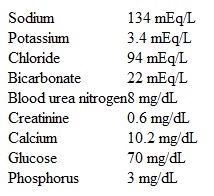 Stool occult blood test is negative. Which of the following is the most appropriate initial step in management of this patient?
 (Multiple Choice)
4.8/5 (73)
(73) A 69-year-old man with chronic kidney disease comes to the office to discuss options for dialysis. The patient wishes to choose the dialysis modality that will allow him to live the longest. The following Kaplan-Meier survival curve is obtained from a prospective study on the survival of 1800 patients who began dialysis with either hemodialysis (HD) or peritoneal dialysis (PD) and were followed for 5 years. The event of interest was death while on dialysis. 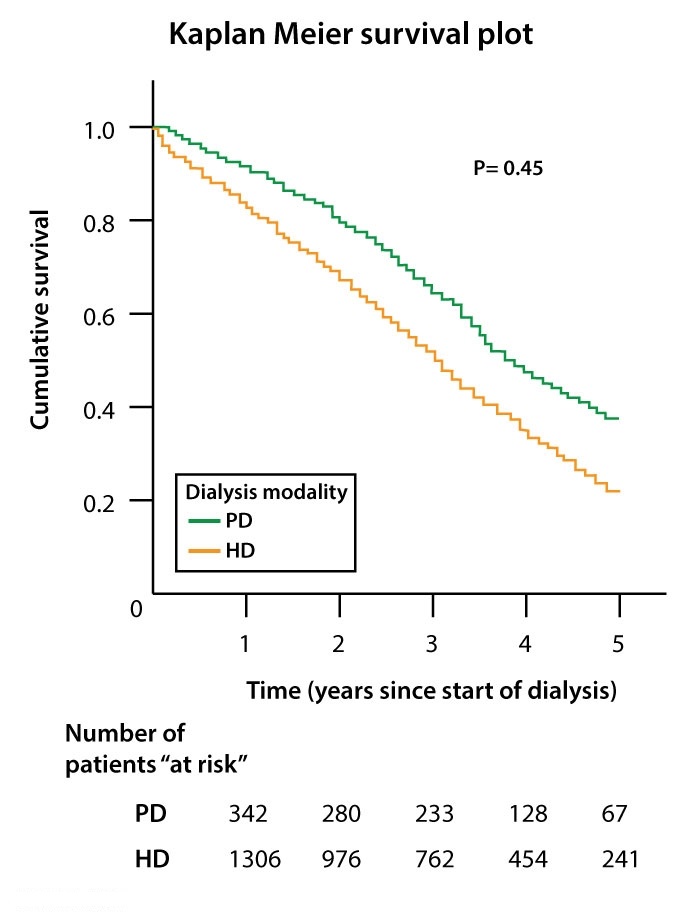 Based on the findings of this study, which dialysis option offers improved survival?
 (Multiple Choice)
4.9/5 (69)
(69) A randomized study assigned patients with sickle cell anemia and silent stroke to either monthly transfusion therapy (transfusion group of 110 patients) or usual care (observation group of 105 patients). An excerpt of the study results is provided below: Which of the following adverse event estimates is most subject to selection bias?
(Multiple Choice)
4.8/5 (90)
(90) A 24-year-old woman has a 2.1-cm nodule in her right thyroid lobe. She is otherwise healthy and takes no medications. The patient has no past history of radiation exposure or family history of thyroid disease. She does not experience pain, difficulty swallowing, or voice changes. Physical examination is within normal limits. Laboratory studies show normal T3, T4, and TSH levels. An ultrasound of the thyroid gland reveals a solid nodule measuring 2.6 x 1.7 x 1.3 cm in the right lobe. The left lobe appears to be normal in size and echotexture.
Which of the following is the best next step in the management of this patient?
(Multiple Choice)
4.9/5 (76)
(76) A biomedical research company creates 2 similar real-time, nondestructive cancer diagnostic devices (X and Y) in the form of a pen. The pens are applied to the tissue surface for a few seconds, during which time each pen releases a single water droplet onto the tissue. The water droplet, which picks up small biomolecules from the tissue, is then sucked back into the pen and transferred via tubing to a mass spectrometer. The spectrometer performs a quick molecular analysis and determines whether the tissue is normal (noncancerous) or abnormal (cancerous). The devices allow surgeons to know which tissue to remove and which not to remove. The performance of Devices X and Y was compared using the same samples of tissue. The biomedical research company reported that, compared to Device Y, Device X is better at identifying cancerous tissue as abnormal but worse at identifying noncancerous tissue as normal. Based on this information, which of the following conclusions about the diagnostic devices must be true?
(Multiple Choice)
4.8/5 (87)
(87) A 43-year-old man comes to the office with his wife for evaluation of his snoring. His wife reports that he snores loudly most nights and keeps her awake, but she has not observed him choke, gasp, or stop breathing while asleep. The patient is unaware of his snoring and reports no morning headaches, memory loss, or poor concentration. He occasionally falls asleep after lunch while seated at his desk. He reports no fatigue, weight gain, or constipation. His medical problems include seasonal allergies and hypothyroidism. The patient's medications include intranasal fluticasone and levothyroxine. He drinks 12-24 ounces of beer daily, usually 1-2 hours before going to bed. He does not use tobacco or illicit drugs. Both his parents have hypertension. Temperature is 36.8 C (98.2 F), blood pressure is 125/75 mm Hg, pulse is 65/min, and respirations are 16/min. BMI is 26 kg/m2 and neck circumference is 39.4 cm (15.5 in). Physical examination reveals an alert, oriented, and cooperative man in no distress. Oropharyngeal examination is normal. No nasal polyps or septal deviation is seen, and the nares are normal in appearance. Cardiac examination reveals normal first and second heart sounds and no jugular venous distension. The lung fields are clear bilaterally. No edema or rashes are present. Laboratory results are as follows: 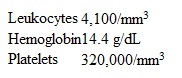 Which of the following is the best next step in management of this patient?
 (Multiple Choice)
4.9/5 (70)
(70) A 50-year-old obese man comes to the emergency department with toe pain. He awoke this morning with sudden severe pain in his left great toe. He has never had this type of pain before and has had no trauma to the toe. The patient has a history of hypertension treated with hydrochlorothiazide. He also has osteoarthritis in his right knee that was treated with an intraarticular steroid injection 6 months ago. He smokes a pack of cigarettes and drinks 1 or 2 glasses of wine daily. His temperature is 36.7 C (98.1 F), blood pressure is 130/80 mm Hg, pulse is 88/min, and respirations are 12/min. The patient's left great toe is inflamed, with swelling and erythema at the metatarsophalangeal joint. There is pain with minimal range of motion. There are no skin rashes. The remainder of the examination is within normal limits. The diagnosis of acute gout is made. Which of the following is the preferred treatment for the patient at this time?
(Multiple Choice)
4.9/5 (78)
(78) A 12-month-old girl is brought to the emergency department by ambulance for evaluation of a generalized tonic-clonic seizure. About 1 hour ago, the mother witnessed rhythmic jerking of the patient's arms and legs and called 911. By the time the paramedics arrived, the jerking had stopped, lasting a total of 7 minutes. She was born at 32 weeks gestation but has no chronic medical conditions. Her maternal uncle had seizures as a child. Temperature is 40 C (104 F), blood pressure is 100/65 mm Hg, pulse is 150/min, and respirations are 30/min. The patient appears drowsy but is in no distress. The anterior fontanelle is open, soft, and flat. The neck is supple. Cardiopulmonary examination is normal. She is difficult to rouse but withdraws from painful stimuli. Skin examination appears normal. Which of the following is this patient's indication for lumbar puncture?
(Multiple Choice)
4.8/5 (95)
(95) A 60-year-old Caucasian male presents to your office because of recent onset dyspnea on exertion. He is physically active, but his dyspnea now restricts his physical activities. He can hardly climb a flight of stairs without having to stop to rest. He denies any chest pain, palpitations, leg swelling and loss of consciousness. He has frequent coughing, sometimes with yellowish or greenish sputum. He has been smoking one-and-half to two packs of cigarettes daily for the last 35 years. He does not consume alcohol. He is currently not taking any medications. The physical examination is significant for bilateral scattered expiratory wheezes. Pulmonary function testing shows the following findings (as percentage of predicted values): 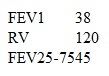 His airway response to bronchodilators is poor. What is the best indicator of this patient's poor prognosis?
 (Multiple Choice)
4.8/5 (90)
(90) A 6-year-old girl is brought to the clinic due to a prolonged cough. The patient started having rhinorrhea 6 weeks ago. A week later, she developed a cough with occasional expectoration of whitish sputum; the rhinorrhea resolved at that time. For the past 5 weeks, the patient's cough has continued throughout the day and night, occasionally awakening her and with no improvement. Her father tried using a humidifier, with no relief of her symptoms. The patient has been afebrile and has had no vomiting, abdominal pain, diarrhea, or sick contacts. She takes no daily medications. Immunizations are up to date. The patient's mother has atopic dermatitis. Height and weight are at the 25th percentile. Temperature is 36.7 C (98 F) and respirations are 24/min. The patient is awake, alert, and playing. Tympanic membranes are normal. The tonsils are normal, the mucous membranes are moist, and the lips are pink. Cardiac examination has a normal rate and rhythm. The lungs are clear to auscultation bilaterally; no retractions or use of accessory chest muscles are present. Which of the following is the best next step in evaluation of this patient?
(Multiple Choice)
4.8/5 (76)
(76) A 61-year-old man comes to the emergency department because of severe pain in his right knee over the last 12 hours. He also has had malaise and low-grade fever. He has not had any trauma. He has peptic ulcer disease, type 2 diabetes mellitus, hypertension, and chronic renal insufficiency. He was hospitalized one year ago for upper gastrointestinal bleeding that required a blood transfusion. He has smoked one pack of cigarettes daily for 40 years. He describes himself as a "heavy drinker." Temperature is 37.9 C (100.1 F), blood pressure is 152/87 mm Hg, and pulse is 96/min. BMI is 32 kg/m2. Examination shows a swollen, warm, and tender right knee. Laboratory results are as follows: 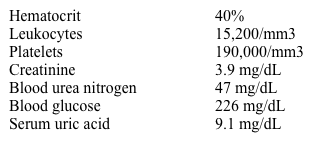 Aspiration of the knee joint is performed. Compensated, polarized, light microscopic analysis of the aspirate shows intracellular needle-shaped, negatively birefringent crystals. Gram staining of the synovial fluid shows no bacteria. Which of the following is the most appropriate next step in management?
 (Multiple Choice)
4.8/5 (75)
(75) A 27-year-old woman comes to the office for a routine medical examination. She reports feeling well since her last appointment a year ago. The patient is sexually active with her boyfriend of 5 years. They are monogamous and use condoms consistently for contraception. She has had no malodorous vaginal discharge or abnormal uterine bleeding. Previous Pap tests were normal. The patient describes her relationship with her boyfriend as stable, although they fight about money and she wishes that he were more supportive. She is unhappy with her job as a waitress and would like to go back to school someday. The patient smokes marijuana about once a week and does not use tobacco or other illicit substances. She has 2 mixed drinks and a couple of beers when socializing with friends after work. The patient denies depression and has no suicidal ideation. Temperature is 36.9 C (98.4 F), blood pressure is 118/78 mm Hg, pulse is 76/min, and respirations are 14/min. Pelvic examination reveals clear cervical discharge throughout the vaginal vault; a Pap test is obtained. Which of the following is the most appropriate next step in management of this patient?
(Multiple Choice)
5.0/5 (56)
(56) A 72-year-old man comes to a rural health clinic due to intermittent leg pain. The patient reports a dull discomfort in his left lower calf with activity, causing him to stop and rest on the way to his mailbox, which is approximately 150 m (492 ft) from his house. The pain improves with rest and does not occur at night when he is lying in bed. Medical history is significant for hypertension and gout. Current medications include lisinopril and allopurinol. The patient has a 40-pack-year smoking history, but quit 5 years ago. Family history is significant for a stroke in his father and breast cancer in his mother. Blood pressure is 130/78 mm Hg and pulse is 75/min. The patient's left foot is shiny and devoid of hair, but there are no lower extremity ulcerations. Strength and sensory examination of the left lower extremity is normal. The ankle-brachial index is 0.76 on the left and 1.05 on the right (normal: 1.0-1.4). Laboratory results are as follows:
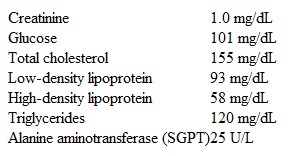 Following medication adjustment, the patient is sent for CT angiography that shows 90% stenosis of the left superficial femoral artery and 80% stenosis of the left popliteal artery. Which of the following is the best additional recommendation for this patient?
 (Multiple Choice)
5.0/5 (78)
(78) A 54-year-old man with new-onset type 2 diabetes mellitus comes to the physician for his first screening ophthalmologic examination. He has no eye symptoms and describes his vision as excellent. He does not smoke. His family history is significant for obesity and diabetes but negative for cancer. Funduscopic examination shows a small, densely pigmented lesion with irregular borders in the peripheral right choroid. The lesion is about 8 mm in diameter and is minimally raised (1 mm). Comprehensive skin examination is unremarkable.
Which of the following should be the next step in the management of this patient?
(Multiple Choice)
4.8/5 (87)
(87) A 48-year-old man with alcoholic cirrhosis is brought to the emergency department due to 2 days of progressive drowsiness and lethargy. Several months ago, the patient had similar symptoms that improved after treatment with lactulose. He has had no nausea, vomiting, hematemesis, or melena. The patient was diagnosed with cirrhosis a year ago and required endoscopic ligation of esophageal varices at that time. Current medications include furosemide, spironolactone, and lactulose. The patient has been abstinent from alcohol for the past year, takes his medications regularly, and does not use tobacco or illicit drugs. Temperature is 37.2 C (99 F), blood pressure is 110/60 mm Hg, and pulse is 86/min. He is somnolent but wakes up to voice and follows instructions. Physical examination reveals mild scleral icterus, dry mucous membranes, and several spider angiomas on the upper chest. The lungs are clear to auscultation, and heart sounds are normal with no murmur. The abdomen is distended with shifting dullness, and there are dilated veins around the umbilicus. No abdominal tenderness is present. Rectal examination reveals negative occult blood stool. A flapping tremor of both hands is present, but there are no other focal neurologic deficits. Laboratory results are as follows: 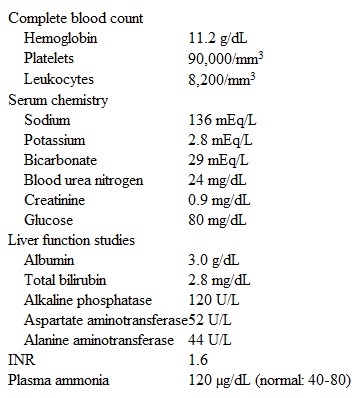 Which of the following is the next best step in management of this patient?
 (Multiple Choice)
4.8/5 (89)
(89) Showing 501 - 520 of 1121

Filters
- Essay(0)
- Multiple Choice(0)
- Short Answer(0)
- True False(0)
- Matching(0)