



 Chat with AI
Exam 1: Advanced Clinical Medicine

Exam 1: Advanced Clinical Medicine1 k+ Questions
Exam 2: Foundations of Independent Practice597 Questions
Select questions type


A 67-year-old man comes to the emergency department due to cough with greenish sputum production and increased shortness of breath over the last 4 days. His medical history includes chronic obstructive pulmonary disease treated with tiotropium and budesonide/formoterol. The patient reports increased use of albuterol to 4 times a day. Two months ago, his FEV1 to FVC ratio was 55% of predicted and diffusing capacity of the lungs for carbon monoxide was within normal limits. Today, the patient's blood pressure is 152/90 mm Hg, pulse is 108/min, respirations are 22/min, and pulse oximetry shows 88% on room air. He is in mild respiratory distress with some accessory muscle usage and can speak in short sentences. Chest auscultation reveals prolonged expiration with bilateral wheezes. Arterial blood gas on room air shows pH 7.35, PaCO2 44 mm Hg, and PaO2 55 mm Hg. Pulse oximetry improves to 95% after he is placed on supplemental oxygen at 5 L/min. Which of the following mechanisms best explains this patient's improvement in oxygen saturation following oxygen supplementation?
(Multiple Choice)
4.7/5  (87)
(87) A 25-year-old woman, gravida 1 para 1, comes to the office for evaluation of fever and right breast pain. The patient is 2 weeks postpartum after an uncomplicated pregnancy and vaginal delivery. She has been breastfeeding every 2-3 hours; however, the infant has had difficulty with latching due to the mother's inverted nipples. Yesterday, the patient developed constant sharp pain in the side of her right breast as well as fever, chills, nausea, and body aches. The pain is worsening, especially during breastfeeding. She has been taking acetaminophen and ibuprofen with minimal relief. The patient has no chronic medical conditions. She is on maternity leave from her engineering job. The patient has no drug allergies and is taking a daily prenatal vitamin. Temperature is 38.9 C (102 F), blood pressure is 110/70 mm Hg, and pulse is 100/min. Examination reveals the upper outer quadrant of the right breast to be erythematous, tender, and swollen but without fluctuance. The left breast has no erythema or tenderness. The patient returns to the office the next day with worsening symptoms. She has a family history of breast cancer and is very concerned about the pain. Temperature is 39.4 C (103 F), blood pressure is 100/70 mm Hg, and pulse is 114/min. Examination shows persistent swelling and erythema in the upper outer quadrant of the right breast in addition to a palpable area of induration. Which of the following is the best next step in management of this patient?
(Multiple Choice)
4.7/5 (82)
(82) A 50-year-old male comes in to the emergency department complaining of unremitting pain in an area of his right buttock near the anus. Although he is uncertain when the discomfort first began, he notes that the pain has increased significantly over the past 24 hours. He finds he is unable to pass stool because of the pain. He has not experienced symptoms like this before. Ten years ago, he was diagnosed with diabetes mellitus. He is currently on insulin. He smokes half a pack of cigarettes per day but would like to quit. He denies drinking alcohol or using recreational drugs. His temperature is 38.1C (100.6F), blood pressure is 128/86 mm Hg, and pulse is 90/min. There is a hot, tender, mass located between the anus and the left ischial tuberosity. The mass fluctuates upon palpation.
The patient is treated appropriately. To minimize risk of complications, he is advised to promptly schedule a follow-up visit with his primary care physician. Patients with anal abscesses are at greatest risk of developing which of the following conditions?
(Multiple Choice)
4.8/5 (64)
(64) A 31-year-old woman, gravida 1 para 0, at 14 weeks gestation comes to the office to establish prenatal care. She has had some nausea but no vomiting, abdominal pain, or vaginal bleeding. The patient contracted HIV through intravenous heroin use. She was diagnosed 3 years ago while hospitalized for drug rehabilitation. The patient is on triple-combination antiretroviral therapy with no significant side effects. She has no other chronic medical conditions and has had no previous surgeries. In addition to her HIV medications, the patient takes a daily prenatal vitamin. She does not use tobacco or alcohol and has not used illicit drugs since rehabilitation. Temperature is 36.7 C (98.1 F), blood pressure is 110/60 mm Hg, and pulse is 65/min. BMI is 24 kg/m2. Pelvic examination reveals a 14-week-sized nontender uterus with no adnexal masses. Laboratory results are as follows:
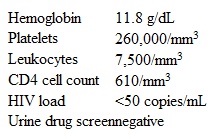 Bedside ultrasound reveals a 14-week intrauterine pregnancy with a normal heart rate.
The patient is compliant with highly active antiretroviral therapy (HAART) throughout pregnancy. She continues to abstain from tobacco, alcohol, and illicit drugs. The patient has an uncomplicated delivery at 38 weeks gestation and indicates that she would like to breastfeed her child. Which of the following is the most appropriate recommendation?
Bedside ultrasound reveals a 14-week intrauterine pregnancy with a normal heart rate.
The patient is compliant with highly active antiretroviral therapy (HAART) throughout pregnancy. She continues to abstain from tobacco, alcohol, and illicit drugs. The patient has an uncomplicated delivery at 38 weeks gestation and indicates that she would like to breastfeed her child. Which of the following is the most appropriate recommendation? (Multiple Choice)
4.9/5 (72)
(72) A 26-year-old man comes to the office for a new patient visit. Three months ago, he was seen at an urgent care clinic for excessive thirst and frequent urination. Laboratory evaluation at that time revealed blood glucose of 384 mg/dL, normal anion gap, and hemoglobin A1c of 11.4%. Several medications were prescribed, but the patient was able to afford only regular insulin. He has been taking the insulin before meals, which has improved symptoms. Home fingerstick glucose readings have usually been at 100-300 mg/dL but have dropped as low as 65 mg/dL after he skipped a meal. The patient has complied with a diabetic dietary regimen but sometimes eats "junk food" when busy at work. Medical history is otherwise unremarkable. The patient's mother and sister have hypothyroidism, and his father died at a young age from a motor vehicle collision. There is no family history of diabetes mellitus. The patient is employed as a construction worker and does not use alcohol, tobacco, or illicit drugs. Blood pressure is 127/78 mm Hg and pulse is 76/min. BMI is 24 kg/m2 and waist circumference is 83.8 cm (33 in). Physical examination, including monofilament testing of the feet, is normal. Laboratory results are as follows: 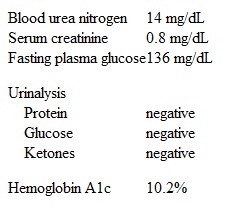 The patient is referred for financial assistance and is now able to afford diabetes-related care. Which of the following is the most appropriate next step in management of this patient?
 (Multiple Choice)
4.9/5 (85)
(85) A 2-year-old boy is brought to the office for follow-up. He was last seen 3 weeks ago for an episode of acute otitis media with symptoms of fever, crankiness, runny nose, and ear pain. Prior to this, he was healthy with no chronic medical conditions and with growth and developmental milestones appropriate for age. Examination at that time showed copious clear rhinorrhea and a bulging, erythematous right tympanic membrane. The patient was prescribed a 10-day course of amoxicillin. His mother reports that he has completed the course and his symptoms have improved: Fever has resolved, he no longer is cranky or indicates ear pain, and his appetite and activity level have returned to baseline. He has had occasional nasal congestion but no cough. Temperature is 36.7 C (98 F), pulse is 106/min, and respirations are 18/min. The patient is awake, alert, and in no acute distress. The head is normocephalic and atraumatic. The pupils are equal and reactive with normal fundi. The nares are patent with clear rhinorrhea; there is no erythema or exudate in the pharynx. The left tympanic membrane is normal; the right tympanic membrane is slightly retracted with yellow fluid behind the membrane and decreased mobility on pneumatic otoscopy. The neck is supple without lymphadenopathy. S1 and S2 are normal without murmurs. The lungs are clear to auscultation bilaterally. There are no rashes or skin lesions. What is the most appropriate next step in management of this patient?
(Multiple Choice)
4.9/5 (86)
(86) A 74-year-old woman is brought to the emergency department with fever, chills, and shortness of breath. Two days ago, she choked while having tea and doughnuts and almost lost consciousness. Her son performed the Heimlich maneuver. The patient has advanced Alzheimer dementia, and her son is her health care proxy and primary caregiver; her 73-year-old husband also participates in her care. Her other medical problems include hypertension, hyperlipidemia, coronary heart disease, ischemic stroke with mild residual right hemiparesis, history of heme-positive stools, and urine incontinence. She is allergic to penicillin (anaphylaxis). Her temperature is 38.9 C (102 F), blood pressure is 120/80 mm Hg, pulse is 92/min, and respirations are 24/min. Pulse oxymetry shows 89% on room air and 94% on 40% facemask oxygen. Auscultation of the chest shows crackles at the right lung base. The heart sounds are regular. There is no jugular venous distension. The abdomen is soft, nontender, and nondistended. There is no peripheral edema. Laboratory results are as follows: 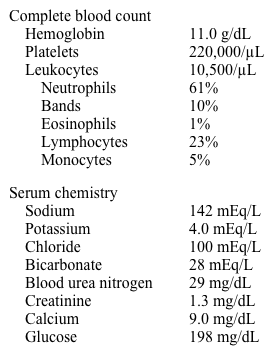 A portable chest x-ray shows a right lower-lobe infiltrate.
During the night, the patient deteriorates and becomes more hypoxic, requiring 100% oxygen by facemask. Her son refuses to have her intubated. She has several episodes of hypotension. Aggressive intravenous fluid therapy is given, and a Foley catheter is placed. Her blood pressure normalizes. Over the course of the next 12 hours, her urine output drops to 5 mL/hr. On the 4th day of hospitalization, her temperature is 37.3 C (99.1 F), blood pressure is 122/70 mm Hg, and pulse is 78/min. Despite receiving intravenous fluids, her urine output remains low. Laboratory results are as follows:
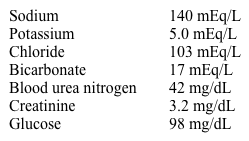 Further evaluation of this patient would most likely show which of the following?
A portable chest x-ray shows a right lower-lobe infiltrate.
During the night, the patient deteriorates and becomes more hypoxic, requiring 100% oxygen by facemask. Her son refuses to have her intubated. She has several episodes of hypotension. Aggressive intravenous fluid therapy is given, and a Foley catheter is placed. Her blood pressure normalizes. Over the course of the next 12 hours, her urine output drops to 5 mL/hr. On the 4th day of hospitalization, her temperature is 37.3 C (99.1 F), blood pressure is 122/70 mm Hg, and pulse is 78/min. Despite receiving intravenous fluids, her urine output remains low. Laboratory results are as follows:
Further evaluation of this patient would most likely show which of the following? (Multiple Choice)
4.8/5 (79)
(79) A 26-year-old woman, gravida 1 para 0, at 39 weeks gestation is admitted to the hospital with painful contractions. The patient has had no vaginal bleeding or rupture of membranes. Fetal movement is normal. Her pregnancy has been complicated by diet-controlled gestational diabetes mellitus. She has no other chronic medical conditions and has had no surgeries. Blood pressure is 120/70 mm Hg and pulse is 84/min. Fetal heart rate tracing shows a baseline of 140/min, moderate variability, accelerations, and no decelerations. The tocodynamometer shows contractions every 3 minutes. Cervical examination reveals the cervix to be 7 cm dilated and 100% effaced, with the fetal head at 0 station. Epidural anesthesia is administered. Two hours later, the patient is reevaluated for labor progression. Fetal heart tracing continues to be normal. The tocodynamometer now shows contractions every 4-6 minutes. Examination reveals the cervix to be 7 cm dilated and 100% effaced with the fetal head at 0 station, unchanged from the previous examination. Which of the following is the best next step in management of this patient?
(Multiple Choice)
4.8/5 (65)
(65) A 62-year-old woman collapses at home after a period of shortness of breath and foaming at the mouth. She has no respirations or pulse when the emergency response team arrives 30 minutes later. The electrocardiogram (ECG) shows asystole. Cardiopulmonary resuscitation with advanced cardiac life support is initiated. The patient is intubated and given epinephrine with restoration of a pulse. She is transferred to the emergency department in a comatose state. ECG shows Q waves in the inferior leads, first-degree atrioventricular block, and a right bundle branch block. Initial laboratory results are as follows: 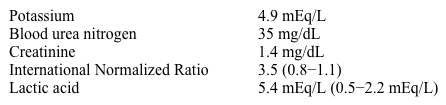 The patient is admitted to the intensive care unit. She remains comatose 24 hours later. Her blood pressure is 108/60 mm Hg, and core temperature is 36.7 C (98 F). There is no motor response to firm supraorbital pressure. Her pupils are fixed and dilated at 8 mm. Corneal reflexes are absent. Caloric testing produces no conjugate eye deviation. Deep tracheal suctioning produces no cough reflex. A brain CT scan demonstrates loss of the gray/white junction, loss of sulci, and obliterated ventricles. Which of the following is the most appropriate next step in management of this patient?
 (Multiple Choice)
4.8/5 (84)
(84) A 26-year-old woman, gravida 1 para 0, at 16 weeks gestation comes to the clinic for follow-up prenatal care. She was diagnosed with Graves disease during her first trimester and was treated with propylthiouracil, which was changed to methimazole 3 weeks ago. The patient has gained 7 kg (15.4 lb) over the last 4 months. She also has experienced increasing fatigue and states, "My breasts feel very full." The patient has had no palpitations or shortness of breath, but her sleep has been interrupted by frequent urination. Her mother has hypothyroidism, which is treated with levothyroxine. The patient has never used tobacco, alcohol, or illicit drugs. Temperature is 37.2 C (99 F), blood pressure is 112/72 mm Hg, pulse is 90/min and regular, and respirations are 18/min. No murmurs are heard on cardiac auscultation. Thyroid examination shows mild, diffuse enlargement with no tenderness or bruit. Deep tendon reflexes are brisk but symmetrical. The remainder of the physical examination is normal. Thyroid function test results are as follows:  Which of the following is the most appropriate management for this patient?
 (Multiple Choice)
4.8/5 (79)
(79) A 57-year-old woman undergoes aortic valve replacement with a bileaflet mechanical valve for bicuspid aortic valve stenosis after an episode of syncope. Her past medical history is also significant for hypertension. Preoperative coronary angiogram showed no evidence of coronary artery disease and postoperative course was uncomplicated. Six months later, she comes to the physician for follow-up. Her medications include aspirin, warfarin, amlodipine, and candesartan. Transthoracic echocardiogram shows a mildly enlarged left atrium, left ventricular ejection fraction of 60%, a normally functioning mechanical aortic valve, and normal aortic root size. Which of the following is the best treatment option for this patient?
(Multiple Choice)
4.9/5 (66)
(66) A 27-year-old woman, gravida 1 para 0, at 9 weeks gestation comes to the office for an initial prenatal visit. She feels well and has had no abdominal pain or vaginal bleeding. The patient has sickle cell disease and has had multiple hospitalizations and transfusions for acute pain episodes. She was previously on hydroxyurea, but it was discontinued several months ago when she began attempting conception. The patient has had no acute pain episodes since discontinuation of the medication. She has no other chronic medical conditions and her only surgery was a laparoscopic cholecystectomy. The patient does not use tobacco, alcohol, or illicit drugs. She is up to date on vaccinations. Temperature is 36.7 C (98 F), blood pressure is 150/80 mm Hg, and pulse is 76/min. Pulse oximetry is 99% on room air. BMI is 22 kg/m2. Cardiac examination reveals a normal rate and regular rhythm. The lungs are clear to auscultation bilaterally. Pelvic examination shows a 9-week-sized uterus without adnexal masses or tenderness. Urine dipstick shows 1+ proteinuria. Ultrasound confirms a 9-week intrauterine gestation with fetal cardiac activity. Which of the following is the next best step in management of this patient?
(Multiple Choice)
4.8/5 (71)
(71) A 44-year-old man comes to the office to establish medical care. He feels well at this time. The patient has a history of hypertension, stage 3 chronic kidney disease, and generalized anxiety disorder. He is "mostly" adherent to his medications, which include lisinopril, amlodipine, and paroxetine. He is sexually active with both men and women and uses condoms inconsistently. The patient has had 4 sexual partners over the last year. He was recently treated for gonococcal urethritis. HIV testing a year ago was negative. He does not use tobacco or consume alcohol but occasionally smokes marijuana. Blood pressure is 155/90 mm Hg and pulse is 78/min. BMI is 24 kg/m2. No jugular venous distension is present. Cardiac auscultation reveals a fourth heart sound but no murmurs. There is no peripheral edema. Laboratory results are as follows: 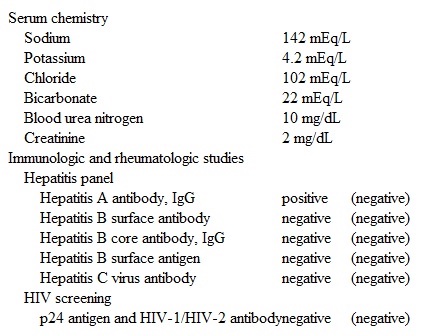 Laboratory screening for syphilis, gonorrhea, and chlamydia is negative. In addition to education on safe sexual practices, which of the following is the most appropriate course of action in this patient?
 (Multiple Choice)
4.8/5 (81)
(81) A 65-year-old postmenopausal woman comes to the office for evaluation of dyspareunia. The patient recently became sexually active after 7 years of abstinence after the death of her husband. She has a new partner and has pain with intercourse but has had no postcoital or postmenopausal bleeding. The patient was last seen in the office 10 years ago when she underwent treatment for biopsy-proven lichen sclerosus. Her symptoms improved after she was treated with high-dose topical corticosteroids. Pap test at that time was normal. The patient has type 2 diabetes mellitus and hypertension, for which she takes metformin and an ACE inhibitor. She had 3 vaginal deliveries when she was in her 20s. The patient stopped smoking 5 years ago and does not use alcohol or illicit drugs. Family history is noncontributory. Blood pressure is 128/82 mm Hg and pulse is 72/min. BMI is 28 kg/m2. Pelvic examination shows a raised, pigmented lesion over the clitoral hood and extending to the right labium majus. Multiple areas of excoriations are noted throughout the vulva. There is no palpable inguinal lymphadenopathy. Speculum examination reveals an atrophic vagina and a cervix with no visible lesions. Which of the following is the best next step in management of this patient?
(Multiple Choice)
4.9/5 (78)
(78) A 64-year-old man comes to the emergency department complaining of facial swelling. He has not had such symptoms before and has no associated itching or rash. The patient's medical problems include type 2 diabetes mellitus, hypertension, and coronary artery disease. He had a myocardial infarction 7 years ago. He was recently diagnosed with congestive heart failure with systolic dysfunction. The patient's medications include ramipril, metoprolol, furosemide, spironolactone, aspirin, glyburide, and simvastatin. Physical examination shows prominent lip and tongue swelling without stridor. His symptoms subside within 24 hours after he is admitted. Which of the following is the best statement concerning the management of this patient?
(Multiple Choice)
4.8/5 (71)
(71) A 76-year-old man is brought to the emergency department from a nursing home in critical condition due to fever and confusion. His nursing home records were not transferred with him. On initial evaluation, his temperature is 38.9 C (102 F), blood pressure is 75/50 mm Hg, and heart rate is 120/min. The patient is obtunded and cannot provide a history. He is immediately intubated and placed on mechanical ventilation. An internal jugular venous central line is placed and infusion of normal saline boluses is initiated. The covering clinician places a STAT order for cefepime and contacts the on-call pharmacist to expedite order approval. The antibiotic is administered as soon as it arrives in the emergency department. Shortly thereafter, the patient develops profound hypotension, skin rash, and respiratory distress. Despite resuscitation efforts, he expires. Retrospective review of the nursing home paperwork shows documentation of severe penicillin and cephalosporin allergy. Which of the following interventions would improve patient safety during similar high-risk situations?
(Multiple Choice)
4.9/5 (97)
(97) A 37-year-old woman, gravida 1 para 0, comes to the emergency department at 37 weeks gestation for a severe headache unrelieved by acetaminophen. For the past several days, the patient has experienced fatigue, headaches, and blurred vision. She reports good fetal movement and has no abdominal pain, vaginal bleeding, or fluid leakage. The patient's pregnancy has been complicated by gestational hypertension that has not required antihypertensive therapy. She has no other chronic medical conditions or previous surgeries. The patient takes a prenatal vitamin daily. Blood pressure is 170/110 mm Hg and pulse is 80/min. Fetal monitoring shows a baseline of 140/min, moderate variability, no decelerations, and no accelerations. Fundal height is 37 cm. Physical examination shows edema of the hands and face. Cervical examination reveals the cervix to be closed, long, and posterior. Deep tendon reflexes are 2+. Urine dipstick shows 3+ protein. A complete blood count and liver function panel are unremarkable. A biophysical profile shows a score of 8/8 and a fetus in vertex presentation. Which of the following is the best next step in management of this patient?
(Multiple Choice)
4.9/5 (73)
(73) A 36-year-old woman, gravida 3 para 2, at 13 weeks gestation comes to the office for a prenatal visit. The patient had painless vaginal spotting a few weeks ago that has since resolved. An ultrasound was performed several days ago as a part of the first-trimester integrated screening. The patient's previous 2 pregnancies ended in uncomplicated term vaginal deliveries. She has no chronic medical conditions. Her only surgery was a laparoscopic cholecystectomy. She is the vice principal at a local elementary school and volunteers as a basketball coach. The patient takes a prenatal vitamin and an iron supplement daily. She does not use tobacco, alcohol, or illicit drugs. The patient attends a yoga class 3 times a week. Blood pressure is 110/70 mm Hg and pulse is 68/min. BMI is 26 kg/m2. Fetal heart rate is 150/min. The ultrasound reveals a 13-week fetus with a normal nuchal translucency measurement and a 1.8-cm (0.71-in), crescent, hypoechoic area between the gestational sac and the uterus, which is consistent with a hematoma. The patient's blood type is B, Rh positive. The other results from the first-trimester integrated screening are normal. Item 1 of 2
Which of the following is the best next step in management of this patient?
(Multiple Choice)
4.8/5 (90)
(90) A 34-year-old man comes to the emergency department due to 3 weeks of nonproductive cough, increasing shortness of breath, subjective fevers, night sweats, and intermittent right-sided, sharp chest pain. Two weeks ago, the patient was diagnosed with community-acquired pneumonia at an urgent care clinic and received a week of oral antibiotics without symptomatic improvement. He has no other medical problems and takes no medications. The patient has a history of injection drug use and was recently incarcerated. Temperature is 37.7 C (99.8 F), blood pressure is 120/70 mm Hg, and pulse is 88/min. Chest examination reveals decreased breath sounds and dullness to percussion in the right lower chest. Heart sounds are normal and without murmurs. The abdomen is soft and non-tender with no hepatosplenomegaly. He has no skin rash or enlarged lymph nodes. Chest imaging reveals a right lower lobe pulmonary infiltrate and moderate-sized pleural effusion. A thoracentesis is performed; the pleural fluid is lymphocyte predominant and exudative with an elevated adenosine deaminase level. No organisms are seen on smear. Rapid HIV testing is positive. Which of the following is the best next step in management of this patient's pleural effusion?
(Multiple Choice)
4.7/5 (90)
(90) A 9-year-old boy is brought to the office by his parents due to knee pain. His mother states, "He started having occasional left knee pain with mild swelling 2 weeks ago, but the pain and swelling have worsened over the last 5 days." The patient plays basketball but has had no recent trauma. Last week, he had a runny nose and sore throat that resolved on their own. The patient has had no fever, headaches, or chest pain. His mother notes that he has been sleeping "a little more than usual" over the last month. The patient recalls a tick bite 3 months ago during a camping trip in Pennsylvania. He does not remember developing a rash at that time. The patient has congenital hearing loss for which he wears a hearing aid. He takes no daily medications and has no known allergies. Temperature is 36.7 C (98 F) and blood pressure is 100/70 mm Hg. Physical examination shows a well-appearing child with a moderately swollen, warm, and mildly tender left knee. There is no erythema. Minimal pain is elicited with full extension of the knee. The patient is able to stand and bear weight. Sensation is intact. Capillary refill in the bilateral lower extremities is brisk. There is a small bruise on his right knee but no rashes or petechiae. Laboratory results are as follows:
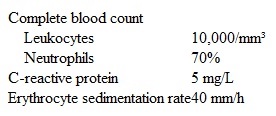 A left knee arthrocentesis is performed, and synovial fluid analysis reveals a white blood cell count of 24,000/mm³ with 85% neutrophils.
Left knee arthrocentesis relieves the patient's swelling, and he is now able to walk almost normally. After 3 days, the patient returns for a follow-up visit. His parents are concerned about his ability to participate in sports. A mild effusion is present on left knee examination. Laboratory results are as follows:
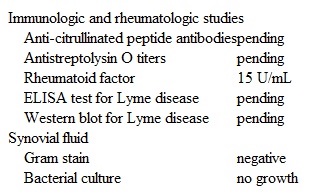 Which of the following is the most accurate description regarding this patient's prognosis?
A left knee arthrocentesis is performed, and synovial fluid analysis reveals a white blood cell count of 24,000/mm³ with 85% neutrophils.
Left knee arthrocentesis relieves the patient's swelling, and he is now able to walk almost normally. After 3 days, the patient returns for a follow-up visit. His parents are concerned about his ability to participate in sports. A mild effusion is present on left knee examination. Laboratory results are as follows:
Which of the following is the most accurate description regarding this patient's prognosis? (Multiple Choice)
4.8/5 (86)
(86) Showing 101 - 120 of 1121

Filters
- Essay(0)
- Multiple Choice(0)
- Short Answer(0)
- True False(0)
- Matching(0)