



 Chat with AI
Exam 1: Advanced Clinical Medicine

Exam 1: Advanced Clinical Medicine1 k+ Questions
Exam 2: Foundations of Independent Practice597 Questions
Select questions type


A 26-year-old woman comes to the office due to greenish vaginal discharge and vulvar pruritus that started several days ago. The patient had an uncomplicated vaginal delivery 2 months ago and is breastfeeding her infant exclusively. She completed a course of antibiotics for lactational mastitis 2 weeks ago. The patient has no chronic medical conditions and has had no surgeries. She was treated for a Chlamydia trachomatis cervicitis during high school. Sexually transmitted infection screening performed at the initial prenatal visit was negative. The patient is in a monogamous relationship with her boyfriend of 3 years. She is taking a daily prenatal vitamin and does not use tobacco, alcohol, or illicit drugs. Temperature is 36.7 C (98 F) and blood pressure is 100/60 mm Hg. BMI is 30 kg/m2. Vulvar edema and erythema are present. Pelvic examination reveals a nontender, anteverted uterus and no adnexal masses. Speculum examination shows punctate hemorrhages on the cervix. Which of the following is the most appropriate treatment for this patient?
(Multiple Choice)
4.8/5  (79)
(79) A 9-year-old girl is evaluated due to a neck mass. The patient first noticed the swelling 2 weeks ago after a viral respiratory illness. The lesion is mildly tender and is not enlarging. She has not had heat or cold intolerance or recent change in appetite or weight. The patient has no other medical conditions. Vital signs are within normal limits. Physical examination shows a 2x2 cm, soft mass in the midline just above the thyroid cartilage. The mass moves superiorly when she is instructed to swallow. There are no other palpable neck masses. The remainder of the examination reveals no abnormalities. Serum TSH is within normal limits. Imaging is performed and confirms a cystic midline mass superior to the thyroid gland. Which of the following statements is most appropriate regarding the management of this mass?
(Multiple Choice)
5.0/5 (89)
(89) An 11-year-old boy is brought to the clinic by his parents due to eye redness and discharge. He has had a sore throat for 4 days and right eye redness for 2 days. The boy says, "It sometimes feels like my eye is burning!" This morning, both eyes were crusted shut. His father used a moist towel to open the patient's eyelids and saw that the left eye was also red. The boy has had no eye pain, visual changes, or itching. He has a history of eczema for which he uses topical moisturizers at night. The patient lives with his parents, 2 younger sisters, 7 dogs, 3 cats, and a turtle. No one in his family has similar symptoms. Temperature is 37.4 C (99.4 F). Physical examination reveals conjunctival injection and clear mucoid discharge in both eyes. Mild rhinorrhea and pharyngeal erythema are also present. The lungs are clear to auscultation, and the remainder of the examination is normal. Item 1 of 2
Which of the following is the most likely diagnosis?
(Multiple Choice)
4.9/5 (83)
(83) A 60-year-old man comes to the physician complaining of shaking of his right hand. This problem began several months ago and has progressed over time. He says it is worse while watching TV, but that he frequently forgets about it while working or doing his regular daily activities. He is an accountant who works at a bank. His past medical history is significant for left hip osteoarthritis for which he occasionally takes naproxen to relieve the pain. His mother has diabetes mellitus. His father died of a heart attack at age 60. His blood pressure is 125/68 mm Hg in both arms and heart rate is 72/min. His BMI is 27 kg/m2. Physical examination shows a right hand tremor that diminishes with movement, and involuntary resistance to flexion of the right wrist and right arm. No sensory abnormalities are present. Muscle strength is preserved on both sides. Plantar reflexes are flexor bilaterally.The patient confirms his strong intention to follow all recommendations. Which of the following is the most appropriate next step in management of this patient's abdominal pain?
(Multiple Choice)
4.8/5 (78)
(78) A 62-year-old Caucasian woman presents to her primary care physician complaining about her facial appearance. She says she dislikes "looking so much worse than all my friends." Specifically, she mentions that the deep wrinkles and brown spots on her face are what she finds most disturbing. Her past medical history is significant for breast cancer, hypothyroidism, and diverticulosis. Her only medications are levothyroxine, tamoxifen, and a multivitamin. She is a divorced mother of two and has recently retired from working as the supervising gardener of a large estate. She has a forty-year history of smoking one pack of tobacco per day and consumes one or two glasses of wine each night. She admits to occasional marijuana usage when she was a younger adult. Examination of her facial skin is remarkable for a general leathery appearance with many deep furrows and wrinkles. The wrinkles are especially prominent on the forehead and at the lateral corners of the eyes. The skin is sallow and has variable pigmentation. The surface texture is rough in areas. There are scattered flesh-colored scaly patches with slightly irregular margins and occasional clusters of what appear to be dilated superficial capillaries and venules.
Which of the following would be the most appropriate treatment for this woman's condition?
(Multiple Choice)
4.8/5 (72)
(72) An 18-month-old boy is brought to the office for a well-child visit. The family relocated to the area 5 months ago. The patient speaks 15-20 words and runs well. His diet has variety and includes whole milk, fruits, vegetables, and meat. He has no fatigue, vomiting, constipation, or abdominal pain. The patient has no chronic medical conditions and takes no daily medications. Vaccinations are up to date. He lives with his parents and 5-month-old sister in a home built in 1938 that is currently undergoing renovations. A lead level performed at age 12 months was 4 μg/dL (normal: <5). Examination shows a playful and active boy. Cardiac, pulmonary, and abdominal examinations are unremarkable. Capillary blood sample shows a hemoglobin level of 12 mg/dL and lead level of 35 μg/dL. Item 1 of 2 Which of the following is the best next step in management of this patient?
(Multiple Choice)
4.7/5 (79)
(79) A 35-year-old man comes to the office due to joint pain. The patient is a charter pilot and operates flights from Wisconsin to the Caribbean islands, where he frequently stays for several weeks. During his most recent trip 3 months ago, he had fever and malaise for several days accompanied by severe pain in his fingers, wrists, and ankles. Since then, he has had persistent joint pain that has slightly improved over time. The patient has no fever, night sweats, rash, or abdominal symptoms. He is also an avid hiker. Temperature is 37 C (98.6 F), blood pressure is 130/72 mm Hg, and pulse is 80/min. No scleral icterus, mucosal lesions, or lymphadenopathy is present. The lungs are clear on auscultation, and there are no heart murmurs. The abdomen is soft and nontender with no hepatosplenomegaly. Tenderness and mild swelling are noted in the bilateral wrists, metacarpophalangeal joints, and ankles. No rash is present. Blood cell counts and serum chemistry study results are within normal limits. Which of the following is the most likely cause of this patient's symptoms?
(Multiple Choice)
4.9/5 (78)
(78) A 4-year-old girl is brought to the emergency department for evaluation of a rash. This morning, the family noticed "lots of little spots on her arms and legs" that have now spread to her chest and trunk. Her mother also noticed several bruises over the lower extremities and says, "She had a nosebleed this morning but it stopped after a few minutes." The patient and her family do not recall any preceding trauma. She has no fever, vomiting, diarrhea, or decrease in appetite, but did have a "cough and runny nose a few weeks ago." The patient has mild, intermittent asthma for which she takes albuterol as needed. Immunizations are up to date. Temperature is 36.7 C (98 F), blood pressure is 100/60 mm Hg, pulse is 100/min, and respirations are 20/min. Physical examination shows a well-appearing, smiling girl. Scattered petechiae and ecchymoses are noted over the upper and lower extremities, chest, and trunk. There are 3 small hematomas on the buccal mucosa, and there is dry, crusted blood in the left nostril. Cardiac, abdominal, and lymphatic examinations are normal. Laboratory results are as follows: 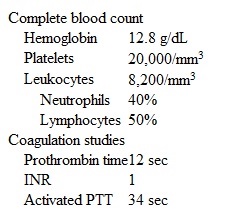 Which of the following is the most appropriate management for this patient?
 (Multiple Choice)
4.9/5 (91)
(91) A 2-year-old boy is brought to the emergency department by his father due to ingestion of a foreign body an hour ago. The patient's father states, "He was playing with his mother's purse when I saw him put a dime into his mouth. I immediately went over to try to remove the coin but it was no longer in his mouth." The child has been acting normally since the ingestion and has had no coughing, drooling, or vomiting. He has not tried to eat or drink since the incident. The patient is otherwise healthy and takes no daily medications. He has no known allergies. Blood pressure is 80/50 mm Hg, pulse is 120/min, and respirations are 24/min. Pulse oximetry is 99% on room air. Physical examination demonstrates a well-appearing, comfortable child. No foreign bodies are visualized in the mouth, nares, or ears. Cardiopulmonary examination is normal. The abdomen is soft, nontender, and nondistended. X-ray of the chest and abdomen reveals a 2-cm radiopaque object in the stomach. Which of the following is the best next step in management of this patient?
(Multiple Choice)
4.9/5 (83)
(83) A 64-year-old man comes to the emergency department after developing fever and chills during hemodialysis. He still feels feverish but has no sore throat, cough, abdominal pain, nausea, or diarrhea. Temperature was 38.9 C (102 F) at the dialysis center. The patient has a history of poorly controlled type 2 diabetes mellitus and hypertension, which led to end-stage renal disease. He was initiated on long-term intermittent hemodialysis 2 months ago. The patient has no known drug allergies. He does not use tobacco, alcohol, or illicit drugs. Temperature is 38 C (100.4 F), blood pressure is 120/62 mm Hg, pulse is 105/min, and respirations are 22/min. Oxygen saturation is 96% on room air. There is a tunneled central venous catheter in the right internal jugular vein, and the skin around the insertion site is not erythematous or tender. Cardiopulmonary auscultation reveals clear lung fields and normal heart sounds. The abdomen is soft and nontender. No skin rash or neck stiffness is present. Leukocyte count is 14,000/mm3 with 90% neutrophils. Chest-x ray reveals no infiltrate or consolidation. Two sets of blood cultures, one from a peripheral vein and the other from the central venous catheter, are obtained.
Which of the following is the most appropriate immediate next step in management of this patient?
(Multiple Choice)
4.8/5 (73)
(73) A 74-year-old hospitalized woman is seen for preoperative medical evaluation. The patient was admitted due to a right ankle injury after stepping off a curb and falling. She did not hit her head or lose consciousness during the event. The patient has had no recent chest pain, dyspnea, palpitation, or syncope. Prior to the injury, she was able to walk 1-2 blocks on a flat level and climb a flight of stairs without difficulty. Medical history is significant for hypertension, paroxysmal atrial fibrillation, osteoporosis, and mild cognitive impairment. Medications are amlodipine, metoprolol, rivaroxaban, alendronate, and vitamin D supplements. The patient does not use tobacco, alcohol, or illicit drugs. Blood pressure is 136/88 mm Hg and pulse is 88/min and irregular. Physical examination shows clear lungs and no heart murmurs. Right ankle x-rays reveal a bimalleolar fracture. ECG shows atrial fibrillation with normal ventricular rate. Blood cell count, serum chemistry studies, prothrombin time, and activated partial thromboplastin time are within normal limits. Orthopedic consultation has been obtained, and an operative repair of the fracture is planned in the next 48 hours. In addition to rivaroxaban discontinuation, which of the following is the most appropriate preoperative recommendation regarding this patient's arrhythmia?
(Multiple Choice)
4.8/5 (76)
(76) A 4-month-old boy is brought to the office for a well-child visit. The boy is rolling over and cooing. He reaches for toys and mouths them frequently. He is breastfed exclusively and takes a multivitamin with iron. Last week, the patient was diagnosed with acute otitis media and croup, which were treated with a 10-day course of amoxicillin and a single dose of dexamethasone. He is currently on day 6 of antibiotics and is no longer irritable or coughing. His last fever was 4 days ago. The patient lives at home with his parents and sister age 3. His sister has a seizure disorder of unclear etiology that is well controlled on antiepileptic medication. Temperature is 36.7 C (98.1 F). Physical examination is normal for his age. The infant is scheduled to receive several immunizations today as part of the recommended schedule. The parents express concern about their son receiving the diphtheria-tetanus-acellular pertussis vaccination. The father says, "After he got his shots the first time, he had a fever of 103 and was so fussy that we had to take him to the urgent care clinic to make sure he was okay. I'm not sure I can go through that again." Based on this child's history, which of the following is the most appropriate step regarding DTaP administration in this patient?
(Multiple Choice)
4.8/5 (88)
(88) Paramedics bring a 24-year-old man who was involved in a motor vehicle accident to the emergency department of a small community hospital. At the accident scene, the medics noted that he had sustained a traumatic amputation of his right thumb. They were able to retrieve the severed digit and bring it to the hospital. The patient undergoes initial wound care and hemostasis with a compression dressing. The hospital does not have a facility for digit replantation and reconstructive surgery, and a decision is made to transfer the patient to a nearby tertiary care center. Five minutes later, the nurse asks, "How do you want me to preserve his severed digit?" The nurse brings an insulated cooling container to transport the severed thumb. Before putting the plastic bag in the container, the nurse asks, "What should we use to fill up the container?" Which of the following is the most appropriate response?
(Multiple Choice)
4.9/5 (83)
(83) A 6-day-old boy is brought to the office for poor feeding. He rejects the breast or bottle whenever his mother tries to feed him. He sleeps all day and is very difficult to rouse. Two days ago, the neonate was discharged from the nursery, where he received phototherapy for jaundice. He was born at 39 weeks gestation by uncomplicated vaginal delivery. The pregnancy was uncomplicated and prenatal laboratory studies were normal. His family history is not significant. The neonate currently takes no medications. He is febrile and tachycardic. Physical examination shows a lethargic infant with mild generalized jaundice. Lungs are clear to auscultation. Laboratory results are as follows: 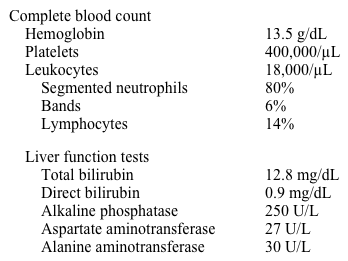 Urinalysis shows positive leukocyte esterase and 15 white blood cells/hpf. Blood, urine, and cerebrospinal fluid cultures are pending. Which of the following treatment regimens is most appropriate for this patient?
 (Multiple Choice)
4.8/5 (70)
(70) A 65-year-old man is brought to the emergency department by his neighbor after fainting in his garden. The neighbor says, "We were discussing how to manage weed overgrowth this season, and suddenly he started slurring his words, began drooling, and fell to the ground." The patient cannot remember what happened, reports that he feels fine, and says, "It was probably just the heat." Medical history is significant for hypercholesterolemia, hypertension, gout, and major depressive disorder. Medications include simvastatin, lisinopril-hydrochlorothiazide, escitalopram, and allopurinol. The patient lives with his daughter, who is his next of kin. The patient is mildly depressed and nonsuicidal. Blood pressure is 124/72 mm Hg and heart rate is 78/min. Neurological examination shows no localizing signs, and the remainder of the examination is normal. The physician leaves to order a full blood panel and ECG. On return to the patient's room, the physician finds him standing next to his bed, fully dressed and ready to leave. The patient says, "I know you want to do tests but I am really fine and just want to get home." The physician explains that cardiovascular events such as a heart attack or stroke need to be ruled out. The patient still refuses and says, "I understand your concerns and the risks involved, but I really think it was just the heat. I will feel better at home." Which of the following is the most appropriate next step in management of this patient?
(Multiple Choice)
4.8/5 (61)
(61) A 72-year-old Caucasian male comes to your office. He is complaining of hoarseness for the past six months. He says the hoarseness has been gradually worsening, and now he has developed difficulty in swallowing, pain in both ears, and exertional shortness of breath. He adds that he recently had a couple of episodes of hemoptysis. On examination, significant cervical lymphadenopathy is present. Chest x-ray is normal. Flexible fiberoptic endoscopy shows a laryngeal mass involving both supra glottic and infra glottic regions, as well as the vocal cords. The biopsy report reveals squamous cell carcinoma. The surgery and otolaryngology team, after careful review of all the findings, declare the lesion inoperable. At this time, what is the most appropriate treatment option for your patient?
(Multiple Choice)
4.8/5 (98)
(98) An 11-year-old girl is brought to the office for vulvar pruritus that has increased over the past 3 months and now causes her to awaken from sleep. She tried applying her sister's diaper cream but had no relief of symptoms. The patient has also developed perianal pruritus and constipation. She has had no vaginal or rectal bleeding and no abnormal vaginal discharge. The patient has allergic rhinitis managed with a glucocorticoid nasal spray. She has had no surgeries. Vaccinations are up to date. The patient has not reached menarche. She has no known drug allergies. Weight and height are at the 50th and 45th percentile, respectively. Blood pressure is 98/62 mm Hg and pulse is 84/min. Physical examination reveals Tanner stage 2 breast and pubic hair development. Thin white lesions cover the vulva and extend over the perineum and around the anus. The labia majora and minora are edematous and have areas of thickened skin. Multiple excoriations appear throughout the vulva. There is no evidence of trauma. Which of the following is the most likely diagnosis in this patient?
(Multiple Choice)
4.9/5 (67)
(67) A 43-year-old woman comes to the office for an initial evaluation. The patient recently moved to the area for a new job and is worried about her poor health. She explains that she had to call in sick several times this past month because either "I felt too exhausted" or "I was lightheaded and had an upset stomach." The patient has a history of hypothyroidism, chronic headaches, insomnia, and dysmenorrhea. She describes a long history of fatigue, but previous doctors have assured her that her hypothyroidism is well controlled with medication. She also describes chronic problems with urinary frequency; stomach bloating; and dry, itchy skin. The patient is worried about her symptoms and wonders if all the doctors she has seen may have "missed something." Her medications include levothyroxine, daily multivitamins, and zolpidem and naproxen as needed. The patient does not smoke or use illicit drugs. She stopped drinking alcohol a year ago as it made her symptoms worse. Blood pressure is 110/70 mm Hg, pulse is 84/min, and respirations are 12/min. Physical examination is normal. T4 is 10 µg/dL and TSH is 1.3 µU/mL. The physician assures the patient that her blood tests and physical examination are normal. She schedules an appointment 2 weeks later and now reports frequent headaches in addition to her ongoing concerns. The patient says, "These headaches just make me even more tired." Her headaches occur 2-3 times a week and are bilateral and nonthrobbing. She reports, "My neck is sore and my shoulders are so tight I can hardly turn my head without it being painful." The patient has no aura and the headaches are relieved by naproxen. Physical examination is normal apart from some muscle tenderness in the shoulders and neck. When the physician inquires if moving and starting a new job have been stressful, she replies, "It's not the job or the move; it's not feeling well that is stressful. Maybe I should see a neurologist." The patient is very anxious and asks if the physician can order a repeat brain MRI to determine the diagnosis. Her records indicate that a brain MRI performed last year was normal. Which of the following is the most appropriate response to the patient?
(Multiple Choice)
4.8/5 (84)
(84) A 31-year-old man comes to the office due to increased flatulence and 2 or 3 loose, bulky stools per day. The patient initially presented 2 years ago with similar symptoms and was found to have a positive anti-tissue transglutaminase antibody test and duodenal villous atrophy. His symptoms resolved after appropriate interventions were implemented but have recurred over the last 3 months. The patient reports no recent travels or dietary changes and has had no fever, chills, abdominal pain, hematochezia, or melena. He has lost about 2.2 kg (5 lbs) since his symptoms recurred. He has no other medical issues and his only medication is an over-the-counter multivitamin. He works as an accountant and is recently divorced from his wife. The patient says lately he has been going out for drinks with his coworkers more frequently but does not use tobacco or illicit drugs. Vital signs are within normal limits. The abdomen is soft, nondistended, and nontender. Bowel sounds are normoactive. The remainder of the physical examination shows no abnormalities. Which of the following is the most appropriate next step in management of this patient's symptoms?
(Multiple Choice)
4.9/5 (82)
(82) A 6-month-old boy is brought to the emergency department by his mother during the winter due to 3 days of nasal discharge and cough. His mother states, "He hasn't been breastfeeding well today because he's so congested." The infant has been voiding adequately and has had no vomiting, diarrhea, or skin rash. His older brother attends preschool and is recovering from an upper respiratory illness. The patient has no prior illnesses and no known allergies, and all vaccinations are up to date. He was born at term via an uncomplicated delivery and has met all developmental milestones appropriately. Temperature is 37.5 C (99.5 F), blood pressure is 90/60 mm Hg, pulse is 150/min, and respirations are 50/min. Pulse oximetry shows an oxygen saturation of 93% on room air. Examination reveals moderate respiratory distress with subcostal retractions, coarse breath sounds, and expiratory wheezing bilaterally. Oral mucous membranes are dry, but capillary refill is <2 seconds. The patient is admitted to the hospital and placed on appropriate infection-control precautions. Two days later, the patient remains afebrile, and pulse oximetry has been consistently >97% on room air. Weight has decreased 6 oz (0.17 kg) from admission, but the patient is now breastfeeding well every 3-4 hours. Examination shows crusted rhinorrhea at the nares and no grunting, nasal flaring, or retractions. The lungs are clear to auscultation. The patient is stable for discharge home, but his parents are concerned about his prognosis. The infant is at greatest risk for developing which of the following?
(Multiple Choice)
4.9/5 (102)
(102) Showing 121 - 140 of 1121

Filters
- Essay(0)
- Multiple Choice(0)
- Short Answer(0)
- True False(0)
- Matching(0)