



 Chat with AI
Exam 1: Advanced Clinical Medicine

Exam 1: Advanced Clinical Medicine1 k+ Questions
Exam 2: Foundations of Independent Practice597 Questions
Select questions type


A 24-year-old woman comes to the office due to low energy and poor concentration. She says, "I don't know what is wrong with me. Nothing bad has happened, but over the past month I've felt really down and exhausted all the time. Last weekend, I didn't even get out of bed all day. Luckily, I work from home, so I don't even shower or get dressed. I stare at the computer all day, unable to concentrate or get any work done." At night, the patient has difficulty falling asleep, awakens at 4:00 AM, and has difficulty getting back to sleep. She has no appetite and eats only cereal as shopping and preparing food take too much effort. The patient has a psychiatric history of attention deficit hyperactivity disorder as a child, which was treated successfully. She has no medical history. Her medications include oral contraceptives and ibuprofen for menstrual cramps. The patient does not use tobacco or illicit drugs. She usually drinks a glass of wine each day but admits that for the past couple of weeks she has had a second glass at bedtime to help her fall asleep. There is a family history of alcoholism in her father and uncle. Other than a 3.1-kg (6.8-lb) weight loss since her last visit, physical examination is normal. Mental status examination is remarkable for soft, slowed speech and several lapses in concentration during the interview. She has no suicidal ideation. Complete blood count, serum chemistry panel, and TSH are within normal range. Which of the following is the most appropriate next step in management of this patient?
(Multiple Choice)
5.0/5  (73)
(73) A 19-year-old woman comes to the office due to intermittent nausea, abdominal discomfort, and diarrhea. She has also had a diminished appetite and feels that her abdomen is swollen. Her parents immigrated to the United States from Guatemala when she was an infant, and she recently went there for 3 weeks to meet her cousins. The patient had a mild cough for a few days during the trip but no diarrhea or abdominal pain. She is a college freshman and does not use tobacco, alcohol, or illicit drugs. She does not take any medications. Vital signs are within normal limits. The lungs are clear to auscultation and heart sounds are normal. The abdomen is soft, mildly distended, and nontender with increased bowel sounds. There is no rebound tenderness or hepatosplenomegaly. Fecal occult blood is positive. Laboratory results are as follows: 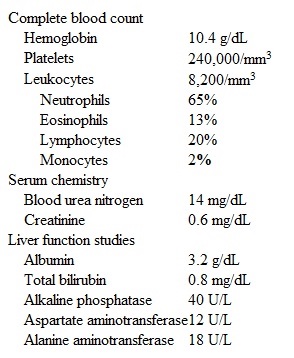 This patient is most likely to improve with which of the following medications?
 (Multiple Choice)
4.8/5 (81)
(81) A 65-year-old man is brought to the office by his daughter due to decreased activity and impaired sleep over the past month. He was diagnosed with Parkinson disease 2 years ago. According to his daughter, he displays very few emotions and does not want to do anything. She says, "He has been slowing down these past few years and I suppose that was to be expected, but I am worried that he's getting worse so quickly. He just sits in his chair and watches TV with a blank expression. He has been waking up early in the morning, which is very unusual for him. When I suggest that he should go out, he says he is too tired or makes excuses. It's like he doesn't care much about anything." The patient is quiet during most of the discussion. He does not disagree with his daughter's comments, but says, "I'm alright. I manage. I don't have much to add." The patient is adherent with his current levodopa/carbidopa treatment. His other medication is pravastatin for hypercholesterolemia. He does not use tobacco, alcohol, or illicit drugs. Physical examination shows masklike facies and slowed movements. Mild hand tremor and postural instability have improved since his last visit. Which of the following is the most appropriate next step in pharmacological management of this patient?
(Multiple Choice)
4.8/5 (77)
(77) A 35-year-old woman, gravida 1 para 0, at 27 weeks gestation is evaluated in the labor and delivery unit after she was involved in a motor vehicle collision. The patient was initially evaluated in the emergency department and then was transferred to labor and delivery in stable condition after repair of a facial laceration. She was restrained by a lap-and-shoulder belt; the airbag was deployed. In addition to the facial laceration, the patient has dull abdominal pain. She reports no vaginal bleeding or leakage of fluid and has had multiple fetal movements since the collision. The patient was previously evaluated in the emergency department at 9 weeks gestation for persistent nausea, and an ultrasound at that time confirmed gestational age. She has otherwise had no prenatal care. The patient has no chronic medical conditions or prior surgeries. She does not use tobacco, alcohol, or illicit drugs. Blood pressure is 100/70 mm Hg, pulse is 104/min, and respirations are 16/min. Pulse oximetry is 99% on room air. The abdomen is mildly tender at the uterine fundus, without rebound or guarding. Sterile speculum examination confirms a closed cervix and no vaginal bleeding or rupture of membranes. The fetal heart rate tracing has a baseline of 130/min with moderate variability, accelerations, and no decelerations. The tocometer exhibits low-amplitude contractions every 3 minutes. Initial laboratory results are as follows: 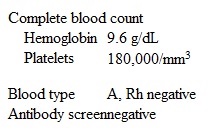 Which of the following is the best next step in management of this patient?
 (Multiple Choice)
4.9/5 (80)
(80) A 32-year-old Caucasian female presents to your office with persistent cough and shortness of breath. She has had three episodes of pneumonia over the last year. She had severe sinusitis one year ago, and an episode of bloody diarrhea that required hospitalization and IV antibiotic therapy six months ago. She does not smoke or consume alcohol. She denies any illicit drug use. She is currently not taking any medications. All her immunizations are up-to-date. Her blood pressure is 130/80 mmHg and heart rate is 90/min. Physical examination reveals fine crackles over the right lower lung lobe. No lower extremity edema is present. Neck palpation does not reveal any lymph node enlargement. The chest x-ray shows right lower lobe infiltrates and left upper lobe fibrosis. The ECG reveals non-specific ST segment and T wave changes. What is the best next step in the management of this patient?
(Multiple Choice)
4.7/5 (80)
(80) A 26-year-old woman comes to see you in the office. She has tattoo marks on the back of her neck and anterior chest wall. She has had these tattoos for 10 years and wants to remove them now. Which of the following is the correct statement regarding the removal of tattoo marks?
(Multiple Choice)
4.9/5 (74)
(74) A 74-year-old woman is admitted to the hospital for an episode of paroxysmal atrial fibrillation that caused palpitations and dizziness. She is started on metoprolol and amiodarone. Her past medical history is also significant for recurrent deep venous thrombosis 6 months ago. The patient has been on chronic anticoagulation therapy with a stable dose of warfarin since then. Her primary care physician checks her International Normalized Ratio every month; it is 2.6 at the time of admission. Echocardiogram shows left atrial enlargement and left ventricular ejection fraction of 45%. She feels well the following day and is ready for discharge. Which of the following is the best management for this patient's anticoagulation?
(Multiple Choice)
4.7/5 (85)
(85) A 53-year-old woman comes to the physician for her annual health care visit. Her last menstrual period was >1 year ago. She initially had hot flashes which have gradually subsided. Her past medical history is unremarkable. The patient takes no medications, vitamins, or herbal supplements. She does not smoke or drink alcohol. Her father has premature coronary artery disease. There is no history of cancer or osteoporosis in her family. She jogs and does weight-training exercises for up to 1 hour daily. Her mammogram and pelvic exam were normal last year. The patient's vital signs are normal and her physical examination is unremarkable. Which of the following is the best next step in management of this patient?
(Multiple Choice)
4.8/5 (83)
(83) A 42-year-old woman comes to the office due to increasing heartburn and regurgitation over the last 2 years. Previously her symptoms only occurred after a large meal, but recently they have occurred almost daily. She has had no dysphagia, odynophagia, weight loss, hematemesis, or melena. The patient has no other medical issues and takes no medications. She smokes cigarettes and drinks alcohol, although she has been cutting back on both. The patient is a paralegal and describes her work as stressful. Vital signs are within normal limits. BMI is 28 kg/m2. The abdomen is nondistended, soft, and nontender with no hepatosplenomegaly. The remainder of the physical examination is unremarkable and fecal occult blood testing is negative. The patient says her symptoms are starting to affect her life and would like them to be controlled. Which of the following is the most appropriate response to the patient regarding the next step in management?
(Multiple Choice)
4.8/5 (78)
(78) An 18-month-old boy is brought to the office for a well-child visit. The family relocated to the area 5 months ago. The patient speaks 15-20 words and runs well. His diet has variety and includes whole milk, fruits, vegetables, and meat. He has no fatigue, vomiting, constipation, or abdominal pain. The patient has no chronic medical conditions and takes no daily medications. Vaccinations are up to date. He lives with his parents and 5-month-old sister in a home built in 1938 that is currently undergoing renovations. A lead level performed at age 12 months was 4 μg/dL (normal: <5). Examination shows a playful and active boy. Cardiac, pulmonary, and abdominal examinations are unremarkable. Capillary blood sample shows a hemoglobin level of 12 mg/dL and lead level of 35 μg/dL. A venous blood sample confirms a lead level of 35 μg/dL. The parents are concerned about potential consequences of lead toxicity. Which of the following complications is this child at greatest risk of developing?
(Multiple Choice)
4.9/5 (60)
(60) A 36-year-old woman comes to the office due to joint pain during sexual intercourse. Over the past year, she has had difficulty during intercourse due to limited range of motion of the right hip and pain radiating from the hip to the low back. The patient has tried a number of medications, including acetaminophen and naproxen, without relief. In addition to bilateral osteoarthritis of the hips and knees, medical history is notable for morbid obesity, obstructive sleep apnea, and mixed hyperlipidemia. For the past 6 months, the patient has been in a supervised weight-loss program consisting of a modified diet and orlistat and has lost 3 kg (6.6 lb). BMI is 41 kg/m2. Physical examination shows limited abduction of the right leg due to pain. Which of the following is the most appropriate next step in management of this patient?
(Multiple Choice)
4.9/5 (85)
(85) A 25-year-old man comes to the office for follow-up. The patient was diagnosed with Graves disease 12 months ago during an evaluation for diarrhea, tremor, and palpitations. He received radioiodine therapy and required initiation of levothyroxine due to iatrogenic hypothyroidism. The patient reports that most of his symptoms have improved with treatment, but he still has occasional diarrhea and fatigue. In addition, his serum TSH levels have remained elevated despite escalating dosages of levothyroxine. The patient takes no other medications and does not use tobacco, alcohol, or illicit drugs. Blood pressure is 130/90 mm Hg and pulse is 64/min. The thyroid is not palpable and skin is mildly dry; otherwise, physical examination is unremarkable. Laboratory results are as follows: 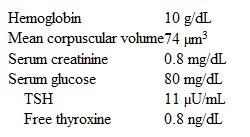 Stool occult blood test is negative. Which of the following is the best next step in management of this patient?
 (Multiple Choice)
4.9/5 (87)
(87) An 8-month-old boy is brought to the office due to recurrent episodes of otitis media, including 2 episodes of acute otitis media in the past 3 months. One episode was in his left ear; the second was in his right ear 2 weeks ago and resolved after a course of amoxicillin. He was born by spontaneous vaginal delivery at 38 weeks gestation and has had no other medical problems. He lives with his mother and 3-year-old brother, both of whom are in good health. There are no pets or carpets in the house. His mother smokes a pack of cigarettes a day but only outdoors. The patient does not attend day care. He eats solid foods twice a day and breastfeeds every 3 hours, including overnight when he falls asleep while feeding. His growth and developmental milestones are age-appropriate. On physical examination, he is awake, alert, and playful. His head is normocephalic. Pupils are equal and reactive to light and accommodation. The nares are clear; there is no erythema of the pharynx; the tympanic membranes are clear without erythema or effusion. Cardiopulmonary examination is normal. The mother is concerned that the recurrent infections will affect his hearing and asks for advice on avoiding future episodes. Which of the following is the most appropriate intervention in management of this patient?
(Multiple Choice)
4.8/5 (91)
(91) A 29-year-old woman, gravida 1 para 1, had an uncomplicated vaginal delivery 10 minutes ago. The patient underwent an induction of labor at 39 weeks gestation for insulin-controlled gestational diabetes mellitus. An insulin drip was utilized for glycemic control during labor. The patient was diagnosed with gestational diabetes mellitus at 26 weeks gestation and started on an insulin regimen at 29 weeks gestation when glycemic control via dietary modification failed. Her pregnancy was otherwise uncomplicated. She has no other medical conditions or previous surgeries. The patient is also taking a prenatal vitamin and folate supplementation. She does not use tobacco, alcohol, or illicit drugs. The patient currently has minimal vaginal bleeding; she has no fever, chills, or abdominal pain. Temperature is 36.7 C (98 F), blood pressure is 110/80 mm Hg, and pulse is 88/min. Prepregnancy BMI was 23 kg/m2. Physical examination reveals a nontender uterine fundus that is 1 cm above the umbilicus. Bilateral lower extremities have trace edema but no calf tenderness. Blood glucose level 1 hour prior to delivery was 118 mg/dL. Which of the following is the best next step in management of this patient?
(Multiple Choice)
4.7/5 (76)
(76) An 8-year-old boy is brought to the office by his father due to concerns at school. His father says, "He was a great student last year, but his grades have slipped this year. His teacher says that he does not pay attention and often 'spaces out' during class. I think he just likes to daydream and gets distracted." At home, the father has noticed that the boy "blanks out" sometimes for a few seconds when he is in the middle of playing, and then he blinks his eyes a lot and quickly resumes his activity. The patient says that he feels sad about his grades. He has had no recent fever or sore throat, and there have been no recent stressors in his life. The patient has gastroesophageal reflux that is controlled with ranitidine. Vaccinations are up to date. He has a 10-year-old sister who is in good health. Vital signs are normal. On physical examination, the patient is alert and interactive. Heart rate is regular with normal S1 and S2. The abdomen is soft and nondistended. Cranial nerves II-XII are intact. Muscle tone and strength are normal in all extremities. There is a small bruise on his left knee but no rashes or pigmented skin lesions. Which of the following is the most accurate statement regarding management of this patient's condition?
(Multiple Choice)
4.8/5 (70)
(70) A 26-year-old man comes to the office due to several months of dysuria and increased urinary frequency. He also has blood in his urine at the end of urination. A month ago, he finished 7 days of oral antibiotics for urinary tract infection, but his symptoms did not improve. The patient has no other medical issues and takes no medications. He emigrated from Ghana 2 years ago and works in a chemical fertilizer factory. The patient smokes a pack of cigarettes daily and occasionally drinks alcohol. He is married and has no children. Temperature is 37.2 C (99 F), blood pressure is 130/80 mm Hg, and pulse is 76/min. No abdominal mass or suprapubic or costovertebral angle tenderness is present. Genital examination is normal. Laboratory results are as follows: 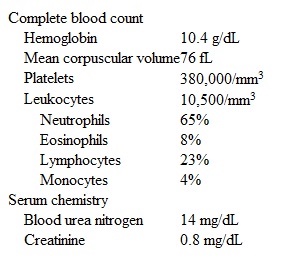 A dipstick urinalysis shows 1+ blood but is otherwise negative. Which of the following is the best next step to establish the diagnosis in this patient?
 (Multiple Choice)
4.8/5 (98)
(98) A 78-year-old man is brought to the office by his daughter, who states that he has become forgetful. Over the past year, his responses have become slow, and he has had increasing difficulties in caring for himself. He was recently seen by another physician, who suspected a "certain type of anemia." He has no urinary or respiratory problems. The patient was previously diagnosed with hypertension and coronary artery disease. He takes lisinopril, metoprolol, and aspirin. He lives with his daughter and son-in-law. He does not use tobacco, alcohol, or illicit drugs. Examination shows an elderly man who is disoriented to time and place and communicates poorly. He speaks softly and slowly and seems to think too much about his answers. The mini-mental state examination (MMSE) score is 22 points (normal >24). The patient's gait is slow and cautious, as if he were expecting to fall. Laboratory test results are as follows: 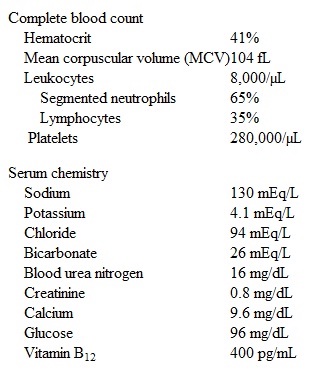 Which of the following is the most appropriate next step in the management of this patient?
 (Multiple Choice)
4.8/5 (67)
(67) A 50-year-old man is brought to the emergency department due to chest pain and lightheadedness for the past hour. He was clearing away snow when he suddenly felt substernal chest pressure accompanied by cold sweats. The pain has been constant, radiates to the left jaw, and is not relieved by rest or the nitroglycerin spray he received in the ambulance. The patient has a history of well-controlled hypertension. He smokes occasionally, especially on weekends, but does not use alcohol. His father had a myocardial infarction at age 60. On examination, the patient appears to be in mild distress. The extremities are cold. Temperature is 36.1 C (97 F), blood pressure is 84/52 mm Hg, pulse is 34/min, and respirations are 16/min. Oxygen saturation is 94% on 4 L/min nasal cannula oxygen. Lung auscultation reveals crackles at both lung bases. There are no heart murmurs. The abdomen is soft and nontender. ECG shows sinus bradycardia with a 3-mm ST-segment elevation in leads II, III, and AVF. Which of the following is most appropriate as part of initial management for this patient?
(Multiple Choice)
4.9/5 (84)
(84) A 24-year-old male veteran comes to the office for evaluation of chronic knee pain. He has no other medical history. He takes naproxen for knee pain due to an old athletic injury and says that he borrowed some oxycodone/acetaminophen from a friend on 2 occasions when the pain was particularly severe. He requests a prescription for pain medication "just in case the pain does not improve. I used to work in construction and I can't be in pain or I won't get a job." The patient has been unable to find steady employment since returning from his last deployment and worries about providing for his wife and 2-year-old son. He discloses that he has been drinking more when he feels depressed and can't sleep. The patient has difficulty both falling and staying asleep and problems concentrating. He feels guilty for not wanting to spend time with his son and for punching a hole in the wall during a recent argument with his wife. His appetite is unchanged and he has no suicidal ideation. Physical examination is unremarkable. Which of the following is the most appropriate next step in management of this patient?
(Multiple Choice)
4.9/5 (62)
(62) A study examined the role of a humanized monoclonal antibody (mAb) that binds soluble forms of amyloid in treating Alzheimer disease. Patients were randomly assigned to a mAb injection or placebo group for 14 months. The outcomes included changes in cognitive performance assessed by different scores at week 72 compared to baseline. Higher scores indicate worse impairment. The following numbers were reported for patients with mild and moderate Alzheimer disease. 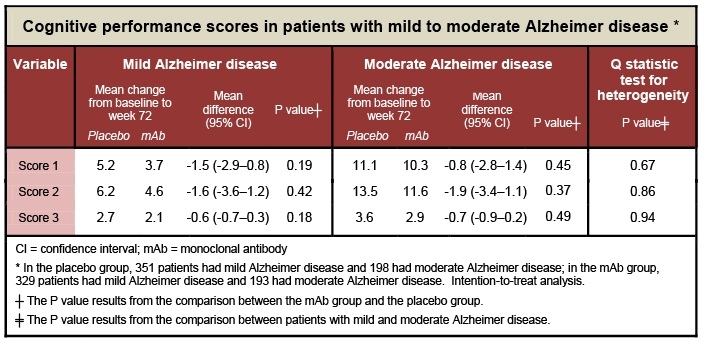 Which of the following is the most accurate interpretation of these study results?
 (Multiple Choice)
4.9/5 (78)
(78) Showing 301 - 320 of 1121

Filters
- Essay(0)
- Multiple Choice(0)
- Short Answer(0)
- True False(0)
- Matching(0)