



 Chat with AI
Exam 10: Pathology

Exam 1: Anatomy291 Questions
Exam 2: Behavioral science240 Questions
Exam 3: Biochemistry156 Questions
Exam 4: Biostatistics117 Questions
Exam 5: Embryology52 Questions
Exam 6: Genetics103 Questions
Exam 7: Histology24 Questions
Exam 8: Immunology129 Questions
Exam 9: Microbiology336 Questions
Exam 10: Pathology816 Questions
Exam 11: Pathophysiology464 Questions
Exam 12: Pharmacology538 Questions
Exam 13: Physiology272 Questions
Select questions type


A 23-year-old African American man comes to the emergency department due to back and lower extremity pain for 2 days. He has had several similar episodes over the last 15 years that have required hospitalization. His pain is not responsive to over-the-counter analgesics, and review of his prior records shows that he has needed treatment with opioids for adequate pain relief. The patient does not use tobacco, alcohol, or illicit drugs. On physical examination, he has scleral icterus and tenderness over his lower back and long bones of his thighs. Laboratory evaluation shows a hemoglobin level of 6.7 g/dL.Histopathologic evaluation of this patient's spleen is most likely to reveal which of the following?
(Multiple Choice)
4.8/5  (77)
(77) A 72-year-old man develops mild abdominal pain and bloody diarrhea after undergoing urgent cholecystectomy. The surgery was complicated by an episode of hypotension that was treated with bolus intravenous crystalloid fluids. The patient had no previous gastrointestinal bleeding. His last colonoscopy 10 years ago was normal. Past medical history is notable for hypertension, hyperlipidemia, type 2 diabetes mellitus, and a myocardial infarction 7 years ago. The patient smoked for 40 years and quit after the myocardial infarction. Colonoscopy would most likely show pathology in which of the following portions of the large bowel?
(Multiple Choice)
5.0/5 (80)
(80) A 24-year-old man comes to the physician with complaints of tinnitus, vertigo, and hearing loss. A contrast-enhanced, T1-weighted image of his brain is shown below. 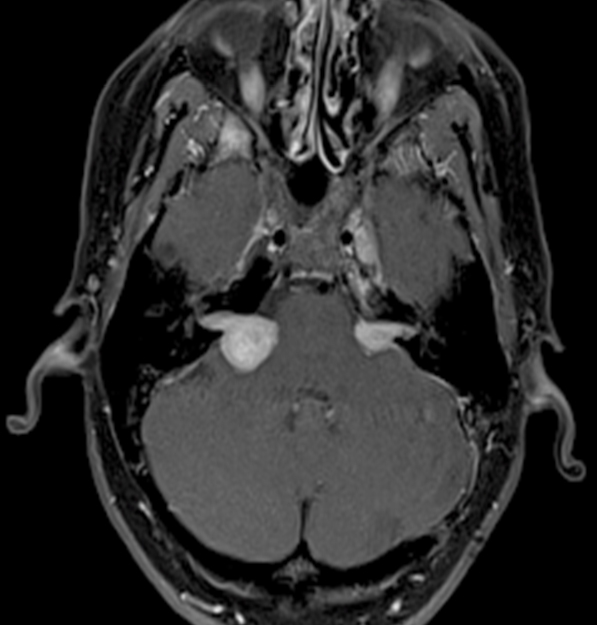 This patient's condition is most likely associated with a mutation involving which of the following genes?
 (Multiple Choice)
4.8/5 (79)
(79) A 52-year-old woman comes to the office due to a 2-month history of oral lesions that cause pain with chewing and swallowing food. The patient did not seek treatment because she thought the lesions would go away on their own, but they have persisted. On examination, there are erosions of the buccal and gingival mucosa, as shown in the image below. There are several flaccid bullae with erosions scattered over her trunk. The blisters spread laterally with pressure, and traction on seemingly uninvolved skin produces blistering. Autoantibodies directed against which of the following structures are most likely responsible for this process? 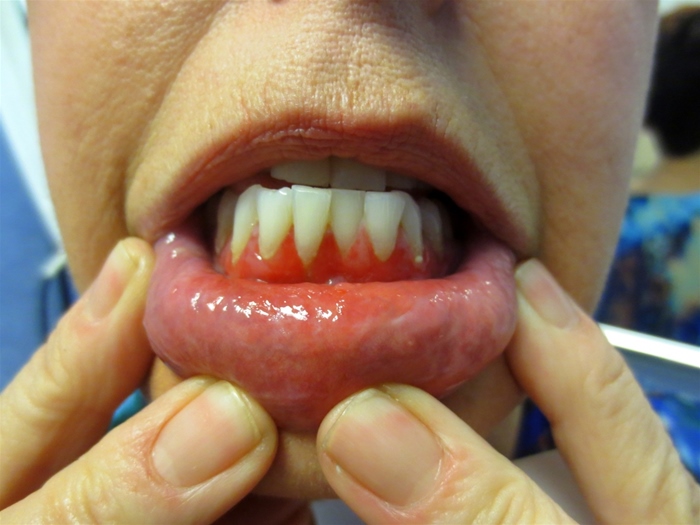
(Multiple Choice)
4.9/5 (77)
(77) A 42-year-old woman comes to the clinic due to a lesion on the left side of her chest. The lesion first appeared several months ago and is slowly enlarging and occasionally oozing blood. The patient underwent a living-donor kidney transplant 5 years ago for end-stage renal disease due to IgA nephropathy. She also has hypothyroidism due to Hashimoto thyroiditis. Medications include tacrolimus, mycophenolate, low-dose prednisone, and levothyroxine. Vital signs are normal. On physical examination, a 1 × 2 cm crusted lesion is noted over the midsternal area. Biopsy of the lesion is performed; histopathology findings are shown in the exhibit. 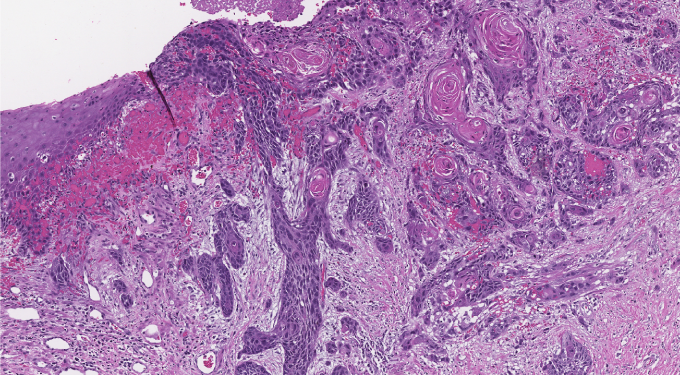 Which of the following most likely contributed to the development of this patient's skin lesion?
 (Multiple Choice)
4.8/5 (77)
(77) A 54-year-old Caucasian male comes to the emergency room with retrosternal chest pain of 30 minutes duration. The patient also complains of sweating and mild dyspnea. A single tablet of nitroglycerin is delivered sublingually, and the patient's pain decreases significantly. The patient has experienced several similar episodes of pain over the last 12 hours, all of which resolved spontaneously. Which of the following ultrastructural changes would most likely indicate irreversible myocardial cell injury in this patient?
(Multiple Choice)
4.7/5 (87)
(87) A 68-year-old man with a long history of using chewing tobacco comes to the office for follow up of squamous cell carcinoma (SCC) of the oral cavity. A month ago, the patient was diagnosed with SCC of the left lateral tongue. He underwent resection, the surgical specimen showed clear margins, and he started additional treatment. The patient recently noticed a second ulcerative lesion on the right lateral tongue. Biopsy is performed and it also shows SCC. The second tumor most likely arose from which of the following mechanisms?
(Multiple Choice)
4.8/5 (88)
(88) A 55-year-old man is found unresponsive on the street during a cold winter night. He is hypothermic and does not follow commands. Medical history is unavailable. Despite rewarming efforts, the patient dies in the emergency department. An autopsy is performed. Light microscopy of a section of the patient's kidney is shown on the slide below. 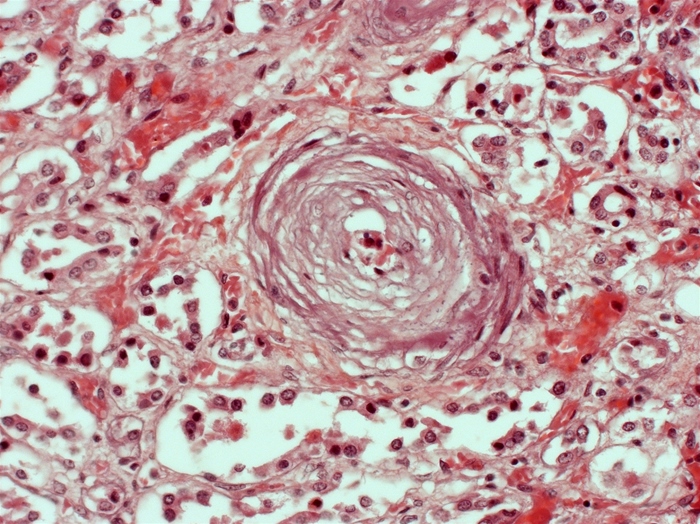 This individual's renal condition could most likely have been prevented by use of which of the following types of medication?
 (Multiple Choice)
4.9/5 (89)
(89) A 15-year-old boy is brought to the emergency department due to progressive shortness of breath. The patient has no chronic medical conditions. Temperature is 37.1 C (98.8 F), pulse is 130/min, and respirations are 32/min. Pulse oximetry is 94% on room air. Lung examination demonstrates diffusely diminished breath sounds. Clusters of enlarged cervical lymph nodes are palpable bilaterally. A large mediastinal mass is visualized on chest x-ray. The leukocyte count is elevated, and a peripheral blood smear shows abnormal white blood cells, as shown in the image below: 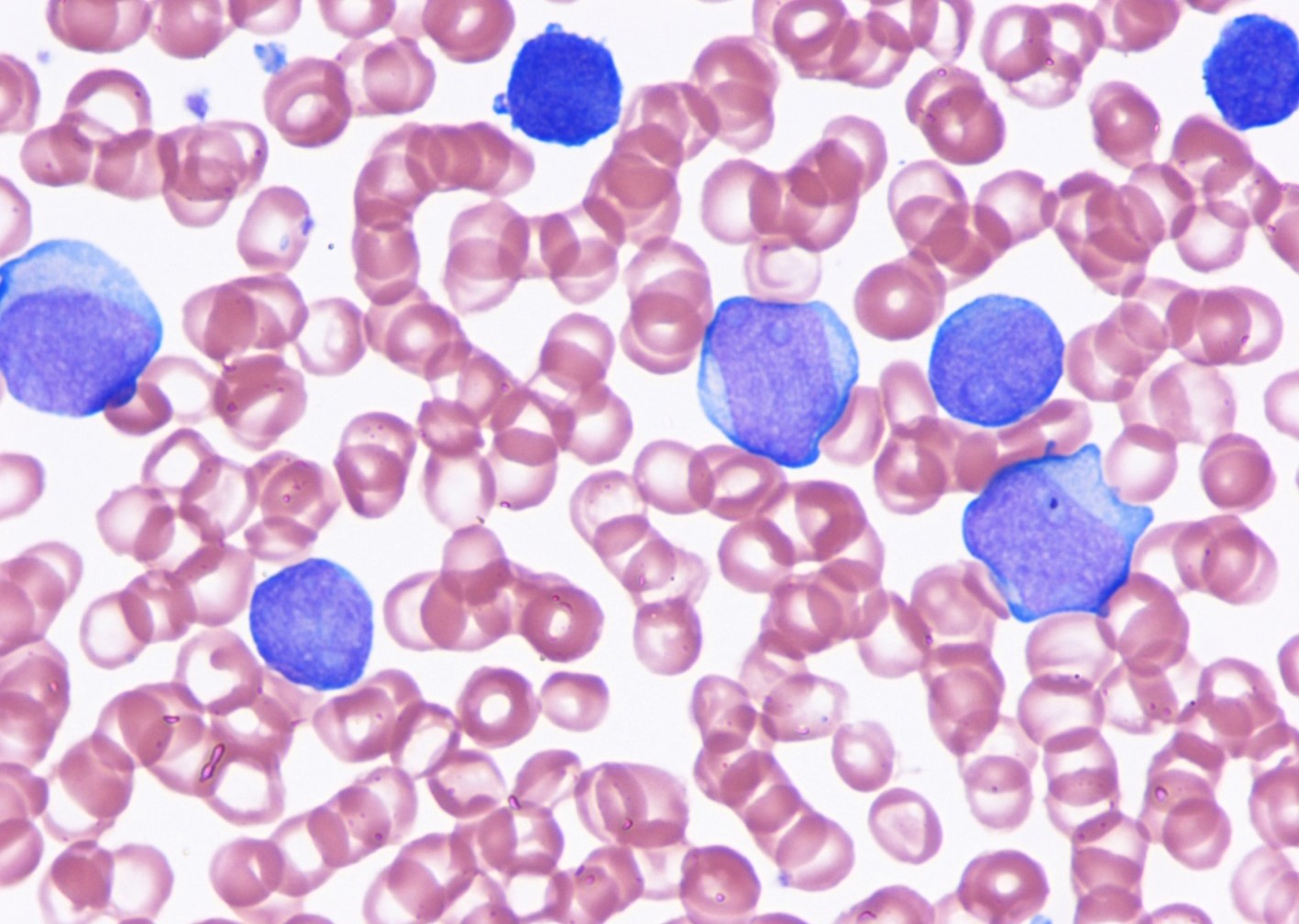 Specialized staining shows the cells are positive for terminal deoxynucleotidyl transferase (TdT) and CD3; they are negative for CD19 and myeloperoxidase (MPO). Which of the following is the most likely diagnosis?
 (Multiple Choice)
4.9/5 (86)
(86) A 21-year-old woman comes to the office due to recurrent episodes of self-limited, colicky abdominal pain. She also had an episode of facial swelling that resolved spontaneously. The patient has no other significant past medical history and takes no medications. Examination is unremarkable. Evaluation shows that her complement protein C1, even when not attached to an antigen-antibody complex, is excessively cleaving C2 and C4. Which of the following is most likely increased in this patient?
(Multiple Choice)
4.8/5 (79)
(79) A 6-year-old boy is brought to the emergency department after a traumatic fall from his bicycle. Physical examination shows a large laceration over his left leg that is irrigated and closed with sutures. While he is receiving care, a routine blood draw shows milky plasma that forms a creamy-appearing supernatant upon standing. Further testing shows that his plasma lipoprotein lipase activity measured after intravenous heparin administration is substantially lower than normal. If his condition remains untreated, this patient is most likely to develop which of the following features?
(Multiple Choice)
5.0/5 (89)
(89) A 32-year-old man comes to the clinic for peptic ulcer disease follow-up. The patient has received several months of proton pump inhibitor therapy without significant improvement in his epigastric discomfort. He does not use nonsteroidal anti-inflammatory drugs, tobacco, or alcohol. Helicobacter pylori testing is negative. The patient undergoes a partial gastrectomy for refractory peptic ulcer disease. The pathologist receives the tissue and notes significant enlargement of the gastric rugal folds on gross examination. Microscopy of the gastric mucosa reveals parietal cell hyperplasia. Which of the following stimuli is the most likely cause of parietal cell proliferation in this patient?
(Multiple Choice)
4.9/5 (82)
(82) A 10-year-old boy is brought to the hospital for difficulty swallowing. During dinner a few hours ago, a piece of chicken became stuck in the patient's mid-chest region. His parents say that he has previously had the sensation of food becoming stuck, but it has never lasted this long. The patient has vomited multiple times, but the chicken has not dislodged. Medical history is significant for eczema. He is drooling and visibly uncomfortable. An upper endoscopy is performed to remove the chicken from the esophagus, which exhibits multiple stacked, circular, ringlike indentations; linear furrowing; and scattered, small, whitish papules. Which of the following findings is most likely to be seen on biopsy of this patient's esophagus?
(Multiple Choice)
4.8/5 (66)
(66) A 42-year-old man comes to the emergency department due to fatigue and exertional dyspnea. Over the last 2 weeks his symptoms have progressively worsened to the point that he can no longer walk across his living room without becoming short of breath. He is admitted to the hospital but dies suddenly despite aggressive treatment. An autopsy is performed, and a cross-section of his heart is shown in the image below. 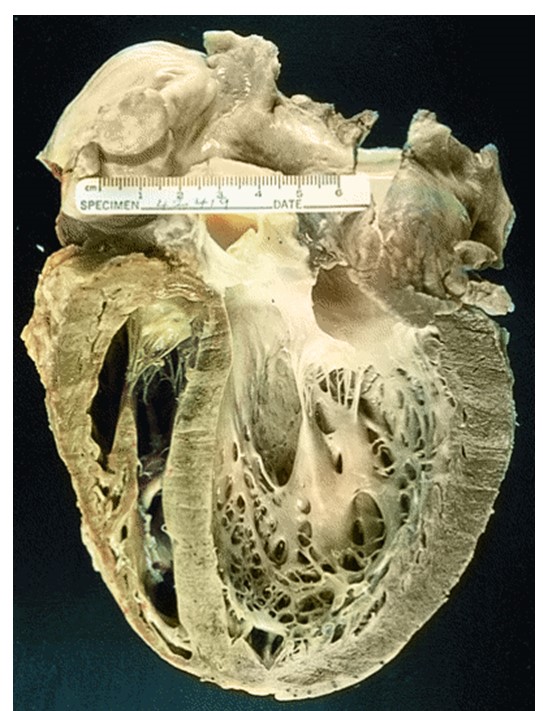 This patient's symptoms were most likely caused by which of the following mechanisms?
 (Multiple Choice)
4.9/5 (81)
(81) A 22-year-old man comes to the office due to 3 months of progressive back pain. He has also had intermittent subjective fever. The patient emigrated from Nepal for a master's program 6 months ago. He has no other medical conditions, takes no medication, and does not use tobacco, alcohol, or illicit drugs. Temperature is 38.3 C (100.9 F), blood pressure is 122/78 mm Hg, and pulse is 84/min. BMI is 19 kg/m2. Tenderness is noted over the lumbar spine; flexion, extension, and rotation of the spine are limited due to pain and muscle spasm. MRI of the lower spine reveals partial destruction of the anterior portion of the L1-L3 vertebral bodies and a fluid collection beneath the anterior longitudinal ligament. Which of the following is the most likely diagnosis?
(Multiple Choice)
4.9/5 (83)
(83) A 45-year-old man comes to the office due to slowly progressive back and joint pain. In particular, his knee and ankle joints are stiff and painful when he walks. Over the past year, the patient has also experienced excessive sweating, and his ring and shoe sizes have increased. He has no prior medical issues and takes no medications. The patient does not use tobacco, alcohol, or illicit drugs. There is no significant family history. Physical examination shows coarse facial features with a prominent forehead, protruding jaw, and widely separated maxillary teeth. There is mild swelling and crepitus of the knees and ankles bilaterally. Which of the following is most likely to be associated with this patient's condition?
(Multiple Choice)
4.7/5 (74)
(74) A 63-year-old man comes to the emergency department with 2 hours of chest pain and shortness of breath. The pain started as lower sternal discomfort that he attributed to indigestion, but then spread all over the anterior chest. The patient has never had similar pain before. Medical history includes hypertension, hyperlipidemia, and diet-controlled type 2 diabetes mellitus. The patient is an ex-smoker with a 20-pack-year history. On cardiac auscultation, a systolic murmur is heard. Basilar crackles are present on both sides. After initial evaluation, the patient is taken to the cardiac catheterization laboratory and is found to have a coronary artery occlusion, which is successfully revascularized. The next morning, the patient appears comfortable and wants to go home. The lungs are clear on auscultation, and no heart murmur is present. The murmur heard during initial presentation is most likely explained by a pathologic process involving which of the following structures?
(Multiple Choice)
4.9/5 (84)
(84) A 17-year-old boy collapses while jogging and dies despite resuscitation efforts. He has no medical history; however, his family history is significant for an uncle who died suddenly at age 20. The boy is 185.4 cm (6 ft 1 in) tall and weighs 80 kg (176.4 lb). Autopsy reveals significant left ventricular hypertrophy predominantly affecting the interventricular septum. There are no valvular abnormalities. Assuming the boy died of an inherited condition, which of the following proteins was most likely affected by the relevant mutation?
(Multiple Choice)
4.8/5 (82)
(82) A 4-year-old girl is brought to the clinic due to an inward deviated right eye. Examination shows a pale red reflex in the right eye relative to the left eye. Dilated funduscopic examination reveals a well-circumscribed white mass within the retina. Genetic analysis shows a germline mutation in the patient's cells leading to development of the mass. Which of the following is the most likely function of the protein affected by this patient's gene mutation?
(Multiple Choice)
4.9/5 (88)
(88) A 34-year-old man comes to the office due to a persistent skin rash. He has a 6-month history of a scaly rash involving the upper and lower extremities that is associated with mild pruritus. The patient has attempted treatment with topical antihistamines and emollients without relief. Medical history is notable for childhood asthma and orolabial herpes simplex virus infection. He does not use tobacco or alcohol and works as a sales associate for a home improvement store. On examination, the patient has skin lesions as shown in the image below. 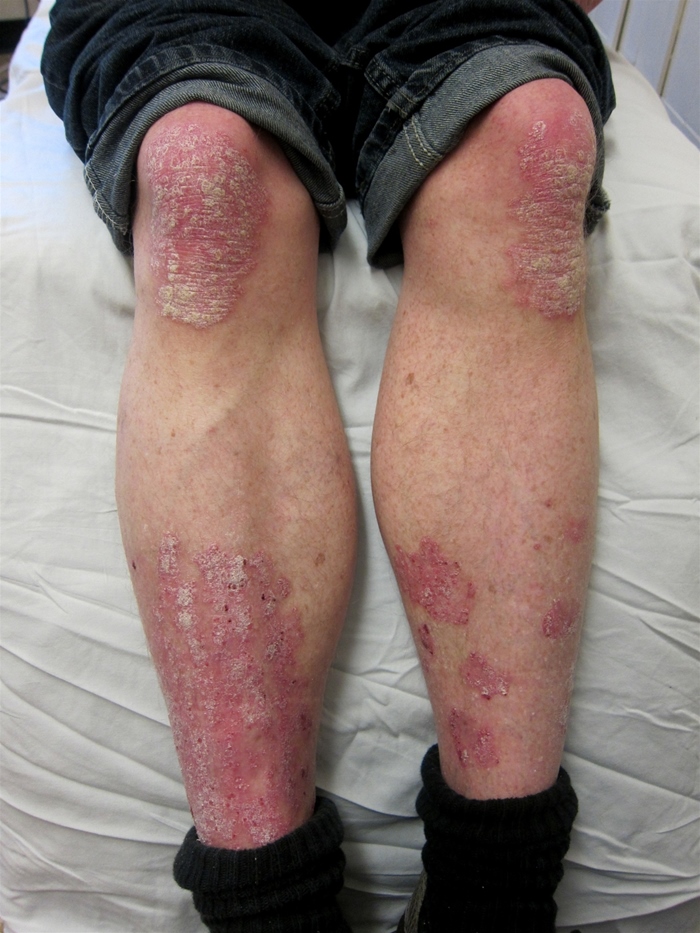 This patient's disorder is most likely associated with which of the following extradermal complications?
 (Multiple Choice)
4.8/5 (77)
(77) 
Filters
- Essay(0)
- Multiple Choice(0)
- Short Answer(0)
- True False(0)
- Matching(0)