



 Chat with AI
Exam 10: Pathology

Exam 1: Anatomy291 Questions
Exam 2: Behavioral science240 Questions
Exam 3: Biochemistry156 Questions
Exam 4: Biostatistics117 Questions
Exam 5: Embryology52 Questions
Exam 6: Genetics103 Questions
Exam 7: Histology24 Questions
Exam 8: Immunology129 Questions
Exam 9: Microbiology336 Questions
Exam 10: Pathology816 Questions
Exam 11: Pathophysiology464 Questions
Exam 12: Pharmacology538 Questions
Exam 13: Physiology272 Questions
Select questions type


A 26-year-old woman, gravida 1, para 1, comes to the office for a routine examination. The patient has noticed new facial hair over the past few months and thinks her voice is deeper. Her last menstrual period was 5 months ago. The patient's mother died from infiltrating lobular breast carcinoma at age 60. Physical examination is significant for coarse facial hair, and pelvic examination reveals clitoromegaly with a large adnexal mass. Urine pregnancy test is negative. Pelvic ultrasonography confirms a large ovarian mass. Which of the following is the most likely diagnosis?
(Multiple Choice)
4.8/5  (83)
(83) A 49-year-old man comes to the office for evaluation of a dry cough that occurs mainly at night. His symptoms have been present on and off for several years, but he has not been previously evaluated. The patient also reports a frequent sore throat and occasional epigastric discomfort. He has tried a variety of antihistamines and over-the-counter cough medications without relief. Past medical history is notable for obesity and diet-controlled type 2 diabetes mellitus. He does not smoke or drink alcohol. Cardiopulmonary and abdominal examinations are unremarkable. Chest x-ray reveals no abnormalities, and pulmonary function testing is normal. The patient undergoes upper gastrointestinal endoscopy with mucosal biopsies. Microscopic findings on lower esophageal biopsy are shown in the image below. 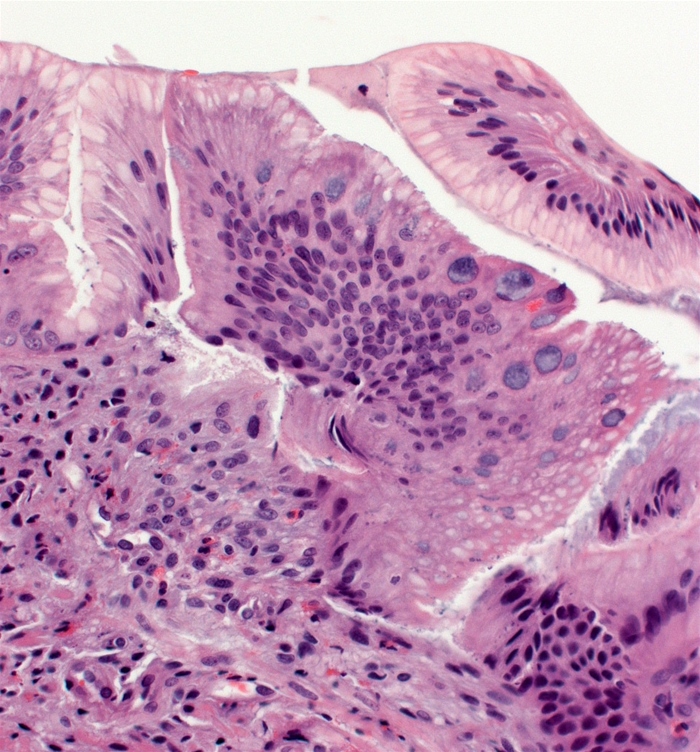 This patient is at highest risk of which of the following complications?
 (Multiple Choice)
4.8/5 (83)
(83) A 55-year-old man comes to the office due to recurrent abdominal discomfort. He also has bloating, a feeling of fullness, and indigestion. Vital signs are within normal limits, and abdominal examination is unremarkable. Fecal occult blood testing is positive. Gastrointestinal endoscopic procedures are performed and confirm the presence of an ulcer. The patient is told that the ulcer itself is very unlikely to be malignant based on its location. Which of the following is the most likely site of this patient's gastrointestinal ulcer?
(Multiple Choice)
4.8/5 (73)
(73) A 3-year-old girl is brought to the office due to 2 days of fever and rash. Her mother says the patient has also been refusing to eat or drink. She has no prior medical conditions and is up to date with recommended vaccinations. None of the family members have had recent febrile illness, but the patient recently started attending day care. Temperature is 38.3 C (101 F). Physical examination shows multiple small vesicles and ulcers with an erythematous base on the buccal mucosa and tongue. There are similar vesicular lesions on the distal extremities. Which of the following is the most likely underlying cause of this patient's rash?
(Multiple Choice)
4.8/5 (78)
(78) A 68-year-old woman comes to the office due to increasing low back pain. The pain is constant and worsens at night. She has also had a 6.8-kg (15-lb) weight loss over the past 3 months. Medical history is significant for osteoporosis and hypothyroidism. Family history is significant for breast cancer in her mother. She has smoked 1 pack of cigarettes daily for 30 years and drinks 1 or 2 glasses of wine every day. The patient immigrated to the United States from China 30 years ago; she mainly eats food she cooks herself. Vital signs are within normal limits. Physical examination shows point tenderness over the L3 and L4 vertebrae. MRI reveals lytic bone lesions in the corresponding vertebrae and also a right lower pole kidney mass. Histologic examination of the mass is shown below: 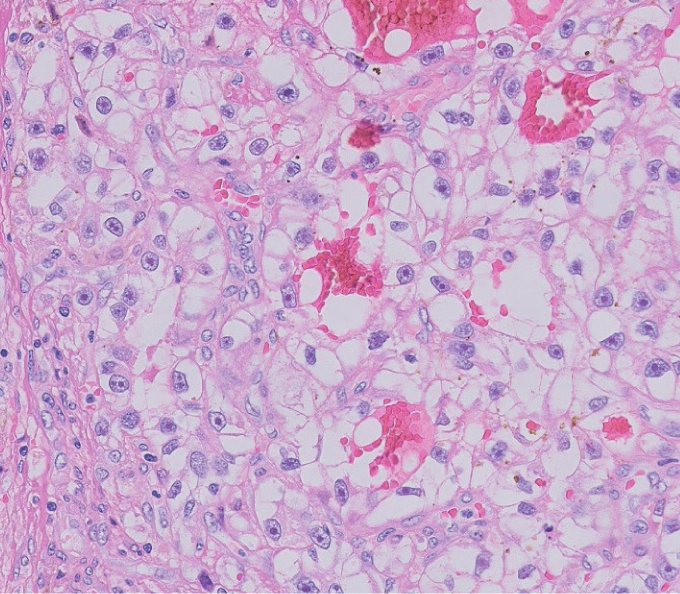 Which of the following risk factors most likely contributed to this patient's current condition?
 (Multiple Choice)
4.8/5 (78)
(78) A 34-year-old woman is evaluated in the emergency department due to 1-day of chest and left shoulder pain. The patient describes the pain as constant and worse in certain positions. A month ago, she was treated for a skin rash and joint pain. Her medical history is otherwise unremarkable. She is a lifetime nonsmoker and does not use alcohol or illicit drugs. Her father has hypertension and had a stroke at age 64. Temperature is 37.5 C (99.5 F), blood pressure is 122/70 mm Hg, and pulse is 97/min and regular. A triphasic, scratchy sound is heard over the left sternal border with the patient sitting up. The lungs are clear on auscultation. ECG shows sinus rhythm with ST-segment elevation in all leads except avR and V1. Which of the following is the most likely diagnosis?
(Multiple Choice)
4.9/5 (73)
(73) A gross brain section of a 54-year-old male who suffered from severe tuberculous meningitis is shown below. 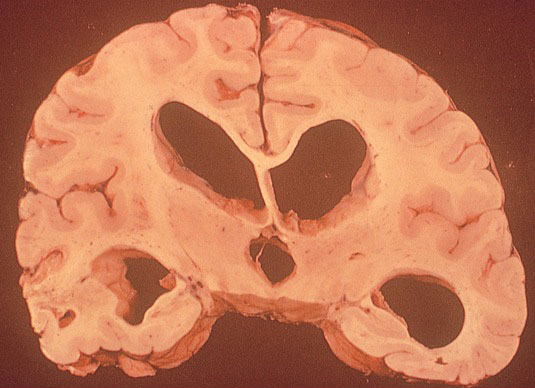 This patient's condition is most likely related to impaired function of which of the following?
 (Multiple Choice)
4.8/5 (83)
(83) A 65-year-old woman is evaluated for worsening urinary urgency and incontinence. The patient has had no abdominal pain, dysuria, or changes in urinary frequency. On several occasions, she has urinated involuntarily, which she attributes to an inability to walk quickly to the bathroom. The patient feels unsteady while ambulating and walks slowly with small steps. Her family also reports that she has become forgetful and has difficulty planning and executing various activities that she used to perform regularly. Medical history is notable for hypertension. The patient does not use tobacco, alcohol, or illicit drugs. Vital signs are within normal limits. Cardiopulmonary, abdominal, and genitourinary examinations show no abnormalities. Neurological examination shows impaired attention and short-term memory. MRI of the brain reveals chronic white matter changes with no infarction, hemorrhage, or mass lesions. There is diffuse ventriculomegaly with no sulcal enlargement. Which of the following is the most likely underlying cause of this patient's urinary incontinence?
(Multiple Choice)
4.9/5 (84)
(84) A 4-year-old boy is brought in by his parents for evaluation of a fever that has persisted for the past 5 days. He has also been more irritable than usual and had 2 or 3 episodes of vomiting. The patient has no prior medical problems and takes no medications. He has received all recommended vaccinations. He traveled to China last year to visit his grandparents and cousins but has not traveled outside of the country this year. Temperature is 38.9 C (102 F). Physical examination shows bilateral conjunctival injection with no exudates. His tongue is bright red and lips are cracked. Nonpitting edema is present on his hands and feet. Which of the following complications is this patient at greatest risk for developing?
(Multiple Choice)
4.9/5 (76)
(76) A 28-year-old woman at 32 weeks gestation is seen in the office for a routine prenatal visit. The patient has had burning, squeezing pain in the middle of her chest that lasts for minutes to hours at a time and usually occurs after meals. The pain is occasionally accompanied by small amounts of sour-tasting material in the back of her throat. The patient does not have any abdominal pain, emesis, or visible blood in the stool. Her pregnancy has been complicated by gestational diabetes mellitus, which has been well controlled with nutritional therapy and exercise. She does not use alcohol, tobacco, or illicit drugs. Vital signs are normal. Fundal height is 32 cm and fetal heart tones are normal. Which of the following is the most likely cause of the patient's symptoms?
(Multiple Choice)
4.8/5 (73)
(73) A 21-day-old boy is brought to the office by his mother because of a palpable bulge in the child's neck. He continues to feed well but appears comfortable only when held with his body sideways under the breast. He is at the 50th percentile for height, weight, and head circumference. The child favors looking toward the right and cries when his head is turned to the left. There is a firm mass on the left side of his neck that does not move when the child swallows. The remainder of the examination is unremarkable. Which of the following conditions was most likely present prenatally?
(Multiple Choice)
4.9/5 (73)
(73) A 23-year-old man comes to the office due to a rapidly enlarging left jaw mass that has developed over the past several weeks. The patient is a political refugee from East Africa. He has no known medical problems and takes no medications. Temperature is 37.1 C (98.8 F). Physical examination shows a large left-sided tumor on his jaw with surrounding lymphadenopathy but no erythema or warmth. The rest of the examination is unremarkable. HIV testing is negative. The lesion is biopsied, and numerous mitotic figures and apoptotic bodies are observed on histopathologic examination. Which of the following genetic features is most likely to be present in this tissue?
(Multiple Choice)
4.8/5 (77)
(77) A 27-year-old man comes to the emergency department due to severe left knee pain and swelling for the past 2 days. He has no recent injury or significant medical problems. The patient drinks 3 or 4 cans of beer daily but does not use tobacco or illicit drugs. He works as a groundskeeper at a nearby golf course and has had to take the last couple of days off because of the pain. Temperature is 38.3 C (101 F), blood pressure is 115/70 mm Hg, and pulse is 92/min. On examination, the left knee is swollen, erythematous, warm, and tender with restricted range of active and passive motion. The remainder of the examination is unremarkable. Which of the following is the best next step in management of this patient?
(Multiple Choice)
4.8/5 (79)
(79) A 56-year-old man is evaluated for dyspnea, wheezing, and cough productive of yellow sputum. The patient reports that he has been treated with antibiotics when the dyspnea is severe. He has smoked 2 packs of cigarettes daily for the past 25 years. The schematic diagram below is a representation of a bronchial wall. Which of the following ratios is the best pathological index to determine the severity of this patient's disease? 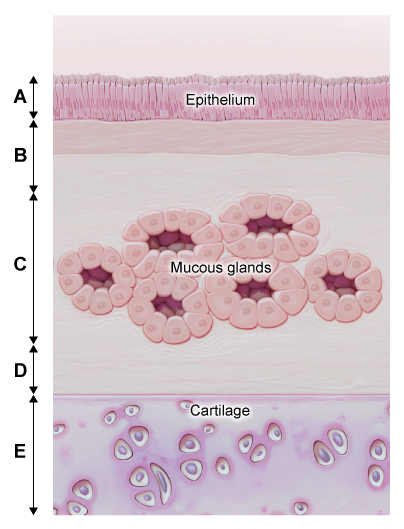
(Multiple Choice)
4.9/5 (85)
(85) A 37-year-old woman comes to the office due to a two-month history of abdominal pain, salt craving, and weight loss. She also has dizziness on standing. The patient has no chronic medical conditions and takes no medications. She does not use tobacco, alcohol, or illicit drugs. Her mother and sister have hypothyroidism. Blood pressure is 100/70 mm Hg supine and 80/50 mm Hg standing. Laboratory results are as follows: 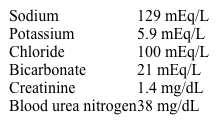 Which of the following changes in circulating hormone levels are expected in this patient?
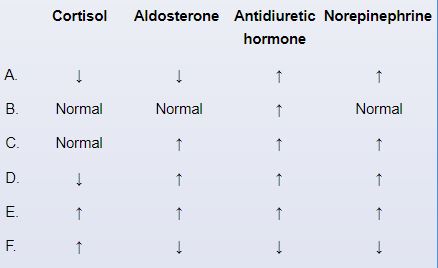
Which of the following changes in circulating hormone levels are expected in this patient?
(Multiple Choice)
5.0/5 (89)
(89) A 10-year-old boy who recently immigrated from overseas with his family is brought to the office due to exertional dyspnea and fatigability. The boy tires easily when walking and cannot keep up with his peers at the playground. According to his parents, he was diagnosed with congenital heart disease in infancy, but corrective surgery was unavailable. They cannot recall the details of his diagnosis. He takes a daily multivitamin and no medications. Pulse oximetry of the right hand shows 99% on room air. Physical examination reveals no murmurs. There is bilateral cyanosis and clubbing of the toes. The fingers are normal. All extremity pulses are full and equal. Which of the following is the most likely diagnosis?
(Multiple Choice)
4.9/5 (77)
(77) A 62-year-old man comes to the office due to poorly localized, intermittent abdominal pain that is triggered by eating and slowly subsides over the ensuing several hours. The patient has also lost 4.5 kg (10 lb) over the past 2 months. He has a history of hypertension and hyperlipidemia and has smoked a pack of cigarettes daily for 40 years. Blood pressure is 175/105 mm Hg and pulse is 70/min and regular. The abdomen is soft and nontender. CT scan of the abdomen reveals the renal findings shown in the image below. 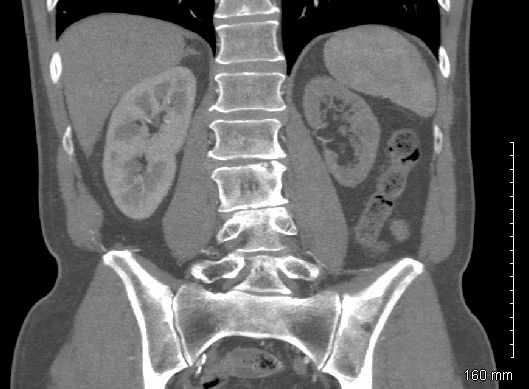 This patient most likely suffers from which of the following conditions?
 (Multiple Choice)
4.9/5 (77)
(77) A 57-year-old man is hospitalized for aspiration pneumonia. The patient was healthy and worked as an engineer without difficulty until about 4 months ago. Since that time, he has developed severe confusion, mood changes, and memory impairment and had to take medical leave from work. The patient is now completely dependent on his wife for toileting, feeding, and general self-care. Physical examination shows disorientation and sporadic, jerky extremity movements. During hospitalization, the patient lapses into a coma and dies. Postmortem examination of his brain shows widespread atrophy of the cerebral cortex and cerebellum. Histologic analysis of the patient's brain tissue would most likely show accumulation of which of the following?
(Multiple Choice)
4.7/5 (72)
(72) A research center studying cardiovascular pathology is conducting trials in which experimental rabbits are fed sweet peas containing substances that alter connective tissue synthesis and maturation. The animals are monitored for several weeks prior to euthanasia. Autopsy shows myxomatous degeneration with pooling of proteoglycans in the media layer and an intact intima layer in large arteries. The pathologic findings seen in the experiment are most similar to which of the following conditions?
(Multiple Choice)
4.8/5 (69)
(69) A 47-year-old woman, gravida 2 para 2, comes to the office after noticing a pea-sized lump in her right breast while taking a shower. Her medical history is significant for 3 pack-years of cigarette use during her 20s. She underwent infertility treatment and in vitro fertilization for both of her pregnancies. The patient has no family history of breast or ovarian cancer. A clinical breast examination confirms the presence of a firm, fixed nodule in the right breast with a small patch of overlying puckered skin. Mammogram findings are highly suspicious for malignancy, and a needle biopsy reveals infiltrating ductal carcinoma. A right mastectomy and axillary lymph node dissection are scheduled. Overexpression of which of the following markers is most likely to be associated with aggressive disease in this patient?
(Multiple Choice)
4.7/5 (85)
(85) 
Filters
- Essay(0)
- Multiple Choice(0)
- Short Answer(0)
- True False(0)
- Matching(0)