



 Chat with AI
Exam 10: Pathology

Exam 1: Anatomy291 Questions
Exam 2: Behavioral science240 Questions
Exam 3: Biochemistry156 Questions
Exam 4: Biostatistics117 Questions
Exam 5: Embryology52 Questions
Exam 6: Genetics103 Questions
Exam 7: Histology24 Questions
Exam 8: Immunology129 Questions
Exam 9: Microbiology336 Questions
Exam 10: Pathology816 Questions
Exam 11: Pathophysiology464 Questions
Exam 12: Pharmacology538 Questions
Exam 13: Physiology272 Questions
Select questions type


A 34-year-old woman comes to the office due to vague abdominal pain over the past several months. She has no significant past medical history. The patient does not use tobacco or alcohol. Temperature is 36.7 C (98.1 F). On physical examination, right upper quadrant fullness is present. Abdominal imaging reveals a dense liver mass. Angiography shows a well-demarcated, highly vascularized tumor surrounded by normal liver parenchyma. Which of the following substances most likely contributed the most to blood vessel development in this patient's tumor?
(Multiple Choice)
4.8/5  (80)
(80) A 26-year-old man is brought to the emergency department after a high-speed motorcycle collision. The patient was thrown several feet after his motorcycle collided with a car. On arrival, he is profoundly comatose. A CT scan of the head performed within an hour of the event shows no abnormalities. The patient dies several hours later, and autopsy examination is performed. Brain histopathology shows widespread axonal swelling, predominantly at the gray-white junction. Immunohistochemical staining of these axons reveals accumulation of alpha-synuclein and amyloid precursor proteins. Which of the following is the most likely cause of these observed findings?
(Multiple Choice)
4.8/5 (85)
(85) A 64-year-old man comes to the office due to generalized edema, fatigue, and dyspnea on exertion for 2 months. The patient has a 25-year history of poorly controlled rheumatoid arthritis. Temperature is 36.9 C (98.4 F), blood pressure is 108/70 mm Hg, and pulse is 90/min. The patient is thin and appears chronically ill but is in no acute distress. There is no lymphadenopathy. Breath sounds are decreased at the lung bases. Musculoskeletal examination shows severe deformities of the hands and feet related to rheumatoid arthritis. There is pitting edema of both legs up to the knees. Peripheral pulses are normal. Urinalysis shows 4+ protein but is otherwise normal. A renal biopsy is performed. Which of the following histologic abnormalities is most likely to be seen in this patient's glomeruli?
(Multiple Choice)
4.8/5 (80)
(80) A 58-year-old homeless man is brought to the emergency department after being found unresponsive on a sidewalk. The patient has been hospitalized on several occasions for alcohol and illicit drug intoxication. He also has a history of hypertension but is not adherent with medical therapy. On arrival, the patient is obtunded, febrile, and hypotensive. Physical examination reveals lung crackles and a new blowing diastolic murmur consistent with aortic regurgitation. Appropriate treatment is started, but the patient dies several days later. Autopsy examination shows symmetric, bilateral wedge-shaped strips of necrosis over the cerebral convexity, parallel and a few centimeters lateral to the interhemispheric cerebral fissure. Which of the following is the most likely cause of this patient's cerebral findings?
(Multiple Choice)
4.9/5 (94)
(94) A 35-year-old woman comes to the emergency department due to fatigue, exertional dyspnea, and cough. She has had subjective fevers but no upper respiratory symptoms, and no family members have had a similar illness. Medical history is unremarkable, and the patient does not use tobacco. Temperature is 37.5 C (99.5 F), blood pressure is 118/75 mm Hg, pulse is 90/min, and respirations are 22/min. Pulmonary examination shows normal air exchange with scattered crackles and no wheezes. The patient also has nontender cervical lymphadenopathy. Serum chemistry shows a calcium level of 12.0 mg/dL. Chest x-ray demonstrates scattered nodules and parenchymal infiltrates, as shown in the image below. 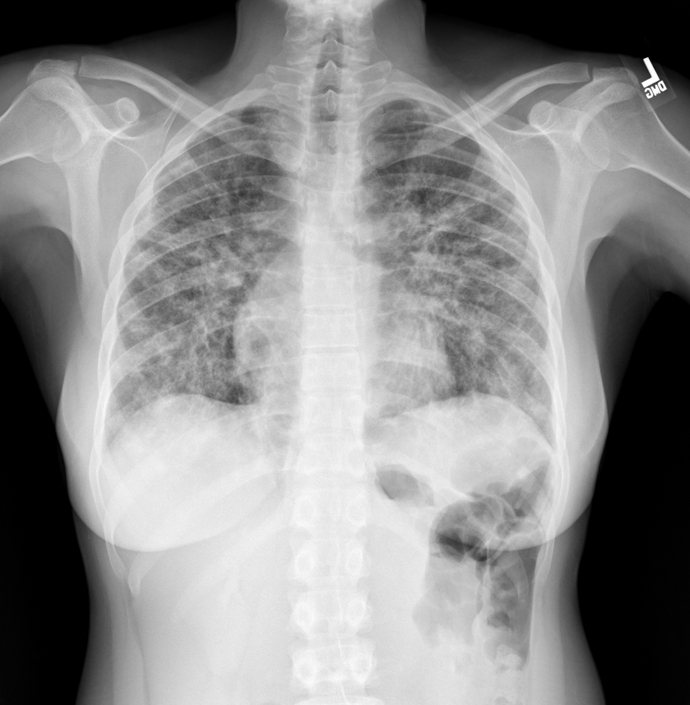 Lymph node biopsy reveals noncaseating granulomas. Which of the following is the most likely cause of the elevated calcium level in this patient?
 (Multiple Choice)
4.8/5 (80)
(80) A 61-year-old woman is hospitalized due to chest pressure and shortness of breath. Two days ago her husband died in a car accident. The patient's medical history is significant for hypertension, hyperlipidemia, and gout. Five years ago, she was diagnosed with breast cancer and treated with surgery and chemotherapy. Blood pressure is 165/90 mm Hg and pulse is 95/min and regular. Physical examination is unremarkable. ECG shows normal sinus rhythm with T-wave inversions in the anterior leads. Echocardiogram shows hypokinesis of the apical wall with decreased left ventricular ejection fraction. Diagnostic coronary angiography shows no evidence of obstructive coronary artery disease. The patient is treated medically and discharged home. Four weeks later, she is seen in the office and has no symptoms. Repeat echocardiography demonstrates normal left ventricular wall motion and ejection fraction. Which of the following is the likely cause of this patient's initial presentation?
(Multiple Choice)
4.9/5 (77)
(77) A 28-year-old woman comes to the office due to discomfort during urination for the past 3 months. Antibiotics for a urinary tract infection were prescribed at an urgent care center a few weeks ago, but her symptoms have persisted despite treatment. The patient has also noticed increasing pain with the passage of stool for the last year, particularly during menses. Bowel movements occur daily and are soft and not watery. Examination shows suprapubic tenderness and an immobile, retroverted uterus. Rectovaginal examination reveals nodularity in the posterior cul-de-sac. Urinalysis and urine culture are normal. Surgical biopsy of the pelvic nodules would most likely show which of the following?
(Multiple Choice)
4.9/5 (73)
(73) A 44-year-old woman comes to the office due to indigestion. The patient says she often develops right upper quadrant abdominal discomfort and nausea with fatty meals, which subside spontaneously after several hours. She does not use tobacco, alcohol, or illicit drugs. The patient immigrated to the United States from Nepal 10 years ago. Abdominal ultrasound reveals numerous gallstones, and she undergoes elective laparoscopic cholecystectomy. The stones in her gallbladder have very low cholesterol content and appear small, dark, and spiculated. Which of the following conditions most likely predisposed this patient to gallstone formation?
(Multiple Choice)
4.8/5 (77)
(77) A 65-year-old woman comes to the office due to progressively worsening weakness of the legs for 5 months. Examination shows increased muscle tone, brisk deep tendon reflexes, and decreased muscle strength in the lower extremities. The Babinski sign is positive in both legs. Upper extremities are normal. MRI of the spine reveals a 2-cm, round lesion with homogeneous, intense contrast enhancement compressing the spinal cord at the T12 level; the lesion is extramedullary but is surrounded by cerebrospinal fluid, as shown in the exhibit. 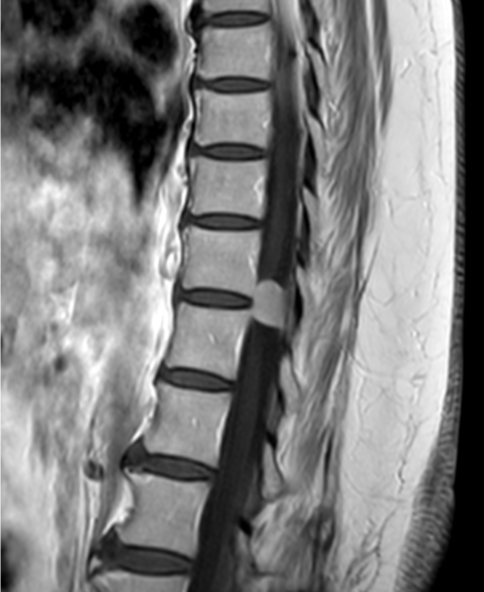 Which of the following is the most likely cell of origin of the lesion?
 (Multiple Choice)
4.7/5 (85)
(85) A 32-year-old chef accidentally slices into the tip of her thumb while hurriedly trimming ribeye steaks with a knife. The laceration extends through the skin into the subcutaneous pulp. Which of the following sequences is most likely to occur in the subsequent wound healing process?
(Multiple Choice)
4.8/5 (88)
(88) A 68-year-old woman comes to the office for a preventive visit. The patient feels well, and recently lost 4 kg (8.8 lb) on a new diet and exercise regimen. She has no recent history of abdominal pain, jaundice, or changes in her stools. Past medical history is notable for hypertension and hypercholesterolemia, for which the patient takes appropriate medications. She does not use tobacco, alcohol, or illicit drugs. Vital signs are normal. On examination, the abdomen is soft and nontender, and no hepatosplenomegaly is noted. However, a firm mass is palpated in the right upper quadrant. CT scan of the abdomen is ordered and is shown below. 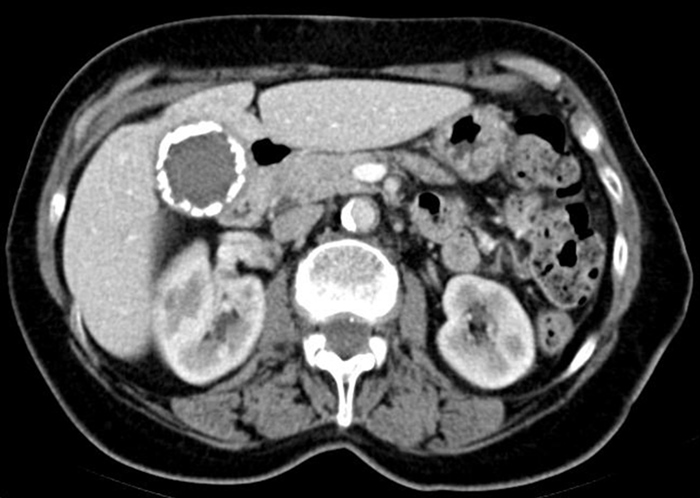 This patient is at elevated risk for which of the following conditions?
 (Multiple Choice)
4.9/5 (84)
(84) A 21-year-old man comes to the office due to yellow discoloration of his eyes after a hiking trip. The patient had a similar episode 2 years ago after fasting for a couple of days. Vital signs are within normal limits. Examination shows scleral icterus; there is no hepatosplenomegaly. Laboratory findings are as follows: 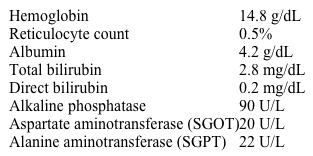 Which of the following is the most likely cause of this patient's jaundice?
 (Multiple Choice)
4.7/5 (83)
(83) A 33-year-old man comes to the emergency department due to 3 days of shortness of breath, profound fatigue, and chills. The patient has a history of intravenous drug use. He was enrolled in a methadone program but admits to relapsing last week. Temperature is 40 C (104 F), blood pressure is 75/40 mm Hg, pulse is 122/min and regular, and respirations are 40/min. He is admitted to the intensive care unit but dies despite treatment efforts. Lung autopsy findings are shown in the image below. 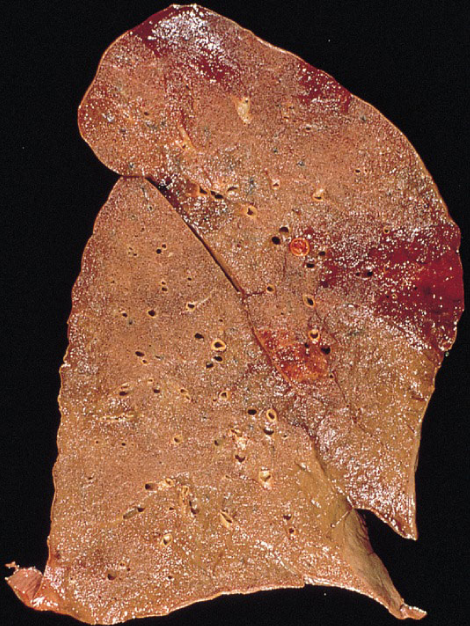 Which of the following is the most likely diagnosis in this patient?
 (Multiple Choice)
4.7/5 (75)
(75) A 70-year-old man is brought to the emergency department due to left-sided weakness and slurred speech upon awakening 30 minutes ago. The patient was asymptomatic when he went to bed last night. Medical history includes type 2 diabetes mellitus, hypertension, and hyperlipidemia. The patient is a former smoker with a 30-pack-year history. Physical examination shows a right gaze preference, left lower facial droop, and hemiplegia and hemisensory loss on the left. CT scan of the brain reveals early infarction in the right middle cerebral artery territory with no acute hemorrhage. The patient is hospitalized for further management. Several hours later, he becomes progressively obtunded with elevated intracranial pressure. A repeat CT scan reveals edema in the region of acute infarction causing mass effect. Which of the following is the primary contributor to the pathogenesis of this patient's raised intracranial pressure?
(Multiple Choice)
4.7/5 (65)
(65) A 48-year-old woman comes to the office 10 days after undergoing breast reduction surgery. She feels well overall and is taking acetaminophen as needed for pain control. Vital signs are normal. Examination of the breasts reveals intact surgical incisions without drainage; the incisions are pink, shiny, and slightly warm. The surrounding skin has mild edema but no erythema. Which of the following wound healing processes is most likely occurring at this time?
(Multiple Choice)
4.8/5 (77)
(77) A 42-year-old woman comes to the office due to several months of episodic shortness of breath and cough. The patient has a history of migraines and occasionally takes acetaminophen. She is a school teacher and does not use tobacco, alcohol, or illicit drugs. Temperature is 36.1 C (97 F), blood pressure is 110/80 mm Hg, and pulse is 84/min. Pulse oximetry shows 96% on room air. Lung examination and chest x-ray are normal. Spirometry shows that FEV1 is 71% of the predicted value. Sputum analysis shows predominant eosinophils. Exposure to which of the following is most closely associated with this patient's symptoms?
(Multiple Choice)
5.0/5 (89)
(89) Experimental animals are immunized to protein fragments derived from peripheral nerve myelin. Subsequent analysis finds evidence of a T-cell response as well as production of autoantibodies against nonprotein antigens. This leads to segmental demyelination of peripheral nerves in the animals. The experimentally induced condition is most analogous to which of the following?
(Multiple Choice)
4.9/5 (71)
(71) A 1-week-old boy is brought to the office for his first primary care visit following an uncomplicated vaginal delivery at 40 weeks gestation. The boy was born to a 30-year-old woman who took prenatal vitamins throughout the pregnancy. She was diagnosed with gestational diabetes mellitus at 28 weeks gestation, which was treated with dietary modification and exercise. The nursery course was uncomplicated, and the boy was discharged at around 30 hours of life following observation of appropriate breastfeeding, voiding, and stooling. His weight, length, and head circumference are at the 50th percentile. Physical examination shows a grade II/VI harsh, holosystolic murmur best heard at the left mid to lower sternal border. Birth records show that no murmur was heard by 2 different health care providers in the newborn nursery. Which of the following is the most likely diagnosis?
(Multiple Choice)
4.7/5 (92)
(92) A 34-year-old man comes to the office due to upper abdominal pain. The patient has vague discomfort that happens mostly in the afternoon and at night and is partially relieved by food. He sometimes feels nauseated. He has had no vomiting, black or bloody stools, or weight loss. The patient takes no prescription or over-the-counter medications. Family history is negative for cancer. Upper gastrointestinal endoscopy reveals a small ulcer with a clean base in the duodenal bulb. Biopsy of which of the following sites is most likely to demonstrate the infectious agent responsible for this patient's current condition?
(Multiple Choice)
4.8/5 (80)
(80) An 82-year-old man is brought to the emergency department after multiple falls. He has had severe back pain over the last month, for which he has been taking over-the-counter pain medication without significant relief. Over the last week, the patient has noted weakness in his legs bilaterally, and his gait has become unstable. Medical history is significant for hypertension, hyperlipidemia, coronary artery disease, and gout. The patient has lost 6.8 kg (15 lb) in the last month due to poor appetite. Rectal examination reveals an enlarged, firm, nodular prostate. Which of the following is the most likely cause of this patient's current symptoms?
(Multiple Choice)
4.7/5 (71)
(71) 
Filters
- Essay(0)
- Multiple Choice(0)
- Short Answer(0)
- True False(0)
- Matching(0)