



 Chat with AI
Exam 10: Pathology

Exam 1: Anatomy291 Questions
Exam 2: Behavioral science240 Questions
Exam 3: Biochemistry156 Questions
Exam 4: Biostatistics117 Questions
Exam 5: Embryology52 Questions
Exam 6: Genetics103 Questions
Exam 7: Histology24 Questions
Exam 8: Immunology129 Questions
Exam 9: Microbiology336 Questions
Exam 10: Pathology816 Questions
Exam 11: Pathophysiology464 Questions
Exam 12: Pharmacology538 Questions
Exam 13: Physiology272 Questions
Select questions type


A 65-year-old woman comes to the office after finding blood in her stool. She is physically active and exercises regularly. She does not use tobacco or alcohol. She has no history of peptic ulcer disease. Her physical examination is unremarkable. Colonoscopy reveals several large adenomatous polyps with severe dysplasia in the sigmoid colon. She undergoes resection of the sigmoid colon, and her carcinoembryonic antigen level is normal. The patient is interested in decreasing her chances of developing new polyps and colon cancer. The physician discusses exercise, healthy weight, and dietary factors associated with reduction of colon cancer risk, including increased fiber intake and reduced consumption of refined sugars and fat. Which of the following enzymes could be inhibited with medication to further reduce this patient's risk of developing recurrent adenoma?
(Multiple Choice)
4.9/5  (79)
(79) A 23-year-old, previously healthy man was involved in a motor vehicle collision. He lost consciousness at the scene but recovered by the time emergency medical services arrived. The patient was alert and awake in the ambulance but lost consciousness again soon after arriving at the emergency department. His breath smells of alcohol. Blood pressure is 130/90 mm Hg, pulse is 68/min, and respirations are 12/min. A bruise is noted over the left temple area. The left pupil is mildly dilated. Brain imaging would most likely reveal blood accumulating between which of the following tissues?
(Multiple Choice)
4.8/5 (95)
(95) A 54-year-old man comes to the emergency department due to severe shortness of breath and palpitations. During initial assessment, pulse oximetry shows 83%. Diffuse, bilateral crackles are heard on lung auscultation. Chest x-ray is consistent with pulmonary edema. ECG shows atrial fibrillation with rapid ventricular response. The patient dies despite appropriate medical care. Autopsy is performed and gross examination of the heart is shown below. 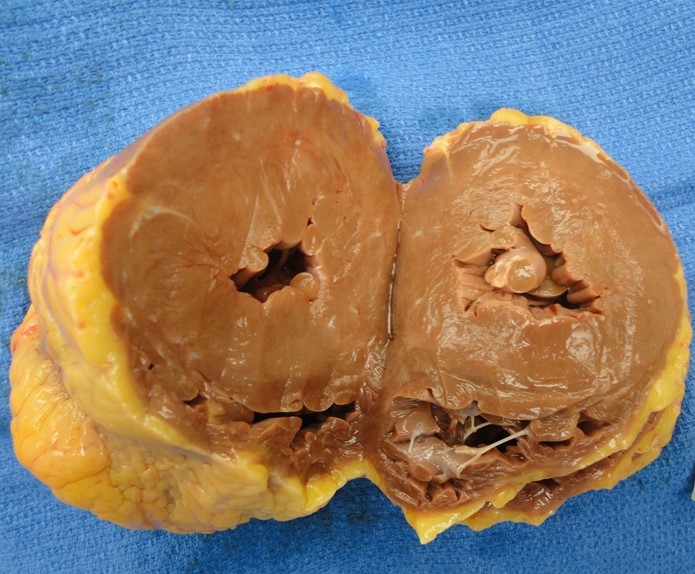 Histologic examination of the myocardial tissue reveals thick myocardial fibers with large, hyperchromatic nuclei as well as mild interstitial fibrosis. Which of the following is the most likely diagnosis?
 (Multiple Choice)
4.9/5 (81)
(81) A 25-year-old man comes to the hospital due to worsening abdominal pain, distension, and nausea and vomiting for 3 days. He has a 4-year history of recurrent abdominal pain associated with diarrhea, low-grade fever, and easy fatigability. The symptoms usually occur after stress and resolve spontaneously in a few days. However, this time, the patient's symptoms persisted and worsened. He has no other medical problems and takes no medications on a regular basis. Temperature is 38.2 C (100.8 F), blood pressure is 110/70 mm Hg, pulse is 104/min, and respirations are 16/min. BMI is 19 kg/m2. Examination shows a tender mass in the right lower quadrant of the abdomen. Imaging is consistent with small-bowel obstruction. Laparotomy reveals that the abdominal mass is composed of inflamed small bowel, adherent and indurated mesentery, and enlarged abdominal lymph nodes. The affected region of the small bowel is resected. Which of the following is most likely to be seen on histologic examination of this patient's intestine?
(Multiple Choice)
5.0/5 (86)
(86) A 46-year-old woman comes to the office due to dysphagia. The patient has had difficulty swallowing both liquids and solid foods as well as frequent episodes of regurgitation and cough while eating. She has also had weakness in her extremities and a rash. The patient has no prior medical problems and takes no medications. Vital signs are within normal limits. Physical examination shows an erythematous eruption on the upper eyelids. The oropharynx is clear and cardiopulmonary and abdominal examinations are unremarkable. She has difficulty lifting her arms above her head and standing from a sitting position. Which of the following is the most likely cause of this patient's dysphagia?
(Multiple Choice)
4.8/5 (87)
(87) A 17-year-old boy is brought to the office due to occasional blood in the urine. The first episode occurred 1 year ago during a flulike illness, and resolved spontaneously. The patient had a similar episode about 6 months ago, which also seemed to resolve. He has no other medical conditions and does not use tobacco or alcohol. There is no history of blood or kidney disorders in the family. Vital signs are normal. On laboratory evaluation, blood urea nitrogen level is 14 mg/dL and creatinine is 0.8 mg/dL. Urinalysis results are as follows: 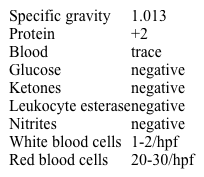 A renal biopsy is performed. Which of the following findings is most likely to be seen on microscopic evaluation?
 (Multiple Choice)
4.8/5 (73)
(73) A 69-year-old man is evaluated for abdominal pain. Upper gastrointestinal endoscopy shows a single shallow, 1-cm ulcer in the duodenal bulb and mild gastric erythema. Biopsy specimens from the gastric antrum do not show Helicobacter pylori, and stool testing for H pylori antigen is negative. Which of the following parts of the history is most likely to reveal the cause of this patient's current condition?
(Multiple Choice)
4.7/5 (89)
(89) A 64-year-old man has had difficulty walking for 6 months, experiencing muscle cramps in his right thigh after walking a block on level ground. The cramps subside quickly with rest. He has also had decreased sexual performance. Medical history is significant for hypercholesterolemia and myocardial infarction. The patient smokes a pack of cigarettes daily but does not use alcohol or illicit drugs. He is afebrile. Blood pressure is 128/78 mm Hg, pulse is 76/min, and respirations are 16/min. Cardiac auscultation reveals normal S1 and S2, and equal vesicular breath sounds are heard over the bilateral lungs. The abdomen is soft and without masses. There is no peripheral edema, muscle tenderness, or muscle weakness. Which of the following is the most likely cause of this patient's symptoms?
(Multiple Choice)
4.8/5 (79)
(79) A 17-year-old right-handed boy is brought to the emergency department due to brief loss of consciousness after colliding with another player during a football game. The patient reports "fogginess" but has had no headache, vomiting, focal weakness or numbness, or seizures. He has no other medical conditions and takes no medications. Vital signs are within normal limits. On physical examination, the patient demonstrates retrograde amnesia about the game but no focal neurologic deficits. CT angiography of the head reveals no skull fractures or intracranial bleeding, but a small lesion in the left temporoparietal region composed of abnormal vascular channels is noted and is shown in the exhibit. 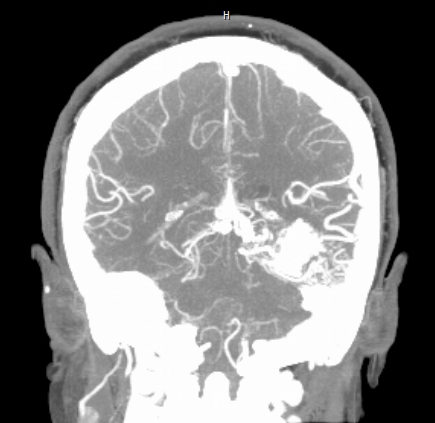 Without treatment of this abnormality, which of the following will most likely occur in this patient?
 (Multiple Choice)
4.9/5 (71)
(71) A 32-year-old man with abdominal pain and periodic diarrhea is found to have heme-positive stools. Stool cultures show no growth of pathogenic organisms. Colonoscopy with biopsy of the colonic mucosa is performed. Light microscopy of the tissue sample is shown in the image below. 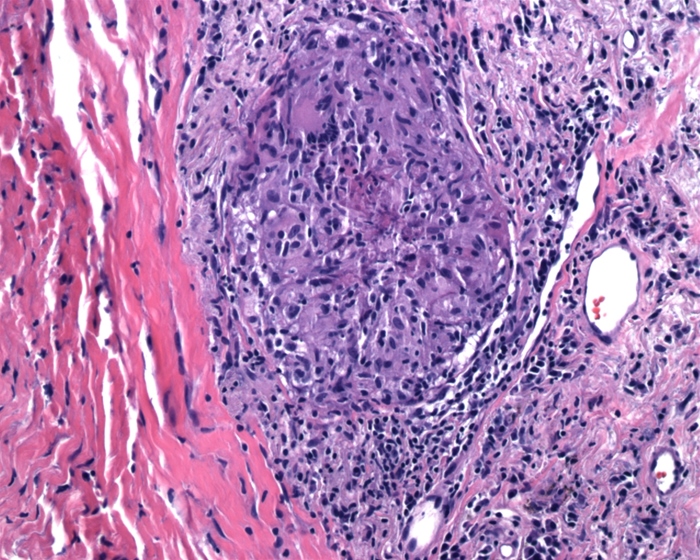 This patient most likely suffers from which of the following disorders?
 (Multiple Choice)
4.8/5 (84)
(84) A 64-year-old man comes to the office due to 3 months of constant, dull, low back pain that is worse with movement. The patient has also had intermittent episodes of difficult urination over the last year. He has no other medical conditions and takes no medications. The patient smoked a pack of cigarettes daily for 15 years but quit 10 years ago. Vital signs are within normal limits. On physical examination, the lungs are clear and heart sounds are normal. The abdomen is soft and nontender with no hepatosplenomegaly. Digital rectal examination shows a diffusely enlarged prostate with no nodules. Laboratory testing reveals a serum creatinine level of 1.9 mg/dL. Urine dipstick testing is within normal limits, but 24-hour urinary protein excretion is elevated. Urine microscopy shows waxy, laminated casts. Imaging of the spine demonstrates diffuse osteopenia and multiple irregular, radiolucent lesions in the thoracic and lumbar vertebrae. Which of the following histopathologic findings is most likely associated with the development of this patient's bone lesions?
(Multiple Choice)
4.8/5 (73)
(73) A 33-year-old woman, gravida 2 para 1, at 32 weeks gestation is brought to the labor and delivery unit and precipitously delivers a male infant within 2 minutes of arrival. The infant appears small for gestational age. Apgar scores are 5 and 6 at 1 and 5 minutes, respectively. The mother did not receive prenatal care this pregnancy. On delivery, the placenta appears pale and enlarged. In addition, the umbilical cord is inflamed with multiple areas of abscess-like foci of necrosis surrounding the umbilical vessels. Which of the following is the most likely cause of these findings?
(Multiple Choice)
4.9/5 (79)
(79) A 64-year-old man comes to the office due to blisters on his trunk and groin. Itching has occurred for the past several weeks, and blisters developed a week ago. He has a history of hypertension and osteoarthritis. The patient received the zoster vaccine at age 60. Examination shows numerous 0.5- to 3-cm bullous skin lesions. The findings from a skin biopsy are shown in the image below: 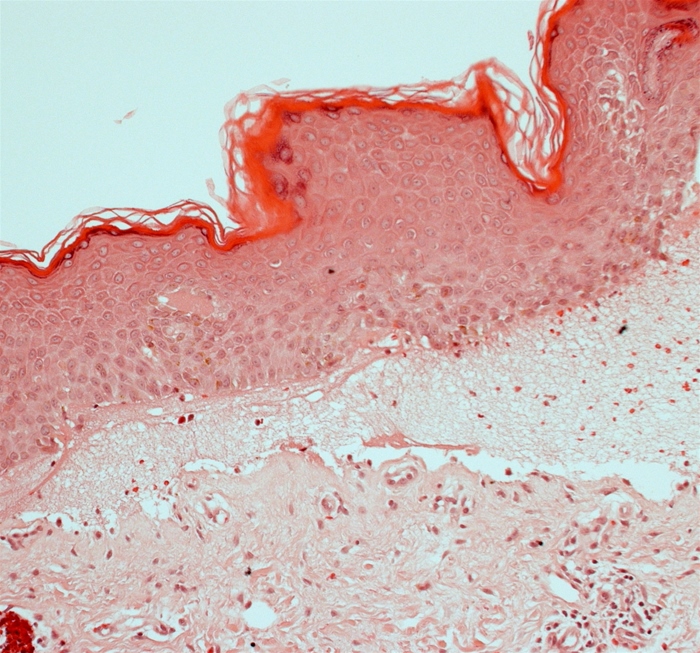 Which of the following is the most likely diagnosis?
 (Multiple Choice)
4.9/5 (88)
(88) A 35-year-old woman comes to the office due to 3 months of progressive dyspnea on exertion, nonproductive cough, and fatigue. She has a history of seasonal allergies for which she takes over-the-counter antihistamines. The patient ascribes her symptoms to smoking cigarettes and has cut down from a pack to 3 or 4 cigarettes daily. Her mother has rheumatoid arthritis. CT-guided lung biopsy is performed; findings are shown in the image below. 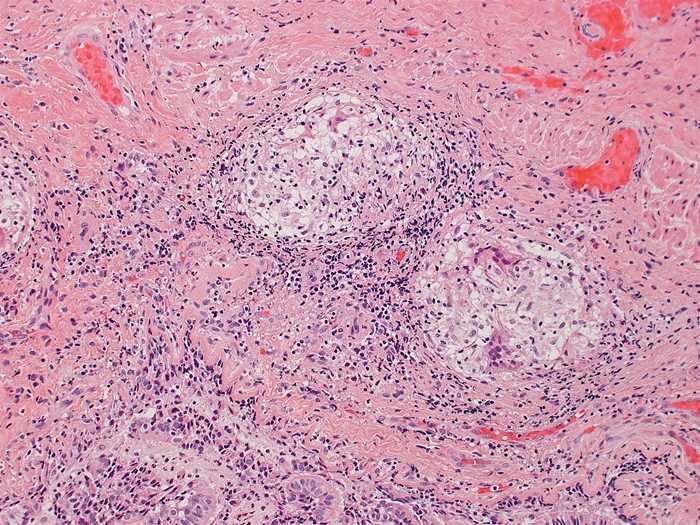 This patient most likely has which of the following conditions?
 (Multiple Choice)
4.9/5 (80)
(80) A 33-year-old nulligravid woman comes to the office for evaluation of infertility. She has never been pregnant despite years of unprotected intercourse with her husband. She also has a history of pelvic pain, which worsens with menses. The pain has persisted despite medical therapy and is suspected to be due to endometriosis. Exploratory laparoscopy is performed, and multiple flesh-colored nodules are present on the pelvic organs, along with thin, filmy adhesions. In addition to having endometrial glands with hemosiderin pigment, one of the biopsies contains simple cuboidal epithelial cells. Which of the following is the most likely site of the biopsy?
(Multiple Choice)
4.7/5 (75)
(75) A 45-year-old male sustains a traumatic injury at work and presents to the emergency department with a deep laceration on the palm of his right hand. Three weeks later, actin-containing fibroblasts and increased metalloproteinase activity are detected at the site of injury. These findings are most likely related to which of the following complications?
(Multiple Choice)
4.8/5 (86)
(86) A 20-year-old man is brought to the emergency department due to fever, headache, and neck pain for the last day. He has no significant medical history. Temperature is 38.7 C (101.7 F), blood pressure is 120/72 mm Hg, pulse is 112/min, and respirations are 26/min. There is neck stiffness and a petechial rash on the trunk. Cerebrospinal fluid (CSF) analysis reveals the following: 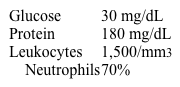 CSF gram stain shows gram-negative diplococci. In the emergency department, the patient's hemodynamic status deteriorates rapidly. Blood pressure drops to 80/50 mm Hg, and the venous access sites are oozing blood. Which of the following findings is most likely to be seen on this patient's peripheral blood smear?
 (Multiple Choice)
4.9/5 (67)
(67) A 65-year-old man comes to the office due to fatigue, decreased appetite, and weight loss. He has lost 5.4 kg (12 lb) over the last 3 months and eats only small portions of food because he feels full soon after he begins eating. The patient smokes a pack of cigarettes per day and drinks alcohol socially. Blood pressure is 152/90 mm Hg and pulse is 90/min. Physical examination shows a firm, 3-cm lymph node above the left clavicle. There are also numerous skin lesions on his trunk, as shown below, which the patient notes have developed since the onset of his other symptoms. 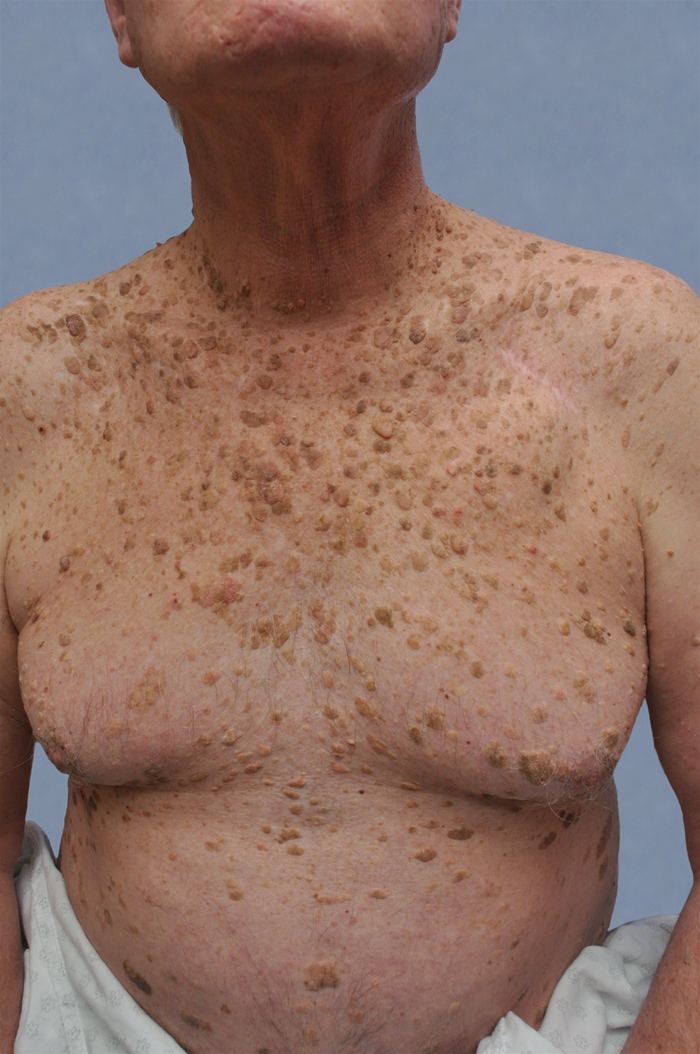 This patient's skin lesions most likely represent which of the following conditions?
 (Multiple Choice)
5.0/5 (73)
(73) A 49-year-old woman, gravida 2, para 2, comes to the office due to 10 months of irregular vaginal bleeding. Her last menstrual period was 3 years ago. She has a history of hypothyroidism and takes levothyroxine daily. Ultrasound reveals a thickened endometrium and a solid left adnexal mass. Endometrial biopsy is abnormal, and the patient requires surgery. Intraoperatively, the ovarian mass is yellow and firm. Pathology reports small cuboidal cells in sheets with gland-like structures containing acidophilic material. The cells are arranged in a microfollicular pattern around a pink, eosinophilic center. Which of the following is most likely secreted by this patient's tumor?
(Multiple Choice)
4.8/5 (73)
(73) An 18-year-old man suddenly collapses during a high school soccer game. There was no preceding collision or trauma. Immediate resuscitation is initiated but he dies before the emergency medical service arrives. The patient had recently experienced occasional exertion-related chest discomfort and dyspnea. Otherwise, he had no significant medical history. He took no medications and did not use tobacco, alcohol, or illicit drugs. Which of the following is most likely to be seen on autopsy?
(Multiple Choice)
4.8/5 (80)
(80) 
Filters
- Essay(0)
- Multiple Choice(0)
- Short Answer(0)
- True False(0)
- Matching(0)