



 Chat with AI
Exam 10: Pathology

Exam 1: Anatomy291 Questions
Exam 2: Behavioral science240 Questions
Exam 3: Biochemistry156 Questions
Exam 4: Biostatistics117 Questions
Exam 5: Embryology52 Questions
Exam 6: Genetics103 Questions
Exam 7: Histology24 Questions
Exam 8: Immunology129 Questions
Exam 9: Microbiology336 Questions
Exam 10: Pathology816 Questions
Exam 11: Pathophysiology464 Questions
Exam 12: Pharmacology538 Questions
Exam 13: Physiology272 Questions
Select questions type


A 73-year-old man comes to the clinic with epigastric pain that starts 30-40 minutes after meals and does not respond to antacids. The pain is non-radiating and is graded 6/10 in intensity. The patient has lost more than 4.5 kg (10 lb) over the last few months, which he attributes to eating less due to his fear of the pain. He has no vomiting, diarrhea, or urinary symptoms. His past medical history is significant for hypertension, hyperlipidemia, coronary artery bypass grafting, and right-sided carotid endarterectomy. He has smoked a pack of cigarettes daily for 32 years. Upper gastrointestinal endoscopy shows no abnormalities. The underlying pathophysiology of this patient's disease process is most similar to which of the following conditions?
(Multiple Choice)
4.8/5  (90)
(90) A 70-year-old man is brought to the hospital by his son for evaluation of worsening fatigue. The patient has not seen a physician in the past 15 years. He takes naproxen occasionally for knee arthritis. Physical examination of the prostate shows no abnormalities. Laboratory results are as follows: 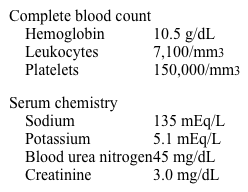 Urine sediment is unremarkable. Ultrasound examination shows bilateral small kidneys and no hydronephrosis. Kidney biopsy shows intimal thickening and luminal narrowing of the renal arterioles with evidence of glomerular sclerosis. Which of the following is most likely responsible for this patient's kidney disease?
 (Multiple Choice)
4.8/5 (74)
(74) A 56-year-old woman with unknown medical history is brought to the emergency department in an unresponsive state. Paramedics were called for sudden-onset, left-sided weakness, and when they arrived at the patient's house she was having a generalized tonic-clonic seizure. Antiseizure medications were given and the patient was subsequently intubated. Evaluation shows a comatose woman with left hemiplegia. Neuroimaging reveals a large infarction in the right middle cerebral artery territory with cerebral edema. Despite aggressive interventions, the patient dies from brain herniation. Autopsy reveals multiple small, nondestructive masses attached to the edges of the mitral valve leaflets. Microscopy shows that these masses are composed of platelet-rich thrombi, but no organisms are present. Which of the following is most closely associated with this patient's heart valve findings?
(Multiple Choice)
4.9/5 (72)
(72) A 44-year-old man with a history of advanced HIV is brought to the office by his family due to progressive cognitive decline. Over the last several years he has had worsening memory deficits and difficulty carrying out simple mental tasks. The patient has had no headaches, slurred speech, muscle weakness, or changes in vision. He was diagnosed with HIV 7 years ago, but his medical follow-up and treatment compliance have been poor. The patient does not use tobacco, alcohol, or illicit drugs. Vital signs are normal. He has difficulty with delayed recall as well as several executive function tasks. The remainder of his neurologic examination is unremarkable. Two weeks later, he dies from severe pneumonia and respiratory failure. Which of the following histopathologic findings would most likely be found on biopsy of this patient's brain?
(Multiple Choice)
4.9/5 (95)
(95) A 55-year-old man is evaluated due to worsening fatigue and exertional shortness of breath. He has no chronic medical conditions and takes no medications. Physical examination shows facial puffiness and bilateral lower extremity edema. Urinalysis shows 3+ proteinuria. Kidney biopsy findings with special staining under polarized light are shown on the image below: 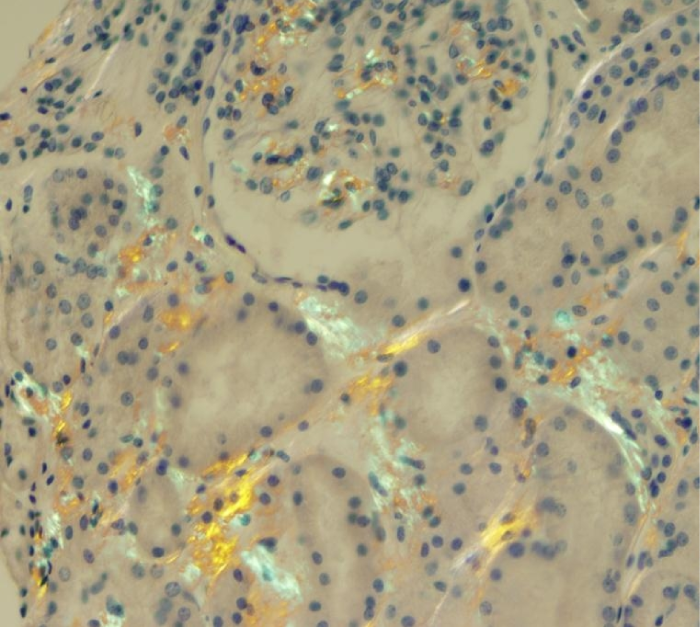 Which of the following tests would be most helpful for establishing a specific diagnosis in this patient?
 (Multiple Choice)
4.8/5 (81)
(81) A 25-year-old man comes to the office for evaluation of facial acne. He has no significant past medical history and does not use tobacco or alcohol. The patient works as a personal trainer. His family history is significant for diabetes mellitus in his mother and leukemia in his father. His blood pressure is 134/82 mm Hg and pulse is 58/min. On physical examination, there is mild facial acne. The patient's lungs are clear to auscultation. The liver span is 8 cm, and the spleen is not palpable. His testes are soft, and testicular volume is decreased. Laboratory results are as follows: 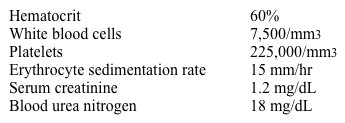 Which of the following is the most likely explanation for this patient's abnormal laboratory findings?
 (Multiple Choice)
4.9/5 (64)
(64) A 28-year-old man is hospitalized following a motor vehicle collision complicated by severe hemorrhage. Over the next 8 hours his urine output is markedly decreased. Laboratory results reveal elevated blood urea nitrogen. The patient is given aggressive intravenous fluid hydration. After 24 hours of therapy, urine output is increased and blood urea nitrogen declines toward normal. Which of the following additional laboratory abnormalities suggests that this patient's initial oliguria is a compensation for volume contraction?
(Multiple Choice)
4.8/5 (75)
(75) A 76-year-old man comes to the office due to bilateral flank pain and nausea. The patient has not urinated for 24 hours. Medical history is significant for diet-controlled type 2 diabetes and degenerative arthritis of the knee. He occasionally takes naproxen for pain. Temperature is 36.9 C (98.4 F), blood pressure is 140/90 mm Hg, and pulse is 90/min. Cardiopulmonary examination reveals no abnormalities. Abdominal examination shows suprapubic fullness. Mild bilateral costophrenic angle tenderness is present. Laboratory results show a blood urea nitrogen level of 32 mg/dL and creatinine level of 2.6 mg/dL. Four weeks ago, laboratory studies were normal. Which of the following is the most likely cause of this patient's renal dysfunction?
(Multiple Choice)
4.8/5 (73)
(73) A 42-year-old man is brought to the emergency department 1 hour after the onset of severe headache, nausea, vomiting, and confusion. The patient has primary (essential) hypertension and chronic kidney disease; he has been prescribed 2 antihypertensive agents but has been noncompliant with therapy. Temperature is 36.8 C (98.2 F), blood pressure is 240/150 mm Hg, heart rate is 90/min, and respirations are 20/min. Ophthalmologic examination shows bilateral papilledema. The lungs are clear to auscultation. Cardiac examination reveals an S4 and no murmurs. Laboratory results are as follows: 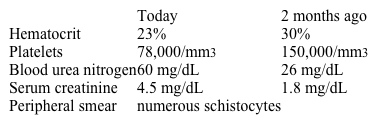 If renal biopsy is performed in this patient, which of the following pathologic findings is most likely to be found?
 (Multiple Choice)
4.7/5 (67)
(67) A 59-year-old man is being evaluated for markedly elevated prostate-specific antigen levels. He has no bone pain or urinary symptoms. The patient has no chronic medical conditions or surgical history. His father died of prostate cancer. Vital signs are normal. Digital rectal examination reveals an indurated prostate with no palpable nodules. The remainder of the examination is normal. Prostate biopsy is planned. Which of the following is the best way to obtain a diagnosis in this patient?
(Multiple Choice)
4.8/5 (84)
(84) A 32-year-old man dies suddenly in his sleep. He had been experiencing easy fatigability for the past 6 months and mentioned that he was feeling tired "'all the time"' and needed to take naps during the day. He did not drink alcohol or use illicit drugs. He smoked a pack of cigarettes per day for 10 years. His father died from a "heart problem" at age 40. On autopsy, the heart appears grossly enlarged. A layered mural thrombus is seen in the left ventricular apex. Coronary atherosclerosis is present, with 20% narrowing of the mid-left anterior descending artery and 25% narrowing of the left circumflex artery. Which of the following is the most likely cause of death of this patient?
(Multiple Choice)
4.9/5 (74)
(74) A 19-year-old man comes to the office to establish medical care. He is transitioning care from his pediatrician. The patient states that he recently changed his glasses for myopia; he otherwise has no symptoms. He takes no medications. Vital signs are within normal limits. On physical examination, the patient is tall with long upper extremities and fingers. The face appears narrow with down-slanted palpebral fissures, flattened malar bones, and a small jaw. The lungs are clear on auscultation. A late-systolic murmur is present at the cardiac apex. The abdomen is soft and nontender with no organomegaly. Which of the following is the most likely cause of this patient's murmur?
(Multiple Choice)
5.0/5 (83)
(83) A 29-year-old woman comes to the emergency department due to fever and headache for the last week. The patient has a generalized tonic-clonic seizure while being evaluated. Laboratory results are as follows: 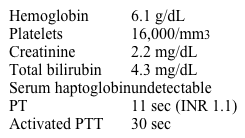 Peripheral blood smear is shown in the exhibit.
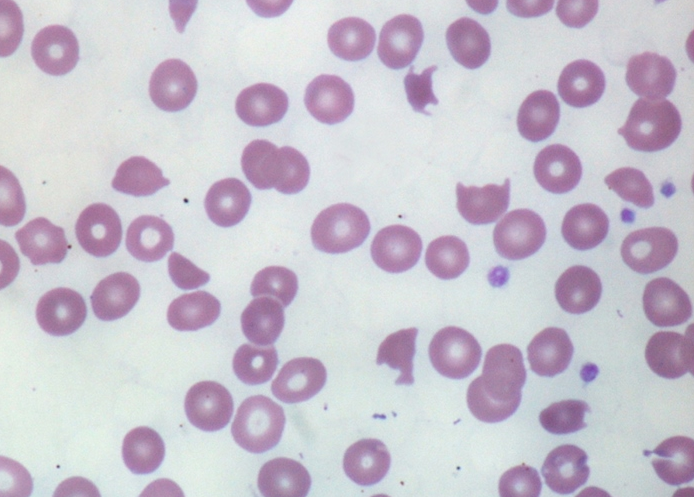 Which of the following is the most likely underlying cause of this patient's current condition?
Peripheral blood smear is shown in the exhibit.
Which of the following is the most likely underlying cause of this patient's current condition? (Multiple Choice)
4.9/5 (89)
(89) A 74-year-old woman comes to the emergency department due to 2 days of left leg pain and numbness. She has a history of atrial fibrillation and hypertension. Her left lower limb is pale and cold to palpation below the knee. Arterial Doppler ultrasound shows an occluding thrombus, and a left femoral embolectomy is performed. Post-procedure dorsalis pedis and posterior tibial pulses become palpable. Several hours later, the patient begins to experience severe left calf pain. On repeat examination, the left calf is swollen, tense, and tender, and the pain worsens with dorsiflexion of the left foot. The distal pulses are also absent. The physician suspects injury of the reperfused muscles in part due to overproduction of reactive oxygen species. Which of the following enzymes is most likely to help neutralize these toxic molecules?
(Multiple Choice)
4.7/5 (81)
(81) A 77-year-old man comes to the emergency department due to cough, shortness of breath, sharp chest pains, night sweats, and fatigue for 4 days. Temperature is 38.3 C (101 F), blood pressure is 110/62 mm Hg, pulse is 106/min, and respirations are 24/min. The patient appears ill. Neck veins are nondistended. There is decreased chest expansion on the right side. Auscultation reveals decreased breath sounds over the right lung base. Chest imaging shows a right lower lobe infiltrate and a small, free-flowing pleural effusion on the right side. Thoracentesis is performed. Laboratory results are as follows: 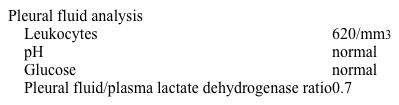 Which of the following processes best explains this patient's pleural fluid findings?
 (Multiple Choice)
4.9/5 (70)
(70) A 64-year-old man is brought to the hospital by ambulance after being found unresponsive by his brother. Despite resuscitative efforts, he dies shortly thereafter. The family reports that the patient had 2 months of progressive fatigue and an unintentional weight loss prior to the episode. Autopsy examination reveals a massive pulmonary embolus, and a cross-section of the liver shows the following: 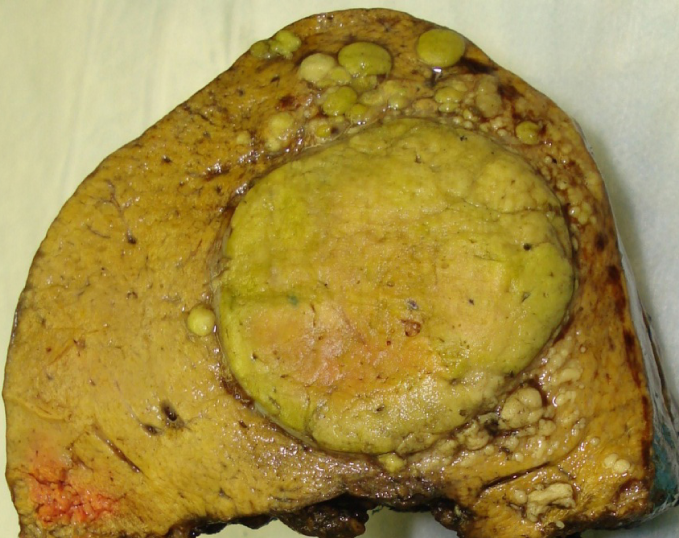 Genomic analysis of the hepatic lesions demonstrates intranuclear fragments of foreign DNA. These fragments most likely belong to which of the following pathogens?
 (Multiple Choice)
4.9/5 (74)
(74) An 82-year-old man is found unresponsive by his neighbor. The patient lives alone in his suburban home. When the neighbor went to check on him, the patient was on the floor and not answering any questions. His medical history is unknown. On arrival of emergency medical services, the patient is obtunded and responds only to painful stimuli. Supportive measures are begun, including endotracheal intubation, but the patient dies en route to the hospital. Autopsy reveals extensive atherosclerotic disease involving the coronary and internal carotid arteries. Histopathologic examination of the brain in the right middle cerebral artery territory shows neurons with intensely eosinophilic cytoplasm and nuclear fragmentation. Based on these findings, this patient's cerebral injury most likely occurred approximately how long ago?
(Multiple Choice)
4.8/5 (82)
(82) A 2-year-old Caucasian boy is hospitalized with abdominal pain and vomiting. After initial evaluation laparotomy is performed, and a portion of the intestine is resected (see the slide below). 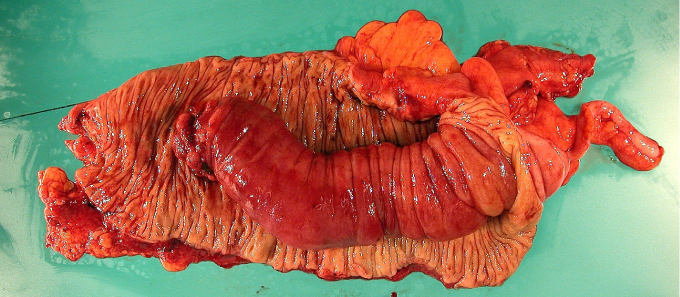 This patient most likely suffers from:
 (Multiple Choice)
5.0/5 (97)
(97) A 48-year-old woman comes to the office with a 4-month history of pain, stiffness, and swelling of her hands, feet, and knees that is associated with daily fatigue. She has taken over-the-counter nonsteroidal anti-inflammatory agents, but they only temporarily relieve the pain. The patient has no other medical issues. She does not use tobacco, alcohol, or illicit drugs and is not sexually active. Vital signs are within normal limits. BMI is 35 kg/m2. The patient walks with a limp due to pain in the foot. There is symmetric swelling, tenderness, and restricted range of motion involving the wrists, ankles, forefeet, and knees. There is no skin rash. Laboratory studies show anemia. Which of the following is most likely to be the earliest finding during the development of this patient's condition?
(Multiple Choice)
4.8/5 (90)
(90) A 2-year-old boy is brought to the office by his mother due to a rash that started 3 days ago. A similar red, itchy rash on the cheeks, trunk, and arms has occurred intermittently since infancy. The mother thought that the rashes were related to the consumption of certain foods, but elimination of cow's milk and fruits did not improve the rash. The patient has had a few upper respiratory infections but no major illnesses. Vaccinations are up to date, and he takes no medications. He attends a day care facility. Vital signs are within normal limits. The rash on the patient's back is shown in the exhibit. 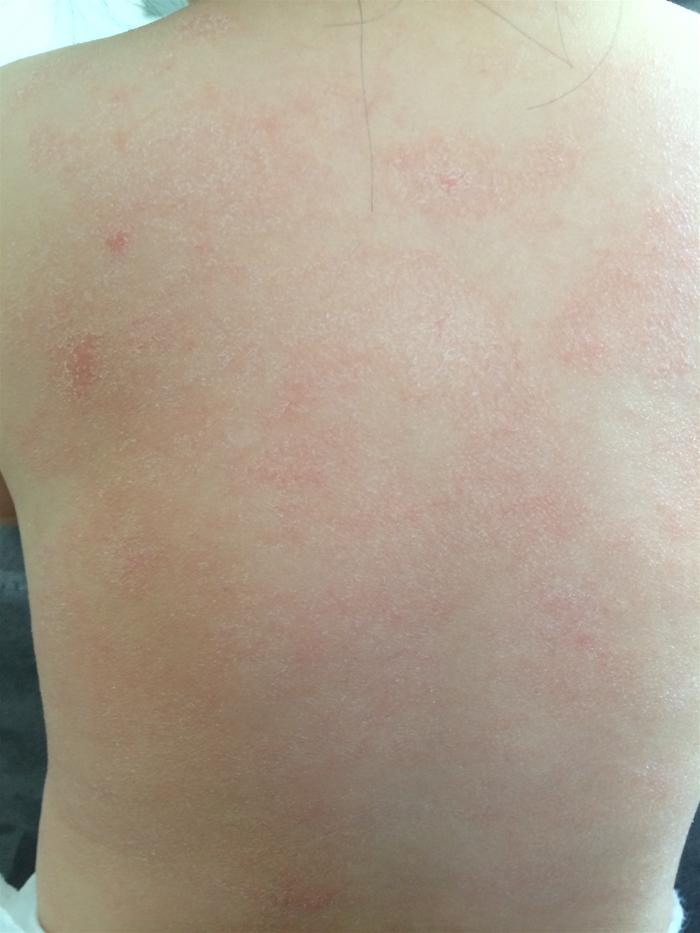 Similar findings are observed on the cheeks and proximal upper extremities. The diaper area is clear, and no mucosal lesions are present. This patient's condition is often associated with the development of which of the following disorders?
 (Multiple Choice)
4.8/5 (91)
(91) 
Filters
- Essay(0)
- Multiple Choice(0)
- Short Answer(0)
- True False(0)
- Matching(0)