



 Chat with AI
Exam 10: Pathology

Exam 1: Anatomy291 Questions
Exam 2: Behavioral science240 Questions
Exam 3: Biochemistry156 Questions
Exam 4: Biostatistics117 Questions
Exam 5: Embryology52 Questions
Exam 6: Genetics103 Questions
Exam 7: Histology24 Questions
Exam 8: Immunology129 Questions
Exam 9: Microbiology336 Questions
Exam 10: Pathology816 Questions
Exam 11: Pathophysiology464 Questions
Exam 12: Pharmacology538 Questions
Exam 13: Physiology272 Questions
Select questions type


A 32-year-old man is brought to the emergency department due to weakness and tingling that started in his feet and is now at his knees. A week ago, the patient noticed that his legs felt weak while climbing stairs. Since then, the weakness has progressively worsened every day. Today, he fell twice when attempting to walk. Medical history is insignificant, except for a mild respiratory infection 2 weeks ago that resolved spontaneously. The patient does not use tobacco, alcohol, or illicit drugs. He takes no medications. Vital signs are within normal limits. Physical examination shows marked weakness in the distal muscles and moderate weakness in the proximal muscles in both legs. Deep tendon reflexes are absent at the knees. This patient's condition is most likely associated with which of the following?
(Multiple Choice)
4.8/5  (65)
(65) A 54-year-old man comes to the office due to worsening fatigue, generalized weakness, and an unintentional 7-kg (15.4-lb) weight loss over the past several weeks. The patient has no prior medical conditions and takes no medications. He has a 40-pack-year history of smoking and does not use alcohol or illicit drugs. Blood pressure is 160/100 mm Hg and pulse is 80/min. Physical examination shows darkening of the skin in sun-exposed areas. There are scattered ecchymoses on the extremities. Mild proximal muscle weakness is present. Chest imaging reveals a 6-cm, irregular right lung mass with mediastinal lymphadenopathy. Which of the following is most likely responsible for the patient's current symptoms?
(Multiple Choice)
4.8/5 (82)
(82) A 3-year-old boy diagnosed with thalassemia major receives multiple transfusions to maintain his blood hemoglobin level. On physical examination, his liver and spleen are mildly enlarged. He also has glucose intolerance as demonstrated by an oral glucose tolerance test. Which of the following therapies would prevent congestive cardiac failure in this patient?
(Multiple Choice)
4.8/5 (82)
(82) A researcher studying the cell cycle observes a sudden increase in the activity of several enzymes, including dihydrofolate reductase and DNA polymerase. Which of the following processes most immediately precedes the observed increase in enzyme activity?
(Multiple Choice)
4.7/5 (75)
(75) A 36-year-old man presents to your office with persistent fever, bleeding gums, and a sore throat. Peripheral blood microscopy findings are shown in the image below. 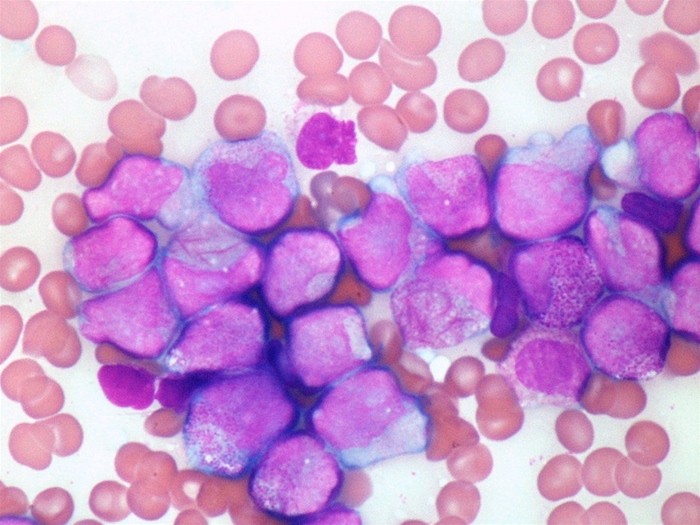 These cells contain structures that would stain positive for which of the following?
 (Multiple Choice)
4.8/5 (65)
(65) A 63-year-old man comes to the emergency department due to fever and loss of appetite. He also has chest pain with deep breaths. The patient has never had regular medical care and his medical history is unknown. He has smoked half a pack of cigarettes daily for 30 years. Laboratory evaluation shows a hematocrit of 56%. Chest imaging shows multiple round lesions in both lungs. Biopsy of one of the lesions reveals the microscopic findings shown below. 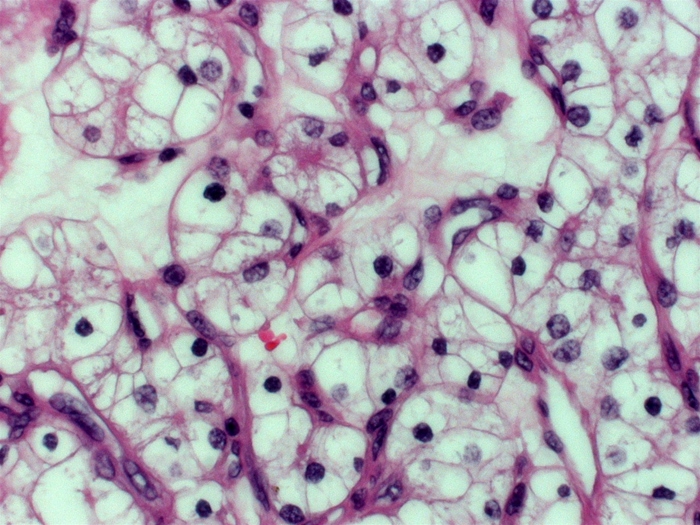 This patient's metastatic disease most likely originated from which of the following organs?
 (Multiple Choice)
4.8/5 (81)
(81) A 45-year-old man comes to the office due to a week of purulent nasal discharge, headache, sore throat, and nonproductive cough. He has no significant past medical history except for an episode of infectious mononucleosis at age 22. The patient smokes a pack of cigarettes daily. His temperature is 38 C (100.4 F). He has maxillary sinus tenderness, pharyngeal erythema, and tender anterior cervical lymphadenopathy. Laboratory results are as follows: 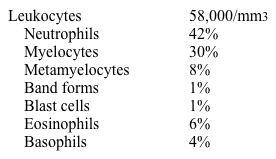 The leukocyte alkaline phosphatase score is low. Which of the following is the most likely diagnosis?
 (Multiple Choice)
4.8/5 (89)
(89) A 28-year-old previously healthy woman comes to the office for evaluation of a raised, pigmented skin lesion on her leg. The patient has had no itching or pain and cannot remember how long she has had the lesion. She has used tanning machines a few times in the past but denies excessive sun exposure. She is particularly concerned about the risk of malignancy as her father was recently diagnosed with skin cancer. Skin examination shows the nodule seen in the image below. 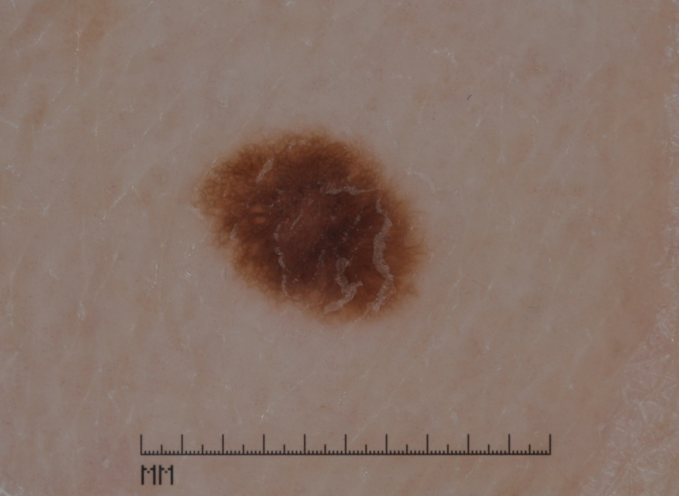 A biopsy of the lesion reveals nests of uniform round cells at the basal portion of the epidermis that extend into the underlying dermis. The cells contain inconspicuous nucleoli and show no mitotic activity. Which of the following is the most likely diagnosis?
 (Multiple Choice)
4.7/5 (92)
(92) A 58-year-old man comes to the office for evaluation of a thyroid nodule. The patient first noticed a painless neck lump 2 months ago, which has progressively enlarged. He has had no heat or cold intolerance, recent weight changes, or difficulty breathing or swallowing. Medical history is notable for well-controlled hypertension. The patient has no history of radiation exposure or family history of thyroid diseases. Physical examination shows a firm, nontender nodule in the right thyroid lobe. Serum TSH level is normal, and ultrasonography shows a 4-cm solid nodule in the right thyroid lobe. Fine-needle aspiration biopsy shows a large number of follicular cells dispersed in clusters and microfollicles. The patient undergoes right thyroid lobectomy. Which of the following histologic findings would confirm a diagnosis of follicular thyroid carcinoma in this patient?
(Multiple Choice)
5.0/5 (86)
(86) A 45-year-old man is brought to the emergency department after sustaining a traumatic head injury in a motor vehicle collision. The patient was found unresponsive and had several generalized tonic-clonic seizures during transport. Medical history includes hypertension as well as alcohol and cocaine misuse. Temperature is 36.7 C (98.1 F), blood pressure is 170/96 mm Hg, pulse is 50/min, and respirations are 10/min. Pulse oximetry shows 98% on mechanical ventilation with 50% oxygen. On examination, the patient is comatose with midpositioned and fixed pupils and rigid extension of the upper and lower extremities. Noncontrast CT scan of the head is shown in the image below: 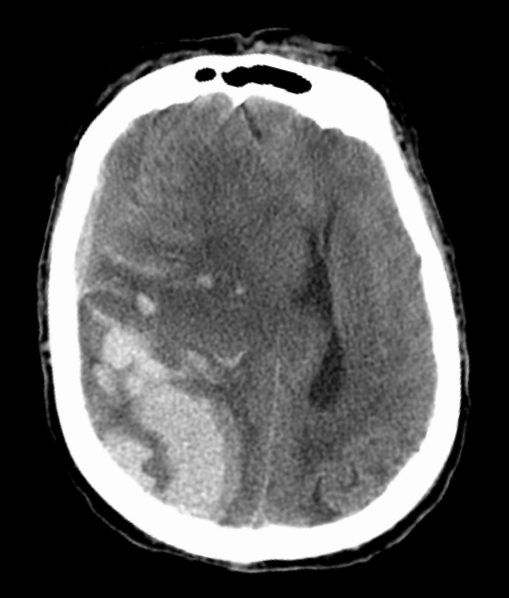 Damage to which of the following structures is the most likely explanation for this patient's abnormal posturing?
 (Multiple Choice)
4.9/5 (80)
(80) A 64-year-old man comes to the office due to persistent back pain, constipation, and easy fatigability for the last several months. Blood pressure is 115/75 mm Hg and pulse is 88/min. The patient has dry mucous membranes. Laboratory results are as follows: 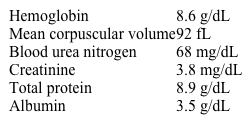 Renal biopsy is performed and light microscopy shows atrophic tubules, many of which contain large, obstructing, waxy casts that stain intensely with eosin. Which of the following is the most likely diagnosis in this patient?
 (Multiple Choice)
4.9/5 (92)
(92) A 62-year-old man comes to the office due to worsening difficulty with swallowing food over the last 3 months. He has smoked a pack of cigarettes daily for the past 45 years. On examination, there is a firm, palpable mass at the base of tongue. Cervical lymph nodes are also palpable. Which of the following histologic features is most likely to be seen on biopsy of the tongue lesion?
(Multiple Choice)
4.9/5 (75)
(75) A 46-year-old man comes to the office due to abdominal discomfort and diarrhea. The symptoms began 6 months ago, and he has now developed significant weight loss. The patient does not use tobacco or alcohol. Intestinal biopsy is performed, and a periodic acid-Schiff (PAS) stained section is shown in the image below: 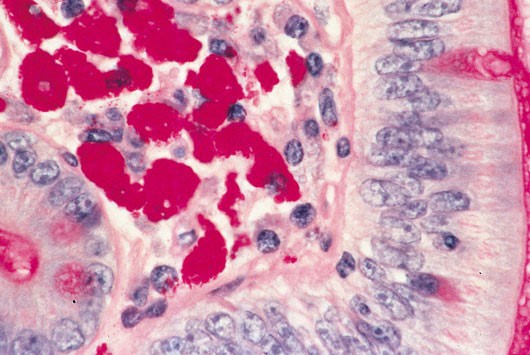 Which of the following is the most likely cause of this patient's symptoms?
 (Multiple Choice)
5.0/5 (70)
(70) A 3-year-old boy is brought to the office by his parents due to constipation. The boy previously had soft stools 1-2 times daily. However, over the past 3 months, his bowel movements have decreased to 1 stool every 3-4 days with significant straining and production of hard stool balls. The boy has intermittent diffuse abdominal pain and increased irritability, but these symptoms have not affected his overall appetite. Family history is notable for a maternal aunt with celiac disease and a paternal grandmother with "thyroid problems." Four months ago, the boy and his parents moved into a house owned by their family for generations, and the parents are worried that the stress of the move might be contributing to his symptoms. Height and weight have been tracking appropriately. Physical examination shows a pale, tired boy with palpable stool in his abdomen but no abdominal tenderness. Which of the following is the most appropriate diagnostic test for this patient?
(Multiple Choice)
4.9/5 (80)
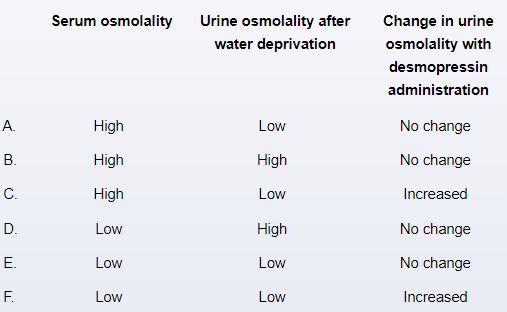
(80) A 3-month-old boy is brought to the office due to fussiness, poor weight gain, and polyuria. Urine volume is 700-800 mL/day. The patient's maternal grandfather has polydipsia and polyuria. Serum sodium is 151 mEq/L. Genetic testing reveals a vasopressin-2 receptor mutation. Which of the following additional findings is most likely to be seen in this patient?
(Multiple Choice)
4.8/5 (78)
(78) A 68-year-old man comes to the office due to exertional shortness of breath and fatigue, which have progressed over the past year. The patient has a history of hypertension, but medical history is otherwise unremarkable. He is a lifetime nonsmoker. His father died of a "heart attack" at age 70. Blood pressure is 144/74 mm Hg, and pulse is 72/min and regular. Cardiac auscultation reveals a 3/6 ejection-type, late-peaking systolic murmur and a barely audible S2. The murmur diminishes in intensity during the straining phase of the Valsalva maneuver. Which of the following processes underlies this patient's current condition?
(Multiple Choice)
4.9/5 (70)
(70) A 56-year-old man is brought to the emergency department due to burning substernal pain that began 6 hours ago. The patient has a history of type 2 diabetes mellitus and hypertension. He smokes 2 packs of cigarettes daily and consumes alcohol occasionally. An ECG performed in the emergency department shows ST segment elevation in leads I, aVL, and V3-V6. During the next several hours, the patient develops progressive shortness of breath that worsens when lying flat. Which of the following histologic features is most likely to be present in this patient's lung tissue?
(Multiple Choice)
4.9/5 (76)
(76) A 43-year-old woman is brought to the emergency department because of a sudden and severe headache. Her blood pressure is 160/90 mm Hg and pulse is 90/min. Her pupils are symmetric and reactive to light and she can move all four extremities without weakness. CT of her head is shown below. 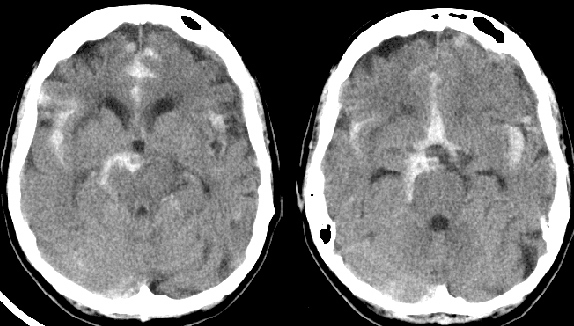 This patient's condition is most likely caused by which of the following?
 (Multiple Choice)
4.8/5 (73)
(73) A 45-year-old woman comes to the office due to several months of episodic right upper quadrant abdominal pain associated with nausea. The pain is often brought on by fatty meals and subsides in 1-2 hours. The patient has no fever, vomiting, diarrhea, melena, or bright red blood per rectum. Her BMI is 31.2 kg/m2. Physical examination is unremarkable. A cholecystokinin stimulation test is performed and shows slow and incomplete gallbladder emptying. This patient is most likely to have which of the following pathologic findings?
(Multiple Choice)
4.8/5 (68)
(68) A 64-year-old man comes to the office due to several episodes of intermittent hematuria over the past 2 months. He has had no abdominal pain, burning on urination, or fever but has lost 4.5 kg (10 lb) since the onset of symptoms. The patient has smoked a pack of cigarettes daily for 30 years. Vital signs are within normal limits. The abdomen is soft, nontender, and nondistended. An enlarged and firm prostate is palpated on digital rectal examination. Serum calcium is 12.3 mg/dL. Urinalysis shows 30-40 red blood cells/hpf, negative protein, and no casts. A CT scan of the abdomen is shown below. 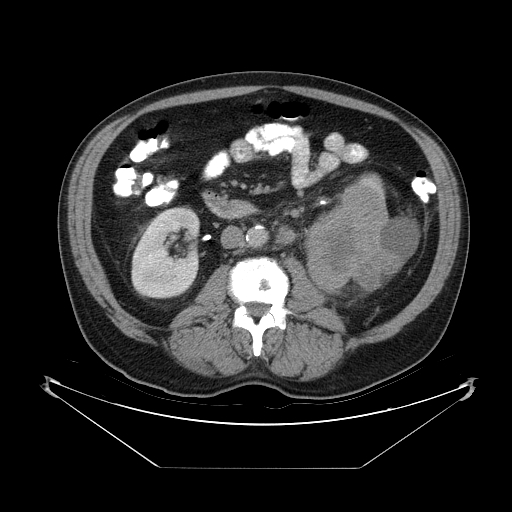 Which of the following is the most likely diagnosis?
 (Multiple Choice)
4.9/5 (73)
(73) 
Filters
- Essay(0)
- Multiple Choice(0)
- Short Answer(0)
- True False(0)
- Matching(0)