



 Chat with AI
Exam 10: Pathology

Exam 1: Anatomy291 Questions
Exam 2: Behavioral science240 Questions
Exam 3: Biochemistry156 Questions
Exam 4: Biostatistics117 Questions
Exam 5: Embryology52 Questions
Exam 6: Genetics103 Questions
Exam 7: Histology24 Questions
Exam 8: Immunology129 Questions
Exam 9: Microbiology336 Questions
Exam 10: Pathology816 Questions
Exam 11: Pathophysiology464 Questions
Exam 12: Pharmacology538 Questions
Exam 13: Physiology272 Questions
Select questions type


A 38-year-old woman comes to the urgent care clinic with a 2-day history of sore throat. It is associated with fever and cervical lymphadenopathy, but not rhinorrhea, sneezing, or coughing. On examination, erythema and edema involving the posterior pharynx and a purulent tonsillar exudate are present. Rapid bedside streptococcal antigen testing is positive, and the patient is started on oral penicillin V. She returns the following day with a pruritic skin rash that came on suddenly after starting the antibiotic. The skin lesions observed on physical examination are shown in the image below. 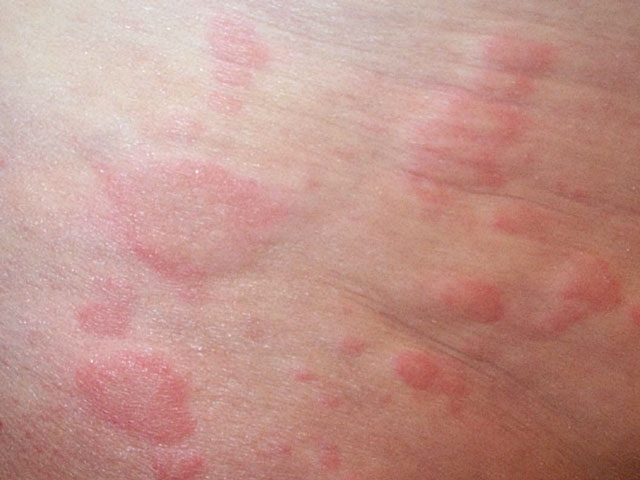 What is the most likely finding on biopsy of these lesions?
 (Multiple Choice)
4.9/5  (81)
(81) A 65-year-old man with a history of chronic gastroesophageal reflux comes to the clinic due to dysphagia. The patient has had difficulty swallowing foods such as steak or hard-boiled eggs but is able to drink hot tea and coffee without any issues. Increasing the frequency of his proton pump inhibitor to twice daily did not improve symptoms. He has also lost 6.8 kg (15 lb) over the past 4 months. The patient has a history of hypertension, hyperlipidemia, and osteoarthritis. Medications include amlodipine, atorvastatin, and ibuprofen as needed. He drinks 2 or 3 glasses of wine with dinner most nights but does not use tobacco or illicit drugs. Vital signs are within normal limits. BMI is 32 kg/m2. Physical examination is unremarkable. Esophagogastroduodenoscopy reveals a 4-cm mass surrounded by a large segment of discolored mucosa in the lower half of the esophagus. Esophagogastrectomy results are shown in the image below: 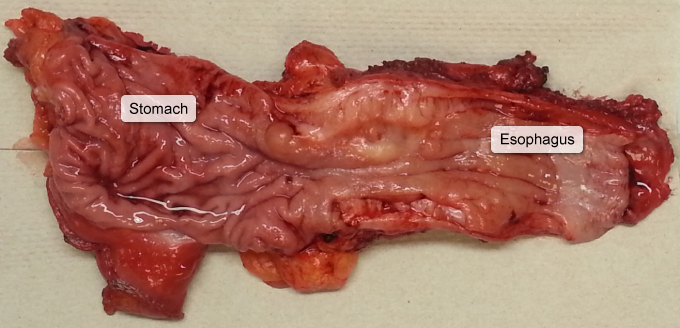 Which of the following is the most likely predisposing factor for this patient's esophageal disease?
 (Multiple Choice)
4.8/5 (89)
(89) A 55-year-old man comes to the office due to intermittent abdominal pain. He has no difficulty or pain with swallowing. The patient occasionally uses over-the-counter pain medicine for osteoarthritis of the right knee. He does not use alcohol or tobacco and has no history of cancer in the family. He works as an air traffic controller at a busy airport. Upper gastrointestinal endoscopy shows an ulcer in the distal duodenum. Fasting serum gastrin concentration is at the upper limit of normal and rises in response to intravenous secretin. This patient's condition is most likely caused by which of the following processes?
(Multiple Choice)
4.8/5 (80)
(80) A 43-year-old man is hospitalized with recent-onset oliguria and a high serum creatinine level. He has been seen in clinic several times for an intranasal ulcer that has failed to heal. This patient's condition is most likely associated with antibodies against which of the following?
(Multiple Choice)
4.9/5 (89)
(89) A 24-year-old woman comes to the physician with a 3-week history of progressive fatigue. Physical examination shows lesions involving the nail beds, as seen in the photograph below. 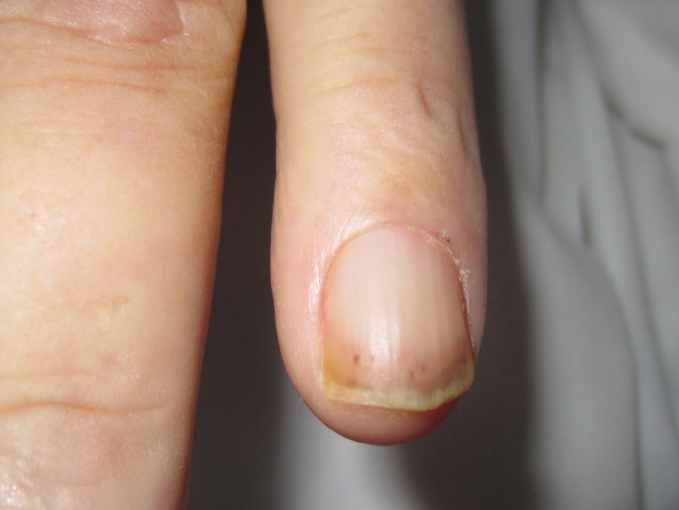 Further evaluation would most likely reveal additional abnormalities during which part of the physical examination?
 (Multiple Choice)
4.9/5 (79)
(79) A 60-year-old man comes to the emergency department due to 10 days of worsening cough, shortness of breath, and right-sided chest pain. The patient also has had low-grade fever, fatigue, and unspecified weight loss. A month ago, he was hospitalized for 2 days due to right lower lobe pneumonia. Although oral antibiotics were prescribed at discharge, he did not get the prescription filled because his symptoms had improved. Temperature is 38.2 C (100.8 F), blood pressure is 116/70 mm Hg, pulse is 104/min, and respirations are 18/min. Physical examination is notable for decreased breath sounds at the right lung base. Chest imaging reveals loculated pleural fluid on the right side. Laboratory analysis reveals the following: 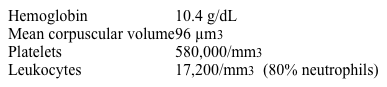 Blood cell counts were normal a month ago at the time of hospital discharge. Which of the following is the most likely underlying cause of this patient's increased platelet count?
 (Multiple Choice)
5.0/5 (87)
(87) A 56-year-old man comes to the emergency department with acute, severe chest pain. His electrocardiogram is within normal limits. Contrast-enhanced computed tomography of his chest is shown below. 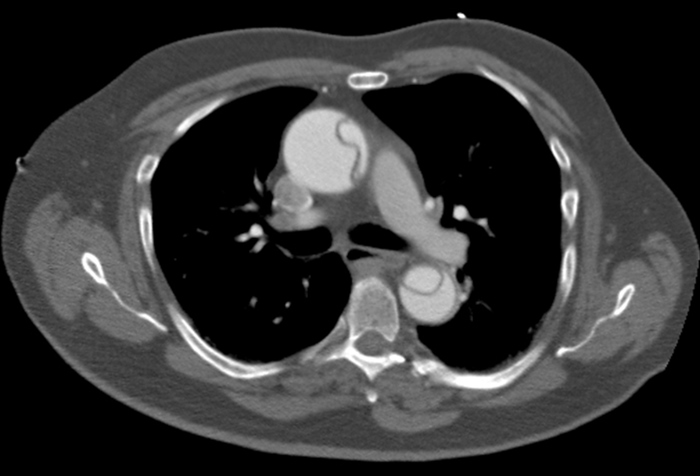 Which of the following is the single most important risk factor for this patient's current condition?
 (Multiple Choice)
4.8/5 (92)
(92) A 38-year-old man is evaluated for bloody stools, weight loss, and anemia. The patient's past medical history is unremarkable, and he does not take any medications. He uses tobacco and drinks alcohol "socially." The patient's father died of colon cancer at age 40. His younger sister suffers from endometrial cancer. Examination is remarkable for minimal right-sided abdominal tenderness without guarding to deep palpation. Stool is positive for occult blood. Colonoscopy shows a right-sided ulcerative colon mass. No polyps are noted. Biopsy of the mass reveals adenocarcinoma. A mutation in which of the following genes is most likely responsible for this patient's condition?
(Multiple Choice)
4.9/5 (87)
(87) A 38-year-old man is evaluated due to a 2-year history of gradually worsening low back pain, bilateral buttock pain, and stiffness. Symptoms are worse in the morning and relieved with stretching and hot showers. The patient also has fatigue but no fever, chills, night sweats, or weight loss. Vital signs are normal. The patient appears healthy but has a stooped walking posture. Deep palpation over the lumbar spine at the midline and both sacroiliac joints elicits tenderness. Erythrocyte sedimentation rate is 75 mm/hr. Which of the following pathologic findings is most likely causing this patient's symptoms?
(Multiple Choice)
4.9/5 (79)
(79) A 35-year-old primigravid woman comes to the clinic during the second trimester. The patient reports that she has had some tiredness, which she attributes to pregnancy. She takes 1 nap during the day. She has no chest pain, cough, or lower extremity swelling. As a child, the patient was told that she has a murmur but does not know any details and says that she has felt well until recently. On physical examination, a 3/6 midsystolic murmur is heard at the left upper sternal border and S2 is widely split. Which of the following is the most likely diagnosis?
(Multiple Choice)
4.9/5 (73)
(73) A 46-year-old woman is admitted to the hospital with dehydration secondary to excess output from an ileostomy. Five years ago, the patient had a total colectomy with a diverting ileostomy for colon cancer. For the last 6 months, she has had increased output from the ileostomy and has been admitted to the hospital twice with similar episodes of dehydration. On the second day of admission, she reports right flank pain. X-ray of the abdomen reveals a nonspecific bowel gas pattern with no evidence of renal calculi. Ultrasound of the abdomen shows a 4-mm stone in the distal right ureter. The patient is treated with analgesics and the stone passes spontaneously. Microscopic analysis of the stone reveals a pure uric acid stone. Which of the following is the most likely underlying mechanism leading to stone formation in this patient?
(Multiple Choice)
4.9/5 (68)
(68) A 34-year-old woman comes to the office due to diplopia, clumsiness of the left hand, and numbness of the right foot. Six months ago, the patient had numbness of the right hand, which resolved without treatment. Ten years ago, she was hurt by an explosion at work that resulted in a metallic foreign body in her left eye. She has no other medical problems and takes no medications. The patient has a 10-pack-year smoking history. Both parents are healthy. Vital signs are normal. BMI is 27 kg/m2. Neurologic examination shows slowing of left eye adduction and left arm power of 4/5 with mild spasticity. Sensation to pinprick is decreased over the right foot. Cerebrospinal fluid analysis shows mononuclear cell pleocytosis and oligoclonal banding. Which of the following pathologic findings is most likely to be present in this patient's brain?
(Multiple Choice)
4.7/5 (98)
(98) A 75-year-old man is brought to the emergency department due to problems with vision and right-sided hemisensory loss that started an hour ago. While in the emergency department, his symptoms gradually worsen and he develops a headache. Head CT reveals multiple, small lobar hemorrhages of varying ages in the occipital and parietal areas with a medium-size acute bleed in the left parietooccipital lobe. Two years ago, the patient developed sudden right arm weakness; neuroimaging at that time demonstrated a small left frontal lobe hemorrhage. He has no head trauma and does not use anticoagulants. This patient most likely suffers from which of the following?
(Multiple Choice)
4.7/5 (76)
(76) A 50-year-old man comes to the clinic for evaluation prior to a left total knee arthroplasty. Medical history is significant for osteoarthritis. The patient does not smoke. Preoperative chest x-ray demonstrates a 1.5-cm, round lesion in the periphery of the right upper lobe of the lung. Further imaging studies are suggestive of a pulmonary hamartoma. If a transthoracic biopsy were performed, which of the following microscopic features would be most consistent with this diagnosis?
(Multiple Choice)
4.9/5 (77)
(77) A 54-year-old man hospitalized with an acute myocardial infarction goes into cardiac arrest. The patient is resuscitated successfully and transferred to the cardiac intensive care unit where he remains hemodynamically stable. However, on the second day of hospitalization, his urine flow diminishes to 400 mL/day. Blood pressure is 115/68 mm Hg and pulse is 78/min. Laboratory results are as follows: 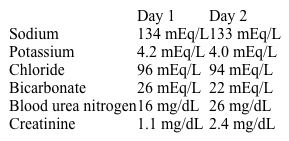 Urine sediment microscopy reveals muddy brown casts. Which of the following renal structures are most likely to demonstrate signs of ischemic injury?
 (Multiple Choice)
4.9/5 (75)
(75) A 54-year-old man comes to the emergency department after an episode of bloody vomiting. He has had no fever, chills, abdominal pain, diarrhea, or constipation. The patient has a history of alcohol abuse with multiple previous hospital admissions due to alcohol withdrawal and generalized tonic-clonic seizures. He also has a history of intravenous drug abuse and is currently enrolled in a methadone maintenance program. Blood pressure is 96/62 mm Hg and pulse is 102/min. On examination, the patient appears comfortable but develops dizziness when asked to sit up. There is no jugular venous distension. The abdomen is distended with dullness to percussion at both flanks. The liver is enlarged on palpation, and the tip of the spleen is also palpable. There is trace pedal edema. Laboratory studies show: 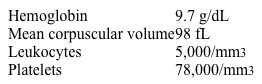 Histopathologic examination of this patient's spleen is most likely to show which of the following?
 (Multiple Choice)
4.9/5 (73)
(73) A 45-year-old woman is brought to the emergency department after an episode during which she abruptly lost consciousness and had rhythmic jerking movements of the limbs followed by a period of confusion. The patient has had mild daily headaches associated with nausea that have progressed over the past 2 years. The headaches are worse at night and occasionally awaken her. The patient reports no head trauma, visual changes, weakness, numbness, or difficulty swallowing or speaking. She does not use alcohol or illicit drugs. There is no family history of seizures. An intracranial mass is discovered on neuroimaging and a biopsy of the mass is shown in the image below. 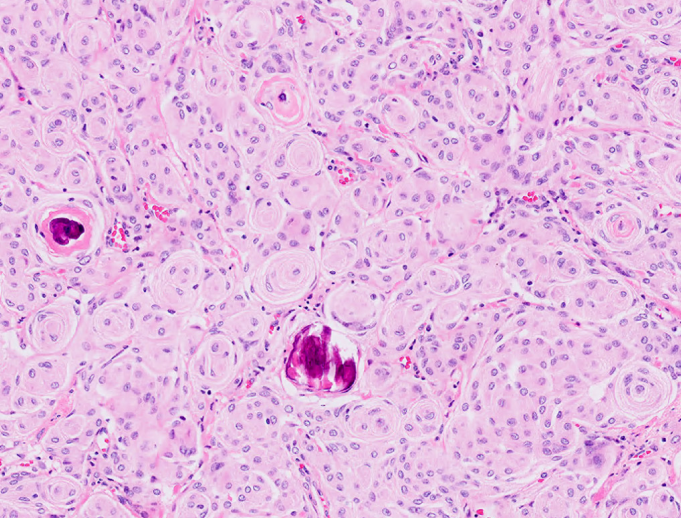 Which of the following is the most likely diagnosis?
 (Multiple Choice)
4.9/5 (72)
(72) A 32-year-old man is hospitalized due to nausea, vomiting, and severe abdominal pain. He has a history of heavy alcohol use and was admitted to the hospital for acute pancreatitis a year ago. He has continued to drink alcohol since his last hospitalization and had a party last weekend, during which he consumed an entire 750-mL bottle of liquor. Temperature is 38.3 C (100.9 F), blood pressure is 110/80 mm Hg, pulse is 104/min, and respirations are 20/min. Abdominal examination is notable for marked tenderness in the epigastric region. Serum lipase is 2,392 U/L. The patient is admitted and started on intravenous fluids, analgesics, and antiemetics with subsequent improvement in his symptoms. His vital signs remain stable with adequate urine output. However, on the second day of hospitalization, the patient develops progressive shortness of breath and hypoxemia. Chest x-ray reveals new bilateral opacities. Which of the following parameters is most likely to be normal in this patient?
(Multiple Choice)
4.9/5 (80)
(80) Intravenous fluids and vasopressors are administered, but the patient remains hypotensive and dies 3 hours later. Autopsy examination is performed and reveals bilateral hippocampal necrosis. Which of the following areas of the colon would be most likely to also demonstrate necrosis?
(Multiple Choice)
4.8/5 (90)
(90) A 50-year-old woman comes to the office for an annual examination. She is healthy and takes no medications other than vitamin D and calcium supplements. The patient does not smoke, drink alcohol, or use illicit drugs. Her blood pressure is 118/69 mm Hg. Physical examination is unremarkable. A recent mammogram was normal. A colonoscopy showed 2 polyps, which were excised. On histological examination, one polyp is small and has early adenoma features; the other is larger and has late adenoma features. A mutation in which of the following genes would most likely cause this patient's small early adenoma to grow and develop late adenoma features?
(Multiple Choice)
4.8/5 (78)
(78) 
Filters
- Essay(0)
- Multiple Choice(0)
- Short Answer(0)
- True False(0)
- Matching(0)