



 Chat with AI
Exam 10: Pathology

Exam 1: Anatomy291 Questions
Exam 2: Behavioral science240 Questions
Exam 3: Biochemistry156 Questions
Exam 4: Biostatistics117 Questions
Exam 5: Embryology52 Questions
Exam 6: Genetics103 Questions
Exam 7: Histology24 Questions
Exam 8: Immunology129 Questions
Exam 9: Microbiology336 Questions
Exam 10: Pathology816 Questions
Exam 11: Pathophysiology464 Questions
Exam 12: Pharmacology538 Questions
Exam 13: Physiology272 Questions
Select questions type


A 26-year-old previously healthy man comes to the office with a 3-week history of shortness of breath, cough, and hemoptysis preceded by an upper respiratory tract infection. He has no fever, night sweats, or weight loss. His blood pressure is 150/85 mm Hg and pulse is 86/min and regular. Physical examination reveals bilateral inspiratory crackles and lower extremity edema. His creatinine is 4.1 mg/dL. Urinalysis shows proteinuria and hematuria with dysmorphic red blood cells. Bilateral pulmonary infiltrates are seen on chest x-ray. He is also found to have an increased carbon monoxide diffusing capacity (DLCO) on pulmonary function testing. Antibodies directed against which of the following is most likely to be associated with this patient's condition?
(Multiple Choice)
5.0/5  (75)
(75) A 35-year-old man is admitted to the hospital with a 2-day history of abdominal pain. The patient's condition deteriorates throughout the course of hospitalization, and he dies 5 days after admission. Autopsy reveals chalky white lesions in the mesentery. Histologic evaluation of the lesions reveals adipose cell destruction and calcium deposition. Which of the following is the most likely cause of this patient's autopsy findings?
(Multiple Choice)
4.8/5 (72)
(72) A 7-year-old boy comes to the office for follow-up. A week ago, the patient began having episodes of bloody diarrhea that have since resolved. His current laboratory studies show elevated blood urea nitrogen and serum creatinine levels. Complete blood count reveals anemia and thrombocytopenia. Coagulation studies are within normal limits. His peripheral blood smear is shown in the image below. 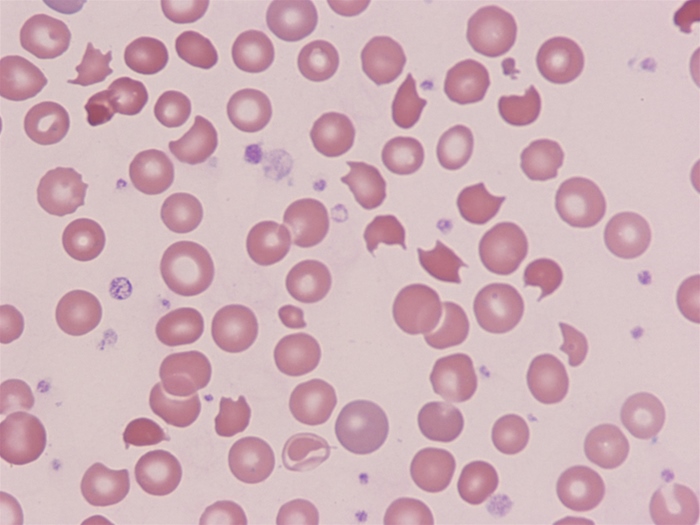 Which of the following is the most likely cause of this patient's anemia?
 (Multiple Choice)
4.8/5 (85)
(85) A 73-year-old woman comes to the office due to increasing abdominal girth. She also has constipation and decreased appetite that has worsened progressively for the last 6 months. On physical examination, the abdomen is distended and nontender, and there is a palpable right adnexal mass. The patient undergoes a right oophorectomy, and gross and microscopic examinations of the specimen are shown in the exhibit.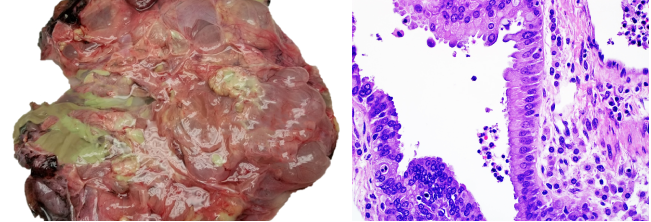 Which of the following markers is most likely to be elevated in this patient?
 (Multiple Choice)
4.9/5 (84)
(84) A 54-year-old man comes to the hospital due to acute-onset right flank pain associated with nausea. Five years ago, the patient had nephrolithiasis; the renal calculi passed spontaneously with intravenous fluids. Review of systems is positive for occasional palpitations. Other medical problems include hypertension, obesity, and obstructive sleep apnea. Temperature is 38 C (100.4 F), blood pressure is 170/98 mm Hg, pulse is 90/min, and respirations are 18/min. Cardiopulmonary examination shows no abnormalities. Right flank tenderness is present. Urinalysis demonstrates 2+ red blood cells and no white blood cells or protein. A representative kidney specimen is shown below: 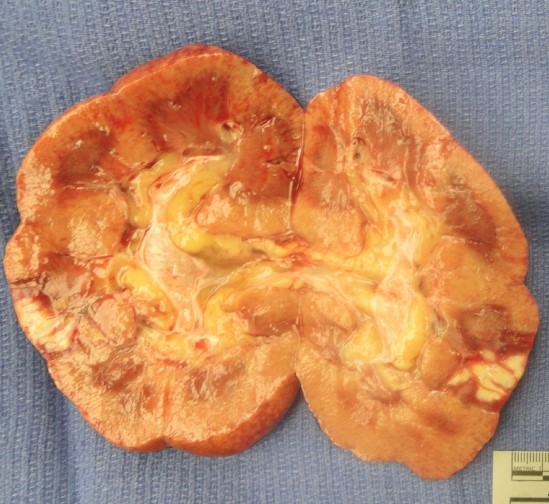 Which of the following is the most likely diagnosis?
 (Multiple Choice)
4.8/5 (79)
(79) A 31-year-old woman is brought to the hospital due to respiratory difficulty. She has had trouble performing her daily activities for the past few weeks due to fatigue. In particular, her arms seem to "just drop" when she combs her hair. The patient's symptoms are generally better in the morning and worsen throughout the day. She does not use tobacco, alcohol, or illicit drugs. Examination shows diplopia. Chest auscultation shows normal heart and breath sounds. Deep tendon reflexes are normal. Babinski sign is absent. The results of arterial blood gas analysis are as follows: 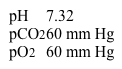 Which of the following is most likely abnormal in this patient?
 (Multiple Choice)
4.9/5 (72)
(72) A 54-year-old man is brought to the office by his daughter. She says that her father has been acting strangely over the past 2 years. He makes inappropriate sexual jokes, has little regard for social rules, is often irritable, and is borderline aggressive at times. The patient denies that his personality is any different from normal. When speaking with the patient, the physician notices that he has minimal verbal output and repeats "it is what it is" when asked questions about his strange behavior. On physical examination, he appears unkempt but otherwise has no significant findings. This patient most likely has a condition that predominantly involves which of the following structures?
(Multiple Choice)
4.8/5 (78)
(78) A 32-year-old woman describes five episodes of intractable vomiting over the last year. The episodes last several hours and are associated with a sensation that the room is spinning or tilting. At these times, it is difficult for her to walk because she loses her balance. She cannot relate the timing of the episodes to any particular inciting event. Physical examination reveals stability in the Romberg position and during tandem walk. Proprioception is intact. Dysfunction of which of the following structures best explains this patient's symptoms?
(Multiple Choice)
4.9/5 (77)
(77) A 26-year-old woman comes to the office due to a skin condition. The patient has had dry, flaky skin since childhood, but it has worsened in recent years. Symptoms are typically worse in the winter but improve as the weather warms in the spring. The patient has a family history of asthma; both parents also have chronically dry skin. Examination shows diffuse scaling of the skin that is most notable on the extremities, as shown in the exhibit. 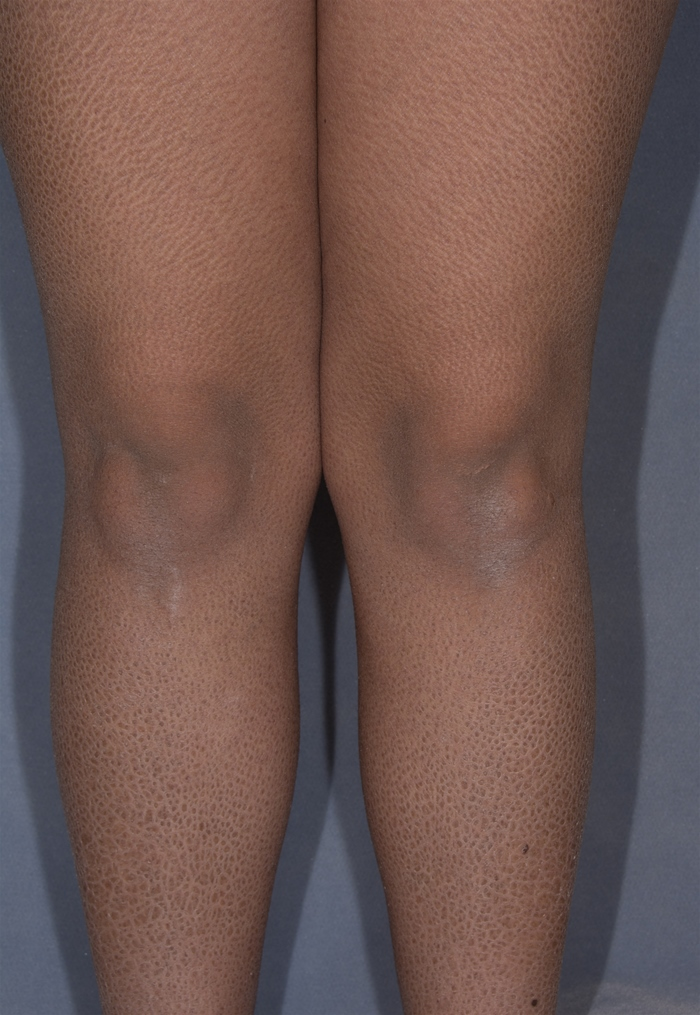 Which of the following is most likely contributing to this patient's condition?
 (Multiple Choice)
4.9/5 (86)
(86) A 39-year-old man comes to the emergency department with anterior chest pain. He had felt well until the pain developed 4 days ago. The patient says the pain is sharp and makes it difficult to take a deep breath. Since yesterday, he has also felt out of breath. Medical history is unremarkable. The patient's father died of a heart attack at age 52, and his mother suffers from rheumatoid arthritis. He does not use alcohol or tobacco. Temperature is 37.4 C (99.3 F), blood pressure is 112/65 mm Hg, and pulse is 103/min and regular. Bedside ultrasound examination demonstrates a moderate pericardial effusion. Which of the following is the most likely cause of this patient's current condition?
(Multiple Choice)
4.8/5 (90)
(90) A 55-year-old man comes to the office for follow-up of abnormal serum chemistries found on routine laboratory testing. He has a history of hypertension, for which he is being treated with pharmacologic therapy, weight loss, and dietary salt restriction. Blood pressure is 130/80 mm Hg and pulse is 80/min. BMI is 27 kg/m2. Physical examination reveals no abnormalities. Laboratory studies are as follows: 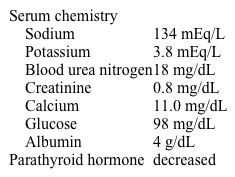 Which of the following is most likely responsible for these findings?
 (Multiple Choice)
4.9/5 (77)
(77) A 61-year-old man comes to the office due to 4 months of easy fatigability, anorexia, and a 4.5-kg (10-lb) unintentional weight loss. His stool occult blood testing is positive, and laboratory studies show microcytic hypochromic anemia. Colonoscopy reveals a 6-cm (2.4-in) mass in the descending colon. Biopsy samples obtained during the procedure are consistent with adenocarcinoma. A subsequent CT scan of the abdomen shows multiple metastatic liver lesions. Therapy with monoclonal antibodies that bind to epidermal growth factor receptors on the malignant cells is considered. An activating mutation in which of the following will most likely make this therapy ineffective?
(Multiple Choice)
4.8/5 (93)
(93) A 21-year-old Caucasian male presents to the emergency department following an episode of syncope. The syncopal episode was not provoked by any activity or circumstance, nor was it preceded by lightheadedness. The patient has no significant past medical history and he is not taking any medications. An ECG obtained in the ER reveals QT-interval prolongation but is otherwise unremarkable. Assuming this is an inherited condition, the relevant mutation most likely affects which of the following structures?
(Multiple Choice)
4.7/5 (77)
(77) A 52-year-old man comes to the physician complaining of dizziness, headaches, and pruritus after showering. He has smoked half a pack of cigarettes daily for the past fifteen years and drinks alcohol socially. Physical examination shows a reddish facial complexion and mild splenomegaly. Laboratory results are as follows: 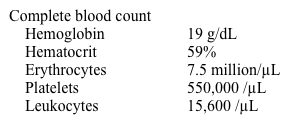 Which of the following is the most likely cause of this patient's findings?
 (Multiple Choice)
4.9/5 (75)
(75) A 28-year-old woman with a history of type 1 diabetes mellitus comes to the hospital due to abdominal pain, nausea, and vomiting. She is found to have severe hyperglycemia, high anion gap metabolic acidosis, and an elevated beta-hydroxybutyrate level. While being evaluated in the emergency department, the patient develops involuntary, rhythmic jerking of her right upper extremity that lasts for about a minute. She remains fully alert during and after the event. The patient has never had similar symptoms in the past and has no other medical conditions. Physical examination shows no weakness or sensory loss in the right upper extremity. Which of the following is the most likely diagnosis?
(Multiple Choice)
4.9/5 (80)
(80) A 16-year-old girl comes to the office due to fatigue for the past few months. She attends high school and plays on the school soccer team but says that her endurance has decreased. The patient sleeps 9 hours a night and has been a vegetarian for the past year. She reached menarche at age 13 and has had regular menses for the past 6 months. The patient is not sexually active and does not smoke cigarettes but does report drinking 1 or 2 cans of beer a month. Her blood pressure is 110/60 mm Hg, pulse is 70/min, and BMI is 21 kg/m2. Physical examination shows a well-nourished teenage girl with pale conjunctivae. Her hemoglobin is 9.2 g/dL. Which of the following sets of additional laboratory findings are most likely to be seen in this patient?
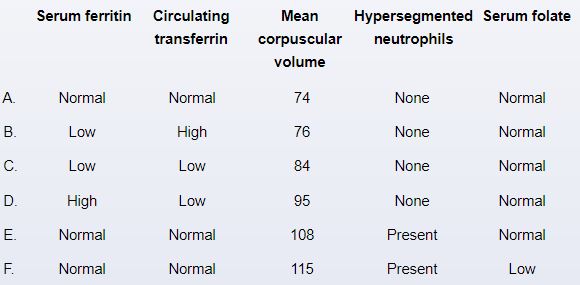
(Multiple Choice)
4.8/5 (78)
(78) A 30-year-old man with a history of intravenous drug abuse and known HIV infection comes to the emergency department because of increasing abdominal distention and anorexia. A CT scan of the abdomen shows ascites and a large mass surrounding the small intestine. Biopsy of the mass reveals uniform, round, medium-sized tumor cells with basophilic cytoplasm and a proliferation fraction (Ki-67 fraction) of > 99%. Which of the following infectious agents is most closely associated with the development of his current condition?
(Multiple Choice)
4.9/5 (87)
(87) A 74-year-old man is brought to the emergency department due to acute-onset lower abdominal and back pain that was followed by an episode of syncope 2 hours ago. The pain is sharp and constant. He has had no changes in bowel or bladder function. Other medical conditions include hypertension and hyperlipidemia. The patient has a 50-pack-year history of smoking cigarettes. Temperature is 36.9 C (98.4 F), blood pressure is 90/60 mm Hg, pulse is 108/min and regular, and respirations are 18/min. BMI is 34 kg/m2. The patient is diaphoretic and appears pale. Heart and lung sounds are normal. Abdominal examination reveals moderate tenderness to deep palpation in the lower abdomen; there is no guarding or rebound tenderness. Bowel sounds are normal. Which of the following is the most likely diagnosis?
(Multiple Choice)
4.9/5 (89)
(89) A 24-year-old woman comes to the office due to worsening acne. Over the past 3 months, the patient has had frequent breakouts on the shoulders and upper back. She had acne on her face during puberty, which cleared spontaneously after several years, but has never before had symptoms on her trunk. The patient has no other medical conditions, and her only medication is a combination oral contraceptive. She has been training for a half-marathon for the past 4 months and has lost 6.8 kg (15 lb) during this period. She does not use tobacco, alcohol, or illicit drugs, and she relocated from California to Wisconsin for work a year ago. Vital signs are within normal limits. Physical examination shows acneiform eruptions on the shoulders and mid-back. Which of the following is most likely contributing to worsening of this patient's acne?
(Multiple Choice)
5.0/5 (69)
(69) A 50-year-old man comes to the office for evaluation of a nodule in his palm just proximal to the third metacarpophalangeal joint. It has grown larger since it first appeared several months ago and he now has mild flexion of the finger, which he is unable to straighten. The patient reports that his mother had similar problems with her fingers. Examination of the affected hand is shown in the exhibit. 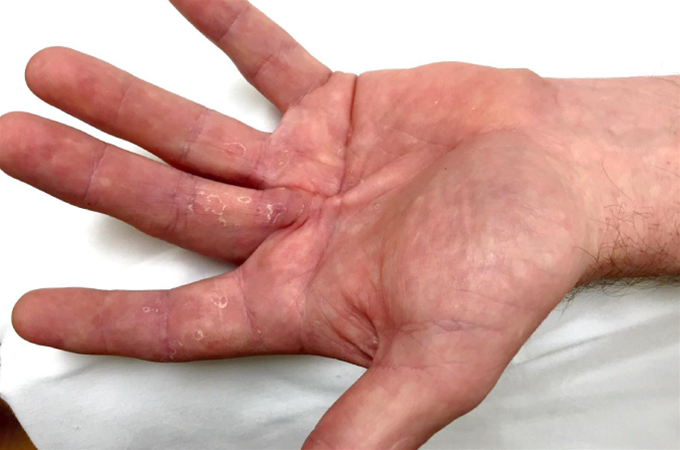 Which of the following pathologic processes is most likely involved in this patient's condition?
 (Multiple Choice)
4.8/5 (75)
(75) 
Filters
- Essay(0)
- Multiple Choice(0)
- Short Answer(0)
- True False(0)
- Matching(0)