



 Chat with AI
Exam 10: Pathology

Exam 1: Anatomy291 Questions
Exam 2: Behavioral science240 Questions
Exam 3: Biochemistry156 Questions
Exam 4: Biostatistics117 Questions
Exam 5: Embryology52 Questions
Exam 6: Genetics103 Questions
Exam 7: Histology24 Questions
Exam 8: Immunology129 Questions
Exam 9: Microbiology336 Questions
Exam 10: Pathology816 Questions
Exam 11: Pathophysiology464 Questions
Exam 12: Pharmacology538 Questions
Exam 13: Physiology272 Questions
Select questions type


A 2-year-old girl is brought to the emergency department with intermittent pain in the abdomen that began several hours ago. The patient also had a bowel movement that appeared tinged with blood. Ultrasound shows an area along the ileum in which the proximal small intestine is telescoped into the distal small intestine. Reduction via enema is unsuccessful, and the patient undergoes laparotomy with resultant resection of the involved intestine. The pathologic finding at the lead point is shown in the following image: 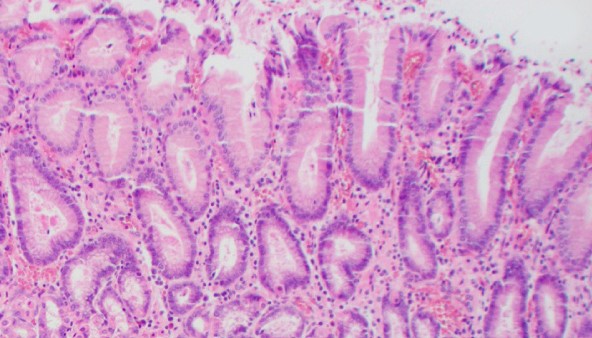 Which of the following is the most likely underlying diagnosis in this patient?
 (Multiple Choice)
4.9/5  (71)
(71) A 58-year-old man comes to the office due to exertional dyspnea and cough. His symptoms started 6 months ago and have progressively worsened. Other medical problems include recurrent pyelonephritis, peptic ulcer disease, and rheumatoid arthritis. The patient had taken a medication for rheumatoid arthritis for many years but stopped a year ago, as the drug failed to improve his worsening hand arthritis. He does not use tobacco, alcohol, or illicit drugs. Physical examination shows joint disease consistent with rheumatoid arthritis. Chest x-ray is shown in the image below. 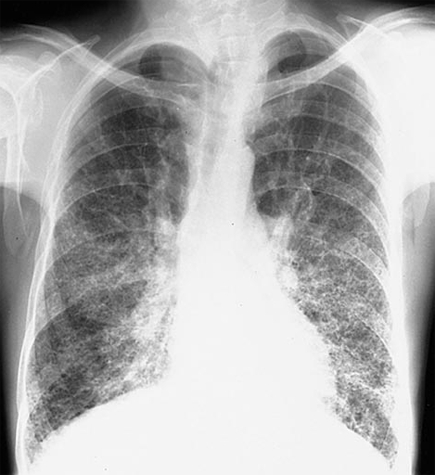 Which of the following is the most likely explanation for this patient's pulmonary symptoms?
 (Multiple Choice)
4.8/5 (82)
(82) A 68-year-old man comes to the office due to episodes of gross hematuria over the last 3 months. Blood is present throughout micturition. The patient has no abdominal pain, dysuria, urinary frequency, or nocturia. Medical history includes type 2 diabetes mellitus, for which he takes metformin. The patient is retired, lives at home with his wife, and spends most of his free time working in his backyard greenhouse. Prior to retirement, he worked at a rubber manufacturing plant for 35 years. Vital signs are within normal limits. On examination, the abdomen is soft and nontender with no palpable masses. Serum creatinine is 1.1 mg/dL. Which of the following is most likely to be discovered on further workup of this patient's symptoms?
(Multiple Choice)
4.8/5 (66)
(66) A 35-year-old woman comes to the office due to reduced energy and fatigue. She reports heavy menstrual bleeding over the past 6 months. The patient is found to have hypochromic microcytic anemia. Iron supplementation is prescribed. A week later, a peripheral blood smear shows numerous enlarged red blood cells that have a bluish hue on Wright-Giemsa staining. The bluish color of these red blood cells is best explained by the presence of which of the following?
(Multiple Choice)
5.0/5 (85)
(85) A 6-year-old boy is evaluated in the office for difficulty hearing. The patient has no ear pain, discharge, or upper respiratory symptoms. Initial testing suggests that he has bilateral sensorineural hearing loss. He has no motor deficits or cerebellar signs. His paternal uncle died suddenly at age 12. Examination of the ears, nose, and throat is normal. ECG shows normal sinus rhythm with a prolonged QT interval (520 msec). Echocardiogram shows normal left and right ventricular function with no significant valvular disease. A genetic defect affecting which of the following is most likely present in this patient?
(Multiple Choice)
4.8/5 (87)
(87) A 61-year-old woman who recently immigrated to the United States has a long history of "joint problems." She began to have pain in her hands at age 30, and her symptoms have been intermittent but progressive since then. The symptoms were treated with nonsteroidal anti-inflammatory drugs when the pain was most severe. The patient also has a history of hypertension and chronic anemia. She does not smoke cigarettes or use illicit drugs. Family history is insignificant. On examination, there is gross deformity of multiple joints in both hands. X-ray findings are shown in the image below. 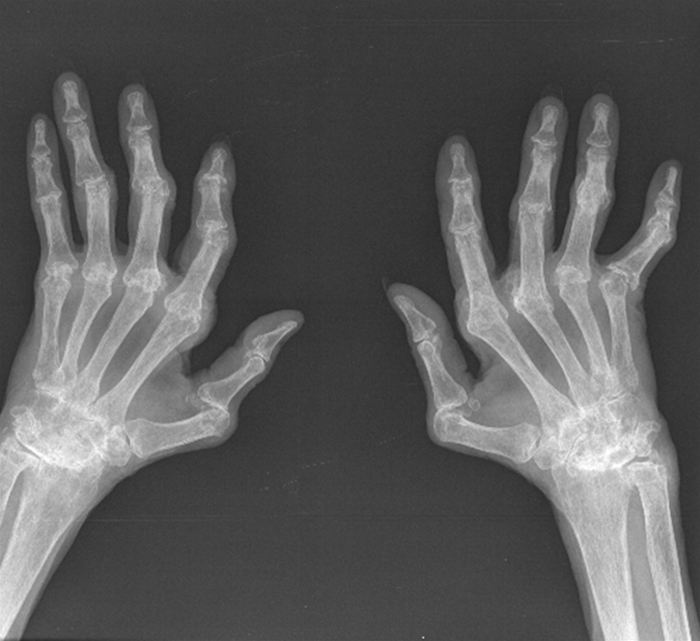 The disease process responsible for the radiographic findings would most likely affect which of the following?
 (Multiple Choice)
4.9/5 (78)
(78) A 34-year-old man with an unremarkable past medical history is evaluated for an enlarged lymph node in his anterior cervical chain that measures 4 cm in diameter. The patient first felt the lymph node several weeks ago and states that it has been steadily increasing in size. He is concerned about whether or not he "has cancer." The patient is referred to a specialist for surgical removal of the enlarged node. Biopsy reveals abnormal lymph node architecture and numerous lymphocytes. Which of the following, if present, would be most consistent with malignancy in this patient?
(Multiple Choice)
4.8/5 (77)
(77) A 68-year-old male presents to your office complaining of difficulty urinating. His past medical history is significant for prostate cancer treated with radiation therapy one year ago. Ultrasonography reveals bilateral dilation of the ureters and renal calyces. If related to the previous therapy, which of the following is the most likely cause of this patient's current condition?
(Multiple Choice)
4.8/5 (72)
(72) A 72-year-old woman comes to the office due to persistent headaches, fatigue, and muscle pain. She has a history of hypertension and osteoarthritis. The patient does not use tobacco, alcohol, or illicit drugs. Her father had a subarachnoid hemorrhage from a ruptured berry aneurysm. She is treated with prednisone, leading to marked and rapid improvement in her symptoms. Which of the following pathologic processes is most likely responsible for this patient's condition?
(Multiple Choice)
4.8/5 (73)
(73) A 52-year-old man comes to the office due to a progressively enlarging neck mass, fatigue, and weight loss over the past 2 months. Physical examination shows enlarged, firm, and nontender cervical lymph nodes. The patient also has enlarged tonsils, bilateral axillary lymphadenopathy, and splenomegaly. Excisional lymph node biopsy reveals diffuse sheets of atypical, large B cells that have replaced the normal tissue architecture. In situ hybridization of the tissue specimen is positive for Epstein-Barr virus. Which of the following risk factors is most strongly associated with development of this patient's condition?
(Multiple Choice)
4.8/5 (80)
(80) A 30-year-old man is brought to the emergency department due to left-sided weakness. His left arm was sluggish after awakening, and he had difficulty walking to the bathroom. The patient has no known medical conditions but has a 2-month history of positional dyspnea. Vital signs are within normal limits. On examination, strength of the left upper and left lower extremity is reduced, and touch/temperature sensation is similarly diminished. Cardiovascular examination reveals an intermittent murmur at the apex without carotid bruits. Echocardiography shows a mobile, 3-cm left atrial mass obstructing the mitral opening during diastole. Histologic examination of this mass would most likely show which of the following findings?
(Multiple Choice)
4.9/5 (82)
(82) A 56-year-old man is evaluated for increased fatigability. His past medical history is significant for diabetes mellitus, osteoarthritis, and severe aortic stenosis that required aortic valve replacement. His peripheral blood smear is shown on the slide below. 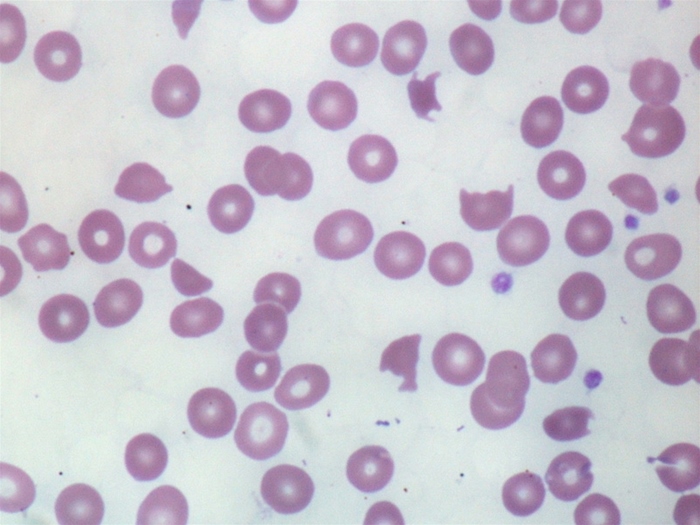 Which of the following laboratory findings is most likely to be seen in this patient?
 (Multiple Choice)
5.0/5 (64)
(64) A 67-year-old woman is evaluated for worsening fatigue and exertional dyspnea. She has no prior medical conditions and takes no medications. The patient does not use tobacco, alcohol, or illicit drugs and consumes a balanced diet. Vital signs are within normal limits. Physical examination is notable for mucosal pallor. Stool testing for occult blood is negative. Laboratory studies reveal that hemoglobin is 6.7 g/dL, white blood cell count is 35,000/mm3, and platelets are 45,000/mm3. Peripheral blood flow cytometry of the white blood cell population is shown below. 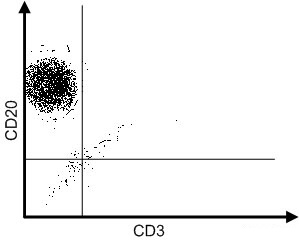 Which of the following is the most likely diagnosis?
 (Multiple Choice)
5.0/5 (81)
(81) A 46-year-old, previously healthy man develops sudden-onset, sharp, left-sided flank pain radiating to the groin. CT scan of the abdomen reveals a left ureteral calculus, which he passes spontaneously in the urine. Other, incidental findings include a left lower lobe lung nodule and foci of calcifications in the spleen. Chest imaging shows several small calcified nodules in both lungs and a calcified mediastinal lymph node. The patient has had no pulmonary symptoms and is a lifelong nonsmoker. He is a farmer who lives in Ohio and has not traveled recently. Physical examination shows no abnormalities. Tuberculosis skin test shows a <5 mm induration at 48 hours. Repeat chest imaging 3 months later reveals no changes. Which of the following is the most likely cause of the observed findings in this patient?
(Multiple Choice)
4.9/5 (70)
(70) A 36-year-old woman comes to the office after she noticed some lumps under her arm while getting dressed. She says she feels fine and has no other symptoms. Her medical history is significant for hypothyroidism. Family history is negative. On physical examination, her body mass index is 24 kg/m2. Breast examination shows nontender left axillary lymphadenopathy. The patient is sent for an ultrasound-guided biopsy. Microscopy of the tissue specimen shows clumps of cells that have positive immunohistochemical staining for cytokeratin. These cells most likely belong to which of the following lineages?
(Multiple Choice)
4.8/5 (73)
(73) A 63-year-old man comes to the emergency department due to abdominal pain. Physical examination shows abdominal tenderness without guarding or rebound. His laboratory test results are as follows: 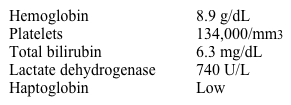 On further investigation, magnetic resonance angiography of the abdomen reveals mesenteric vein thrombosis. Flow cytometry shows absence of CD55 on the surface of red blood cells. Which of the following is the most likely pathologic renal finding in this patient?
 (Multiple Choice)
4.9/5 (101)
(101) A 52-year-old man comes to the office due to periodic substernal chest heaviness. The pain is precipitated by fast walking, especially uphill and against the wind, and remits after 5 minutes of rest. The patient has a history of hypertension and smokes a pack of cigarettes a day. Blood pressure is 140/80 mm Hg and pulse is 80/min. The lungs are clear to auscultation, and no heart murmurs are heard. There is no peripheral edema. Which of the following pathologic states is most likely to be present in this patient?
(Multiple Choice)
4.7/5 (68)
(68) A 68-year-old man is brought to the emergency department with chest pain. For the last year, the patient has had exertional chest pain that has progressively worsened. He was shoveling snow this morning when the pain became unbearable. He has smoked a pack of cigarettes daily for 40 years. Blood pressure is 140/100 mm Hg and pulse is 90/min. Examination showed mild diaphoresis. The lungs are clear to auscultation. ECG shows ST-and T-wave changes suggestive of ischemia. Cardiac enzymes are elevated. Emergent coronary angiography is performed, which demonstrates significant atherosclerotic involvement of the left anterior descending and circumflex arteries. Development of these vascular lesions most likely involved growth factors released from which of the following sources?
(Multiple Choice)
4.9/5 (83)
(83) A 55-year-old woman is brought to the office by her husband for evaluation of strange behavior. She has been spending large amounts of money to buy expensive clothes and jewelry. The patient has also offered sex to unknown men in the neighborhood and has become increasingly indifferent toward her family, about whom she used to care deeply. She usually drinks 1 or 2 glasses of wine on weekends but lately has been drinking 2 or 3 glasses almost every day. When asked about these changes during the interview, the patient states that she has not noticed any change in her behavior. Vital signs are normal. The general physical and neurologic examinations are normal. This patient's condition is most likely due to abnormal accumulation of which of the following?
(Multiple Choice)
4.9/5 (83)
(83) A 31-year-old woman comes to the physician with a velvety skin rash in her axilla, as shown in the image below. 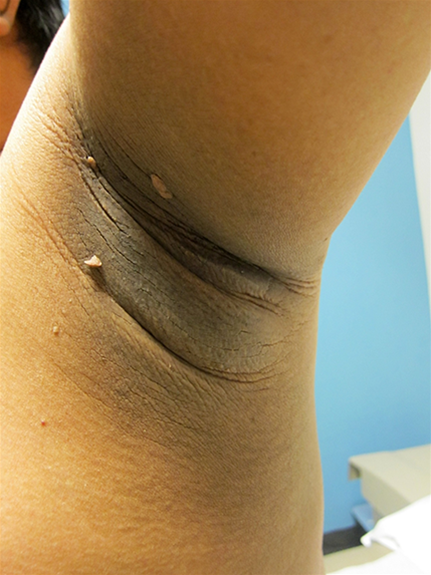 Which of the following is the most likely cause of this patient's condition?
 (Multiple Choice)
4.9/5 (69)
(69) 
Filters
- Essay(0)
- Multiple Choice(0)
- Short Answer(0)
- True False(0)
- Matching(0)