



 Chat with AI
Exam 10: Pathology

Exam 1: Anatomy291 Questions
Exam 2: Behavioral science240 Questions
Exam 3: Biochemistry156 Questions
Exam 4: Biostatistics117 Questions
Exam 5: Embryology52 Questions
Exam 6: Genetics103 Questions
Exam 7: Histology24 Questions
Exam 8: Immunology129 Questions
Exam 9: Microbiology336 Questions
Exam 10: Pathology816 Questions
Exam 11: Pathophysiology464 Questions
Exam 12: Pharmacology538 Questions
Exam 13: Physiology272 Questions
Select questions type


A 35-year-old woman comes to the physician complaining of weakness, fatigue, and pallor. She denies heavy menses or melena. Physical examination is unremarkable except for conjunctival pallor. Laboratory results are as follows: 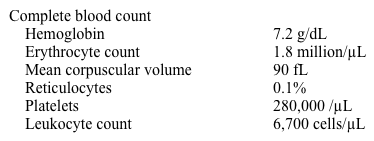 Iron studies and serum B12 and folic acid levels are within normal limits. Bone marrow biopsy shows absence of erythroid precursors but preserved myeloid and megakaryocytic elements. Further workup would most likely show which of the following?
 (Multiple Choice)
4.8/5  (79)
(79) A 77-year-old man is brought to the emergency department due to acute-onset chest pain, shortness of breath, and syncope. Medical history is significant for coronary artery disease, which was treated with right coronary artery stenting 5 years ago. The patient develops cardiac arrest and resuscitation is unsuccessful. Autopsy shows a large bilateral pulmonary embolism occluding the pulmonary trunk. Further history obtained from the patient's wife indicates that he has had constant back pain over the past few months. Autopsy of the vertebrae is shown in the image below: 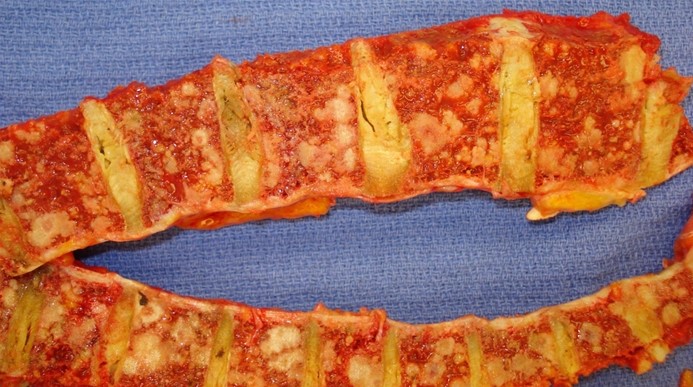 Histologic examination of the bone lesions in this patient would most likely show which of the following?
 (Multiple Choice)
4.9/5 (75)
(75) A 58-year-old man with a history of chronic liver disease secondary to hepatitis C infection comes to the office due to progressive fatigue and abdominal discomfort. He has no other medical conditions, and a recent colonoscopy was normal. Physical examination shows ascites and jaundice. Ultrasonography of the abdomen reveals a solid mass within the liver parenchyma. Surgical resection of the liver lesion is performed. Microscopy reveals large cells with prominent nucleoli arranged in thickened plates as shown below. 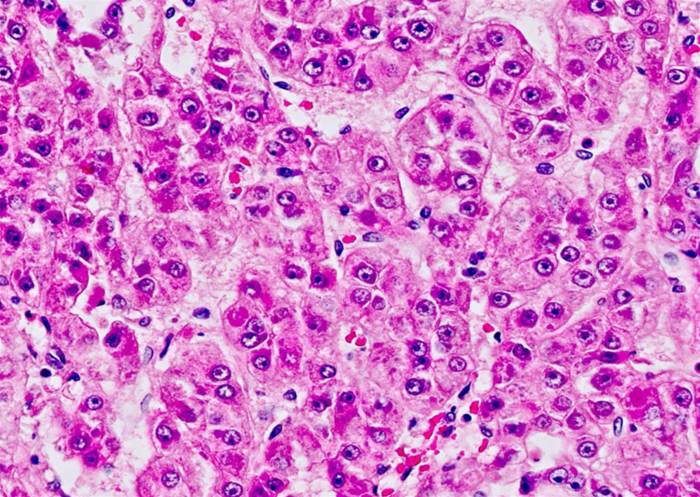 Which of the following serum markers would be most useful for monitoring this patient for disease recurrence?
 (Multiple Choice)
4.8/5 (75)
(75) A 22-year-old woman comes to the emergency department due to a severe left frontal headache for the past 30 minutes. The patient has had similar pain every day for the past 3 days, and the episodes resolve spontaneously after about an hour. She has no other medical conditions and takes no medications. On physical examination, the patient appears restless and in pain. There is ptosis on the left side. Which of the following findings is most suggestive of cluster headache in this patient?
(Multiple Choice)
4.8/5 (79)
(79) A 15-year-old boy comes to the office for a follow-up appointment. Since early childhood, he has suffered from recurrent respiratory infections and chronic diarrhea. The patient has been hospitalized several times for parenteral antibiotic treatment. Current prescribed medications include pancreatic enzyme therapy and a number of dietary supplements. Physical examination shows decreased proprioception and hyporeflexia in the lower extremities. Laboratory findings are suggestive of mild hemolytic anemia. Which of the following conditions is the most likely cause of these findings?
(Multiple Choice)
4.8/5 (98)
(98) A 32-year-old woman comes to the emergency department with sudden-onset left flank pain and nausea. The pain radiates to the left groin and she is unable to find a comfortable position on the examination table. The pain is intermittent and waxes and wanes in severity. Temperature is 36.7 C (98 F), blood pressure is 140/90 mm Hg, and pulse is 92/min. She has mild tenderness to percussion over the left flank. Bowel sounds are hypoactive. Which of the following recommendations would most likely prevent a recurrence of this patient's condition?
(Multiple Choice)
4.8/5 (76)
(76) A 64-year-old man comes to the physician with several lesions on his forehead. The patient has been a gardener for much of his life. The photograph below shows findings from the physical examination. 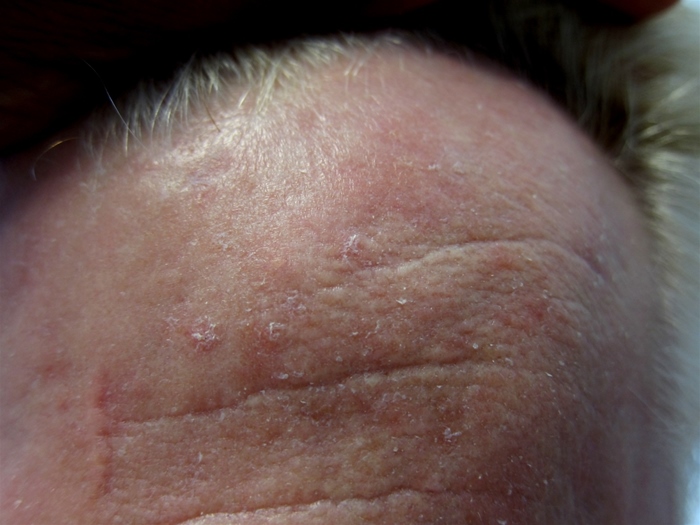 On palpation, the lesions have a rough grainy texture. Biopsy reveals atypical keratinocytes with hyperkeratosis and parakeratosis. This patient's lesions put him at greatest risk for developing which of the following conditions?
 (Multiple Choice)
4.9/5 (97)
(97) A skin lesion on the upper eyelid of a 46-year-old woman is biopsied. Light microscopy of the tissue specimen is shown in the image below. 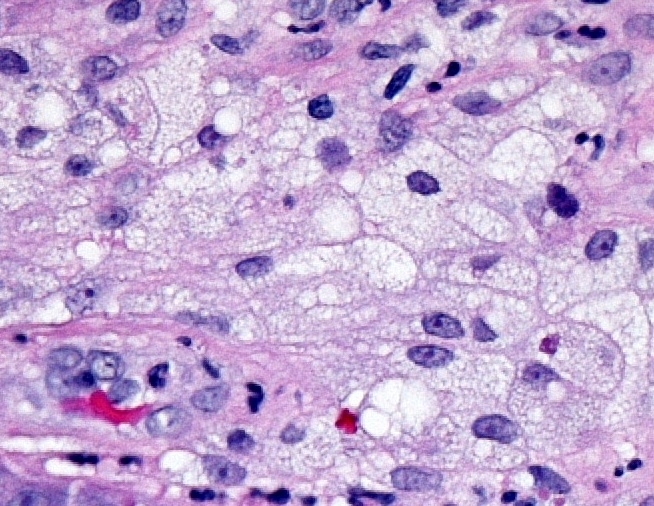 This lesion is most likely to be associated with which of the following conditions?
 (Multiple Choice)
4.8/5 (83)
(83) A 35-year-old woman comes to the clinic due to severe heartburn that is resistant to over-the-counter antacids. The patient has no known medical problems and takes no other medications. She occasionally has a glass of wine with dinner but does not use tobacco or illicit drugs. Physical examination shows scattered telangiectasias on the face, several ulcers at the tips of the fingers, and small calcium deposits in the soft tissues of the hands and elbows. Which of the following processes is the most likely cause of this patient's heartburn?
(Multiple Choice)
4.7/5 (78)
(78) A 36-year-old woman, gravida 2 para 1, at 38 weeks gestation comes to the hospital in active labor, dilated to 10 cm. She has received no prenatal care this pregnancy. Her prior pregnancy resulted in an uncomplicated cesarean delivery. On admission, temperature is 36.7 C (98.1 F), blood pressure is 132/84 mm Hg, and pulse is 94/min. The patient precipitously delivers an infant weighing 4.1 kg (9 lb 2 oz). After delivery of the infant, small placental fragments are removed in pieces via manual extraction. Profuse vaginal bleeding occurs, and intravenous lines are placed. Uterotonic medications are administered and vigorous uterine massage is performed. The uterine fundus is firm, but the bleeding continues. Which of the following is the most likely cause of this patient's ongoing vaginal bleeding?
(Multiple Choice)
4.8/5 (74)
(74) A 57-year-old man comes to the hospital due to nausea, vomiting, and severe crampy pain in the right flank. He has had no fever or chills. Several days ago, the patient had similar, but less severe, pain that resolved spontaneously. Medical history is significant for type 2 diabetes mellitus, obesity, hyperlipidemia, hypertension, and gout. Temperature is 37 C (98.6 F), blood pressure is 160/100 mm Hg, and pulse is 98/min. Physical examination shows right flank tenderness. Blood urea nitrogen and serum creatinine are normal. Abdominal ultrasound reveals right-sided hydronephrosis and proximal ureteral dilation. Urinalysis in this patient would most likely reveal which of the following?
(Multiple Choice)
4.9/5 (76)
(76) A group of forensic pathologists are analyzing tissue samples of adolescents age 13-18 to study the aging process. Autopsy of a 14-year-old boy who died in a motor vehicle accident shows several minimally raised yellow spots on the inner surface of the abdominal aorta. The rest of the cardiovascular findings during the autopsy are unremarkable. He had no known medical problems. There was no family history of cardiovascular disease or sudden cardiac death. Which of the following is most likely to be the predominant cell type in these lesions on light microscopy?
(Multiple Choice)
4.8/5 (80)
(80) A 26-year-old Caucasian female is found to have a single amino acid substitution (glutamine for arginine) near the protein C cleavage site in her coagulation factor V gene product. The patient is at greatest risk for developing which of the following conditions?
(Multiple Choice)
4.7/5 (85)
(85) A 24-year-old woman, gravida 1 para 0, at 28 weeks gestation comes to the labor and delivery unit due to intense abdominal pain, vaginal bleeding, and absent fetal movement. Temperature is 36.7 C (98.1 F), blood pressure is 170/96 mm Hg, pulse is 108/min, and respirations are 22/min. Pulse oximetry shows 98% on room air. Physical examination shows a tense abdomen and a firm, tender uterus. Ultrasound shows a hematoma between the placenta and the uterine wall and no fetal cardiac activity. Laboratory results are as follows: 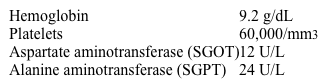 The patient is hospitalized for further management. Once hospitalized, she begins to experience bleeding from her gums and intravenous catheter sites. Blood is also noted in the urinary catheter. Vital signs are unchanged, and she reports no shortness of breath. Which of the following is the most likely underlying cause of this patient's hospital symptoms?
 (Multiple Choice)
4.8/5 (74)
(74) A 34-year-old female presents with a small bluish lesion under the nail of her right index finger. The lesion is extremely tender to touch. If the lesion is a tumor, its cells of origin are most likely to have which of the following functions:
(Multiple Choice)
4.8/5 (76)
(76) Rats subjected to chronic inhalation exposure of formaldehyde develop nasal squamous cell carcinomas. Decreased activity of which of the following genes is likely to be found on cytogenetic studies of the tumor cells?
(Multiple Choice)
4.8/5 (87)
(87) A 56-year-old man dies in the hospital due to aspiration-related complications. The patient was admitted 5 days ago with right-sided weakness, sensory loss, and difficulty with speech and swallowing. CT scan revealed an area of hypodensity in the left frontoparietal region. Autopsy examination is performed, and a section of loose, spongy tissue from the abnormal brain area is obtained. Histologic findings after staining for lipids are shown below. 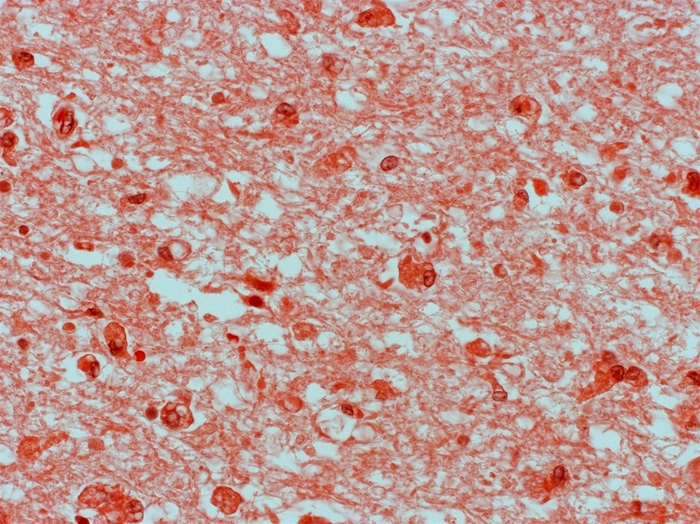 The cells most intensely stained in this patient's brain specimen represent which of the following cell types?
 (Multiple Choice)
4.8/5 (81)
(81) A 26-year-old woman is evaluated for joint pain affecting the elbows, knees, and ankles for the past month. She has also experienced a dry cough and mild shortness of breath over the last 6 months. She is sexually active and takes oral contraceptives. Temperature is 37.2 C (99 F), blood pressure is 120/70 mm Hg, pulse is 84/min, and respirations are 16/min. On physical examination, the lungs are clear to auscultation. There is mild swelling and tenderness of the elbows, knees, and ankles. The lower extremities are tender to palpation and have scattered erythematous nodules. Chest x-ray reveals lung nodules and hilar fullness. Transbronchial biopsy shows large epithelioid cells, occasional giant cells, and no areas of necrosis. Which of the following pharmacotherapies is most appropriate for the initial treatment of this patient?
(Multiple Choice)
4.8/5 (85)
(85) An 18-year-old man is evaluated due to 3 months of lower extremity pain. The pain is persistent and present both day and night. He has no fever, chills, or history of leg trauma. Imaging shows an expansile lesion of the distal femur. Surgical resection is performed, and the specimen is shown below. 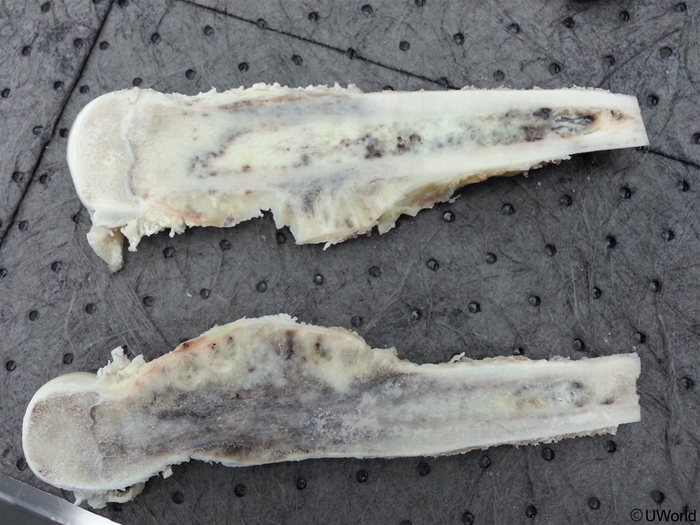 Mutations involving which of the following genes are most likely present in this patient?
 (Multiple Choice)
4.9/5 (69)
(69) A 78-year-old man is brought to the emergency department due to lightheadedness that began earlier in the day. This morning, the patient felt unsteady and almost passed out when he tried to get out of bed. He has not had similar symptoms before and he has had no chest pain or shortness of breath. He has a history of coronary artery disease requiring percutaneous coronary intervention. The rhythm strip of the ECG obtained in the emergency department is shown in the exhibit.  Which of the following is the most likely cause of this patient's current symptoms?
 (Multiple Choice)
4.9/5 (83)
(83) 
Filters
- Essay(0)
- Multiple Choice(0)
- Short Answer(0)
- True False(0)
- Matching(0)