



 Chat with AI
Exam 10: Pathology

Exam 1: Anatomy291 Questions
Exam 2: Behavioral science240 Questions
Exam 3: Biochemistry156 Questions
Exam 4: Biostatistics117 Questions
Exam 5: Embryology52 Questions
Exam 6: Genetics103 Questions
Exam 7: Histology24 Questions
Exam 8: Immunology129 Questions
Exam 9: Microbiology336 Questions
Exam 10: Pathology816 Questions
Exam 11: Pathophysiology464 Questions
Exam 12: Pharmacology538 Questions
Exam 13: Physiology272 Questions
Select questions type


A 22-year-old woman comes to the emergency department due to acute vision disturbances and headache. About an hour ago the patient experienced a small area of visual loss, which she describes as a hole in the visual field. The vision disturbance gradually expanded to a C-shape in her peripheral vision and spontaneously resolved after 15-20 minutes. A progressively worsening, severe, right-sided headache of pulsating quality quickly followed. The patient has had similar headaches in the past but not of such severity. She has no other medical conditions and takes no medications. Blood pressure is 150/86 mm Hg and pulse is 92/min. On physical examination, the patient is lying still in bed with eyes closed. The pupils are equal and reactive to light. Funduscopic examination reveals no abnormalities. Bilateral upper and lower extremity muscle strength, deep tendon reflexes, and sensation are normal. Which of the following is the most likely diagnosis?
(Multiple Choice)
4.8/5  (81)
(81) A 62-year-old man is evaluated for worsening cough, shortness of breath, and episodic hemoptysis over the past 6 months. The patient has also had a 15-kg (33-lb) weight loss over the same period without any change in his diet or activity level. He has a 50-pack-year smoking history and does not use alcohol or illicit drugs. BMI is 18 kg/m2. The patient appears cachectic with temporal wasting and generalized loss of muscle mass. Chest x-ray reveals a large lung mass with mediastinal lymphadenopathy and pleural effusion. Which of the following cellular processes is most likely responsible for this patient's muscle loss?
(Multiple Choice)
4.9/5 (82)
(82) A 42-year-old man comes to the emergency department after a syncopal episode preceded by palpitations and lightheadedness. The patient has no significant medical history and takes no medications. He does not use tobacco, alcohol, or illicit drugs. The patient is a computer programmer and spends most of his time indoors. Vital signs are within normal limits with no orthostatic changes. Heart and lung sounds are normal. The liver span is increased with no tenderness. The skin appears darkly tanned. ECG demonstrates sinus node dysfunction, and echocardiography reveals abnormal diastolic relaxation of the left ventricle. Which of the following is the most likely cause of this patient's condition?
(Multiple Choice)
4.9/5 (82)
(82) A 58-year-old man comes to the physician for evaluation of skin lesions on his forehead. He says that he first noticed the lesions when he was rubbing his forehead because of their roughness. His medical problems include hypertension that is well controlled with chlorthalidone. He has worked as a construction foreman for 32 years. Physical examination shows the findings seen in the image below. 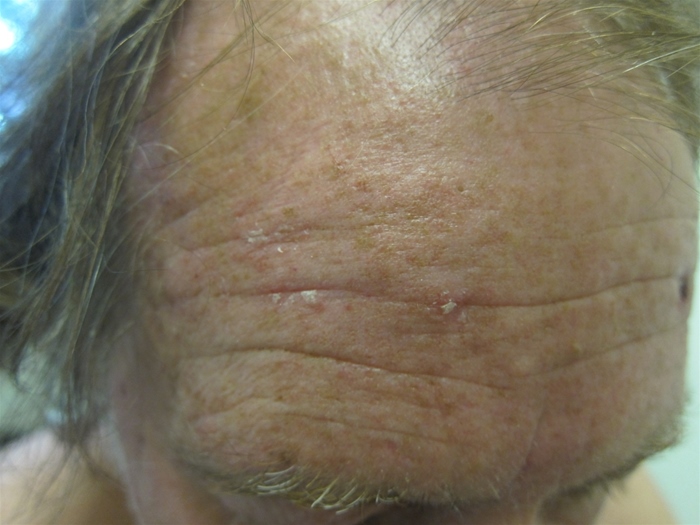 Which of the following is the most likely diagnosis?
 (Multiple Choice)
4.8/5 (86)
(86) A 45-year-old woman comes to the emergency department due to sudden-onset, severe headache. On arrival, the patient is alert and oriented and has no focal neurological deficits. CT scan of the head reveals subarachnoid hemorrhage, and she is admitted to the critical care unit. Over the next several hours, the patient gradually becomes somnolent and less responsive. She opens her eyes to painful stimuli only and does not follow commands. Repeat imaging of the brain shows no new hemorrhage, but there is enlargement of the entire ventricular system compared to the previous CT scan. Which of the following is the most likely cause of this patient's neurologic deterioration in the hospital?
(Multiple Choice)
4.7/5 (86)
(86) A 68-year-old man comes to the office due to difficulty performing normal day-to-day activities with his hands. He has had pain in his finger joints, wrists, and knees for many years and has been taking over-the-counter analgesics. The patient has been evaluated by doctors for "joint problems" in the past but declined their treatment recommendations. He has smoked a pack of cigarettes daily for 30 years. Vital signs are normal. Examination findings of the patient's hands are shown in the image below. 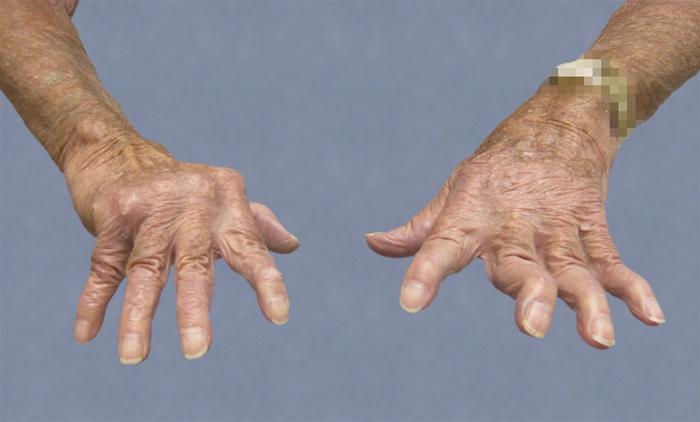 Which of the following pathogenic mechanisms is most likely responsible for this patient's condition?
 (Multiple Choice)
4.8/5 (91)
(91) A 28-year-old man comes to the emergency department due to 12 hours of severe right knee pain and swelling. He has had no trauma. The patient drinks 1 or 2 cans of beer on weekends but does not use tobacco or illicit drugs. On physical examination, right knee effusion, erythema, and tenderness are present. Active and passive range of motion is markedly decreased. Other joints are normal. Arthrocentesis is performed, and synovial fluid analysis shows a white blood cell count of 110,000/mm3. Which of the following would provide the best treatment for this patient's condition?
(Multiple Choice)
5.0/5 (87)
(87) A 3-week-old-girl in the neonatal intensive care unit develops abdominal distension, vomiting, and blood-streaked stools. She had previously tolerated formula feeds and had normal stool and urine output. She was born at 27 weeks gestation to an 18-year-old-mother. The pregnancy was complicated by premature rupture of membranes and preterm delivery. Abdominal x-ray shows thin curvilinear areas of lucency that parallel the bowel wall lumen. Which of the following is the most likely diagnosis?
(Multiple Choice)
4.9/5 (85)
(85) A 32-year-old man is brought to the emergency department with a several-day history of high-grade fever, dyspnea, and fatigue. The patient's temperature is 39.4 C (102.9 F), blood pressure is 122/70 mm Hg, and pulse is 102/min and regular. Physical examination reveals a new holosystolic murmur with a blowing quality that is best heard over the cardiac apex. Skin examination shows nontender lesions on the sole of the feet, as shown in the image below. 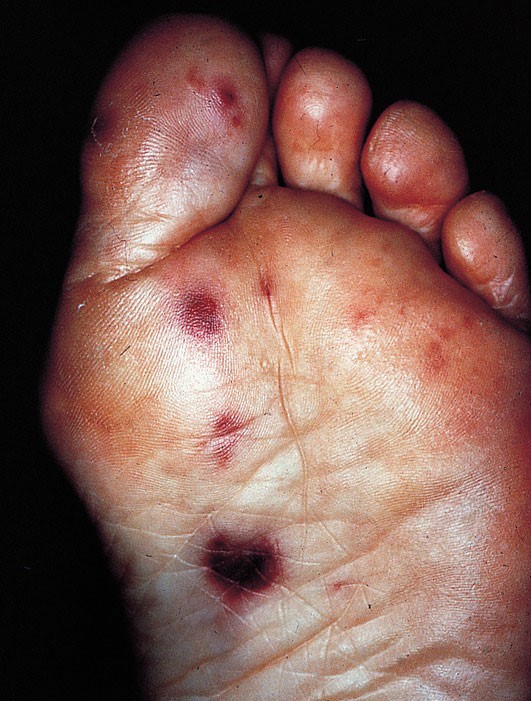 Which of the following do these lesions most likely represent?
 (Multiple Choice)
4.7/5 (67)
(67) A 32-year-old hospitalized man is evaluated for new-onset shortness of breath and confusion. The patient was admitted 3 days ago following a motor vehicle collision during which he sustained bilateral femur fractures, a pelvic fracture, and urethral injury. He underwent surgical repair with no operative complications. Temperature is 37.9 C (100.2 F), pulse is 110/min, respirations are 24/min, and oxygen saturation is 84% on room air. On physical examination, the patient appears agitated and disoriented. The lungs are clear to auscultation and there is no lower extremity edema. A petechial rash is present on the chest. ECG shows sinus tachycardia with no ischemic changes. Which of the following histologic changes has most likely taken place in this patient's lung tissue?
(Multiple Choice)
4.8/5 (84)
(84) A 2-week-old boy has an elevated lesion over the genital area as seen in the image below: 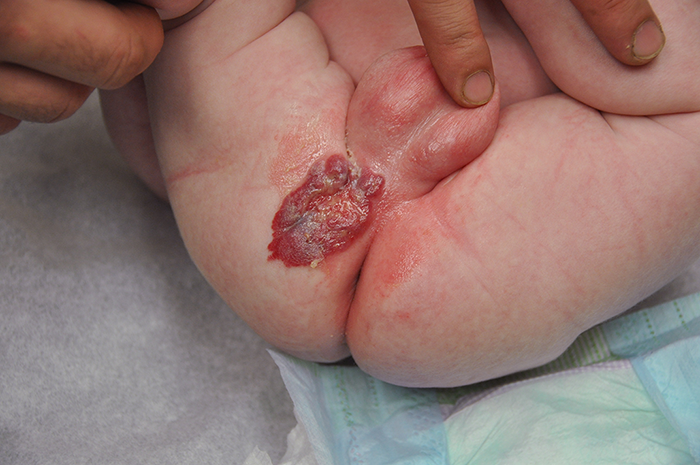 Which of the following is the most likely natural course of this lesion?
 (Multiple Choice)
4.9/5 (79)
(79) A 68-year-old woman comes to the emergency department due to shortness of breath, poor appetite, and abdominal distension for the past 3 months. Her symptoms have progressively worsened, and now she is unable to perform her daily activities. The patient has a history of coronary artery disease and underwent coronary artery bypass grafting 3 years ago. She also has myelodysplastic syndrome for which she receives intermittent blood transfusions. Physical examination shows jugular venous distension, abdominal distension, hepatomegaly, and lower extremity edema. A representative liver biopsy image is shown in the exhibit. 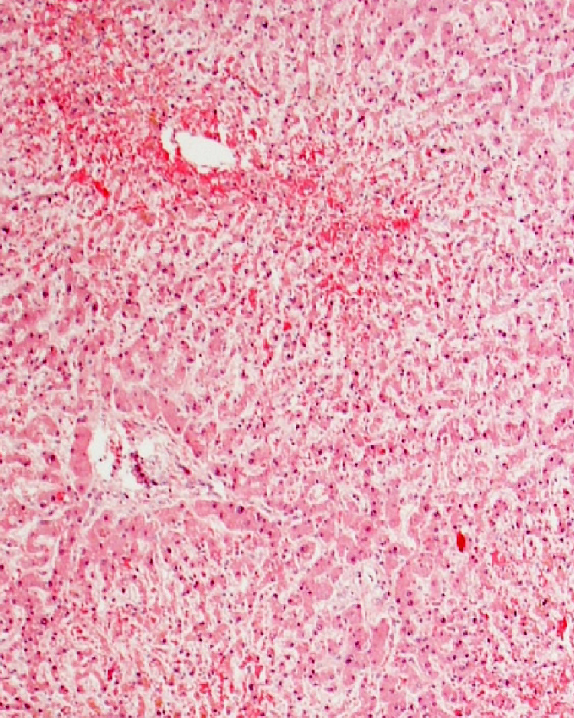 Which of the following is the most likely cause of this patient's liver findings?
 (Multiple Choice)
4.8/5 (92)
(92) A 59-year-old African American male presents to the emergency room with crushing chest pain, sweating, and lightheadedness. His blood pressure is 90/60 mm Hg and his heart rate is 48 beats per minute. Electrocardiogram (ECG) shows sinus bradycardia and ST segment elevation in leads II, III, and aVF. Occlusion of which of the following coronary arteries is most likely responsible for this patient's symptoms?
(Multiple Choice)
4.8/5 (78)
(78) A 65-year-old man comes to the office due to skin lesions on his back. He first noted the spots 5 years ago and says they are becoming more numerous. The lesions are occasionally pruritic but are otherwise asymptomatic. The patient did not come for evaluation previously because he "did not care about them," but made an appointment now at his wife's insistence. Medical history is notable for hypertension, hyperlipidemia, and type 2 diabetes mellitus. On examination, there are numerous pigmented plaques, as shown in the image below. 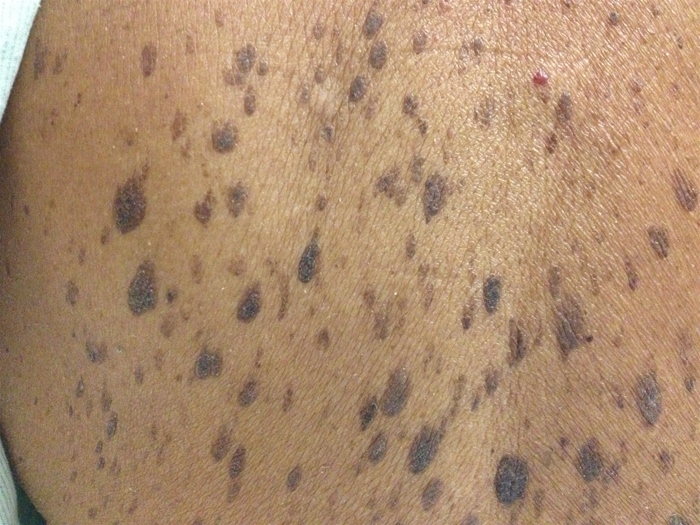 Which of the following is the most likely diagnosis?
 (Multiple Choice)
4.8/5 (70)
(70) A 68-year-old man comes to the office to establish care. He has type 2 diabetes mellitus complicated by chronic kidney disease and peripheral sensory neuropathy. Medical history is notable for hypertension and coronary artery disease. The patient works for an agricultural supply company and spends most of his day walking and standing on the warehouse floor. Vital signs are normal. BMI is 34 kg/m2. Examination of the lower extremities shows decreased sensation to monofilament testing below the knees bilaterally, with 2+ pitting edema, varicosities, and extensive discoloration, as shown below. 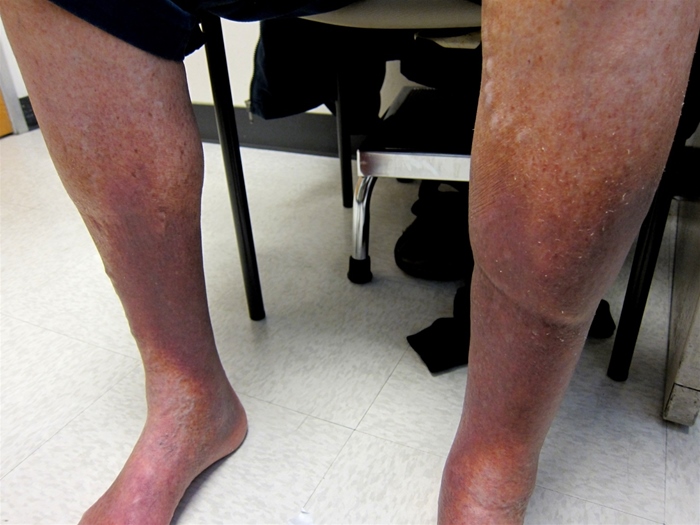 Which of the following is the most likely cause of the discoloration in this patient's skin?
 (Multiple Choice)
4.9/5 (77)
(77) A 9-month-old girl is brought to the emergency department due to fever and cough. Her symptoms began approximately 2 days ago and have been worsening. The patient is otherwise healthy except for an episode of acute otitis media 3 weeks ago that resolved following a course of oral amoxicillin. She lives with her mother, father, and grandmother who have been in good health. Her mother smokes cigarettes. Temperature is 38.5 C (101.3 F) and respirations are 34/min. Pulse oximetry is 95% on room air. Pulmonary examination reveals mild subcostal retractions and focal crackles in the left lower lobe. Which of the following underlying factors is most likely contributing to this patient's current condition?
(Multiple Choice)
4.8/5 (82)
(82) A 2-year-old boy who recently immigrated to the United States with his family is brought to the office for irritability and excessive crying. The mother's pregnancy was uneventful, but the patient was delivered via cesarean section due to obstructed labor. His mother reports that he has developed more slowly than his brother in ability to lift his head, crawl, and walk. She has also noticed that the patient's head is larger than other children of the same age. His weight is at the 60th percentile, height is at the 50th percentile, and head circumference is at the 95th percentile. CT scan of the head is shown in the image below. 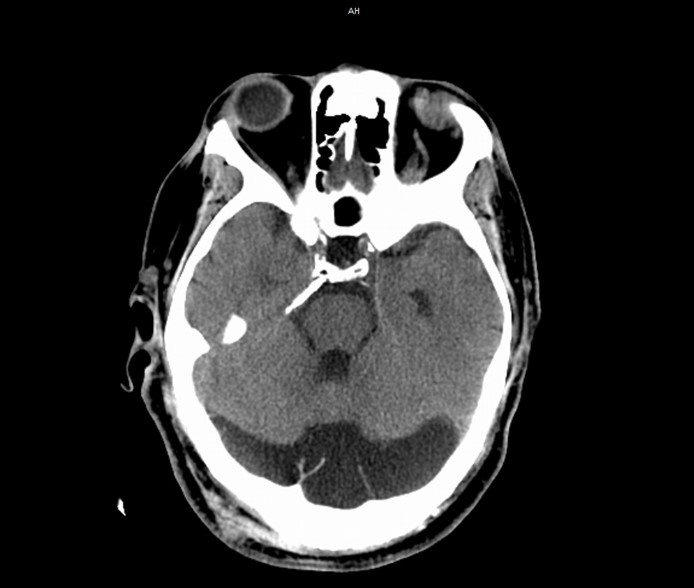 Which of the following is the most likely diagnosis?
 (Multiple Choice)
4.8/5 (72)
(72) A 7-year-old boy is brought to the office due to swelling of the hands and feet. Two weeks ago, the patient was treated for anaphylaxis following a bee sting. During the past 10 days, he has had progressive hand and foot swelling, and his pants feel tighter than usual. The patient's urine has also become frothy. Examination shows periorbital edema and pitting edema of the hands and feet, as well as mild ascites. Lungs are clear to auscultation. Urinalysis results are as follows: 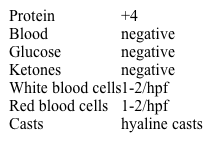 Biopsy of this patient's kidneys would most likely show which of the following microscopy findings?
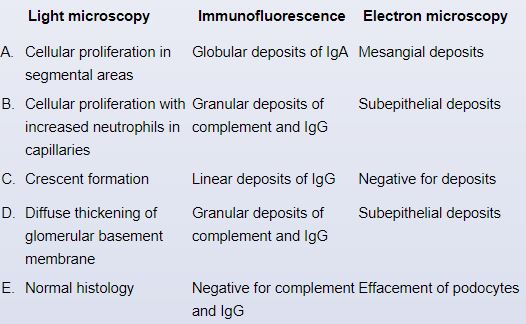
Biopsy of this patient's kidneys would most likely show which of the following microscopy findings?
(Multiple Choice)
4.9/5 (75)
(75) A 55-year-old woman comes to the office due to swelling around her ankles and face that has progressively worsened over the last 1-2 months. The patient has 2+ bilateral pitting edema in the lower extremities, trace edema in the upper extremities, and periorbital edema. Cardiopulmonary examination is normal. Laboratory evaluation shows a serum creatinine level of 2.0 mg/dL and an albumin level of 2.8 g/dL. Urinalysis shows 3+ proteinuria and no hematuria or casts. A kidney biopsy is performed; light microscopic findings following staining with hematoxylin and eosin are shown in the image below: 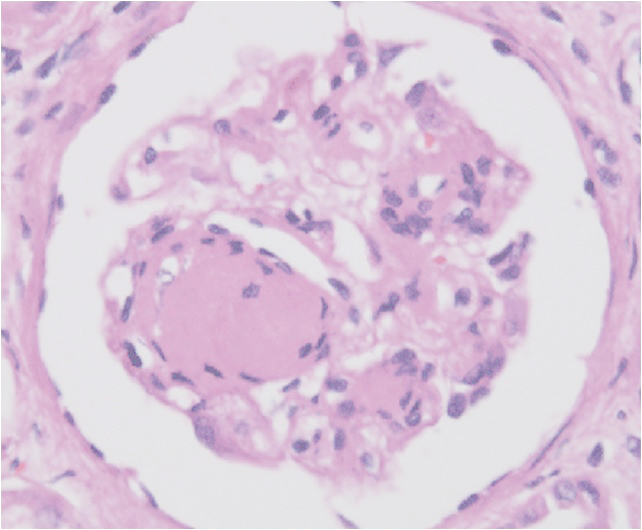 Which of the following is the most likely explanation for this patient's biopsy findings?
 (Multiple Choice)
4.9/5 (71)
(71) A 19-year-old woman comes to the office for evaluation of amenorrhea. The patient underwent menarche at age 12, and she previously had menses regularly every 25-28 days. However, for the past year, her menses have been irregular, and her last menstrual period was 3 months ago. The patient has no significant medical history, eats mainly fruits and vegetables, and exercises regularly at a local gym. On further questioning, she expresses concern about being overweight and asks for suggestions on cutting down her caloric intake. BMI is 18 kg/m2. The patient is thin and has dry skin covered by fine, downy hair. A pregnancy test is negative. Which of the following laboratory findings are most likely present in this patient?
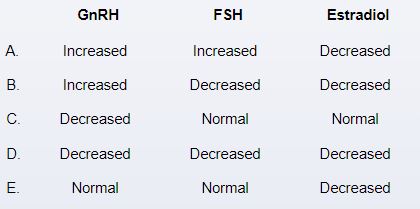
(Multiple Choice)
4.9/5 (81)
(81) 
Filters
- Essay(0)
- Multiple Choice(0)
- Short Answer(0)
- True False(0)
- Matching(0)