



 Chat with AI
Exam 1: Anatomy

Exam 1: Anatomy291 Questions
Exam 2: Behavioral science240 Questions
Exam 3: Biochemistry156 Questions
Exam 4: Biostatistics117 Questions
Exam 5: Embryology52 Questions
Exam 6: Genetics103 Questions
Exam 7: Histology24 Questions
Exam 8: Immunology129 Questions
Exam 9: Microbiology336 Questions
Exam 10: Pathology816 Questions
Exam 11: Pathophysiology464 Questions
Exam 12: Pharmacology538 Questions
Exam 13: Physiology272 Questions
Select questions type


A 23-year-old woman is brought to the emergency department unconscious after a motor vehicle accident. The patient was texting on her cell phone and was not wearing a seatbelt during the incident. She has no known medical problems and takes no medications. Her temperature is 36.7 C (98 F), blood pressure is 155/90 mm Hg, pulse is 62/min, and respirations are 10/min. A linear skull fracture at the junction of the frontal, parietal, temporal, and sphenoid bones is seen on head CT scan. A branch of which of the following arteries is most likely severed in this patient?

Free
(Multiple Choice)
4.9/5  (77)
(77) Correct Answer: Verified
B
A 15-year-old girl is evaluated for recurrent episodes of focal onset seizures evolving to bilateral tonic-clonic seizures over the past several months. She has also had headaches that are severe enough to keep her home from school. The patient has no prior medical conditions. MRI of the brain is shown in the exhibit.
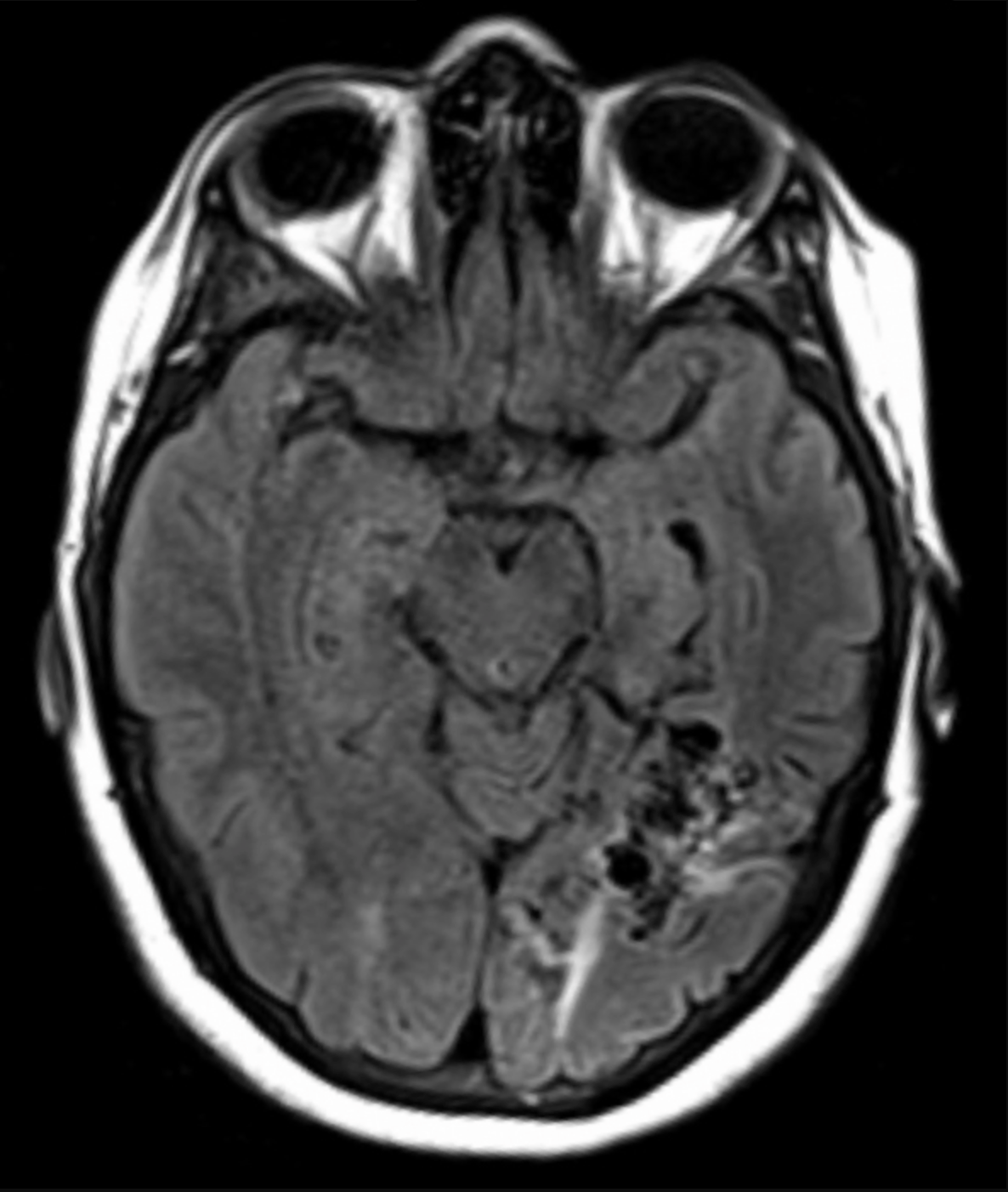 Which of the following histopathological findings are most likely present in the abnormal lesion?
Free
(Multiple Choice)
4.7/5 (82)
(82) Correct Answer:Verified
VerifiedE
A 15-year-old girl is brought to the hospital due to sudden onset of severe left leg pain. She was practicing for an upcoming gymnastics competition when she felt a popping sensation after landing from a jump and developed anterior left leg pain. Following the injury, the patient was unable to bear weight on the leg. Physical examination shows swelling of the left knee with focal tenderness just above the patella. She is unable to raise the left leg against gravity while in the supine position. Imaging confirms a complete tear of the quadriceps tendon, but no fractures are identified. Surgical repair is planned. Lidocaine injection near which of the following sites is most likely to provide adequate anesthesia for the procedure?
Free
(Multiple Choice)
4.8/5 (81)
(81) Correct Answer:Verified
VerifiedB
A 58-year-old man with a history of hypertension and hyperlipidemia comes to the emergency department due to substernal chest pain that began 6 hours ago and has gradually worsened. Blood pressure is 104/72 mm Hg and pulse is 88/min. ECG shows normal sinus rhythm with ST-segment depression and T-wave inversion, and troponin levels are elevated. The patient is diagnosed with non-ST-segment elevation myocardial infarction and admitted to the hospital for medical management, with coronary angiography scheduled the following morning. That evening, telemetry monitoring shows a new Mobitz type 1 second-degree atrioventricular block. Which of the following arteries was most likely obstructed during this patient's myocardial infarction?
(Multiple Choice)
4.8/5 (79)
(79) A 62-year-old man comes to the office due to an elevated prostate-specific antigen level on a screening test. When asked about genitourinary symptoms, the patient says, "It often takes a bit of time before my urine starts flowing," but he has no other problems. Abdominal and external genital examinations are unremarkable. Digital rectal examination reveals hard prostate nodules. A biopsy confirms adenocarcinoma, and the patient undergoes a radical prostatectomy. During the surgery, the nerves within the fascia surrounding the gland are inadvertently injured. Which of the following is the most likely consequence of the nerve injury?
(Multiple Choice)
4.8/5 (93)
(93) A 24-year-old man is being evaluated for gross hematuria. Cystoscopy under general anesthesia is performed. After the scope is passed into the urinary bladder, a triangular portion of the bladder floor formed by the internal urethral orifice and 2 slit-like openings is observed. Gross blood is seen oozing from one of the slit-like openings. Which of the following is the most likely cause of this patient's hematuria?
(Multiple Choice)
4.8/5 (77)
(77) A 47-year-old man is brought to the emergency department after being involved in a high-speed motor vehicle collision. He was a restrained driver and rear-ended a slow-moving car on the highway. He complains of chest pain, abdominal pain, and difficulty breathing. The patient has a past medical history of hypertension, asthma, and type 2 diabetes mellitus. On arrival, his blood pressure is 98/54 mm Hg and pulse is 121/min. Thirty minutes later, he becomes unresponsive and his pulse is no longer detectable. Electrocardiogram demonstrates sinus tachycardia. Despite extensive resuscitation efforts, the patient dies. An autopsy would most likely show an injury involving which of the following areas of the thoracic aorta? 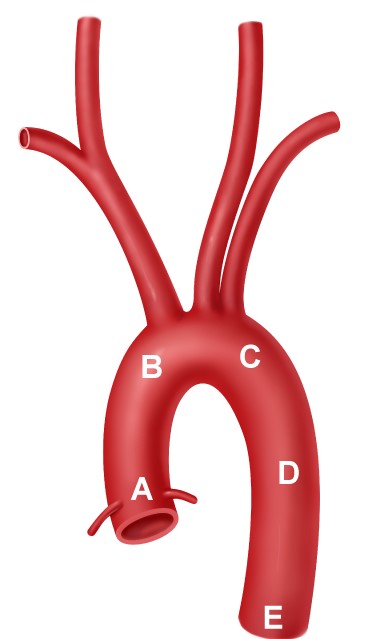
(Multiple Choice)
4.8/5 (87)
(87) A 32-year-old man is evaluated for bowel dysfunction. The patient suffered multiple injuries during a motor vehicle collision 6 months ago. He was hospitalized for several weeks and is currently undergoing treatment with physical therapy. Since the injury, the patient has developed severe constipation with occasional fecal incontinence. Evaluation reveals a large amount of stool in the distal colon due to impaired motor function. Anal sphincter tone is decreased. Injury to which of the following structures best explains this patient's bowel dysfunction?
(Multiple Choice)
4.9/5 (70)
(70) A 70-year-old man is brought to the emergency department due to sudden-onset weakness in his right arm and leg. Although he can speak, he cannot pronounce words clearly. Blood pressure is 170/96 mm Hg and pulse is 80/min. The patient is alert and oriented. Neurologic examination shows 3/5 strength in both right upper and lower extremities. When the patient is asked to stick out his tongue, it deviates to the left. Sensory examination shows no abnormalities. Which of the following is the most likely location of this patient's brain injury?
(Multiple Choice)
4.9/5 (72)
(72) A 6-month-old boy is brought to the urology clinic for follow-up of an undescended right testicle discovered during evaluation in the newborn nursery. Physical examination shows absence of a palpable right testis in the scrotal sac. However, a round mass is palpated superior to the scrotum in the inguinal canal. Orchiopexy, the placement and fixation of the testis in the scrotum, is recommended to the family. During this patient's procedure, the malpositioned testis will most likely be pulled through a physiologic opening in which of the following structures?
(Multiple Choice)
4.8/5 (81)
(81) A 66-year-old, right-handed man is brought to the emergency department due to left-sided numbness and weakness. The patient woke with left-hand clumsiness that rapidly progressed to profound left-sided weakness, affecting the left arm more than the left leg. He has a history of hypertension and has smoked a pack of cigarettes daily for the past 40 years. Blood pressure is 175/90 mm Hg and pulse is 82/min and regular. Neurologic examination reveals impaired touch discrimination in the left arm with left facial weakness sparing the forehead, 2/5 muscle strength in the left upper limb, and 4/5 muscle strength in the left lower limb. Right-sided strength and visual field examinations are normal. Which of the following labeled arteries is most likely occluded in this patient? 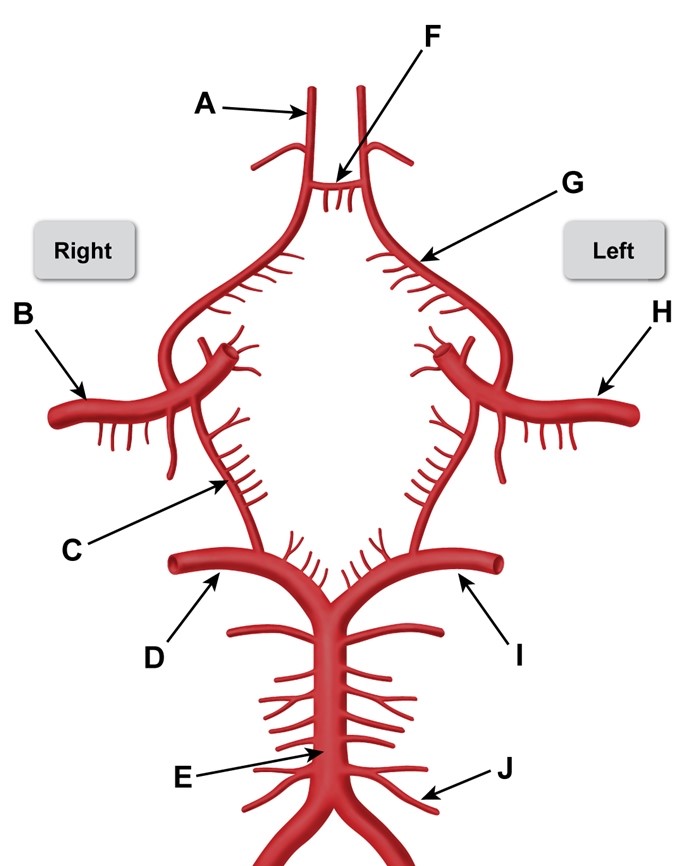
(Multiple Choice)
4.9/5 (77)
(77) A 29-year-old woman comes to the office for treatment of anxiety that has worsened over the past year. She finds herself worrying all the time and fears that she may not complete her graduate studies in time to meet requirements for her degree. The patient is also worried about her son's health and anxiously obsesses about him all the time. She says, "My anxiety just comes out of the blue; one way or another, I'm anxious all the time." The patient has no history of medical problems. Physical examination is unremarkable; complete blood count, chemistry panel, and TSH and B12 levels are normal. An anxiety disorder is diagnosed and fluoxetine is prescribed. The patient's anxiety begins to improve over the next 4-6 weeks. The physician explains that the medication inhibits the reuptake of a neurotransmitter released by a specific set of neurons. These neurons are most likely part of which of the following structures?
(Multiple Choice)
4.8/5 (84)
(84) A 23-year-old man comes to the emergency department due to a sensation of food being stuck in his throat. His symptoms started 2 hours ago after eating fish at a local seafood restaurant. He has tried swallowing multiple times to clear the food with no relief. The patient has no difficulty with breathing. He does not appear to be in significant distress on physical examination. Laryngoscopy reveals a fish bone lodged in the left piriform recess. During retrieval of the fish bone, a nerve is injured deep to the mucosa overlying the recess. Which of the following is most likely to be impaired in this patient?
(Multiple Choice)
4.8/5 (84)
(84) A 4-year-old boy is being evaluated for failure to thrive, shortness of breath, and exercise intolerance. The parents first became aware of his symptoms after the patient started preschool a few weeks ago. His teacher mentioned that the patient seemed to tire faster than the other children when playing outside. Cardiac examination shows bounding peripheral pulses and a palpable thrill below the clavicle near the left upper sternal border. On auscultation, a continuous murmur is best heard over the same region. After discussion with the parents, a thoracotomy is scheduled to correct the patient's condition. During the procedure, the surgeon should plan on ligating a derivative of which of the following embryologic structures?
(Multiple Choice)
4.8/5 (80)
(80) A 55-year-old man with poorly controlled hypertension and type 2 diabetes mellitus comes to the emergency department due to difficulty seeing. He has had blurry vision for the last 2 weeks, and 1 day ago he suddenly noticed a shadow develop across the visual field of his left eye. The patient has no recent headache, double vision, vertigo, light sensitivity, or nausea. On examination, pupils are equal and reactive to light. There is an area of reduced vision in the left eye. Funduscopic examination reveals a flame-shaped hemorrhage in the left temporal hemiretina. The transmission of visual information through which of the following neural structures will be disrupted?
(Multiple Choice)
5.0/5 (79)
(79) In the same midesophageal position, the probe is rotated so that it now faces posteriorly. Which of the following structures will be best visualized with the probe's new orientation?
(Multiple Choice)
4.8/5 (77)
(77) A 55-year-old, right-handed man comes to the emergency department due to recent onset of severe, throbbing, right-sided headache and double vision. His medical history includes poorly controlled hypertension and chronic tobacco use. Neurologic examination shows that he is awake, alert, and oriented and can follow commands. Visual fields and optic fundi are normal. The position of the right eye is down and out with ipsilateral ptosis, and the right pupil is dilated and nonreactive to both light and accommodation. Left eye examination is normal. Based on this patient's neurologic deficits, CT angiography of the head is most likely to reveal an aneurysm arising from which of the following locations in the image below? 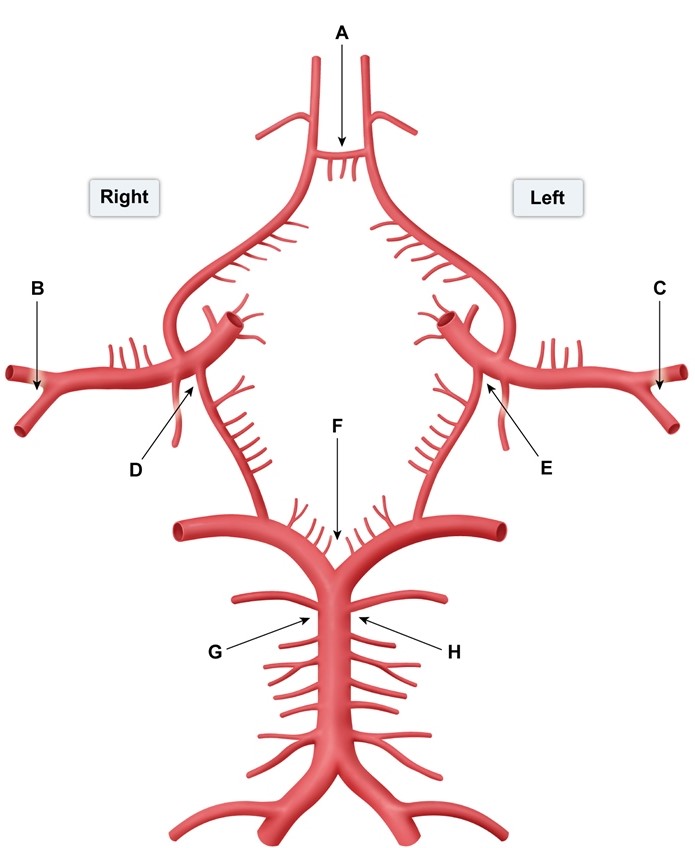
(Multiple Choice)
4.7/5 (75)
(75) A 54-year-old woman is evaluated for a painless thyroid nodule. She has had no weight changes, heat or cold intolerance, hoarseness, or dyspnea. Medical history is notable for mild hypertension, for which she takes appropriate medications. The patient does not use tobacco or alcohol. Physical examination shows a 3-cm, firm nodule in the right thyroid lobe and enlarged, right cervical lymph nodes. TSH is normal, and fine-needle aspiration of the nodule shows papillary structures with nuclear atypia. Total thyroidectomy is planned. During the surgery, a nearby nerve is injured while ligating an artery entering the superior pole of the thyroid lobe. Which of the following muscles is most likely to be denervated as a result of this injury?
(Multiple Choice)
4.9/5 (87)
(87) A 34-year-old man is evaluated in the clinic due to persistent buzzing in his right ear for the past 6 months. The patient also has decreased hearing on the right side. He has had no fever, ear pain, runny nose, sore throat, or cough. The patient does not use cotton swabs and has not been exposed to loud noise. He tried using over-the-counter oral pseudoephedrine with no improvement in his symptoms. On physical examination, there is no sinus tenderness, and mucous membranes are moist without erythema or exudate. Otoscopic examination reveals normal-appearing external auditory canals bilaterally with pinkish-grey tympanic membranes. MRI of the brain reveals an intracranial tumor. This patient's lesion has most likely arisen from which of the following structures? 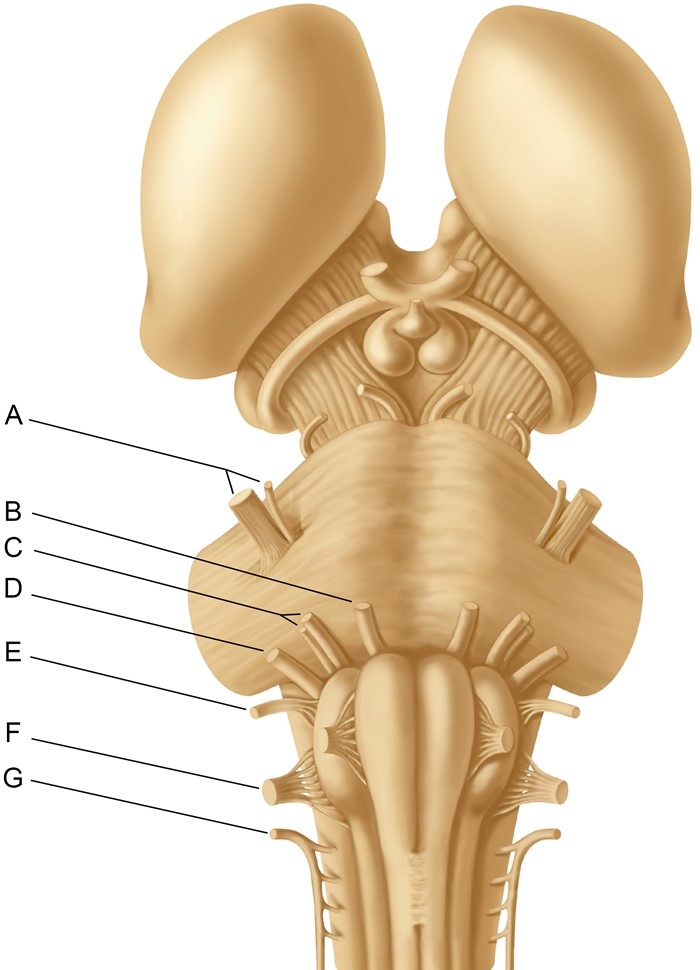
(Multiple Choice)
4.9/5 (85)
(85) A 70-year-old man comes to the emergency department due to severe midback pain that started several hours ago. He describes the pain as excruciating and wants immediate relief. The patient also has nausea, diaphoresis, and lightheadedness. He has a history of hypertension and chronic kidney disease. His medication compliance has been poor. He is an active smoker with a 40-pack-year history. His blood pressure on the right arm is 220/105 mm Hg. ECG shows sinus tachycardia and voltage criteria for left ventricular hypertrophy with secondary ST-segment and T wave changes. After initial evaluation, a transesophageal echocardiogram shows a dissection flap in the descending aorta but no evidence of dissection in the ascending aorta. The dissection flap in this patient most likely originates near which of the following points?
(Multiple Choice)
4.9/5 (95)
(95) 
Filters
- Essay(0)
- Multiple Choice(0)
- Short Answer(0)
- True False(0)
- Matching(0)