



 Chat with AI
Exam 1: Anatomy

Exam 1: Anatomy291 Questions
Exam 2: Behavioral science240 Questions
Exam 3: Biochemistry156 Questions
Exam 4: Biostatistics117 Questions
Exam 5: Embryology52 Questions
Exam 6: Genetics103 Questions
Exam 7: Histology24 Questions
Exam 8: Immunology129 Questions
Exam 9: Microbiology336 Questions
Exam 10: Pathology816 Questions
Exam 11: Pathophysiology464 Questions
Exam 12: Pharmacology538 Questions
Exam 13: Physiology272 Questions
Select questions type


A 68-year-old man is evaluated for visual loss in the left eye that resolved spontaneously within several hours. The patient has a history of hypertension, type 2 diabetes mellitus, coronary artery disease, and ischemic cardiomyopathy. He has smoked a pack of cigarettes daily for the past 40 years. Physical examination reveals a left carotid bruit but no neurologic deficits. A carotid duplex ultrasound shows 85% stenosis of the left internal carotid artery, and carotid angiography with stenting is performed. During the procedure, atherosclerotic debris embolize to the artery shown (red arrow) on the cerebral magnetic resonance angiograph below. 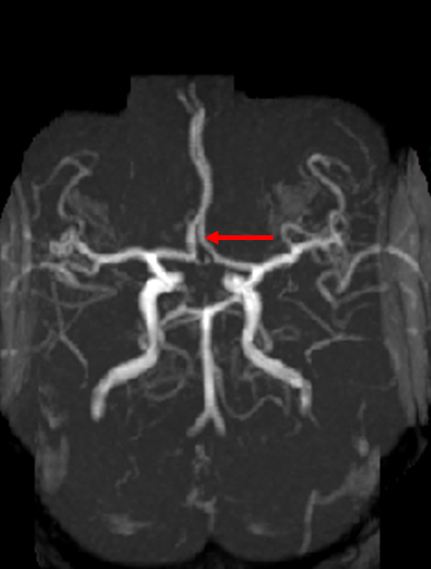 Which of the following actions is most likely to be impaired in this patient?
 (Multiple Choice)
4.9/5  (89)
(89) A 65-year-old man is brought to the emergency department due to acute-onset, right-sided weakness and slurred speech. He also has a severe headache and nausea. Medical history is significant for poorly controlled hypertension and chronic tobacco use. Blood pressure is 240/120 mm Hg and pulse is 104/min. On physical examination, the patient is lethargic with right hemiparesis and lower facial weakness, right hemisensory loss, and dysarthria. Noncontrast CT scan of the head is shown in the image below. 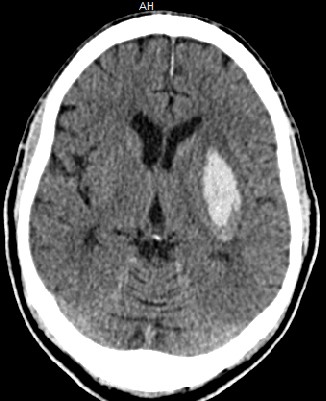 Which of the following cerebral blood vessels is most likely affected in this patient?
 (Multiple Choice)
4.8/5 (68)
(68) A 3-year-old boy is brought to the emergency department after falling off a jungle gym. The boy tried to catch himself and landed on his outstretched arms. He did not lose consciousness and has been crying inconsolably since he fell. Pulse is 140/min; all other vital signs are within normal limits. Physical examination reveals tenderness and swelling over the anterior portion of his right shoulder with crepitus over the swollen area. An x-ray of his right shoulder is shown below. 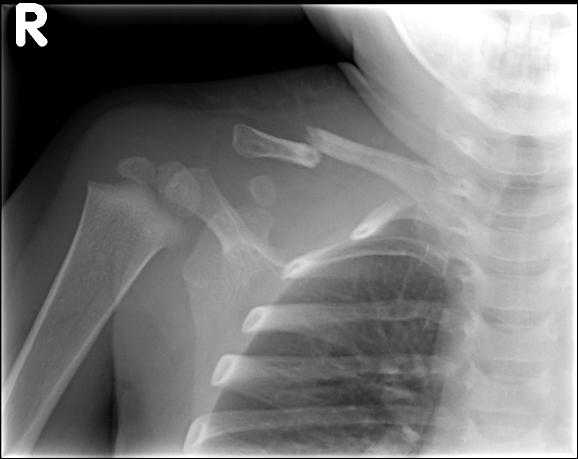 Tension from which of the following muscles is most likely responsible for displacement of the distal bone fragment?
 (Multiple Choice)
4.8/5 (83)
(83) A 35-year-old, right-handed mechanic comes to the clinic due to progressive right hand weakness. The patient frequently uses a screwdriver at work. Neurologic examination shows preserved sensation in the upper limbs. There is weakness on extension of the fingers and thumb in the right hand. Strength is otherwise intact. Triceps reflexes are 2+ and bilaterally symmetric. The nerve affected in this patient was most likely injured at which of the following locations?
(Multiple Choice)
4.7/5 (69)
(69) A 16-year-old high school quarterback comes to the office due to left shoulder pain. One week ago, he suffered an injury during a football game. The patient was running with the football when another player tackled him to the ground, causing him to land directly on the posterior aspect of his left shoulder. He developed severe pain immediately and did not return to the game. The patient has had persistent shoulder pain since the injury despite using ice and over-the-counter ibuprofen. He has been unable to resume playing football due to pain and weakness in his shoulder. On examination, there is diffuse bruising over the posterior aspect of the left shoulder. Abduction of the left arm is normal, but external rotation against resistance is weak and painful. Which of the following muscles is most likely injured?
(Multiple Choice)
4.9/5 (86)
(86) A 3-year-old boy is brought to the emergency department for refusal to move his right arm. This afternoon, he tripped while holding hands with his sister, who pulled up on his arm to prevent him from falling. The patient immediately began to cry and has since refused to move the arm. On physical examination, he holds the right arm against his abdomen with the elbow flexed and forearm pronated. The patient cries with any attempted manipulation of the right elbow. There is no visible swelling or deformity. Which of the following structures is most likely affected in this patient's condition?
(Multiple Choice)
4.9/5 (70)
(70) A 44-year-old woman comes to the office due to increasing right hip pain for the past several days. The pain is exacerbated by walking and by sitting with the right leg crossed over the left leg. The patient has a history of plantar fasciitis. Vital signs are within normal limits. BMI is 30 kg/m2. On examination, right hip abduction and internal rotation against resistance when the hip is flexed reproduce the pain. The cause of this patient's symptoms is suspected to be pathology at a tendon insertion site. The tendon of which of the following muscles is most likely involved?
(Multiple Choice)
4.8/5 (95)
(95) A 54-year-old woman comes to the office due to right upper limb weakness and fatigue. She has no problem during most activities but develops symptoms when attempting to raise her arm overhead. The patient first noticed the symptoms after a recent hospitalization. On examination, there is no sensory loss in the upper extremities, but she has difficulty abducting her right arm past the horizontal position. The patient is instructed to press her outstretched arms against a wall, and the medial border of the right scapula lifts off the thoracic wall and becomes prominent. This patient was most likely hospitalized for which of the following conditions?
(Multiple Choice)
4.7/5 (80)
(80) A 46-year-old woman with a history of hiatal hernia and severe gastroesophageal reflux undergoes antireflux surgery. The reflux symptoms were refractory to medical therapy, so an endoscopic fundoplication procedure is performed. During surgery, the hiatal defect is repaired, and the gastric fundus is mobilized and wrapped around the lower esophagus to reinforce the lower esophageal sphincter. No esophageal or gastric injuries occurred, but a neural structure traversing the esophageal hiatus of the diaphragm was inadvertently injured. Which of the following is the most likely potential effect of this operative injury?
(Multiple Choice)
4.8/5 (77)
(77) A highly agitated 54-year-old man is brought to the emergency department by his family because he is unable to effectively communicate. He speaks clearly and with conviction but his sentences are incomprehensible. He does not appear to understand the doctor's questions, does not follow oral or written instructions, and cannot repeat simple phrases. Branch occlusion of which of the following arteries is most likely responsible for this patient's condition?
(Multiple Choice)
4.9/5 (66)
(66) A 30-year-old man comes to the emergency department due to left eye pain after being involved in a street fight. He received a fist blow to the left eye and has since had pain and diplopia. Past medical history is notable for 2 previous gunshot wounds. The patient does not smoke cigarettes but has a history of heavy alcohol intake and frequent marijuana use. On examination, there is significant soft tissue swelling around the left eye. Visual acuity is normal, but extraocular motility of the left eye is limited. Pupillary reflexes are normal. Coronal CT scan of the orbits is shown in the image below. 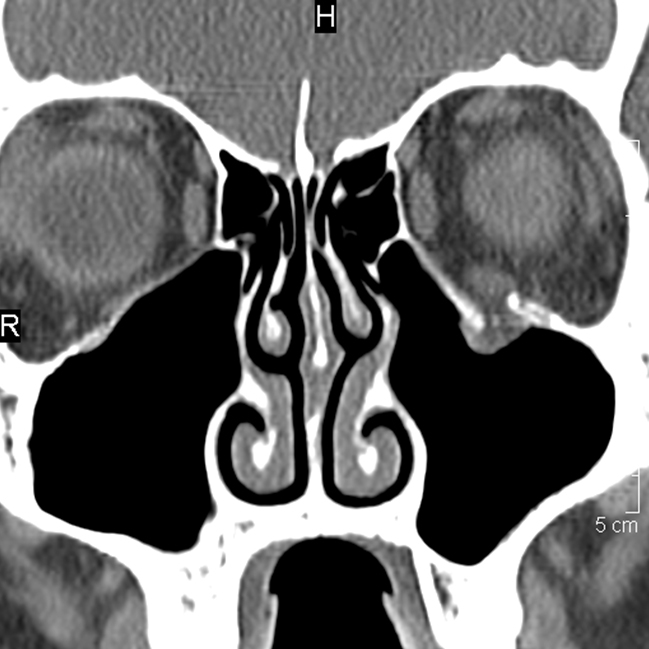 The orbital contents of this patient are most likely to herniate into which of the following sites?
 (Multiple Choice)
4.8/5 (95)
(95) A 53-year-old man is hospitalized due to chest pain and palpitations. Cardiac catheterization is planned to evaluate for coronary artery disease. The femoral artery is palpated in the right groin, and a catheter is introduced into the common femoral artery. The associated vasculature is visualized after injecting a contrast agent into the catheter. 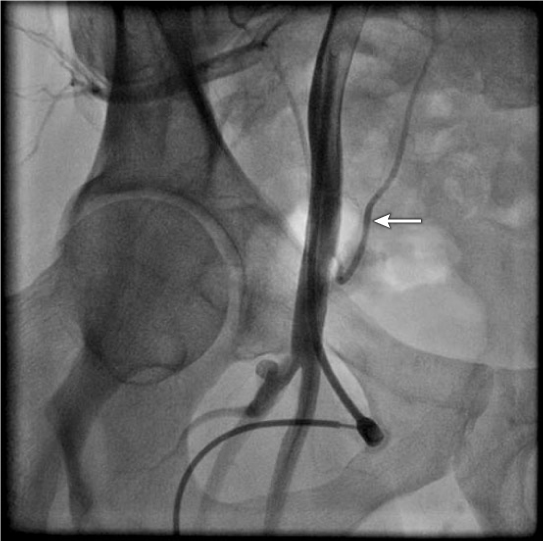 Which of the following is most likely the artery indicated by the arrow in the image above?
 (Multiple Choice)
4.7/5 (87)
(87) A 29-year-old previously healthy man comes to the hospital with a right leg injury after a cycling accident. He reports pain in the lower leg and inability to bear weight. X-ray reveals right tibial and fibular shaft fractures. The patient undergoes closed reduction and immobilization of the fractures. Several hours later, he has increasingly severe pain in his right leg. Physical examination shows increased tension within the anterior compartment. Which of the following structures is most likely to be compromised by this patient's acute complication?
(Multiple Choice)
4.7/5 (90)
(90) A 22-year-old man is brought to the emergency department after being involved in a fight at a nearby bar. The patient's respiratory rate is 28/min, blood pressure is 88/60 mm Hg, and heart rate is 114/min. Physical examination shows a penetrating right-sided stab wound along the upper surface of the clavicle between the lateral border of the sternum and the midclavicular line. Which of the following structures was most likely injured?
(Multiple Choice)
4.9/5 (78)
(78) A 34-year-old woman is evaluated for several months of moderate hearing loss. She has also noticed a ringing in her left ear. The patient has had no recent ear infections or cold symptoms, does not use cotton ear swabs, and has no history of head trauma. Her father has bilateral hearing loss attributed to old age. On physical examination, the auditory canals are patent and tympanic membranes appear gray with a well-visualized light reflex. Hearing is diminished on the left side. Neurologic examination shows left-sided facial numbness, an asymmetric smile, and diminished corneal reflex response in the left eye. This patient's condition suggests an intracranial mass in which of the following locations?
(Multiple Choice)
4.8/5 (79)
(79) A 30-year-old man comes to the emergency department due to severe headache and neck pain following a motor vehicle collision. The patient has no blurry or double vision, dizziness, slurred speech, numbness, or weakness. Neuroimaging is unremarkable except for evidence of a right transverse foramina fracture at the level of C2. The patient is placed in a cervical collar and admitted to the hospital. While undergoing further evaluation, he suddenly develops dizziness, right-sided facial numbness, and hoarseness. Temperature is 36.7 C (98.1 F), blood pressure is 160/90 mm Hg, pulse is 80/min, and respirations are 12/min. Neurologic examination shows partial ptosis and miosis of the right eye, as well as nystagmus. Hearing is intact bilaterally. There is reduced sensation to pain and temperature on the right side of the face and the left side of the body. The patient is ataxic and displays past-pointing with his right hand on finger-to-nose testing. Vascular imaging will most likely reveal an acute dissection in which of the following arteries?
(Multiple Choice)
5.0/5 (89)
(89) A 39-year-old, nulliparous woman comes to the office due to pelvic pressure and constipation that have worsened over the past year. She frequently has an uncomfortable sensation of incomplete evacuation following defecation. Menses occur every 28 days without heavy bleeding or severe pain. The patient has no pain with intercourse and routinely uses condoms for contraception. BMI is 24 kg/m2. Examination shows an irregularly enlarged uterus and normal rectal tone. Which of the following is the most likely etiology of the patient's constipation?
(Multiple Choice)
4.8/5 (84)
(84) A 68-year-old man is evaluated in the hospital due to a pleural effusion. He has a history of base of tongue squamous cell carcinoma with involvement of multiple left anterior cervical lymph nodes. Two days ago, the patient underwent surgery to remove the tumor and the anterior cervical lymph nodes. Today, he has increasing shortness of breath, and chest x-ray reveals a large left pleural effusion. Which of the following was most likely injured during this patient's surgical procedure?
(Multiple Choice)
4.7/5 (82)
(82) A 34-year-old man comes to the clinic with a 3-week history of difficulty hearing. He finds it increasingly difficult to tolerate everyday sounds. He also complains of ear pain and often avoids public places as a result. The patient has no past medical history and takes no medications. Injury to which of the following cranial nerves is most likely responsible for his condition?
(Multiple Choice)
4.8/5 (88)
(88) A 26-year-old woman comes to the office due to several weeks of pain and muffled hearing in the left ear, along with a sensation of jaw clicking when chewing food. The patient has had episodic headaches and left-sided facial pain for several years that is worse when moving her jaw. She also has been told that she grinds her teeth while asleep. On examination, the patient is unable to fully open her mouth and reports pain with passive movement of the jaw. The external auditory canal and tympanic membrane are normal. A disorder affecting pterygoid muscle contractility is suspected. Involvement of which of the following nerves is most likely contributing to this patient's ear symptoms?
(Multiple Choice)
4.7/5 (80)
(80) 
Filters
- Essay(0)
- Multiple Choice(0)
- Short Answer(0)
- True False(0)
- Matching(0)