



 Chat with AI
Exam 6: Genetics

Exam 1: Anatomy291 Questions
Exam 2: Behavioral science240 Questions
Exam 3: Biochemistry156 Questions
Exam 4: Biostatistics117 Questions
Exam 5: Embryology52 Questions
Exam 6: Genetics103 Questions
Exam 7: Histology24 Questions
Exam 8: Immunology129 Questions
Exam 9: Microbiology336 Questions
Exam 10: Pathology816 Questions
Exam 11: Pathophysiology464 Questions
Exam 12: Pharmacology538 Questions
Exam 13: Physiology272 Questions
Select questions type


A 45-year-old man comes to the physician because of involuntary movements and behavioral disturbance. He has frequent, jerky, irregular movements of his upper extremities that have progressively worsened over the past month. His family and friends also say that he has become increasingly irritable over the past year. Genetic testing shows a mutation affecting the huntingtin protein that causes transcriptional repression of a number of other genes. Which of the following mechanisms is most likely responsible for the decreased gene expression seen in this patient?

Free
(Multiple Choice)
4.8/5  (75)
(75) Correct Answer: Verified
B
A 10-year-old girl is brought to the office for evaluation of short stature. She was an average-sized infant, but over the past few years, her height growth velocity has plateaued. The patient has not menstruated and has no symptoms. She takes no medications, has no allergies, and has received all recommended immunizations. Menarche occurred in her mother at age 14 and both of her parents are tall. The patient's height is at the <5th percentile and weight is at the 50th percentile for age and sex. She has no breast buds and no axillary or pubic hair. She has a low hairline, a short and wide neck, a broad chest, and widely spaced nipples. Which of the following is the most likely underlying mechanism for this patient's condition?
Free
(Multiple Choice)
4.8/5 (83)
(83) Correct Answer:Verified
VerifiedC
Electron microscopy of a eukaryotic cell during interphase of the cell cycle shows 10-nm thick chromatin fibers with a "beads on a string" appearance. These chromatin fibers are extracted and treated with an endonuclease, which preferentially cleaves the "string" portions of the chromatin. Further evaluation of the "beads" reveals that they are composed of DNA wrapped around a core of proteins. Which of the following proteins is most likely found outside of this core and helps promote chromatin compaction?
Free
(Multiple Choice)
4.9/5 (75)
(75) Correct Answer:Verified
VerifiedA
A married couple comes to the physician for routine prenatal counseling. The husband is 120 cm (3 ft 11 in) tall with disproportionately short upper and lower extremities, a large head, and a prominent forehead. He is unable to provide a biological family history as he was adopted. His spouse is of average height with normal constitutional features, and her family history is insignificant. They are concerned about their unborn child's height. Which of the following is the best response to their concerns?
(Multiple Choice)
4.9/5 (74)
(74) A 12-year-old boy is evaluated in the clinic due to excessive bleeding following a tooth extraction. The patient also develops large bruises after only minor injury but has had no major bleeding episodes in the past. His maternal uncle died from an intracranial hemorrhage. Laboratory testing reveals decreased coagulation factor VIII activity levels. A referral is made to a clinical geneticist, who suspects that the patient has a deletion mutation in the enhancer sequence of the factor VIII gene. This mutation has resulted in decreased transcription of factor VIII by RNA polymerase II. Which of the following is the most accurate statement regarding the abnormal genetic sequence in this patient?
(Multiple Choice)
4.7/5 (92)
(92) A 12-year-old Caucasian male with history of seizure disorder experiences several stroke-like episodes with residual neurological deficit. He also suffers from muscle weakness. Blood tests show increased serum lactate levels both post-exercise and at rest. This patient's condition is known to be maternally inherited. This patient's sister is also affected by the same disorder, but she displays very few symptoms. Which of the following is the most likely explanation for the variability in clinical presentation between the patient and his sister?
(Multiple Choice)
4.7/5 (68)
(68) A 58-year-old man comes to the office with a persistent dry cough. He has experienced an involuntary weight loss of 10 kg (22 lb) over the last 3 months. The patient drinks 2-3 beers daily and has a 40-pack-year smoking history. Physical examination shows dullness to percussion over the right lower lung base. A chest CT reveals a right-sided pleural effusion and a mass in the lower lobe of the right lung. Transbronchial biopsy of the mass demonstrates malignant cells with large nuclei that contain prominent, round, basophilic bodies as shown below. 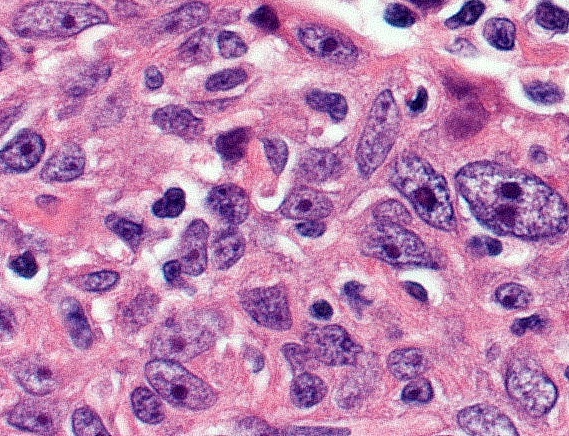 Which of the following enzymes is most likely to function only within this basophilic region of the nucleus?
 (Multiple Choice)
4.9/5 (80)
(80) An 18-year-old woman comes to the office for evaluation of graying hair. The patient has no other concerns and has otherwise been healthy. She reports that her mother had similar features at a young age and died of progressive pulmonary fibrosis. Examination shows diffuse gray hair. There are white patches on the surface of the tongue. Cardiopulmonary examination is unremarkable, and the abdomen is soft and nondistended. Skin examination shows areas of reticular hyperpigmentation on the neck and torso. The nails of the fingers and toes appear thin. Genetic testing reveals a loss-of-function mutation affecting the telomerase reverse transcriptase gene. Which of the following cell types is most likely to be affected by this mutation?
(Multiple Choice)
4.8/5 (73)
(73) A 14-year-old girl is brought to the office for a routine physical examination. The patient will be starting her freshman year of high school soon. She plays the clarinet in the school band but does not play any sports. The patient says that she is not sexually active and does not use tobacco, alcohol, or illicit drugs. Height is at the 5th percentile, and weight is at the 25th percentile. Her temperature is 36.7 C (98 F), blood pressure is 120/80 mm Hg, pulse is 88/min, and respirations are 16/min. Physical examination shows a short and thick neck, a broad chest, and shortened fourth metacarpals bilaterally. A murmur is heard on cardiac auscultation. Which of the following would most likely be seen in an echocardiogram?
(Multiple Choice)
4.8/5 (81)
(81) A 23-year-old asymptomatic male participates in clinical research and is found to be homozygous for the apolipoprotein E-4 allele. In the future, this patient is most likely to suffer from which of the following?
(Multiple Choice)
5.0/5 (81)
(81) Geneticists are studying a malfunctioning protein that causes impaired endothelial cell migration and angiogenesis. They have noticed that the amino acid sequence of the protein is truncated compared to normal controls. The mutated mRNA strand is isolated, and analysis shows a nonsense mutation located near the 3' end of the coding region. The 3' terminal coding sequence of the abnormal mRNA strand is shown below.  Which of the following tRNA anticodons is responsible for adding the last amino acid to the truncated polypeptide during protein translation?
 (Multiple Choice)
4.7/5 (81)
(81) A 41-year-old man with trisomy 21 is evaluated in the clinic due to cognitive decline. The patient has a history of moderate intellectual disability, but his higher cognitive functions have become progressively impaired in the past several years. He previously volunteered at a community library but recently lost his position as he could no longer perform his duties. The patient is now completely dependent on a caregiver for assistance with his activities of daily living such as getting dressed, bathing, and using the toilet. The patient keeps wandering in the group home and has become lost on several occasions. Which of the following is most likely to be increased in this patient?
(Multiple Choice)
5.0/5 (79)
(79) A 26-year-old woman is being evaluated for a possible inherited disorder. She has a 6-year history of generalized tonic-clonic seizures, and a year ago, she had partial loss of vision due to an occipital infarction. Her mother has chronic intermittent muscle weakness and lactic acidosis, and her maternal uncle has hemiplegia. Skeletal muscle biopsy of the patient shows ragged-appearing muscle fibers. After further evaluation, all the affected family members are found to suffer from the same inherited disease. Pedigree analysis is shown in the image below. 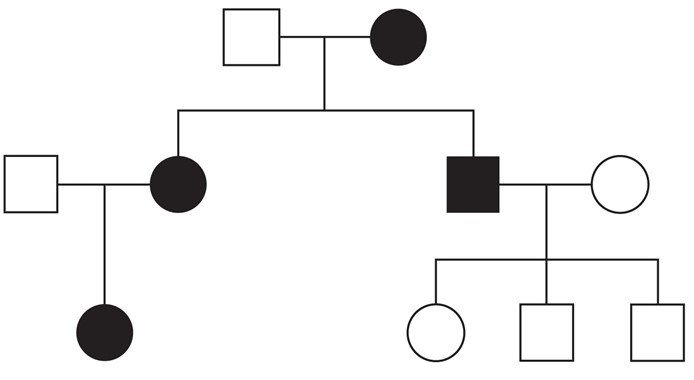 Which of the following is the most likely explanation for the variability of clinical manifestations in the affected family members?
 (Multiple Choice)
4.8/5 (80)
(80) A series of experiments is being conducted to determine the structure and function of different types of bacterial RNA. Cultures of Staphylococcus aureus are exposed to chemicals that lyse the bacterial cells, and the RNA molecules are then extracted. A specific RNA consisting of 90 nucleotides is purified for further analysis. It is found to contain high amounts of chemically modified bases such as dihydrouridine, pseudouridine, and ribothymidine, and its secondary structure arises from base pairing within the chain. Which of the following is the most likely composition of the 3'-end of this molecule?
(Multiple Choice)
4.8/5 (80)
(80) A 3-year-old boy is brought to the office for follow-up on intellectual disability and speech delay. Review of his developmental screening questionnaire shows that the boy does not imitate his parents' activities, have a social smile, or show interest in other children. The patient has 8-10 words in his vocabulary and does not combine them into 2-word phrases. There is also concern that his verbal comprehension is poor, and a subsequent audiological evaluation was normal. The boy is up to date on all vaccinations and has no other significant medical history. Laboratory testing shows 226 CGG trinucleotide repeats in a gene located on the X chromosome. Which of the following is the most likely cause of this patient's clinical condition?
(Multiple Choice)
4.9/5 (84)
(84) A researcher is studying the Fas receptor (FasR), a protein widely expressed on cell surfaces. The signaling cascade of programmed cell death is initiated when FasR binds to its ligand (FasL), which is expressed on cytotoxic T cells. In an experiment, cancer cells that escaped elimination by the immune system were found to contain soluble Fas proteins that did not promote apoptosis. The soluble Fas proteins were shorter and lacked the transmembrane domain. DNA analysis of these cells revealed no FAS gene mutations. Which of the following is the most likely explanation for the formation of altered Fas proteins in these cancer cells?
(Multiple Choice)
4.9/5 (76)
(76) A researcher develops 2 functional mRNA sequences composed of CUC and CUU trinucleotide repeats, respectively. He subsequently incubates these mRNAs in a solution containing functional ribosomes and tRNAs charged with the appropriate amino acids. After several hours, it is found that both mRNA sequences produce polypeptide chains containing leucine repeats. This observed finding is due to which of the following genetic principles?
(Multiple Choice)
4.8/5 (89)
(89) A genetic study performed on a 10-year-old boy reveals a single base substitution mutation involving a DNA segment that encodes a cellular protein, as shown in the image below.  This mutation is most likely to affect which of the following processes?
 (Multiple Choice)
4.8/5 (66)
(66) A newborn is examined immediately after an induced vaginal delivery for fetal growth retardation. On visual inspection, the infant has low-set ears, a small mandible, and a prominent occiput. The neonate has a weak cry and increased tone of the extremities, including clenched hands with second and fifth digits on top of the third and fourth digits. Cardiac auscultation reveals a harsh, IV/VI holosystolic murmur heard best at the left sternal border. The infant is transferred to the neonatal intensive care unit for further workup and management. Which of the following is the most likely chromosomal abnormality in this infant?
(Multiple Choice)
4.9/5 (62)
(62) A 4-year-old boy is brought to the physician for fatigue and persistent bone pain. Physical examination shows diffuse lymphadenopathy and multiple purpura over his arms and legs. Laboratory analysis reveals anemia and thrombocytopenia, and a peripheral blood smear shows lymphoblasts. After further workup, he is diagnosed with acute lymphoblastic leukemia and started on a chemotherapy regimen that includes doxorubicin. This agent intercalates between DNA base pairs and inhibits DNA replication, a process that normally occurs at sites known as replication forks. As the replication forks move across the DNA molecule, 2 distinct daughter strands are formed. Which of the following is unique to the daughter strand that is synthesized in the opposite direction of the growing replication fork?
(Multiple Choice)
4.7/5 (79)
(79) 
Filters
- Essay(0)
- Multiple Choice(0)
- Short Answer(0)
- True False(0)
- Matching(0)