



 Chat with AI
Exam 12: Pharmacology

Exam 1: Anatomy291 Questions
Exam 2: Behavioral science240 Questions
Exam 3: Biochemistry156 Questions
Exam 4: Biostatistics117 Questions
Exam 5: Embryology52 Questions
Exam 6: Genetics103 Questions
Exam 7: Histology24 Questions
Exam 8: Immunology129 Questions
Exam 9: Microbiology336 Questions
Exam 10: Pathology816 Questions
Exam 11: Pathophysiology464 Questions
Exam 12: Pharmacology538 Questions
Exam 13: Physiology272 Questions
Select questions type


A 72-year-old man comes to the office due to constipation. His stools have become increasingly hard, small-volume, and difficult to pass. This has been associated with bloating but not vomiting. Symptoms have not improved despite fiber supplementation, polyethylene glycol, and bisacodyl. The patient was recently diagnosed with metastatic pancreatic cancer and was prescribed palliative chemotherapy 2 months ago. His cancer causes severe abdominal pain, which requires high-dose oxycodone to control. Vital signs are within normal limits. The abdomen is mildly distended with decreased bowel sounds. Which of the following medications acts as a µ-opioid receptor antagonist that could alleviate this patient's constipation without inducing withdrawal symptoms?

Free
(Multiple Choice)
4.8/5  (69)
(69) Correct Answer: Verified
D
A 28-year-old man comes to the clinic due to cough and shortness of breath. The patient has a history of intermittent asthma controlled with an as-needed albuterol inhaler. Over the last month, he has noticed increased severity and frequency of his symptoms. The patient occasionally wakes up at night with coughing spells and has had to use his albuterol inhaler several times per week due to shortness of breath. An inhaled corticosteroid is prescribed to achieve better symptom control. In addition to an anti-inflammatory effect, which of the following effects also directly occurs as a result of this therapy?
Free
(Multiple Choice)
4.7/5 (86)
(86) Correct Answer:Verified
VerifiedE
A 63-year-old man comes to the hospital due to sudden onset chest pain and dyspnea. He has a history of glioblastoma multiforme, for which he has been undergoing radiation treatment. His temperature is 36.1 C (97 F), blood pressure is 110/80 mm Hg, pulse is 118/min, and respirations are 26/min. Pulse oximetry shows 90% on room air. A CT pulmonary angiogram demonstrates a left-sided pulmonary embolism. The patient is started on continuous unfractionated heparin infusion. Several hours later, the patient begins to experience severe headache and quickly becomes unconscious. A CT of the head reveals bleeding into the tumor. After stopping the heparin infusion, administration of which of the following is indicated for immediate anticoagulant reversal?
Free
(Multiple Choice)
4.8/5 (83)
(83) Correct Answer:Verified
VerifiedC
A 67-year-old woman comes to the office due to polymyalgia rheumatica. She was diagnosed a year ago and has required supraphysiologic doses of prednisone to control her symptoms. The patient has no other medical conditions. She has adequate intake of calcium and vitamin D from her diet and supplements. The patient does not use tobacco or alcohol. Physical examination is unremarkable. Laboratory evaluation shows normal serum creatinine, 25-hydroxyvitamin D, and calcium levels. Bone density measured by dual x-ray absorptiometry (DXA) reveals a significant decline when compared to her bone density measured at age 65. Which of the following is most likely contributing to this patient's bone loss?
(Multiple Choice)
5.0/5 (89)
(89) A 64-year-old man comes to the office for follow-up. He has a history of chronic kidney disease due to hypertensive and diabetic nephropathy. Six months ago, he developed significant fatigue and exercise intolerance. Evaluation at that time revealed normocytic anemia and normal serum iron studies so recombinant erythropoietin was initiated. Today, the patient states that his symptoms have significantly improved. Laboratory evaluation reveals a hemoglobin of 12 g/dL. If the erythropoietin treatment is continued, this patient is at greatest risk for which of the following complications?
(Multiple Choice)
4.9/5 (85)
(85) A 5-year-old boy is brought to the emergency department due to accidental drug ingestion. His mother states the patient was playing by himself earlier today and 2 hours later she found him unresponsive in the bathroom. There was an empty bottle of hydrocodone-acetaminophen next to him, but she does not know how many pills were in it. The emergency medical team found the patient stuporous and with bradypnea. His mental status and respirations promptly improved after 1 dose of intravenous naloxone was administered, and he was transported to the hospital. On arrival, the patient is sleepy but arouses easily to voice and follows simple instructions. Vital signs, including respirations, are normal. One hour later, he has worsening lethargy, bradypnea, and miosis. Which of the following most likely accounts for this patient's current clinical deterioration?
(Multiple Choice)
4.7/5 (77)
(77) A new medication, drug A, is being developed for the treatment of peptic ulcer disease. During initial testing, gastric acid secretion in experimental animals is stimulated by vagal stimulation, histamine infusion, or gastrin infusion. Before the stimulus is administered, the animals are divided into 2 groups, one group receives pretreatment with drug A, and the second one serves as the control and is given an injection of an equivalent volume of normal saline. The effects of the drug on hydrochloric acid (HCl) output by the stomach mucosa are recorded and shown in the graphs below. 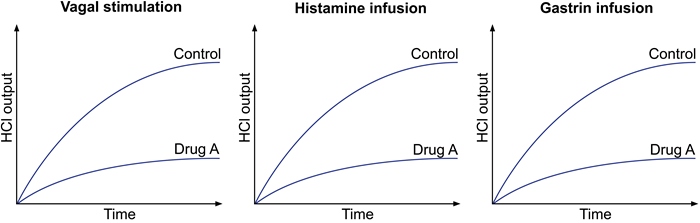 Drug A is most similar to which of the following medications?
 (Multiple Choice)
5.0/5 (75)
(75) A 72-year-old man comes to the office for evaluation of constipation. His stools have been hard and pelletlike for as long as he can remember. The patient has a bowel movement every 3-4 days and frequently strains when using the bathroom. He has had associated abdominal discomfort but no hematochezia, melena, vomiting, or unexpected weight changes. The symptoms have not improved despite fiber supplementation. Vital signs are within normal limits. The abdomen is mildly distended with decreased bowel sounds. In addition to increasing water consumption, the patient is advised to try bisacodyl for constipation. What is the primary mechanism of action of this medication?
(Multiple Choice)
4.9/5 (80)
(80) A 49-year-old woman is brought to the emergency department with squeezing chest pain and profuse sweating for the last 2 hours. Medical history includes diet-controlled type 2 diabetes mellitus. ECG reveals ST-segment elevation in leads I, aVL, and V1-V4. The patient is immediately taken to the cardiac catheterization laboratory, where she is found to have complete occlusion of the left anterior descending coronary artery. The blockage is opened with percutaneous coronary intervention with stenting, but afterward she experiences recurrent and sustained episodes of ventricular arrhythmia. She is treated with an antiarrhythmic agent that preferentially binds to rapidly depolarizing and ischemic ventricular myocardial fibers and has minimal effect on normal ventricular myocardium. Which of the following agents was most likely used in this patient?
(Multiple Choice)
4.8/5 (86)
(86) A previously healthy 45-year-old male undergoes an elective hernia repair under spinal anesthesia. Postoperatively, he complains of difficulty voiding. Bladder catheterization shows a post-void residual of 300cc of urine. This patient would most likely benefit from which of the following medications?
(Multiple Choice)
5.0/5 (80)
(80) A 25-year-old woman with newly diagnosed seizures comes to the emergency department with fever and skin rash. She had her first seizure 6 weeks ago, and an MRI of the brain revealed no structural lesions. She was started on phenytoin 4 weeks ago. Her temperature is 38.9 C (102 F). There is a diffuse confluent erythema involving 60% of the body, palpable generalized lymphadenopathy, and symmetrical facial swelling. Which of the following laboratory findings is most likely to be present in this patient?
(Multiple Choice)
4.7/5 (72)
(72) A 28-year-old woman comes to the office due to several months of progressive abdominal pain and intermittent diarrhea. She denies fever or chills but has lost weight due to poor appetite. The patient works for an organization that installs wood pellet cookstoves in rural villages in Central Africa and has spent much time in the region over the last 5 years. Temperature is 37.8 C (100 F), blood pressure is 126/72, and pulse is 86. BMI is 19 kg/m2. Physical examination is normal. Laboratory results are as follows: 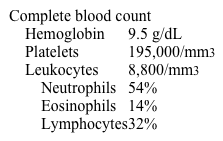 An intestinal biopsy sample is shown in the exhibit.
 Which of the following is the most appropriate treatment for this patient?
An intestinal biopsy sample is shown in the exhibit.
Which of the following is the most appropriate treatment for this patient? (Multiple Choice)
4.9/5 (85)
(85) A 22-year-old woman comes to the emergency department after development of a diffuse pruritic rash following a meal at a buffet restaurant an hour ago. She also felt light-headed and nearly fainted. The patient has no prior medical conditions and takes no medications. Temperature is 37 C (98.6 F), blood pressure is 96/52 mm Hg, pulse is 126/min, and respirations are 16/min. Physical examination shows mild lip swelling; the tongue appears normal. Heart auscultation demonstrates regular tachycardia without extraneous sounds. Lung sounds are clear with normal work of breathing. Skin examination shows confluent urticaria on the neck, shoulders, and abdomen. Intravenous fluids are begun, and intramuscular epinephrine is administered immediately. In addition to its effect on airway and circulation, this medication is most likely to improve this patient's condition through which of the following mechanisms?
(Multiple Choice)
4.9/5 (72)
(72) A 45-year-old woman comes to the office due to gradually progressive pain, stiffness, and swelling of her hand joints for the past several months. The patient has had prolonged morning stiffness and significant restriction of her daily activities due to the pain, as well as generalized fatigue. She describes the symptoms over the last several weeks as "disabling," and she needs assistance with activities of daily living in the morning. The patient has tried over-the-counter pain medications, such as acetaminophen and ibuprofen, with only minimal relief of her symptoms. She has no other medical problems. Family history is significant for diabetes mellitus on her maternal side. Which of the following drugs would provide the most rapid relief of her symptoms?
(Multiple Choice)
4.9/5 (79)
(79) A clinical trial is being conducted to evaluate the safety and efficacy of a novel therapy to treat refractory Crohn disease. The medication is a monoclonal antibody against the α4β7 integrin, which inhibits migration of T-lymphocytes into the intestinal parenchyma and produces a gut-selective anti-inflammatory effect. Patients who have active, moderate to severe Crohn disease and have failed conventional therapy are enrolled in the study. Many of these patients have renal or hepatic dysfunction, and some take other medications that affect cytochrome P450 enzymes. Which of the following is the most appropriate dose adjustment in this patient population to decrease drug toxicity?
(Multiple Choice)
4.7/5 (70)
(70) A 65-year-old man is brought to the emergency department due to central chest pain for the past 2 hours. The patient describes the pain as "very severe" and "going back all the way to my spine." He has never had similar pain. Medical history is significant for hypertension; the patient has been nonadherent with prescribed medical therapy and follow-up visits. He has a 20-pack-year smoking history. Blood pressure is 195/101 mm Hg, and pulse is 93/min and regular. Chest examination reveals clear lungs. ECG shows sinus rhythm and voltage criteria for left ventricular hypertrophy. Portable chest x-ray reveals a widened mediastinum. The patient is immediately treated with intravenous esmolol. Which of the following is the most likely purpose of this patient's current therapy?
(Multiple Choice)
4.9/5 (79)
(79) A 47-year-old woman comes to the office for follow up of an asthma exacerbation. The patient was recently hospitalized and required a prolonged period of mechanical ventilation as well as nebulized bronchodilators and intravenous glucocorticoids. Her symptoms improved, and she was discharged on oral prednisone. The patient reports compliance with therapy. She has no other medical conditions and takes no other medications. Blood pressure is 128/72 mm Hg, pulse is 85/min, and respirations are 18/min. On physical examination, there is mild expiratory wheezing. Because of the persistent respiratory findings, the patient is continued on the same treatment regimen. Long-term administration of this oral therapy is most likely to increase which of the following in this patient?
(Multiple Choice)
4.7/5 (71)
(71) A 20-year-old college student comes to the office due to falling asleep at inappropriate times. He has an irresistible urge to sleep during the day, and these "naps" occur unpredictably, sometimes at the start of class or during examinations. He sleeps 6-7 hours per night and feels refreshed when he awakens. He also experiences frightening auditory hallucinations before falling asleep. He was recently in a motor vehicle collision after falling asleep at the wheel, which resulted in only a minor sprain of his wrist. He does not use tobacco, alcohol, or illicit drugs. Physical examination is unremarkable. Which of the following is the best treatment for this patient's condition?
(Multiple Choice)
4.9/5 (85)
(85) A 42-year-old woman with a history of schizophrenia is brought to the clinic by her parents after attempting to drink rubbing alcohol in response to voices telling her to kill herself. The patient believes that a television newscaster is sending her secret messages and that the devil injects her with poison at night while she is sleeping. She first developed symptoms at age 23 and has had 7 previous psychiatric hospitalizations and 2 suicide attempts. Trials of haloperidol, risperidone, and olanzapine have yielded minimal improvement. Her medical conditions include hypertension and mild obesity. Physical examination is normal. Medication therapy with clozapine is initiated. Which of the following should be regularly monitored in this patient?
(Multiple Choice)
4.9/5 (91)
(91) A 54-year-old man is evaluated for paroxysmal atrial fibrillation. During the episodes, the patient experiences palpitations, chest tightness, light-headedness, and shortness of breath. Medical history is significant for asthma, hypertension, and diet-controlled diabetes mellitus. Prior testing showed normal left ventricular ejection fraction, no evidence of valvular disease, and no obstructive coronary artery disease. It is decided to proceed with dofetilide therapy. Initiation of this therapy increases this patient's risk for which of the following?
(Multiple Choice)
5.0/5 (77)
(77) 
Filters
- Essay(0)
- Multiple Choice(0)
- Short Answer(0)
- True False(0)
- Matching(0)