



 Chat with AI
Exam 12: Pharmacology

Exam 1: Anatomy291 Questions
Exam 2: Behavioral science240 Questions
Exam 3: Biochemistry156 Questions
Exam 4: Biostatistics117 Questions
Exam 5: Embryology52 Questions
Exam 6: Genetics103 Questions
Exam 7: Histology24 Questions
Exam 8: Immunology129 Questions
Exam 9: Microbiology336 Questions
Exam 10: Pathology816 Questions
Exam 11: Pathophysiology464 Questions
Exam 12: Pharmacology538 Questions
Exam 13: Physiology272 Questions
Select questions type


A 64-year-old woman is diagnosed with rheumatoid arthritis after coming to the office with symmetrical joint pain, swelling, and morning stiffness. The patient has a remote history of peptic ulcer disease and was treated with multidrug therapy for Helicobacter pylori eradication; a follow-up H pylori stool antigen test was negative and she had no recurrent symptoms. The patient is started on methotrexate and high-dose ibuprofen therapy. In addition, daily lansoprazole is prescribed for protection against the adverse gastrointestinal effects of ibuprofen. Three months later, joint symptoms were greatly improved. Ibuprofen and lansoprazole were discontinued. However, 2 weeks later, she begins experiencing heartburn after meals. Which of the following is the most likely cause of this patient's new gastrointestinal symptoms?
(Multiple Choice)
4.9/5  (86)
(86) A 65-year-old immigrant from Eastern Europe comes to the physician because of a four-week history of low-grade fever, multiple joint pains, and a well-demarcated erythematous rash on his face and trunk. The patient denies hair loss, mucosal ulceration, or photosensitivity. His serum test is positive for the presence of anti-nuclear antibody (ANA) in very high titers. The patient reports a past medical history of coronary artery disease, congestive heart failure, and "cardiac rhythm abnormalities." This patient should be specifically questioned about the intake of which of the following medications?
(Multiple Choice)
4.8/5 (83)
(83) A 19-year-old woman comes to the office due to 2 days of dysuria, urinary frequency, and urgency. The symptoms began a day after having sexual intercourse with her boyfriend. The patient has no fever, flank pain, nausea, or vomiting. She has no chronic medical conditions and no known drug allergies. Vital signs are within normal limits. Examination shows mild suprapubic tenderness. Urinalysis reveals many bacteria and white blood cells/hpf. Which of the following is the most appropriate pharmacotherapy for this patient?
(Multiple Choice)
4.8/5 (84)
(84) A 60-year-old man is found by his daughter to be confused at home. Emergency medical services are called and he is brought to the emergency department by ambulance. The patient's daughter, who accompanies him, says that she found an empty bottle of amitriptyline next to his bed. He has not been taking any other medications. In the emergency department, the patient is delirious and says that he sees small animals running around in the corner of the room. He appears flushed. The patient has a brief seizure and becomes unconscious. Temperature is 37.2 C (99 F), blood pressure is 90/62 mm Hg, and pulse is 120/min. Both pupils are dilated and equally reactive to light, and his skin and mucous membranes are dry. Initial ECG shows QRS widening and QTc prolongation. He is transferred to the intensive care unit but dies despite resuscitation attempts. Which of the following pharmacological effects most likely contributed to the patient's death?
(Multiple Choice)
4.8/5 (86)
(86) A 75-year-old man comes to the office for follow-up of hypertension. In recent weeks, his blood pressure has consistently been 160-165/85-90 mm Hg. Medical history includes a right carotid endarterectomy for recurrent transient ischemic attacks, a myocardial infarction 2 years ago, and coronary artery bypass surgery for unstable angina 1 year ago. The patient currently takes metoprolol, clopidogrel, amlodipine, and rosuvastatin. He quit smoking 20 years ago and does not drink alcohol. The patient is compliant with his medical therapy and office visits. Ramipril is added to his medication regimen. One week later, creatinine is 2.1 mg/dL, up from a baseline of 1.1 mg/dL. Assuming the patient's baseline urinalysis is normal, a repeat urinalysis at this time would most likely reveal which of the following?
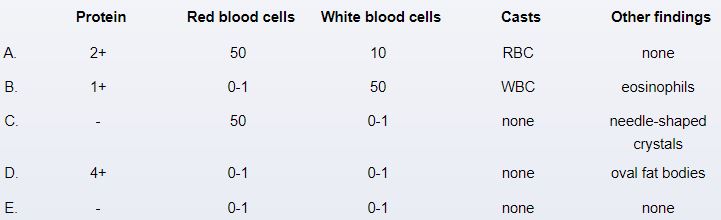
(Multiple Choice)
4.8/5 (71)
(71) A 60-year-old man who was recently diagnosed with hypertension comes to the office for follow-up. He was treated with lisinopril but stopped a week ago due to a dry, nagging cough. Past medical history is notable for type 2 diabetes mellitus with moderately increased albuminuria but normal creatinine clearance. His other medications include metformin and rosuvastatin. The patient does not smoke or drink alcohol. His blood pressure is 150/92 mm Hg. BMI is 31 kg/m2. Physical examination, including the heart and lungs, is unremarkable. Which of the following is the best treatment for this patient's hypertension?
(Multiple Choice)
4.8/5 (77)
(77) A 64-year-old man comes to the office due to several weeks of worsening back pain, fatigue, and polyuria. Physical examination reveals mucosal pallor and diffuse bony tenderness. Laboratory studies are significant for normocytic anemia, hypercalcemia, and renal failure. Serum protein electrophoresis demonstrates a monoclonal spike in the gamma globulin region. Bone marrow biopsy shows a large number of abnormal plasma cells. Treatment with lenalidomide is started; this medication increases affinity of E3 ubiquitin ligase enzyme to substrate transcription factors. Which of the following is the most likely effect of this medication on these transcription factors?
(Multiple Choice)
4.8/5 (71)
(71) A 42-year-old man is brought to the emergency department after a suspected suicide attempt. The patient's wife filed for divorce a few days ago, and 3 hours ago, he began drinking alcohol and took multiple acetaminophen tablets. He has had several episodes of vomiting. The patient has no significant history of alcohol use, and he last drank alcohol 6 months ago. Vital signs are stable. Laboratory results are pending. The patient's family is concerned about significant liver injury given his concurrent alcohol and acetaminophen intake. A physician explains to the family that acute ethanol ingestion may reduce the risk of acetaminophen-induced liver toxicity. Which of the following actions of ethanol best explains this phenomenon?
(Multiple Choice)
4.9/5 (75)
(75) A 62-year-old man is hospitalized for chest pain and palpitations. His past medical history is significant for coronary artery disease, ischemic cardiomyopathy, paroxysmal atrial fibrillation, and hypertension. Blood pressure on admission is 135/78 mm Hg and pulse is 78/min. During hospitalization, the patient has 2 episodes of brief loss of consciousness. ECG recording during the episodes shows polymorphic QRS complexes that change in amplitude and cycle length. Between the episodes, his ECG shows QT interval prolongation but is otherwise unremarkable. Which of the following medications is most likely responsible for this patient's condition?
(Multiple Choice)
4.8/5 (83)
(83) A novel aminoglycoside antibiotic is developed that is intravenously administered and excreted unchanged in urine with an elimination half-life of 4 hours. Two different dosing regimens are tested in a clinical trial: smaller doses given 3 times a day and a higher dose given once a day. The total administered drug amount per kilogram of body weight per day (mg/kg/day) is the same in both regimens. Serum drug concentration is monitored in both groups and is shown in the graph below:[Blue: once-daily (extended interval) dosing, Green: multiple-daily dosing, MIC: minimum inhibitory concentration] 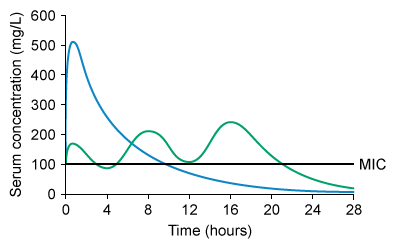 It is found that both regimens are effective against gram-negative pathogens, with clinical improvement occurring slightly earlier on average with once-daily dosing. Which of the following best explains the efficacy of once-daily dosing despite the short half-life of this antibiotic?
 (Multiple Choice)
5.0/5 (82)
(82) A 35-year-old man was hospitalized for a psychotic episode in which he heard voices of God and the devil and believed that his family was plotting to kill him. He improved rapidly with medication therapy and was discharged. Three weeks later, the patient comes to the emergency department due to generalized muscle stiffness and shaking of his right hand. He has no other medical history and takes no other medications. Temperature is 36.7 C (98 F), blood pressure is 110/80 mm Hg, pulse is 68/min, and respirations are 14/min. On mental status examination, he is alert and oriented with mild paranoia but no auditory hallucinations. Which of the following is the best treatment for this patient's current symptoms?
(Multiple Choice)
5.0/5 (74)
(74) A 54-year-old man is transferred to the hospital from his cardiologist's office due to atrial fibrillation with rapid ventricular response. His symptoms began 24 hours earlier with palpitations, lightheadedness, and chest tightness. The patient has had similar episodes several times during the last year. Past history is notable for mitral valve repair 3 years ago for severe symptomatic mitral regurgitation. The patient undergoes direct current cardioversion due to worsening hemodynamic instability, with resolution of the arrhythmia and all associated symptoms. He is considered for long-term amiodarone therapy to prevent future arrhythmic episodes. Which of the following should be tested before initiating this medication?
(Multiple Choice)
4.8/5 (87)
(87) A 23-year-old woman with a history of sickle cell disease comes to the office for follow-up. The patient is homozygous for hemoglobin S and has had frequent episodes of painful vasoocclusive crises. She has no other medical conditions and takes folic acid supplementation. The patient does not use tobacco, alcohol, or illicit drugs. Physical examination shows no abnormalities. Additional therapy with hydroxyurea is planned. This medication is likely to improve this patient's symptoms primarily through which of the following mechanisms?
(Multiple Choice)
4.8/5 (86)
(86) A 3-year-old, previously healthy boy is brought to the emergency department due to accidental drug ingestion. His mother found him playing with his grandfather's pill bottles earlier today, and later, he developed nausea and vomited twice. The patient also began breathing rapidly and appeared ill. His grandfather recently had a myocardial infarction and takes multiple medications. On physical examination, the patient is mildly lethargic, tachypneic, and tachycardic. The abdomen is soft and nontender. The extremities are warm and capillary refill time is normal. Laboratory studies reveal high anion gap metabolic acidosis. Treatment with intravenous sodium bicarbonate infusion is begun. This therapy is most likely to provide a beneficial effect via which of the following mechanisms?
(Multiple Choice)
4.9/5 (76)
(76) A 34-year-old kidney transplant patient treated with cyclosporine comes to the office due to nausea and anorexia. The patient underwent transplantation 6 months ago and had been doing well until recently. On examination, his blood pressure is 160/96 mm Hg. There is no tenderness at the site of the transplanted kidney. Serum creatinine is 3.4 mg/dL, and the serum cyclosporine level is markedly increased. A month ago, he had normal blood pressure and normal levels of cyclosporine and serum creatinine. Further questioning reveals that the patient has been drinking increased amounts of grapefruit juice lately as part of an attempt to improve his overall health. Which of the following mechanisms is most likely responsible for this patient's current condition?
(Multiple Choice)
4.8/5 (76)
(76) A 47-year-old man with known coronary artery disease comes to the emergency department with chest tightness, sweating, and palpitations. His symptoms began abruptly 2 hours ago while he was at work. Six months ago, the patient underwent percutaneous angioplasty of the right coronary artery. Past medical history also includes anxiety and panic attacks. Blood pressure is 180/90 mm Hg and pulse is 110/min with a regular rhythm. An esmolol infusion produces rapid symptom relief and heart rate slowing. Which of the following portions of the ECG will be affected most significantly by the medication? 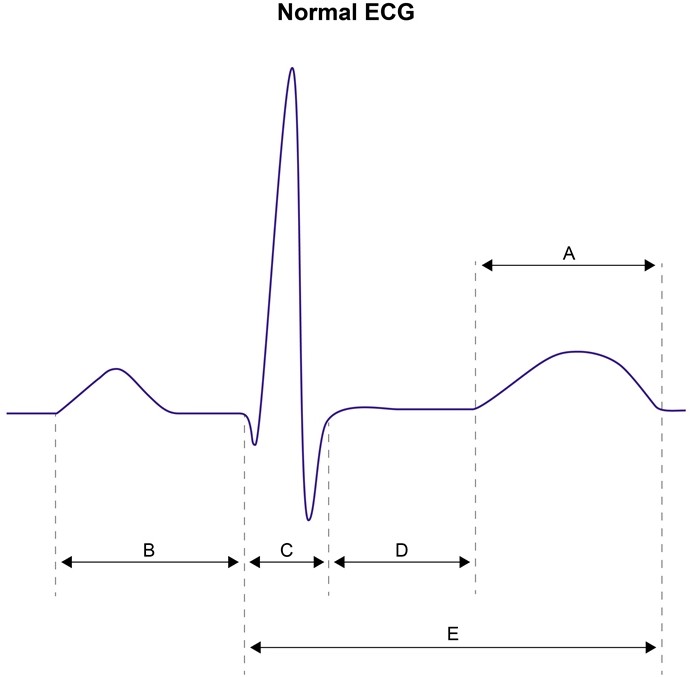
(Multiple Choice)
4.8/5 (82)
(82) A 43-year-old man comes to the emergency department due to painless, progressive visual impairment. The patient was diagnosed with sexually acquired HIV infection 4 years ago. He was previously started on antiretroviral therapy but has been noncompliant with his prescribed medications. His most recent CD4 count was 37 cells/mm3. Physical examination shows no skin rash or corneal lesions. Funduscopy reveals the findings seen in the image below. 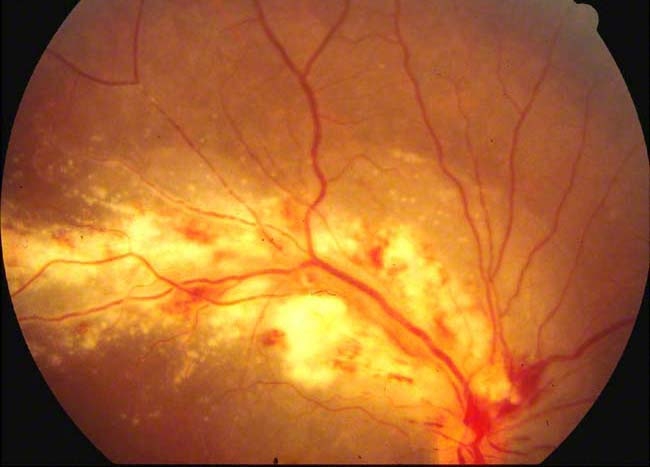 Which of the following medications is the best initial therapy for this patient?
 (Multiple Choice)
4.8/5 (66)
(66) A 48-year-old woman comes to the office for follow-up of type 2 diabetes mellitus. She has had diabetes for 10 years with gradually worsening glycemic control despite taking multiple oral antidiabetic agents. Three months ago, the patient discontinued her oral medications (except for metformin) and started a daily injection of insulin glargine; she has had multiple visits with the diabetes educator since then to review injection technique and titrate up the dose. However, the patient reports a 4.5-kg (10-lb) weight gain since starting insulin. She says, "I feel like I need to eat more. If that's how insulin is going to be, then I don't want to continue it." Which of the following is the most appropriate response to this patient's statement?
(Multiple Choice)
4.8/5 (84)
(84) A 64-year-old man comes to the office due to urinary frequency, hesitancy, and dribbling. His symptoms began insidiously 5 years ago and have progressively worsened. He has to get up 2 or 3 times each night to urinate. Vital signs are normal. Examination shows a smooth, symmetrically enlarged prostate without nodules or tenderness. There is no suprapubic tenderness. Prostate-specific antigen level is 3.5 ng/mL, creatinine is 1.2 mg/dL, and urinalysis is normal. The patient is started on a new medication. After 6 months of therapy, his urinary symptoms improve and prostate volume decreases by 20%. Which of the following medications is most likely responsible for the decreased prostate volume in this patient?
(Multiple Choice)
4.7/5 (88)
(88) An experiment is conducted to assess the effects of drug A on the hemodynamic actions of epinephrine. Two groups of healthy volunteers are selected. The first group receives only low-dose epinephrine, and its effects on diastolic blood pressure and heart rate are monitored and shown below (epinephrine group). The second group is pretreated with drug A and then infused with low-dose epinephrine to produce a new set of curves (epinephrine + drug A group). 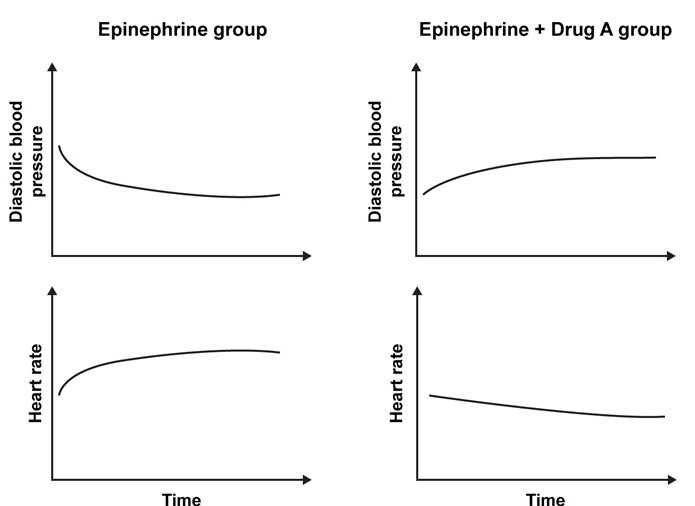 Which of the following medications is most likely to be drug A?
 (Multiple Choice)
4.8/5 (84)
(84) 
Filters
- Essay(0)
- Multiple Choice(0)
- Short Answer(0)
- True False(0)
- Matching(0)