



 Chat with AI
Exam 12: Pharmacology

Exam 1: Anatomy291 Questions
Exam 2: Behavioral science240 Questions
Exam 3: Biochemistry156 Questions
Exam 4: Biostatistics117 Questions
Exam 5: Embryology52 Questions
Exam 6: Genetics103 Questions
Exam 7: Histology24 Questions
Exam 8: Immunology129 Questions
Exam 9: Microbiology336 Questions
Exam 10: Pathology816 Questions
Exam 11: Pathophysiology464 Questions
Exam 12: Pharmacology538 Questions
Exam 13: Physiology272 Questions
Select questions type


A 50-year-old man has recurrent episodes of paroxysmal atrial fibrillation accompanied by uncomfortable palpitations and chest pressure. Echocardiogram reveals normal biventricular function and no significant valvular disease. Coronary angiography reveals no obstructive coronary artery disease. The patient is started on medication to reduce his symptoms. Two weeks later, he is seen in the emergency department for lightheadedness, weakness, and presyncope. ECG reveals sinus bradycardia at a rate of 53/min with QTc prolongation (508 msec). Telemetry monitoring reveals a short episode of self-resolved torsades de pointes. Which of the following medications was most likely used to treat this patient's palpitations?
(Multiple Choice)
4.7/5  (82)
(82) An 82-year-old woman is brought to the office for a new patient evaluation. She recently moved in with her daughter. The patient reports frequent dizziness but cannot provide additional details regarding her symptoms. Medical history includes moderate dementia, hypertension, transient ischemic attack, depression, and chronic insomnia. Blood pressure is 124/72 mm Hg, and pulse is 66/min and regular. Neurologic examination shows disorientation to time and place but normal deep tendon reflexes and no focal sensory or motor deficits. The patient's medication schedule includes 12 different drugs that are used to manage her chronic conditions. Which of the following medications should be discontinued at this time?
(Multiple Choice)
4.9/5 (71)
(71) A 46-year-old woman with confusion and fever is brought to the emergency department. She is disoriented, somnolent, and difficult to rouse. A friend who accompanies the patient says, "She sounded really anxious when I talked to her on the phone so I decided to check in on her. She was just lying on the couch and groaning when I got there. I hope she didn't overdose again-she's tried to before." On physical examination, the patient's skin is flushed, oral mucosa is dry, and pupils are dilated and poorly responsive to light. Which of the following drugs, if taken in overdose, would most likely cause this clinical presentation?
(Multiple Choice)
4.8/5 (70)
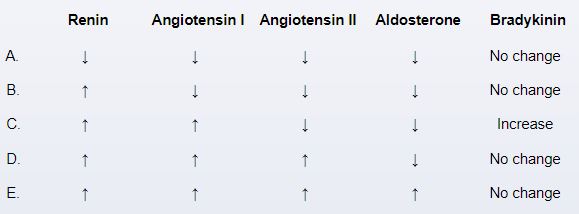
(70) A 60-year-old man comes to the office for a routine follow-up visit. He feels well overall except for an intermittent, mild, generalized headache. The patient has no known medical problems and takes no medications. He does not smoke, follows a generally healthy diet, and exercises daily. On examination, his blood pressure is 150/85 mm Hg, and he is started on lisinopril. At a follow-up visit, the patient's blood pressure is 128/78 mm Hg. He also has a dry cough that began a few weeks after starting lisinopril. This drug is stopped and losartan is now prescribed. The patient seems to be compliant with his medication; the cough resolves and he experiences no significant side effects. When compared with no treatment at all, this patient's current therapy is most likely to result in which of the following changes?
(Multiple Choice)
4.8/5 (72)
(72) A 47-year-old man comes to the emergency department due to fever and fatigue. He has a history of HIV and has not been taking his antiretrovirals consistently. His temperature is 38.3 C (100.9 F), blood pressure is 110/70 mm Hg, pulse is 104/min, and respirations are 20/min. Physical examination is notable for hepatosplenomegaly and multiple erythematous papules. Laboratory studies show pancytopenia. Histoplasma antigen testing is positive. Intravenous amphotericin B therapy is initiated for disseminated histoplasmosis. A day later, the patient develops palpitations and weakness. An ECG reveals frequent premature ventricular beats. If these new signs and symptoms are caused by drug toxicity, they are most likely related to which of the following?
(Multiple Choice)
4.9/5 (93)
(93) An 18-year-old man with a history of recurrent hemarthroses and severe mucosal bleeding due to hemophilia A comes to the office for follow-up. He has had occasional breakthrough bleeding despite receiving prophylactic factor VIII infusions. Testing reveals the patient now has inhibitor alloantibodies against factor VIII, and factor replacement products can no longer be used. Treatment with a novel medication that prevents bleeding by mimicking the function of factor VIII is initiated. This medication most likely works by which of the following mechanisms?
(Multiple Choice)
4.8/5 (78)
(78) A 31-year-old man comes to the office due to persistent nasal congestion and rhinorrhea. The patient has a history of allergic rhinitis and recently moved across the country to start a new job. His nasal symptoms worsened after the move, and he started using an over-the-counter intranasal decongestant spray that initially provided prompt relief. However, after a few days, he had to increase the frequency and number of sprays per nostril needed for adequate symptom control. On examination, the nasal turbinates are swollen and pale with a clear nasal discharge. Which of the following mechanisms is most likely responsible for this patient's increased medication use?
(Multiple Choice)
4.8/5 (93)
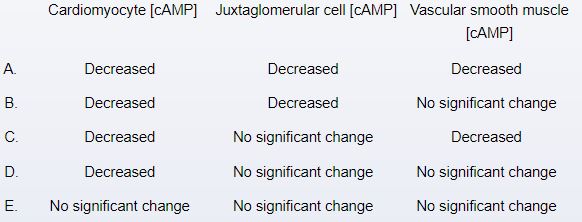
(93) A 47-year-old man comes to the office for follow-up of his elevated blood pressure. The patient's medical history is significant for stable angina pectoris, for which he takes sublingual nitroglycerin as needed. He has no orthopnea, paroxysmal nocturnal dyspnea, or lower extremity swelling. His blood pressure is 154/107 mm Hg and pulse is 86/min. Physical examination shows no abnormalities. The patient is started on a low dose of atenolol. Which of the following cellular changes will most likely occur as a direct effect of this medication?
(Multiple Choice)
4.8/5 (79)
(79) A 64-year-old man comes to the office with 2 months of episodic facial pain. He describes sudden-onset, severe, electric shock-like pain over the right cheek and ear lasting several seconds. The patient reports that activities like shaving and washing his face can trigger the pain and it is becoming more frequent. He is a retired veteran and has a history of posttraumatic stress disorder. Physical examination, including neurologic examination, is normal. Laboratory studies for blood cell counts, electrolytes, and hepatic and renal function are normal. The patient is started on a single drug therapy. On a follow-up visit 3 months later, he reports symptom improvement but is found to have the following blood counts: 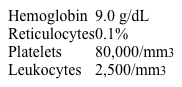 Which of the following is the most likely mechanism of action of the drug used in this patient?
 (Multiple Choice)
4.9/5 (81)
(81) A 10-year-old boy is brought to the emergency department due to a fall while riding his bicycle. The patient hit his forehead on a concrete road barrier and sustained a laceration but did not lose consciousness. He reports no headache, nausea, vomiting, vision disturbances, or focal weakness or numbness. The patient received a tetanus vaccine at age 6. Vital signs are within normal limits. Physical examination reveals a 2-cm laceration above the left eyebrow. There are no other injuries. Neurologic examination shows no abnormalities. Prior to laceration repair with suture, lidocaine is injected in the subcutaneous tissue around the laceration. The patient reports immediate relief of pain, and there is loss of sensation to touch in the area infiltrated with the medication. These effects are most likely due to which of the following changes within the affected neurons?
(Multiple Choice)
4.8/5 (83)
(83) A 58-year-old man comes to the office due to progressive fatigue, dyspnea on exertion, and orthopnea. Medical history is significant for hypertension, hyperlipidemia, and a myocardial infarction 2 years ago. The patient says he has not taken his medications in several months because he was "feeling well." Blood pressure is 160/95 mm Hg and pulse is 94/min and regular. Physical examination shows bilateral lung crackles and lower extremity edema. The point of maximal impulse is displaced toward the axilla, and an S3 is heard. Serum creatinine is 0.9 mg/dL and serum potassium is 4.2 mEq/L. After this patient's condition has stabilized, long-term use of which of the following medications will most likely reduce mortality?
(Multiple Choice)
4.9/5 (84)
(84) A 43-year-old man comes to the office due to depression. He feels sad and unmotivated, sleeps 12 hours a day, and has increased appetite, poor concentration at work, and fleeting thoughts of suicide. The patient has no medical history and laboratory evaluation is unremarkable. Major depressive disorder is diagnosed and antidepressant medication administered. Several weeks after starting the medication, the patient's depressive symptoms are mildly improved, but he is now distressed by a significant decrease in libido and impaired sexual performance. He is considering stopping the medication and requests an alternate treatment. Which of the following drugs is most appropriate for this patient?
(Multiple Choice)
4.8/5 (78)
(78) A 24-year-old woman, gravida 1 para 0, at 14 weeks gestation, comes to the emergency department due to left leg swelling and pain for the past 2 days. She has had no chest pain or shortness of breath. The patient has no prior medical conditions and her only medication is a prenatal vitamin. She is a lifetime nonsmoker. Physical examination shows 1+ edema of the left lower extremity to the knee, associated with mild erythema. The left calf diameter measures 3 cm greater than the right. Doppler ultrasonography shows left popliteal and femoral vein thrombosis. Serum creatinine level is 0.7 mg/dL. Which of the following is the most appropriate pharmacotherapy for this patient?
(Multiple Choice)
4.8/5 (70)
(70) A 57-year-old man with a history of alcohol-induced cirrhosis is brought to the emergency department due to altered mental status. Over the weekend, he ate a lot of smoked meats at a local barbecue competition. Since then, he has been sleeping most of the day and is confused and disoriented when awake. On examination, he has abdominal distension with shifting dullness. The patient answers correctly when asked for his name but does not know that he is in the hospital and says the year is "1997." When asked to extend his hands as if stopping traffic, the patient makes rhythmic flapping movements. He is started on rifaximin. Which of the following is the most likely mechanism of action of this drug when used to treat this patient's current condition?
(Multiple Choice)
4.7/5 (78)
(78) A 65-year-old woman comes to the office to discuss pain at the posterior chest wall. She was seen 4 months ago for acute shingles involving a right mid-thoracic dermatome. The patient was not treated at that time because she had a delayed presentation and the lesions were already well-crusted and healing. The skin lesions subsequently cleared completely. However, since then, she has had persistent burning and stabbing pain in the same region that has now become severe. She has tried oral acetaminophen without relief. During discussion of treatment options, the patient says she does not want any systemic medications due to concerns about possible side effects. She is started on topical capsaicin cream, and her pain improves markedly over the next several days. Decreased activity of which of the following neurotransmitters is most likely associated with pain relief in this patient?
(Multiple Choice)
4.9/5 (79)
(79) A 60-year-old man comes to the office for follow-up after a recent emergency department visit due to cough. The patient was diagnosed with acute bronchitis and the symptoms resolved with symptomatic treatment. A chest x-ray obtained during that visit revealed no lung abnormalities, but the bones appeared osteopenic. The patient reports no bone pain and has had no fractures. He has a history of prostate cancer treated with radiation therapy and is taking leuprolide. The patient has no other medical problems and has no known drug allergies. He drinks a glass of wine daily and does not use tobacco or illicit drugs. He eats a balanced diet and exercises regularly. Blood pressure is 120/80 mm Hg and pulse is 80/min. Physical examination shows no abnormalities. A dual-energy x-ray absorptiometry (DXA) scan shows low bone mineral density. Which of the following is the most likely underlying mechanism of the observed finding in this patient?
(Multiple Choice)
4.9/5 (69)
(69) A 43-year-old man comes to the emergency department due to a 3-day history of persistent headaches. The patient has a history of hypertension and has had poor medical follow-up. Blood pressure is 224/115 mm Hg and pulse is 67/min. He appears mildly confused during the physical examination, but no focal neurologic deficits are noted. Funduscopic examination shows bilateral papilledema. Serum creatinine is 1.4 mg/dL. An intravenous medication is initiated that causes arteriolar dilation while also improving renal perfusion and increasing natriuresis. Which of the following agents is most likely being used in this patient?
(Multiple Choice)
4.9/5 (76)
(76) A 29-year-old woman comes to the office with a 2-month history of right lower quadrant pain and intermittent diarrhea. Vital signs are normal. The examination is unremarkable except for right lower quadrant tenderness. After confirmatory testing, the patient is given a delayed ileal-release medication that works by binding to a cytosolic receptor, translocating to the nucleus, and inhibiting nuclear factor-kappa-B (NF-κB). The patient is most likely being treated with which of the following medications?
(Multiple Choice)
4.7/5 (73)
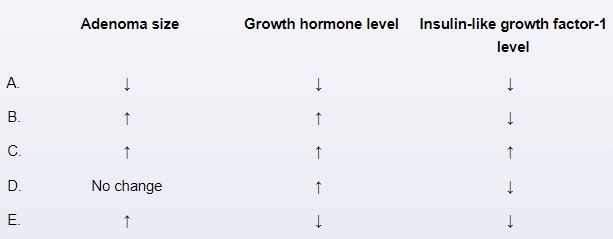
(73) A 50-year-old man comes to the office following transsphenoidal resection of a growth hormone-secreting pituitary adenoma. Three months ago, the patient was diagnosed with acromegaly. MRI of the pituitary showed a 14-mm sellar mass pressing on the optic chiasm and extending into the right cavernous sinus. The surgeon was able to only partially resect the pituitary mass because of the extension into the right cavernous sinus. Medical therapy for acromegaly with octreotide is planned. Which of the following changes are likely to occur following octreotide treatment in this patient?
(Multiple Choice)
4.9/5 (79)
(79) A 16-year-old boy is brought to the office by his parents due to tremors and difficulty walking. Over the past year, his school performance has declined, and he has been moodier and more impulsive. His parents also note that he has been sleeping more than usual and has had a poor appetite for the past 2 months. Approximately 3 weeks ago, the patient developed a tremor in both hands that is most prominent when he reaches for an object or tries to write. The tremor has worsened significantly over the past week, and he has developed an unsteady, broad-based gait. Laboratory studies reveal elevated serum transaminases and 24-hour urinary copper excretion. The patient is prescribed penicillamine therapy. This medication primarily works through which of the following mechanisms?
(Multiple Choice)
4.8/5 (73)
(73) 
Filters
- Essay(0)
- Multiple Choice(0)
- Short Answer(0)
- True False(0)
- Matching(0)