



 Chat with AI
Exam 3: Biochemistry

Exam 1: Anatomy291 Questions
Exam 2: Behavioral science240 Questions
Exam 3: Biochemistry156 Questions
Exam 4: Biostatistics117 Questions
Exam 5: Embryology52 Questions
Exam 6: Genetics103 Questions
Exam 7: Histology24 Questions
Exam 8: Immunology129 Questions
Exam 9: Microbiology336 Questions
Exam 10: Pathology816 Questions
Exam 11: Pathophysiology464 Questions
Exam 12: Pharmacology538 Questions
Exam 13: Physiology272 Questions
Select questions type


A 52-year-old man is being evaluated in the emergency department for abdominal pain associated with watery diarrhea. His symptoms have been progressive over the last month. He says that he is depressed and often has difficulty remembering things. The patient has a 20-year history of alcohol use disorder. On examination, he appears disheveled. A pigmented scaly skin rash is present in the malar distribution of his face, neck, and back of his hands. The rash has been present for several months and worsens on exposure to sunlight. It is determined that the patient's symptoms are secondary to lack of a specific nutrient. Activity of which of the following enzymes is most likely decreased in the patient as a result of this deficiency?

Free
(Multiple Choice)
4.7/5  (80)
(80) Correct Answer: Verified
C
A 6-month-old boy is brought to the office by his mother out of concern that he is not developing normally. He has been feeding regularly and has had no medical problems other than a mild respiratory infection a month earlier. However, the mother says, "he doesn't seem to be as interactive as my other children were at his age." Physical examination reveals delayed developmental milestones and hypotonia. Two years later, the child is found to have involuntary movements and demonstrates a tendency to aggressively bite his own lips and fingers. Laboratory analysis shows an elevated blood uric acid level. Activity of which of the following enzymes is most likely increased as a result of this patient's condition?
Free
(Multiple Choice)
4.9/5 (93)
(93) Correct Answer:Verified
VerifiedD
Succinate dehydrogenase (SDH) is an enzyme complex located within the inner mitochondrial membrane that catalyzes the oxidation of succinate to fumarate. An experiment is conducted to determine if malate alters the rate of SDH activity. Reaction velocity is measured with and without a fixed quantity of malate as succinate concentration is gradually increased. Obtained results are shown below.  Which of the following is the most accurate statement about malate in this experiment?
Free
(Multiple Choice)
4.7/5 (90)
(90) Correct Answer:Verified
VerifiedE
A 68-year-old man comes to the office due to an enlarging mole on his right forearm. The patient is a retired farmer and received a significant amount of sun exposure over the course of his life. On examination, he has a black-brown macular lesion on the dorsum of his right forearm measuring approximately 1 cm in diameter with an irregular border. Excisional biopsy is performed and histopathology reveals malignant melanoma. Immunohistochemical analysis indicates that the malignant cells have decreased integrin expression. These cells are most likely to exhibit poor adhesion to which of the following components of the extracellular matrix?
(Multiple Choice)
4.9/5 (67)
(67) Incidentally, one of the male patients followed in the study is hospitalized with right knee pain and swelling. A sample of his synovial fluid shows negatively birefringent crystals under polarized light microscopy. To achieve rapid improvement in this patient's symptoms, therapy should be directed toward inhibiting which of the following types of cells?
(Multiple Choice)
4.9/5 (83)
(83) A 6-year-old African American boy is brought to the physician because of easy fatigability. Physical examination reveals splenomegaly, and his complete blood count shows mild anemia. Hemoglobin electrophoresis is performed at alkaline pH on a cellulose acetate strip. Findings for the patient are shown below compared to individuals with normal hemoglobin and known sickle cell disease. 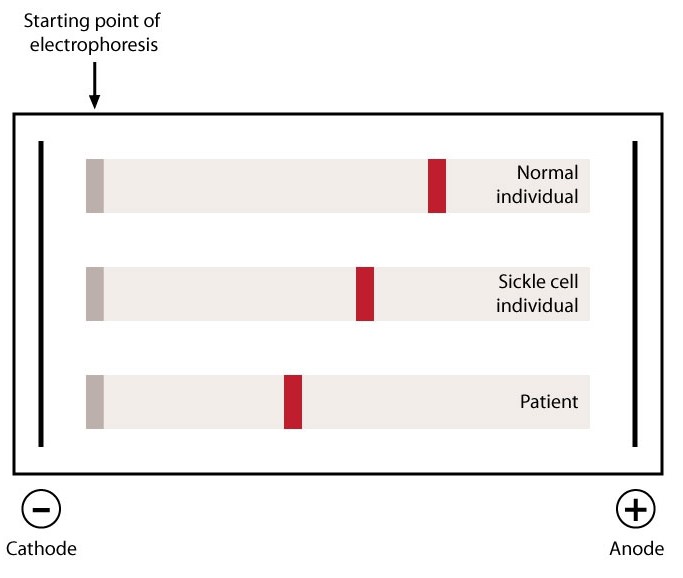 Which of the following is the most likely cause of this patient's condition?
 (Multiple Choice)
4.9/5 (83)
(83) Molecular biologists studying the properties of hemoglobin are investigating the structural changes associated with oxygen loading and unloading. During the transition from point 1 to point 2 on the graph shown below, hemoglobin molecules are most likely to release which of the following? 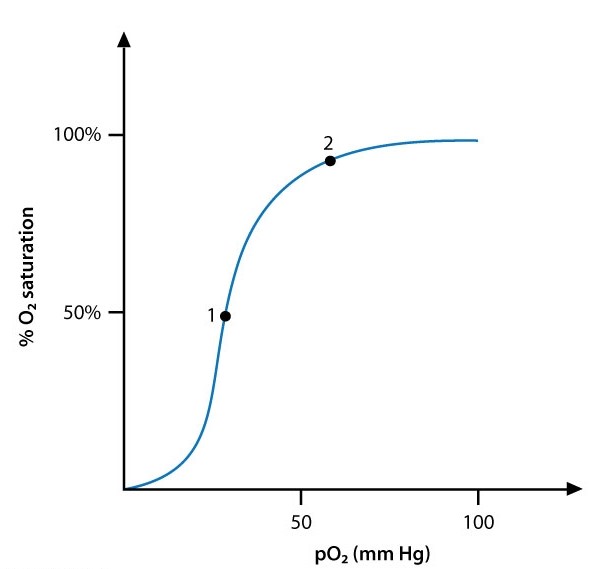
(Multiple Choice)
5.0/5 (87)
(87) A 5-month-old boy is brought to the office due to poor feeding. His mother says that he has difficulty holding his head up while breastfeeding and his suckling seems weaker than usual. Weight is at the 5th percentile. Length and head circumference are tracking along the 25th percentile. Physical examination shows hepatomegaly and hypotonia in all 4 limbs. Cardiac auscultation shows a gallop rhythm, and chest x-ray reveals severe cardiomegaly. Muscle biopsy shows enlarged lysosomes containing periodic acid-Schiff (PAS)-positive material. Which of the following enzymes is most likely deficient in this patient?
(Multiple Choice)
4.7/5 (76)
(76) A 35-year-old man comes to the office with progressively worsening fatigue associated with dark urine and back pain. Two days ago, the patient ate some large, flat beans brought home by his wife after a business trip to Egypt. Physical examination shows jaundice and pallor. Laboratory results reveal a hemoglobin level of 8 g/dL. Further evaluation reveals deficiency of an enzyme involved in the conversion of glucose-6-phosphate to ribulose-5-phosphate. The substance generated during this conversion is necessary for which of the following biochemical processes?
(Multiple Choice)
4.8/5 (84)
(84) A 38-year-old man comes to the office due to pain in multiple joints. He has a 5-year history of lumbar pain and a 2-year history of bilateral knee pain. The patient works in construction and his pain is worst after a long day on his feet. He has taken ibuprofen intermittently, but the pain is no longer tolerable. The patient has a paternal aunt with osteoarthritis. Physical examination shows blue-black spots on his sclerae and diffuse darkening of the auricular helices. Which of the following is the most likely cause of this patient's arthritis?
(Multiple Choice)
4.8/5 (74)
(74) A 12-year-old boy is brought to the office due to gait instability and pruritic skin rash for the past several weeks. His mother reports that he has also been irritable and had loose stools during this time. The patient's childhood development has been unremarkable except for several episodes of similar skin rash that resolved spontaneously. Examination shows scaly, erythematous skin lesions in sun-exposed areas and cerebellar ataxia. Laboratory evaluation shows increased levels of neutral amino acids in the urine. This patient's symptoms would most likely respond to which of the following supplements?
(Multiple Choice)
4.7/5 (82)
(82) A 56-year-old man is evaluated for progressive visual impairment. The patient works as part of the grounds crew at an airport, and says he has trouble identifying aircraft at a distance and with filling out paperwork at the end of his shift. His medical history includes poorly controlled diabetes mellitus, hypertension, and gout. A year ago, the patient underwent an uncomplicated repair of a right inguinal hernia. Physical examination shows bilateral clouding of the lens. The remainder of the examination is unremarkable. Which of the following metabolic conversions is most likely contributing to this patient's current condition?
(Multiple Choice)
4.9/5 (82)
(82) A 3-year-old boy is brought to the office due to abnormal motor development. He was born at 40 weeks gestation and had an unremarkable perinatal course. The boy developed normally during the first year of life. However, for the past 2 years, he has had progressive bilateral leg stiffness and abnormal involuntary movements. His cognitive and motor development is also delayed. There is no significant family history of neurological or muscular disorders. The patient's height, weight, and head circumference are below the 3rd percentile. Examination shows bilateral spastic paresis of his lower extremities and frequent choreoathetoid movements. Comprehensive laboratory testing reveals significantly elevated arginine levels in plasma and cerebrospinal fluid. The deficient enzyme in this patient is normally involved in the production of which of the following?
(Multiple Choice)
4.8/5 (76)
(76) A 34-year-old man comes to the emergency department due to a facial injury. He reports getting hit on the face during a fistfight at a bar. Examination shows dark blue periorbital ecchymosis on the right side. Ophthalmic and neurologic examinations are otherwise normal. After appropriate evaluation, the patient is discharged home. Several days later, the bruise becomes greenish in color. This change in color is best explained by the activity of which of the following enzymes?
(Multiple Choice)
4.8/5 (83)
(83) A 15-year-old boy is brought to the clinic due to poor exercise endurance. He recently began weight lifting with friends but has had difficulty performing the exercises. The patient states that his arms "feel like jelly after just a few repetitions." He also has severe muscle cramping and has noticed occasional urine discoloration after training sessions. Further evaluation reveals that the patient's exercise tolerance can be greatly improved by drinking an oral glucose solution before beginning a strenuous activity. Vital signs are normal, and examination is unremarkable. This patient is most likely deficient in an enzyme that catalyzes which of the following conversions? 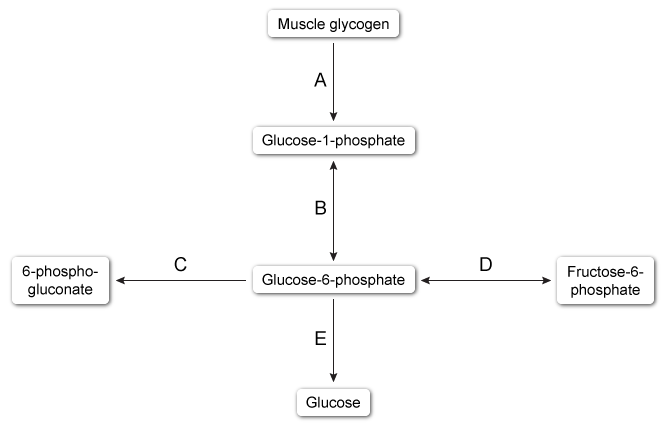
(Multiple Choice)
4.9/5 (81)
(81) A 6-month-old girl is brought to the office by her mother for a checkup appointment. The mother states, "My baby doesn't seem to be growing much despite feeding as often as my previous children. I am worried that something is wrong with her." Physical examination shows hepatomegaly, hypotonia, and height and weight below the 10th percentile. Laboratory studies show hypoglycemia and ketoacidosis. A liver biopsy shows hepatic fibrosis without fat accumulation. Further analysis reveals abundant quantities of a multibranched polysaccharide with abnormally short outer chains within the cytosol of the hepatocytes. Which of the following enzymes is most likely deficient in this patient?
(Multiple Choice)
4.8/5 (65)
(65) A 6-month-old full-term boy is brought to the emergency department with lethargy and vomiting. He was born by uncomplicated spontaneous vaginal delivery and has been growing and developing normally. The patient was breastfed exclusively until 2 days ago when homemade pureed food was added to his diet. He has had no fever or diarrhea. His parents are healthy and he has had no sick contacts. Examination shows a pale, diaphoretic, and ill-appearing infant. Serum glucose is 30 mg/dL. Diagnostic testing confirms aldolase B deficiency. Which of the following should be removed from this patient's diet?
(Multiple Choice)
4.9/5 (87)
(87) Biochemists working for a national endocrinology institute are investigating the specifics underlying glucose transport across adipose cell membranes. One of their experiments shows that, in the presence of insulin, D-glucose transport across the plasma membrane of adipocytes is much faster than L-glucose transport. Which of the following transport processes best describes the mechanism for glucose entry into these cells?
(Multiple Choice)
4.8/5 (77)
(77) A 2-year-old boy who attends daycare is brought to the emergency department due to diarrhea, fatigue, and abdominal cramps. The parents also state that he has foul-smelling, frothy stools. The boy is admitted for rehydration and subsequently diagnosed with giardiasis, which is treated with metronidazole. He improves and is discharged home. One week after discharge, the boy is seen by the primary health care provider for recurrent symptoms of frothy, loose stools and abdominal bloating and cramping. Which of the following steps of this pathway is most likely impaired in this patient? 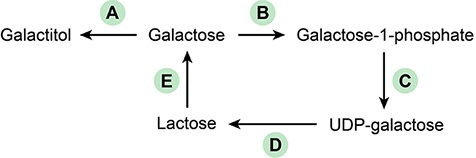
(Multiple Choice)
4.9/5 (86)
(86) A 34-year-old industry worker experiences rapid-onset shortness of breath, dizziness, palpitations, and flushed skin after accidental exposure to chemical fumes. Examination by an occupational physician shows that the patient is tachypneic and has a reddish discoloration of the skin without cyanosis. The patient is immediately instructed to inhale amyl nitrite from the safety kit. The success of this antidote is dependent upon its ability to convert hemoglobin into a form with increased affinity for which of the following substances?
(Multiple Choice)
4.9/5 (104)
(104) 
Filters
- Essay(0)
- Multiple Choice(0)
- Short Answer(0)
- True False(0)
- Matching(0)